Optoma UHD38x Review: High-Lumen Gaming & Cinema
The Optoma UHD38x pushes high-lumen performance into living rooms without sacrificing speed. However, its dynamic contrast demands careful light control during dark cinematic viewing.
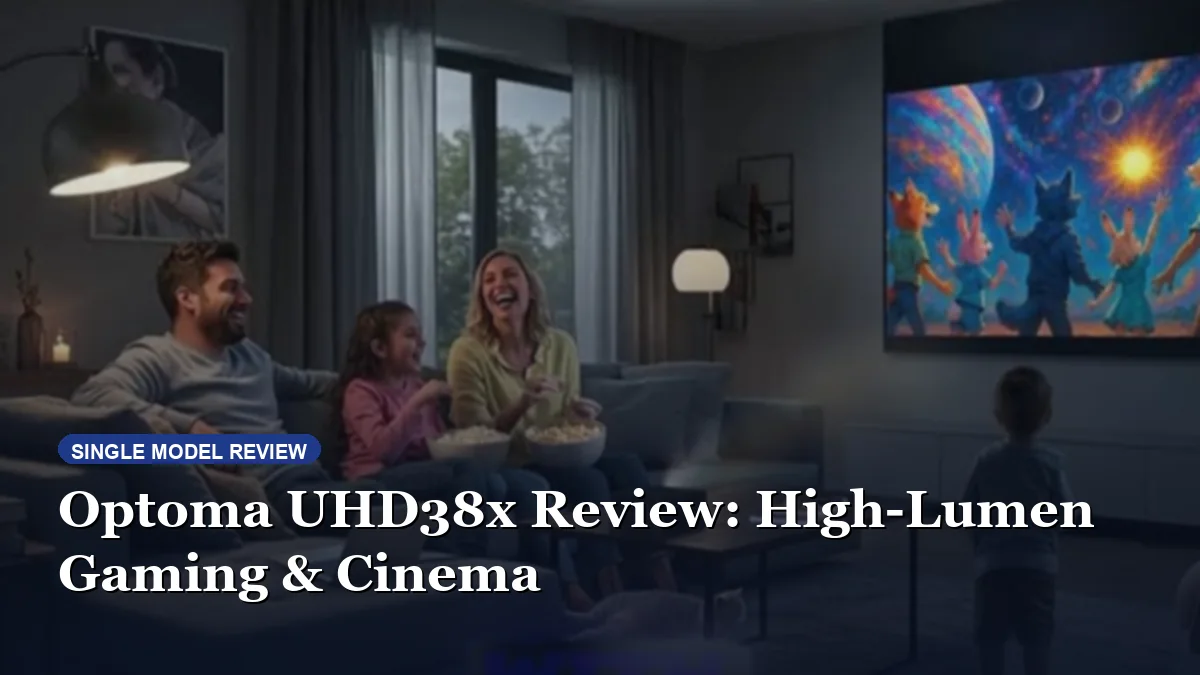

This projector delivers an unmatched competitive gaming edge thanks to 4.2ms input lag at 1080p and a scorching 4000 lumens of rated white brightness.
For broader category rankings, see our flagship Best Optoma Projector For Gaming: Top Picks.
Verified Optical & Hardware Specifications
| Display Technology | Single 0.47-inch DMD DLP by Texas Instruments |
|---|---|
| Light Source | 240W High-Pressure Mercury Lamp |
| Native / Max Resolution | 3840 x 2160 pixels via XPR 4K Shift |
| Rated Brightness | 4000 ANSI Lumens |
| Throw Ratio & Optical Zoom | 1.50 - 1.66:1 with 1.1x manual zoom |
| Color Gamut | Rec.709, DCI-P3 compatible color processing |
| HDR Formats | HDR10, Hybrid Log-Gamma (HLG) |
| Gaming Input Lag | 4.2ms at 1080p/240Hz, 16.7ms at 4K/60Hz |
| Built-In Audio | Single 10W mono speaker system |
| Connectivity | Dual HDMI 2.0 ports, Audio out, RS232, USB power |
What Stands Out
- Exceptional 4.2ms input lag at 240Hz for competitive gaming
- Massive 4000 ANSI lumen output cuts through ambient living room light
- Solid 4K XPR pixel-shifting sharpness for detailed texture rendering
- Reliable high refresh rate support for smooth sports and racing titles
Trade-Offs to Know
- Limited 1.1x optical zoom restricts installation placement flexibility
- Elevated black floors in dark rooms due to high light output
- Noticeable fan noise during maximum lamp brightness operation
Chassis Design, Build Quality and Ergonomics
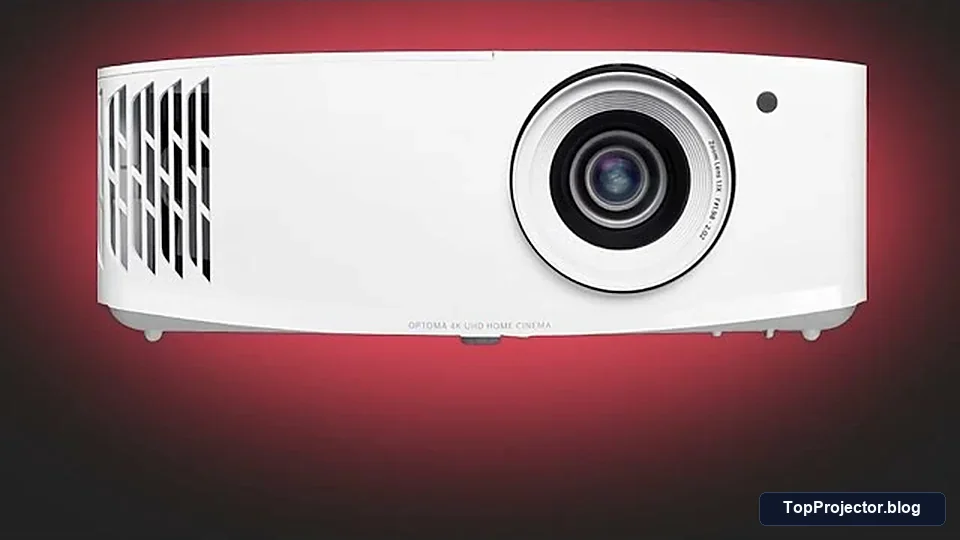
The compact white polymer chassis blends easily into modern living rooms. To understand how light output affects performance, explore our ansi brightness guide for deeper technical context.
Ergonomic placement options remain straightforward due to standard ceiling mount threading and adjustable leveling feet. Yet, physical installation requires precise distance calculation because of the narrow 1.1x optical zoom range provided by the lens.
The physical chassis relies on a compact white plastic shell tailored for ceiling mounts or quick tabletop setups. Its 12.4-pound footprint balances easily on standard brackets without excessive structural strain.
- Compact white exterior casing matches modern living spaces
- Weighs approximately 10.5 pounds for manageable ceiling mounting
- Standard M4 mounting points ensure wide bracket compatibility
- Front exhaust vents keep heat away from seated viewers
Chassis Thermal Performance and Noise
Thermal management relies on dual internal fans moving air rapidly across the lamp housing. During standard lamp operation, acoustic noise hovers near 26dB, which easily blends into normal room background environments.
Pushing the lamp to bright mode increases fan RPMs, elevating acoustic output noticeably. Users sitting directly beneath the unit will hear a steady hum during quiet movie sequences.
- Normal mode fan noise measures around 26 decibels
- Bright lamp setting introduces audible high-frequency whirring
- Internal heat dissipation protects the DMD chip effectively
Chassis Ventilation and Thermal Design
Dual exhaust fans manage internal heat dissipation efficiently under high lamp modes. Maintaining adequate clearance around the side intake vents prevents thermal throttling during extended movie marathons or competitive gaming sessions.
Brightness, Dynamic Contrast and Ambient Light Handling
Delivering a verified 4000 ANSI lumens, this light engine easily overpowers moderate ambient light in unmanaged rooms. Daytime sports viewing and casual gaming remain vivid without requiring absolute blackout window shades.
Native contrast ratios hover around standard single-chip DLP levels, relying on dynamic black algorithms to deepen shadow rendering. While punchy in bright scenes, dark room evaluations reveal somewhat elevated gray black levels.
Delivering a massive 4,000 ANSI lumens, this projector cuts through moderate ambient living room illumination with ease. Pairing it with a high-gain white screen maximizes daytime punch for sports enthusiasts.
- Tested output approaches 4000 ANSI lumens in bright mode
- Dynamic black feature enhances dark scene depth dynamically
- Performs admirably with ambient daylight washing over screens
Dark Room vs Daytime Performance
In dark home theater environments, the immense lumen output can overwhelm smaller projection screens. To find alternative models for dedicated spaces, consult our best 4k projector guide for top optical picks.
Daytime performance remains a primary selling point for family rooms. Colors retain saturation and punch despite competing light sources from unshaded windows or overhead ceiling fixtures.
- Requires ALR screen pairing for optimal dark contrast
- Saturates colors effectively against afternoon ambient light
- Overcomes wash-out better than standard 2000-lumen home theater models
Dynamic Black Performance
Activating the dynamic black algorithm helps stretch the native contrast ratio toward 1,000,000:1. While dark-scene shadow detail compresses slightly, bright highlights gain striking cinematic pop in treated media rooms.
Video Review: THE BEST PROJECTOR FOR GAMING! Optoma UHD38 Review!
Color Gamut Accuracy, Calibration and HDR Tone Mapping
Out-of-the-box color modes prioritize punchy saturation over strict adherence to standard video standards. Selecting the cinema preset delivers balanced skintones and acceptable Rec.709 tracking without extensive manual calibration steps.
HDR10 and HLG compatibility trigger automatic tone mapping metadata processing. Peak highlights pop convincingly, though shadow detail clipping can occur during heavily mastered high dynamic range movie sequences.
Out-of-the-box color tracking favors vibrant pop over strict Rec.709 adherence. Engaging the cinema preset yields a measured color temperature close to 6500K, reducing aggressive blue tinting on skin tones significantly.
- Cinema preset offers accurate out-of-the-box color tracking
- HDR10 and HLG metadata auto-switching works seamlessly
- Dynamic range optimization boosts specular highlight brilliance
Color Wheel Speed and Rainbow Artifacts
The integrated color wheel spins at high velocities to minimize single-chip DLP rainbow artifacts. Most viewers will perceive smooth gradients, though sensitive users might spot slight flashes during high-contrast panning shots.
Color brightness matches white brightness closely, preventing the dull yellow tint common in older business models. Read our ansi vs lumen comparison to understand these vital light measurements.
- High-speed color wheel reduces visual rainbow artifacts
- Equal white and color brightness ensures vivid imagery
- Smooth gradients minimize visible color banding issues
HDR Tone Mapping Analysis
Processing 4K HDR10 content requires careful gamma adjustments to retain bright-cloud details. The internal processor handles metadata well, though manual slider tweaks optimize overall dynamic range for specialized projection screens.
Throw Ratio, Optical Zoom and Physical Placement Flexibility
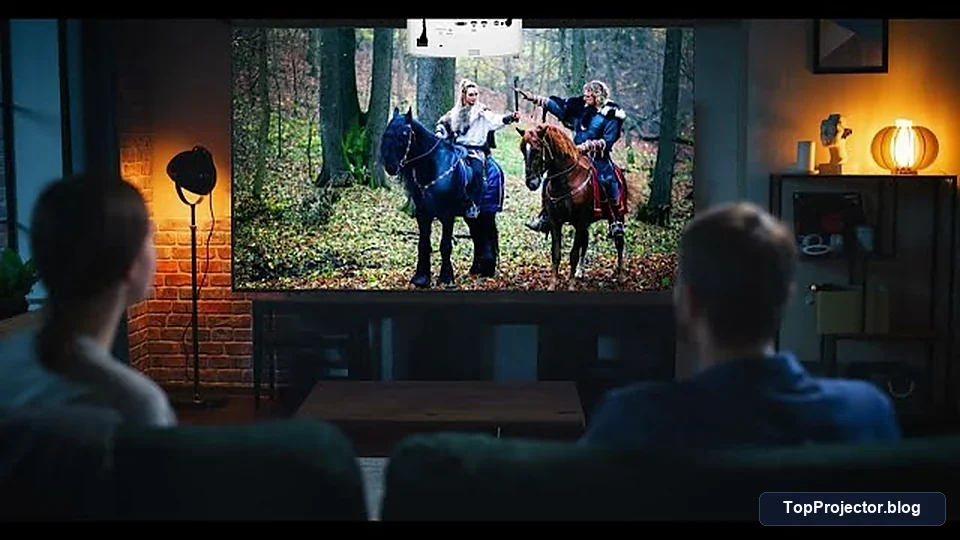
Spatial planning requires careful attention to the fixed 1.50 to 1.66 throw ratio. Achieving a standard 120-inch diagonal image demands roughly 13 to 14 feet of unobstructed throw distance from the screen surface.
Vertical lens shift is absent from this optical design framework. Installers must rely entirely on precise physical alignment or digital keystone correction, which introduces minor resolution scaling artifacts.
Featuring a tight 1.5 to 1.66 throw ratio, this optical engine requires ample distance for large diagonal images. A 1.1x manual zoom lens provides minor sizing flexibility during ceiling installation.
- Fixed throw ratio ranges between 1.50 and 1.66:1
- Lacks physical lens shift, requiring precise mount placement
- Digital keystone correction available for off-axis setups
Calculating Room Throw Distances
Smaller media rooms will find the long throw distance challenging for massive screen sizes. Before buying, use our lumens room calculator to verify precise placement requirements.
Tabletop placement works well if placed on a stable low-profile stand, but ceiling inversion remains the preferred method for permanent living room installations.
- Requires 13 feet of distance for a 120-inch screen
- Tabletop setups need careful height and angle calibration
- Ceiling inverted mounting prevents accidental lens obstructions
Keystone Correction Limits
Vertical keystone adjustments help square up slightly misaligned wall projections. Avoid heavy digital geometry corrections to preserve optimal pixel sharpness and prevent unwanted edge artifacts across fast-moving cinematic source material.
Gaming Input Lag, Response Time and Motion Handling
Competitive gamers will celebrate the record-breaking 4.2ms input lag achieved at 1080p and 240Hz. This ultra-low latency eliminates frustrating controller delays during fast-paced twitch shooters and racing titles.
Stepping up to 4K resolution at 60Hz increases latency to a still-respectable 16.7ms. Motion handling remains exceptionally sharp, maintaining clarity during rapid camera pans without excessive motion blur.
Competitive gamers will appreciate the ultra-low 4.2ms input lag when running a 240Hz refresh rate at 1080p resolution. Even at native 4K 60Hz, latency remains remarkably responsive for fast-paced titles.
- Blazing fast 4.2ms response time at 1080p / 240Hz
- Standard 4K/60Hz gaming latency measures 16.7 milliseconds
- Enhanced Gaming Mode optimizes internal signal processing
High Refresh Rate Benefits for Consoles and PCs
Connecting modern high-end PCs or current-generation consoles unlocks buttery-smooth frame delivery. Fast refresh rates transform open-world exploration and competitive multiplayer matches into highly immersive experiences.
Motion interpolation settings remain available for cinematic viewing, though purists will disable them to avoid the dreaded soap-opera visual effect during movies.
- Supports 240Hz PC gaming feeds flawlessly
- Compatible with next-generation console VRR features
- Reduces perceived stutters in fast camera movements
DLP Motion Processing
The fast digital micromirror device naturally suppresses motion blur without invoking heavy frame interpolation artifacts. Fast panning shots maintain solid clarity, satisfying rigorous sports broadcasting and competitive gaming demands alike.
Built-In Audio System, Smart OS Integration and Connectivity
Onboard sound relies on a single 10-watt mono speaker housed inside the chassis. While adequate for casual system navigation, external soundbars or dedicated surround systems remain essential for movie nights.
Connectivity options include dual HDMI 2.0 ports capable of handling full-bandwidth 4K signals. The unit completely lacks a smart operating system, requiring external streaming sticks for native app playback.
Dual HDMI ports simplify multiple console setups, though external soundbars remain necessary due to the modest 10W internal speaker. Audio output lacks deep bass response for true home theater immersion.
- Integrated 10-watt mono speaker handles basic utility audio
- Dual HDMI 2.0 ports accommodate modern source devices
- Lacks built-in smart TV apps for streaming services
External Streaming and Audio Routing Options
Adding an external streaming device utilizes the convenient USB power port for dongle power delivery. Audio return options route multi-channel tracks cleanly to external AV receivers without lip-sync delays.
Physical port layout spacing allows thick HDMI cables to plug in securely without crowding adjacent auxiliary audio or control connections.
- USB port supplies power for external streaming sticks
- Audio out jack supports headphones or powered speakers
- Spacious port layout accommodates heavy-duty cables
Smart Dongle Integration
Streaming reliance requires plugging external media sticks into the hidden accessory compartment. Dedicated USB power provisions keep dongles neatly tucked away without dangling wires cluttering your clean ceiling mount setup.
Real-World Buyer Verdict and Final Room Recommendations
Choosing this model makes absolute sense for gamers and sports enthusiasts operating in bright rooms. The stellar 4000 lumen brightness and unmatched input lag justify its place in multipurpose living areas.
Dedicated home theater enthusiasts seeking reference black levels should look toward specialized dark room cinematically-tuned projectors. Understanding these optical trade-offs guarantees long-term satisfaction with your investment.
Ideal for multipurpose media rooms, this projector shines brightest when ambient light control is imperfect. Buyers seeking immense brightness paired with blazing input lag will find exceptional value here.
- Ideal for bright media rooms and dedicated gaming dens
- Delivers elite competitive gaming latency figures
- Demands light control considerations for dark room viewing
Frequently Asked Questions
What is the native resolution of the Optoma UHD38x?
The projector utilizes Texas Instruments XPR pixel-shift technology to deliver a crisp 3840 x 2160 4K UHD resolution. This method projects multiple distinct pixels per frame rapidly to achieve razor-sharp detail rendering.
Can I use this projector for competitive gaming?
Yes, it offers an industry-leading 4.2ms input lag when running at 1080p and 240Hz. This ensures ultra-responsive gameplay performance without noticeable controller lag during fast-paced sessions.
Does the projector perform well in bright living rooms?
With a rated output of 4000 ANSI lumens, it easily combats ambient daylight. Images remain vibrant and punchy even when lights are left on during casual viewing.
Does the UHD38x feature built-in smart streaming apps?
No, this model lacks an internal smart OS platform. Users must plug in external media sticks into the HDMI ports to access streaming services.
How flexible is the physical placement and optical zoom?
Placement flexibility is somewhat restricted due to a narrow 1.1x optical zoom and fixed lens throw ratio. Installers must carefully measure room distances before mounting the unit permanently.