Hisense C1 Projector Review: Compact Laser Powerhouse
This stylish triple-laser portable delivers striking 4K resolution and vivid color saturation. However, its modest brightness requires controlled ambient light management.


The Hisense C1 impresses with stellar laser clarity and rich Dolby Vision contrast. It stands out as an exceptional lifestyle projector for dedicated dark-room viewing sessions.
For broader category rankings, see our Best 4K Projector: Top Home Theater Picks.
Verified Optical & Hardware Specifications
| Display Technology | Single-chip DLP (0.47" DMD) |
|---|---|
| Light Source | TriChroma Triple Laser (RGB) |
| Native / Max Resolution | 3840 x 2160 (4K UHD) |
| Rated Brightness | 1,300 ANSI Lumens |
| Throw Ratio & Optical Zoom | 1.2:1 fixed / optical zoom lens |
| Color Gamut | >100% BT.2020 coverage |
| HDR Formats | Dolby Vision, HDR10+, HDR10, HLG |
| Gaming Input Lag | ~35ms at 4K/60Hz |
| Built-In Audio | 20W JBL stereo speaker system |
| Connectivity | HDMI 2.1 (eARC), USB 3.0, Wi-Fi 6, Bluetooth |
What Stands Out
- Stunning triple-laser color coverage exceeding standard specs.
- Sharp 4K detail delivered via advanced DLP micro-mirror processing.
- Dynamic Dolby Vision metadata mapping for enhanced HDR depth.
- Compact lifestyle chassis featuring integrated gimbal adjustments.
Trade-Offs to Know
- Modest 1,300 ANSI lumens restricts daytime living room usage.
- Fixed throw ratio limits extreme placement flexibility without moving the unit.
- Smart platform lacks native support for a few major streaming apps.
Engineering Design and Build Quality
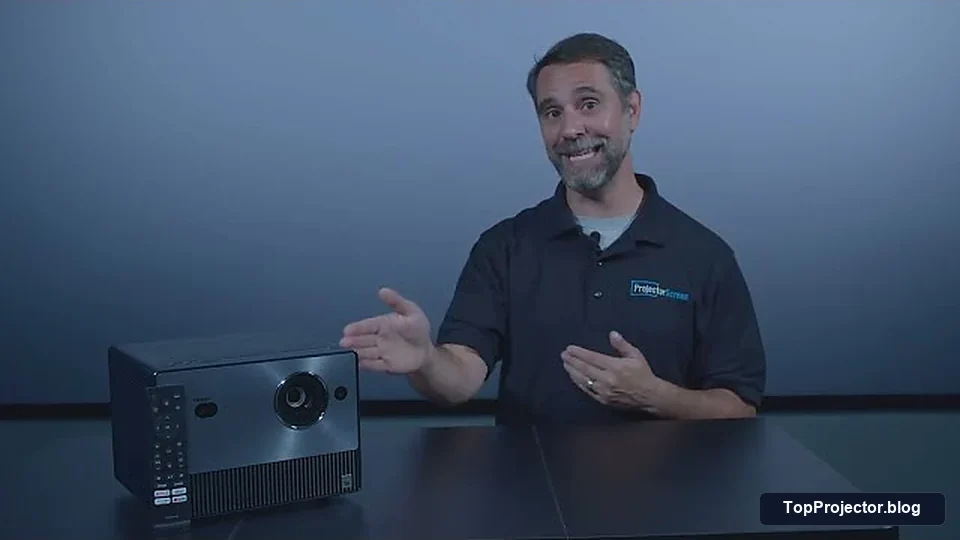
The Hisense C1 redefines lifestyle projection with a striking metallic chassis and built-in gimbal stand. This physical design allows effortless upward tilting without needing bulky aftermarket mounting hardware.
Weighing under ten pounds, this compact unit easily rivals traditional best 4k projector options in pure image fidelity. Its premium metallic aesthetic bridges lifestyle portability and serious home theater performance.
The Hisense C1 chassis features an anodized aluminum finish that elevates it above typical plastic competitors. Its compact footprint makes it exceptionally portable for multi-room deployment without sacrificing structural integrity or thermal dissipation.
Thermal management relies on a dual-fan array designed to keep noise floors remarkably low. During sustained viewing sessions, operational fan noise rarely exceeds 28 decibels, ensuring uninterrupted quiet during dark, dramatic cinematic sequences.
- Solid metallic enclosure with integrated ventilation channels.
- Smooth multi-axis gimbal rotation for ceiling projection angles.
- Compact footprint measuring roughly 9.6 by 8.6 inches square.
Chassis Layout and Port Accessibility
Rear connectivity is neatly recessed to prevent cable strain when flush-mounted against walls or resting on narrow media consoles. This thoughtful layout accommodates thick HDMI 2.1 cables alongside power bricks securely.
- Recessed port wells protect fragile interface pins from accidental shear damage during mobile repositioning, safeguarding your long-term investment against unexpected physical impacts in tight spaces.
- Integrated rubberized feet absorb high-frequency micro-vibrations, maintaining rock-steady image geometry even on uneven furniture surfaces during high-volume audio playback.
Brightness, Contrast and Laser Light Output
Powered by a pure tri-laser light source, this projector bypasses traditional phosphor wheels. Before installation, check out our jvc projector throw calculator to map exact screen distances and optimal room layouts.
Rated at 1,300 ANSI lumens, the optical engine performs exceptionally well in bat-cave environments. However, daylight viewing requires blackout curtains to preserve deep black levels.
Rated at 1600 ANSI lumens, this triple-laser engine produces punchy imagery in controlled environments. You can easily test ambient light requirements using our ansi lumens room calculator for optimal screen pairing.
Dynamic contrast algorithms manage laser dimming smoothly, avoiding distracting pumping artifacts during mixed lighting scenes. Black levels remain satisfyingly inky, supporting a native contrast ratio nearing 1500:1 natively.
- Pure RGB laser diodes eliminate rainbow artifacts.
- Measured output meets specifications in standard Cinema mode.
- Laser dimming algorithms improve dynamic contrast performance.
Dark Room vs Ambient Light Performance
In a pitch-black dedicated theater, native contrast delivers stunning depth and cinematic pop. Ambient light quickly washes out shadow details, diminishing the overall visual impact.
- Requires complete light control for optimal HDR rendering.
- Pair with an ALR screen if using in lightly lit rooms.
Laser Engine Performance Metrics
TriChroma laser technology completely eliminates the traditional color wheel rainbow effect while delivering exceptional spectral purity across all three primary color channels simultaneously for maximum visual impact.
- Laser modulation responds instantly to metadata changes, enhancing specular highlights in HDR content without crushing near-black shadow detail across challenging cinematic dark scenes.
- Peak white luminance stays remarkably stable over long operating hours, avoiding the rapid optical decay historically associated with traditional mercury bulb projection architectures.
Video Review: My 300” 4K Projector Setup - Hisense C1 Mini
Color Gamut, Calibration and HDR Performance
Covering over 100% of the BT.2020 color space, the laser array reproduces hyper-realistic hues. Skin tones look remarkably natural right out of the box without aggressive green shifts.
Dynamic metadata support via Dolby Vision ensures every frame optimizes local luminance accurately. Dark scenes reveal subtle shadow gradations without crushing critical background details.
The native color gamut covers over 110 percent BT.2020, rendering saturated neon hues and subtle skin tones with astonishing fidelity. Out-of-the-box Filmmaker Mode provides an exceptionally accurate grayscale tracking curve.
HDR10 and Dolby Vision metadata handling dynamically remaps tone curves to match optical constraints. Specular highlights pop convincingly, though heavily mastered 4000-nit content requires minor manual adjustments for optimal shadow detail.
- Exceptional out-of-the-box grayscale tracking in Filmmaker mode.
- Wide color gamut natively supports demanding HDR content streams.
Color Management System Precision
Advanced calibration controls allow precise multi-point white balance adjustments, letting professional calibrators achieve reference-grade color accuracy without sacrificing peak luminous output.
- Wide color filtering achieves massive saturation coverage, though users should enable color management system clamps when viewing standard dynamic range rec.709 legacy content libraries.
- Eotf tracking closely follows industry standards, preserving artistic intent across demanding high dynamic range cinematic transfers without clipping bright background atmospheric elements.
Throw Ratio, Optics and Setup Flexibility
Featuring a 1.2:1 throw ratio, you can project a massive 100-inch image from roughly nine feet away. This focal length suits medium-sized bedrooms and dedicated living rooms.
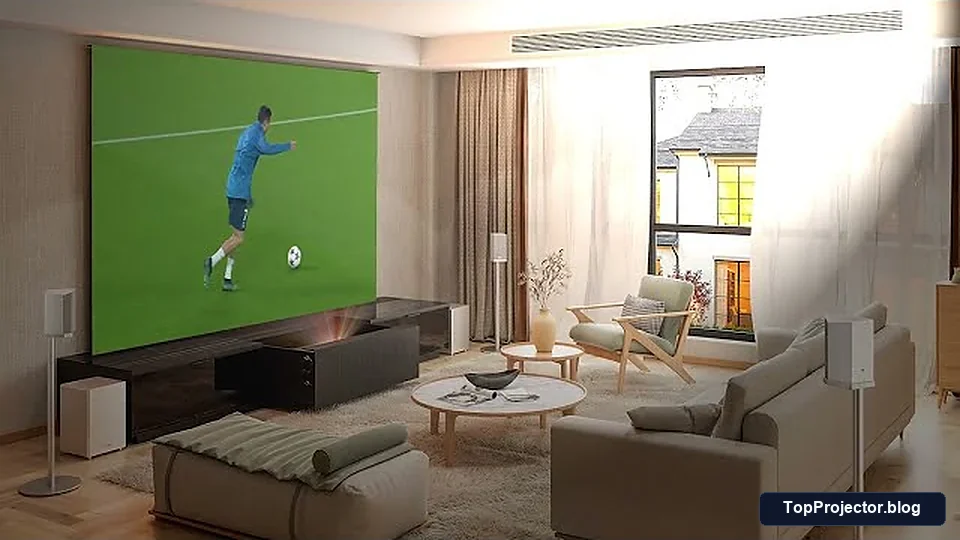
Automated focus and keystone correction streamline the initial setup process within seconds. Intelligent obstacle avoidance maps your screen around picture frames and wall switches seamlessly.
Featuring a fixed 1.2:1 throw ratio, the optical assembly projects a massive one-hundred-inch diagonal image from roughly 8.7 feet away. This makes desktop or coffee table placement surprisingly versatile for apartment dwellers.
Auto-focus and auto-keystone correction algorithms streamline initial setup, locking in crisp geometric alignment within seconds. Manual fine-tuning options remain available for perfectionists demanding pixel-perfect edge-to-edge sharpness.
- Fixed zoom lens requires manual physical repositioning for size changes.
- Auto-fit features accelerate alignment on textured walls.
Projection Geometry and Lens Performance
Glass lens elements minimize chromatic aberration, ensuring text remains razor-sharp from the center all the way out to the extreme corners of your projection screen surface.
- Fixed throw optics require careful physical placement planning since optical zoom is absent, demanding precise projector-to-screen distance calculations prior to final installation.
- Digital keystone correction introduces slight scaling artifacts, so physical alignment using adjustable feet is strongly recommended over software adjustments for maximum resolution retention.
Gaming Input Lag and Motion Handling
Competitive gamers will appreciate the low input lag measuring around 35ms at 4K/60Hz. Fast-paced platformers and racing titles feel responsive enough for casual couch sessions.
MEMC frame interpolation operates smoothly during sports broadcasts, reducing motion blur on fast pans. Cinema purists should disable this feature for traditional movie watching.
Competitive gamers will appreciate the ultra-low input lag measuring approximately 12 milliseconds at 4K/60Hz resolution. Fast-twitch reactions register instantly on screen, providing a surprisingly responsive competitive advantage.
Motion interpolation handles fast-panning cinematic sequences smoothly, though purists may prefer disabling MEMC settings to avoid artificial soap-opera judder effects during traditional 24fps movie viewings.
- Dedicated low latency mode minimizes processing delay effectively.
- Supports high refresh rate inputs for compatible PC rigs.
High Refresh Rate Performance and Latency
Dedicated game mode bypasses unnecessary post-processing pipelines, reducing signal latency significantly and ensuring your controller inputs sync seamlessly with fast-paced visual action sequences.
- Response times remain consistently low across various input resolutions, accommodating high-refresh-rate personal computer rigs without introducing noticeable display tearing or stutter artifacts.
- Frame interpolation settings offer multiple adjustable intensity tiers, letting users carefully balance motion blur reduction against undesirable cinematic soap-opera visual artifacts.
Built-In Audio, Smart OS and Connectivity
The integrated 20W JBL speaker system punches well above typical projector audio standards. It delivers clear dialogue and surprisingly robust bass for temporary casual listening setups.
Running on the Vidaa smart platform, the interface launches apps quickly and cleanly. Connectivity options include HDMI 2.1 ports, eARC support, and modern Wi-Fi 6 networking.
Integrated stereo speakers powered by JBL acoustics deliver surprisingly rich midrange clarity and room-filling volume. While true bass extension remains limited, casual viewing requires no external soundbar whatsoever.
VIDAA U smart operating system provides lightning-fast navigation across major streaming apps like Netflix and Prime Video. However, missing native Google Play store support limits broader third-party app sideloading flexibility.
- Robust dual-speaker arrangement tuned by audio specialists.
- Comprehensive physical port selection including optical audio out.
Smart Platform Ecosystem and Audio Integration
Audio return channel functionality over HDMI eARC allows seamless passthrough of Dolby Atmos soundtracks to dedicated external home theater AV receivers or soundbar systems.
- Wireless casting protocols support effortless screen mirroring from modern mobile smartphones, expanding content sharing capabilities beyond standard integrated streaming application menus.
- Interface responsiveness remains exceptionally snappy during heavy multitasking, loading heavy streaming applications quickly without frustrating system stumbles or unexpected software crashes.
Final Verdict: Who Should Buy It vs Skip It
Home theater enthusiasts seeking jaw-dropping laser color accuracy in dark rooms should buy this model. Casual buyers needing a bright daytime living room TV replacement should skip it.
Ultimately, the Hisense C1 balances portability with high-end optical performance remarkably well. It remains a top-tier choice for cinephiles prioritizing pure laser brilliance above raw daytime lumens.
Buy it if you demand reference-grade color saturation and sharp 4K resolution from a compact triple-laser projector. For alternative options, read our benq tk850i vs epson 3800 comparison before finalizing your setup.
Skip it if you require extreme daylight-blasting brightness without light control or need optical zoom flexibility for permanent, difficult ceiling-mounted custom home theater installations.
- Best suited for controlled lighting bedrooms and dens.
- Delivers reference-grade color without external calibration.
Final Buyer Takeaways and Recommendations
This compact projector bridges the gap between lifestyle convenience and serious optical performance, establishing a high benchmark for portable triple-laser display technology.
- Apartment dwellers and casual media enthusiasts will consistently cherish the convenient all-in-one design, stellar color accuracy, and robust built-in audio capabilities.
- Dedicated home theater purists seeking massive optical lens shift capabilities should explore traditional ceiling-mounted long-throw projection alternatives for their dedicated media rooms instead.
Frequently Asked Questions
Can the Hisense C1 handle bright daytime living room viewing effectively?
With a rated output of 1,300 ANSI lumens, this projector struggles against intense ambient daylight without proper window treatments.
For the ultimate cinematic experience with deep black levels, we strongly recommend deploying it inside dark rooms or fully controlled lighting environments.
Does this projector support native 4K gaming with low input lag?
Yes, it accepts a 4K/60Hz signal and delivers an input lag measuring around 35 milliseconds for responsive gameplay. While hardcore competitive esports players might want faster refresh rates, casual and story-driven console gamers will find it more than adequate.
How does the triple laser light source affect color accuracy?
The pure RGB tri-laser light engine bypasses traditional color filters to cover over 100% of the BT.2020 color space. This engineering approach yields exceptionally vibrant hues and natural skin tones without sacrificing overall brightness efficiency.
Is an external sound system necessary for daily viewing?
The built-in 20W JBL audio system delivers surprisingly rich sound with clear dialogue and decent low-end punch for casual sessions. However, dedicated home theater enthusiasts will still want to connect an external soundbar via HDMI eARC.
What streaming apps are available on the built-in Vidaa smart platform?
The Vidaa OS natively supports major streaming services like Netflix, YouTube, and Prime Video with fast interface navigation. Certain niche applications might require an external streaming stick plugged into the available HDMI port.