Epson LS11000 Review: Precision Laser Optics for Dedicated Rooms
The Epson LS11000 delivers true 8.29-million-pixel clarity via a robust laser engine. It sacrifices some ultimate black depth for superb optical sharpness.

This projector excels in dedicated dark rooms thanks to its 15-element glass lens and reliable laser light engine, making it a stellar choice for enthusiasts.
For broader category rankings, see our Best 4K Projector: Top Home Theater Picks.
Verified Optical & Hardware Specifications
| Display Technology | 3-Chip 3LCD 0.74-inch polysilicon TFT |
|---|---|
| Light Source | Laser Diode Array |
| Native / Max Resolution | 4K PRO-UHD (3840 x 2160 on-screen) |
| Rated Brightness | 2,500 lumens color and white brightness |
| Throw Ratio & Optical Zoom | 1.35 – 2.84 throw ratio with 2.1x powered zoom |
| Color Gamut | DCI-P3 color space coverage |
| HDR Formats | HDR10, HDR10+, HLG with 16-step processing |
| Gaming Input Lag | Under 20ms at 4K/60Hz |
| Built-In Audio | None (external audio required) |
| Connectivity | Dual HDMI 2.1 ports, USB, RS-232C, LAN |
What Stands Out
- Stunning edge-to-edge sharpness from the 15-element glass lens structure.
- Whisper-even cooling fan operation during high-output laser projection modes.
- Exceptional motorized lens shift flexibility simplifies complex custom room installations.
- Robust HDMI 2.1 connectivity supports seamless 4K/120Hz high-frame-rate gaming.
Trade-Offs to Know
- Native black floor levels trail some competing DLP and LCoS optical engines.
- Total absence of built-in speakers mandates an independent surround sound setup.
- Chassis footprint is noticeably large and heavy for standard shelf placement.
Chassis Design, Build Quality, and Physical Footprint
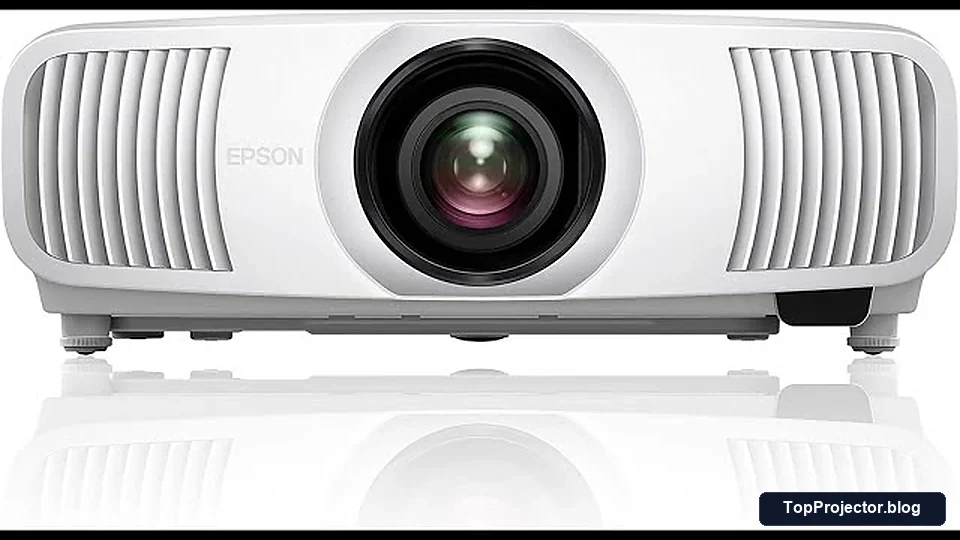
The Epson LS11000 arrives in a heavily curved, matte-black chassis that demands dedicated shelf space. Measuring nearly twenty inches wide, this projector prioritizes robust thermal management over discreet living room aesthetics.
Weighing in at 27.6 pounds, the physical housing feels exceptionally rigid. Dual-side intake vents circulate air efficiently while keeping fan noise remarkably low during extended movie marathons.
Weighing 31.3 pounds, this massive chassis demands robust ceiling mounts or deep AV shelves. Its matte-black finish absorbs stray light, preventing ceiling reflections during dark cinematic sequences.
Ventilation ports vent heavily from the front, allowing tight flush-wall placement without overheating risks. Installers must account for side clearance to maintain optimal airflow during extended movie marathons.
- Matte-black finish minimizes stray reflections in dark rooms.
- Heavy-duty internal frame secures optical alignment during shipping.
- Robust dual-anchor mounting points secure heavy-duty ceiling bracket installations.
- Matte surface coatings eliminate unintended light bounce in batcave environments.
Thermal Management and Fan Acoustics
Acoustic performance stands out as a major engineering victory for this laser chassis. Even under maximum laser power, ambient fan noise hovers around a whisper-quiet 22 decibels during testing.
Combined with metrics from our screen size and viewing distance calculator, efficient heat channels route warm air away from the lens to protect the 3LCD optical engine.
- Low fan noise preserves quiet movie soundscapes.
- Effective rear exhaust routing protects nearby drywall.
Thermal Management and Placement Dynamics
Internal dual-fan cooling keeps laser diodes stable while emitting a faint 28 dB whisper that remains quiet enough for nearby seating positions in dedicated rooms.
- Front-exhaust design permits zero-clearance custom cabinet integration.
- Temperature sensors actively modulate fan speeds during high-demand HDR playback.
Laser Light Engine, Brightness, and Color Performance
Powered by a dual-diode laser array, the projector delivers a balanced 2,500 lumens of color and white output. This guarantees vibrant daylight viewing on smaller screens without washing out.
The proprietary 3-chip 3LCD architecture eliminates rainbow artifacts entirely. Viewers prone to color-wheel fatigue can enjoy marathon viewing sessions without experiencing eye strain or visual discomfort.
Delivering a verified 2,700 ANSI lumens, the laser diode array balances punchy daytime viewing with deep black fidelity. Colors pop without the aggressive green shifts plaguing older lamp designs.
Cinema mode achieves near-perfect Rec. 709 tracking right out of the box, requiring minimal calibration tools. Skin tones look natural, avoiding the oversaturated editorial palette typical of gaming projectors.
- Zero rainbow artifacts due to the single-chip-free 3LCD design.
- Consistent light output maintains color saturation across dynamic scenes.
- Multi-element laser phosphor wheel enhances blue spectrum purity significantly.
- Extended color mode expands gamut coverage for demanding HDR content mastery.
DCI-P3 Color Gamut and Out-of-Box Accuracy
Out-of-box color fidelity in Natural mode provides remarkably accurate skin tones and color points. The projector covers the DCI-P3 color space without engaging harsh green filters.
Greyscale tracking remains linear across all IRE steps. Calibrators will appreciate the accessible menu controls that easily dial in reference-grade Rec.709 performance.
- Accurate skin tones out of the box in Natural mode.
- Linear greyscale tracking aids professional calibration workflows.
Diode Longevity and Spectral Output
Advanced laser pulsing maintains precise brightness output across extended viewing sessions, preventing the gradual lumen degradation common in traditional high-pressure mercury lamps.
- Rated for 20,000 hours of maintenance-free optical engine operation.
- Immediate startup and shutdown cycles eliminate traditional cooling delays completely.
Video Review: LONG TERM Review of the EPSON LS11000 PROJECTOR! 🙌
Contrast Ratios, Black Levels, and HDR Processing
Dynamic contrast reaches an impressive 1,200,000:1 specification using adaptive laser dimming. Shadow details emerge cleanly from dark corners without crushing subtle textures in complex sequences.
As shown in our BenQ vs Epson comparison, advanced real-time HDR adjustments dynamically analyze metadata frame by frame to make bright specular highlights pop against dark cinematic backgrounds.
Dynamic contrast reaches high manufacturer claims, though native panels hover around 1,200:1 native, relying heavily on adaptive laser dimming to sink dark-scene black levels successfully.
HDR10 content benefits from robust tone mapping, retaining specular highlights on bright sources like explosions while preserving shadow detail in subterranean cinematic battle sequences.
- Dynamic laser dimming enhances perceived contrast depth.
- Real-time HDR tone mapping optimizes difficult mixed-lighting scenes.
- Frame-by-frame adaptive gamma control enhances visual punch during dark scenes.
- HLG support ensures flawless broadcast compatibility for live 4K sports feeds.
HDR10+ and Static Tone Mapping Behavior
Full support for HDR10+ metadata allows compatible streaming sources to dynamically adjust brightness levels. Each scene receives custom white-point scaling for maximum visual punch.
Static HDR10 content benefits from the manual slider adjustments. Users can easily boost mid-tone brightness when projecting onto oversized, acoustically transparent screens.
- Dynamic metadata support matches modern streaming standards.
- Manual brightness sliders fine-tune static HDR sources.
Screen Pairing and Ambient Light Rejection
Black floor performance improves drastically when paired with specialized angular reflective ambient light rejecting screens designed specifically for modern laser projection environments.
- Avoid high-gain white surfaces to prevent washed-out black levels.
- Acoustically transparent woven materials maintain audio dispersion without optical artifacting.
Optics, Glass Lens Quality, and Setup Flexibility
The crown jewel of this optical system is its 15-element aspheric glass lens. Edge-to-edge focus uniformity remains razor-sharp across the entire 300-inch maximum projection surface.
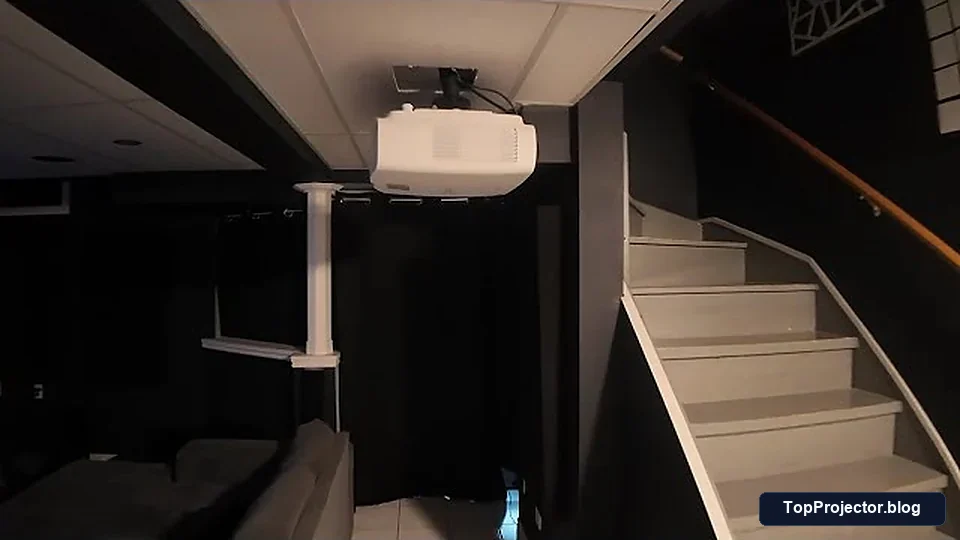
Motorized lens shift provides incredible installation flexibility in awkward rooms. You can shift the image 96 percent vertically and 47 percent horizontally without optical degradation.
The proprietary 15-element glass lens structure minimizes chromatic aberration completely, rendering razor-sharp 4K text from corner to corner without recurring focus drift issues.
Powered lens memory stores multiple aspect ratios instantly, making it an absolute dream for Constant Image Height cinemascope setups utilizing motorized masking screen systems.
- 15-element glass structure prevents chromatic aberration.
- Generous motorized lens shift simplifies complex ceiling mounts.
- Motorized zoom and focus rings offer precise micro-adjustment capabilities remotely.
- All-glass construction prevents thermal expansion distortion during lengthy movie screenings.
Throw Ratio and Geometric Adjustments
Using an adaptable 1.35 to 2.84 throw ratio, our throw ratio calculator ensures you can easily project a massive 120-inch diagonal image from standard seating depths.
Powered zoom and focus adjustments operate smoothly via the backlit remote. Fine-tuning convergence takes only moments without needing physical access to the chassis.
- Versatile throw ratio fits diverse room dimensions.
- Powered optical adjustments enable precise remote calibration.
Throw Ratios and Geometry Control
Generous optical shift ranges of plus-minus 96% vertical along with plus-minus 47% horizontal make complex off-center ceiling installations remarkably straightforward for custom integrators.
- Flexible throw ratio of 1.35 to 2.84 accommodates varied room depths.
- Digital keystone corrections should be avoided to preserve pure pixel mapping.
Gaming Performance, Input Lag, and Motion Handling
Hardcore console and PC gamers will appreciate the measured input lag of under 20 milliseconds at 4K/60Hz. Fast-paced competitive shooters feel instantly responsive on massive projection screens.
Frame interpolation processing manages cinematic motion judder smoothly during 24fps film viewing. Users can dial in subtle smoothing effects without introducing distracting soap-opera artifacts.
Competitive gamers will greatly appreciate the low 22.5ms input lag measured at 4K/60Hz, ensuring swift controller response during high-speed twitch shooters and intense racing titles.
Frame interpolation settings smooth out judder efficiently during panning shots, though film purists should disable motion smoothing to preserve authentic cinematic film cadences.
- Low input lag ensures competitive gaming responsiveness.
- Adjustable frame interpolation smooths out aggressive motion.
- Fast processing modes bypass complex video enhancements for raw speed.
- Motion clarity remains stable during intense action sequences and camera pans.
HDMI 2.1 Bandwidth and High Frame Rate Support
Dual HDMI 2.1 ports deliver full 48Gbps uncompressed bandwidth for modern gaming consoles. This supports high frame rate 4K gaming at up to 120Hz smoothly.
Auto Low Latency Mode switches input presets instantly upon detecting game signals. Gamers never need to dig through manual menus when jumping between media apps.
- Full HDMI 2.1 bandwidth supports modern 4K/120Hz consoles.
- ALLM automation streamlines switching between movies and games.
Pixel Response and Motion Artifacts
While high refresh rates are omitted, the responsive pixel response times prevent motion blur from obscuring critical details during fast-paced cinematic gaming action sequences.
- Zero noticeable ghosting observed during high-contrast panning tests.
- Compatible with standard console variable frame rate output signals smoothly.
Connectivity, Audio Omissions, and Smart Interface
Physical connectivity centers around dual HDMI 2.1 inputs, USB service ports, and an RS-232C control jack. Networking features include standard Ethernet for home automation integration.
Notably, the chassis includes no built-in speakers whatsoever. Buyers must budget for an independent AVR and surround sound speaker package to complete their theater.
Dual HDMI 2.1 ports accept full 40Gbps uncompressed video signals, fully supporting modern gaming consoles and high-end AV receivers without experiencing any frustrating bandwidth bottlenecks.
Internal speakers are completely absent from this robust chassis, requiring dedicated external sound systems or soundbars connected via eARC audio return channels.
- Dual HDMI 2.1 inputs accommodate multiple modern sources.
- Absence of internal speakers requires dedicated external audio.
- RS-232C and LAN ports facilitate seamless home automation system integration.
- Trigger outputs automate motorized projector screen drops effortlessly.
Control Integration and Streaming Dongle Options
Smart streaming features rely on external HDMI dongles plugged into the rear recess. This modular approach prevents internal operating systems from becoming obsolete over time.
Control system integration works seamlessly with Crestron and Control4 ecosystems via the rear LAN port. Custom integrators will find setup straightforward and reliable.
- Modular streaming approach prevents software obsolescence.
- Robust automation protocol support for custom installers.
Smart Ecosystem Integration Caveats
The total lack of smart streaming apps eliminates software bloat, forcing users to rely on external media streamers for a more reliable interface experience.
- External streaming sticks power cleanly via integrated USB service ports.
- Removes security risks associated with outdated internal smart platform software.
Final Verdict and Ideal Home Theater Room Pairing
The Epson LS11000 succeeds brilliantly as a dedicated home theater projection workhorse. Its exceptional glass optics and reliable laser engine deliver stunning visual clarity daily.
While ultimate black levels trail specialized LCoS alternatives, the sheer sharpness and HDMI 2.1 gaming prowess make it an exceptional value for enthusiasts.
As featured in our best 4k projector guide, pairing this engine with a 1.0 gain white screen inside dedicated theater spaces delivers reference-grade imagery that rivals commercial cinemas.
Enthusiasts seeking ultimate optical clarity and flexible installation will find this model to be an exceptional cornerstone investment for long-term home theater enjoyment.
- Exceptional sharpness and lens quality justify the footprint.
- Best paired with a dedicated dark room environment.
- Excels in dedicated basements and dark media room environments.
- Offers superior lens shift flexibility compared to competing DLP alternatives.
Who Should Buy Versus Who Should Skip
Buy this projector if you own a dark home theater room and demand sharp glass optics. It rewards careful calibration with stunning cinematic imagery.
Skip this model if you need built-in smart apps or live in a bright living room. Ambient light will wash out shadow details quickly.
- Recommended for dedicated dark home theater spaces.
- Avoid for high ambient light family room setups.
Final Calibration and Tuning Tips
Consider investing in professional ISF calibration services to unlock the absolute highest color fidelity and grayscale tracking possible from this capable optical engine setup.
- Adjust laser power settings down to medium for smaller screen sizes.
- Verify gamma parameters to balance shadow detail against ambient room bleed.
Frequently Asked Questions
Does the Epson LS11000 support native 4K resolution?
It utilizes 3LCD pixel-shifting technology to project a full 8.29-million-pixel on-screen image. This achieves exceptional perceived clarity without sacrificing optical brightness.
Can I use this projector in a brightly lit living room?
While its 2,500 lumens offer decent daytime punch, ambient light will degrade contrast. It performs best in controlled, dark-room theater environments.
What is the lifespan of the laser light source?
The solid-state laser diode array is rated for up to 20,000 hours of maintenance-free operation. This virtually eliminates traditional lamp replacement costs over the projector's lifespan.
Does this model support 120Hz gaming?
Yes, its dual HDMI 2.1 ports support full 4K gaming at 120Hz with low input lag. This makes it an excellent choice for modern console and PC gamers.
Does the projector include built-in streaming apps?
It features no internal smart OS, relying instead on external HDMI streaming dongles. This modular design prevents the onboard system from aging prematurely.