What Is Projector Screen Gain?
Understanding projector screen gain helps you optimize image brightness and optical performance. Accurate gain matching transforms your dedicated home theater or living room viewing environment.
Screen gain is the optical measurement of a projection surface's light-reflecting efficiency compared to a standard magnesium carbonate reference material. A 1.0 gain surface reflects light equally in all directions.
Ready to compare verified models? Start with our Best Gain For Projector Screen: Brightness Guide.
Practical Quick-Reference Table
| Scenario / Metric | Recommended Target | Why It Matters |
|---|---|---|
| Dedicated Dark Room | 0.9 to 1.1 Gain | Maximizes wide viewing angles and preserves absolute black levels without hot-spotting artifacts. |
| Living Room with Ambient Light | 1.3 to 1.5 Gain (ALR) | Enhances perceived ANSI contrast and combats ambient washing from uncontrolled windows. |
| Ultra Short Throw Laser | 0.6 to 0.8 ALR Gain | Rejects overhead ceiling light while maintaining high color saturation from close throw angles. |
| Large Commercial Venue | 1.8 to 2.5 Gain | Compensates for massive throw distances and oversized image areas where lumens drop. |
| Acoustically Transparent | 1.0 Gain Woven | Prevents audio high-frequency comb filtering while ensuring uniform light dispersion. |
| Passive 3D Projection | 2.0+ Silver Screen | Maintains circular polarization separation and offsets massive filter light loss. |
Defining Screen Gain and Optical Measurement Physics
Projector screen gain quantifies how efficiently a specific projection fabric reflects incident light. Manufacturers measure this optical property by comparing the fabric against a Lambertian reflector baseline standard rated at exactly one.
A gain rating of 1.0 indicates that the screen reflects light uniformly in all hemispherical directions. Higher ratings mean the material redirects light into a narrower cone, increasing center punchiness.
Understanding this metric prevents costly mismatching between your projector lumen output and screen surface. Choosing the wrong coefficient leads to severe eye fatigue, washed-out shadows, or blinding hot-spot artifacts.
The underlying physics rely on microscopic glass beads or metallic flakes embedded within the vinyl substrate. These optical elements actively manipulate incoming light waves rather than merely scattering them randomly.
- Gain is a dimensionless ratio comparing reflected luminance to a standard reference surface.
- A 1.0 gain screen distributes light equally across a full 180-degree viewing hemisphere.
- High-gain materials concentrate light within a narrow viewing cone for increased brightness.
- Microscopic glass beads or reflective flakes govern the specific optical scattering pattern.
How Manufacturers Calculate Gain Ratings
Optical engineers use specialized photometers to measure luminance values under controlled laboratory conditions. They test reflected foot-lamberts against an established magnesium carbonate baseline block.
This rigorous testing ensures that published gain specifications match real-world installation performance. Deviations across batch manufacturing runs are strictly minimized through advanced quality control.
- Laboratory photometers measure exact reflected foot-lamberts.
- Magnesium carbonate serves as the universal baseline reference material.
High-Gain Versus Low-Gain Surfaces in Practical Deployments
Selecting between high-gain and low-gain materials requires balancing room lighting conditions against seating geometry. High-gain options exceed 1.0, while low-gain matte white options typically sit around 0.8 to 0.9.
Low-gain surfaces absorb stray ambient photons, effectively deepening black floor levels in controlled environments. They provide exceptional off-axis viewing consistency without introducing distracting luminance hot spots.
Conversely, high-gain options amplify limited projector output when pairing older lamps with giant screens. However, they demand strict adherence to center seating arrangements to prevent uneven illumination.
Balancing these compromises ensures your home theater delivers accurate HDR dynamic range without crushing highlights, a trait highlighted inside our detailed Epson Home Cinema 2350 review.
- Low-gain surfaces (0.8–0.9) excel at absorbing ambient light and widening viewing cones.
- High-gain fabrics (1.2–2.5+) amplify center brightness for dim projectors.
- Hot-spotting becomes increasingly visible on gains exceeding 1.5 in smaller rooms.
- Matched throw ratios minimize severe brightness inconsistencies across wide screens.
The Role of Matte White Standards
Matte white vinyl remains the undisputed gold standard for dark dedicated home theater spaces. Its predictable 1.0 gain ensures color fidelity stays perfectly true to director intent.
Without directional reflection anomalies, viewers experience natural cinematic depth across every single seat on the couch. This makes matte white the safest baseline choice for most enthusiasts.
- Standard 1.0 gain matte white preserves pristine color accuracy.
- Zero directional hot-spotting ensures uniform brightness distribution.
Video Walkthrough: ✅ Elite Screen ✯ Understanding ANSI Lumens \u0026 Screen Gain [Projector Screen]
Evaluating Viewing Angles and Off-Axis Brightness Falloff
Gain and viewing angles operate in a strict inverse relationship across all projection technologies. As gain ratings increase, the usable half-gain angle narrows down significantly from the center axis.
A standard 1.0 gain screen maintains consistent luminance even for viewers seated at extreme lateral angles. High-gain directional surfaces experience rapid brightness falloff when viewed off-axis.
This optical trade-off means wide basement seating configurations require low-gain matte surfaces. Narrow, dedicated media rooms can leverage directional gain to maximize punchy HDR specular highlights.
Calculating your room layout dimensions prevents viewers on outer seats from experiencing a muddy picture. Always check manufacturer half-gain angle specifications before finalizing screen purchases.
- Higher gain ratings directly correlate with narrower optimal viewing angles.
- Half-gain angle defines the point where image brightness drops by 50 percent.
- Wide sectional sofas require 1.0 gain or lower for uniform coverage.
- Directional gain suits narrow, single-row theater room seating layouts.
Understanding the Half-Gain Angle Metric
The half-gain angle represents the exact lateral degree where perceived image brightness drops by half. High-gain screens often feature half-gain angles narrower than 30 degrees off-center.
Exceeding this angular boundary results in noticeable image dimming and color shifting for side viewers. Careful room planning guarantees every audience member enjoys optimal visual performance.
- Half-gain thresholds define acceptable lateral seating boundaries.
- Narrow angles demand precise projector and seating alignment.
The Impact of Screen Gain on Contrast and Color Fidelity
Screen gain exerts a profound influence on both ANSI contrast ratios and overall color saturation. High-gain surfaces can reflect ambient room light right back into your eyes, degrading black levels.
Specialized angular-reflective and retro-reflective high-gain materials reject off-axis ambient light effectively. They bounce overhead ceiling light away from the viewer while returning projector light cleanly.
Color fidelity also shifts if the reflective substrate introduces an unintended tint into the light path. High-end glass-beaded screens sometimes impart a slight blue or neutral shift requiring calibration.
Maintaining balanced RGB grayscale tracking depends heavily on neutral screen reflectance characteristics. Pairing high-gain fabrics with uncalibrated laser light sources can exaggerate green or red primaries.
- High gain can inadvertently reflect ambient light, raising black floor levels.
- Retro-reflective materials specifically target and reject off-axis ambient light sources.
- Substrate tinting requires careful white balance calibration on the projector.
- Preserving native ANSI contrast demands strict control over room reflections.
Preserving Black Levels in Bright Rooms
Controlling ambient light in multi-purpose living spaces requires specialized high-contrast gray materials. These low-gain gray surfaces absorb ambient room light while boosting perceived black depth.
This trade-off requires higher projector lumen output to maintain punchy daylight viewing, making many options from our best projectors for artists guide surprisingly effective for high-gain setups.
- Gray low-gain surfaces (0.8) significantly improve perceived black levels.
- High lumen laser engines overcome the reduction in white brightness.
Video Walkthrough: The Hunt for the Perfect Cinema Screen
Modern Material Engineering and Ambient Light Rejection

Recent advancements in optical screen engineering have revolutionized living room projection capabilities. Micro-layered ambient light rejection fabrics utilize microscopic optical louvers to block overhead illumination.
These specialized ALR screens achieve positive gain ratings while actively suppressing stray room lighting. This breakthrough allows ultra short throw laser televisions to rival traditional flat-panel televisions.
Traditional white vinyl surfaces lack these sophisticated microscopic structural filters, making them unsuitable for daylight. Advanced optical layering represents the pinnacle of modern home theater screen design.
Investing in an engineered ALR material eliminates the need for total blackout curtains, allowing your setup to deliver rich, punchy contrast even when following tips from our gaming on a projector guide.
- Micro-layered ALR screens block up to 90 percent of overhead ambient light.
- Optical louvers selectively redirect projector light toward seated viewers.
- Ultra short throw ALR surfaces require specialized downward-facing sawtooth structures.
- Daytime home theater viewing is now practical without heavy blackout drapes.
Sawtooth Micro-Structures for UST Projectors
Ultra short throw projectors fire light upward from directly beneath the screen surface. Specialized ALR materials feature microscopic sawtooth ridges that absorb ceiling light while reflecting bottom-up rays.
This asymmetric optical design ensures maximum contrast even in brightly lit living rooms. Matching your UST throw angle to the screen microstructure is absolutely critical.
- Sawtooth ridges actively reject downward ambient ceiling illumination.
- Bottom-up light from UST projectors reflects cleanly to the audience.
Choosing the Correct Gain for Your Specific Environment
Selecting the ideal screen gain requires analyzing three core variables: room lighting, seating width, and projector lumens. Dedicated dark basements with light-absorbing black velvet walls thrive on 1.0 gain white surfaces.
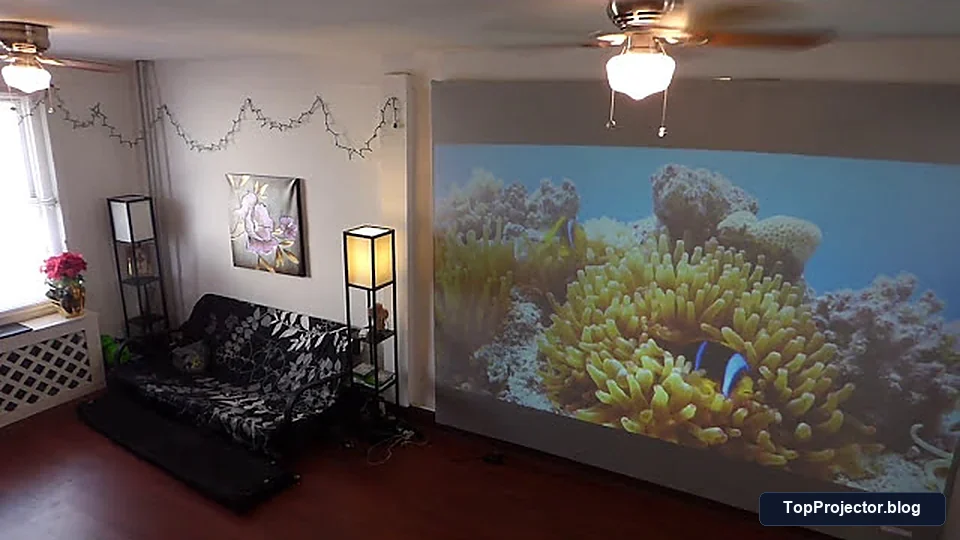
Bright family rooms with white ceilings and large windows demand specialized 1.3 to 1.5 ALR gain materials. Always verify your projector's calibrated lumen output rather than relying solely on peak specs.
Carefully calculate your throw distance and screen diagonal size using our screen size and viewing distance calculator to ensure adequate foot-lambert luminance output.
Consulting expert calculator tools helps prevent costly projection upgrade mistakes before purchasing hardware. Proper system matching guarantees cinematic immersion for every single movie night.
- Audit room lighting, throw distance, and seating geometry before buying.
- Dedicated dark rooms perform best with neutral 1.0 gain matte white.
- Living rooms require specialized ALR gain fabrics to combat ambient light.
- Verify calibrated lumen output matches your target screen surface size.
Balancing Lumens Against Screen Size
Calculating screen luminance involves dividing calibrated projector lumens by total screen square footage. Target between 30 to 50 foot-lamberts for standard dynamic range content in dark rooms.
HDR content demands higher peak luminance headroom to properly render specular highlights. Adjusting your screen gain helps hit these strict optical performance targets effortlessly.
- Target 30–50 foot-lamberts for optimal SDR home theater viewing.
- HDR content requires higher peak luminance headroom for highlights.
Frequently Asked Questions
What is the best screen gain for a completely dark home theater room?
A standard 1.0 gain matte white surface is ideal for dedicated dark rooms. It preserves wide viewing angles and maintains accurate color fidelity without hot-spotting.
Can a high-gain screen completely eliminate the need to turn off room lights?
No, standard high-gain screens reflect ambient room light along with projector light. You need an engineered ambient light rejection screen to combat bright room environments.
What causes hot-spotting on high-gain projector screens?
Hot-spotting occurs when directional reflective particles bounce excessive light directly back along the projection axis. This creates a glaring bright center patch with noticeably darker corners.
How does screen gain affect ultra short throw projector setups?
Ultra short throw projectors require specialized ALR gain surfaces with microscopic optical structures. These fabrics reject overhead light while efficiently reflecting steep bottom-up projector rays.
Is a higher screen gain always better for watching HDR movies?
Not necessarily, because high gain narrows your viewing cone and risks introducing hot spots. Matching projector lumen output to a balanced 1.0 to 1.3 gain surface is safer.