What Is Laser Speckle Projector?
Explore the optical physics behind laser speckle interference patterns. Learn how modern triple-laser projection engines mitigate unwanted grain for pristine image fidelity.
Laser speckle is a grainy interference pattern caused by coherent laser light bouncing off matte projection surfaces. Selecting specialized screens and optical shakers effectively minimizes this visual artifact.
Ready to compare verified models? Start with our Best Laser Projector: Top Home Theater Picks.
Laser Speckle Mitigation Strategies Compared
| Technology / Material | Speckle Reduction Level | Impact on Contrast & Gain |
|---|---|---|
| Standard Matte White Vinyl | Minimal Reduction | Neutral gain (~1.0) with high scatter |
| Silver High-Contrast Screen | Moderate Improvement | Enhances black levels but risks hot-spotting |
| Motorized Optical Shaker | Significant Reduction | Smooths interference without sacrificing ANSI brightness |
| Acoustically Transparent Woven | High Mitigation | Diffuses coherent waves through micro-perforations |
| Dual-Laser Phosphor Hybrid | Low Native Speckle | Lower peak saturation compared to RGB lasers |
| Speckle-Rejecting Optical Coating | Maximum Reduction | Maintains wide color gamut while neutralizing grain |
Decoding Coherent Light Physics and the Origins of Speckle
Modern solid-state projection relies on coherent light sources to achieve unprecedented color volume and brightness. Unlike traditional lamp sources, lasers emit light waves that march in absolute phase alignment across the optical path.
When these highly organized light waves strike a non-perfect projection surface, they scatter in unpredictable directions. This microscopic phase interference creates the signature shimmering grain known throughout the industry as laser speckle.
The human eye perceives this random constructive and destructive interference as a static, unsettling texture overlaying the video frame. It becomes particularly noticeable during bright panning shots across uniform color fields like clear skies.
Understanding this optical phenomenon helps enthusiasts evaluate laser artifacts. For instance, our anker nebula capsule 3 review analyzes how a bright 2000 ANSI lumen output manages these visual challenges.
- Coherent light sources generate synchronized wave fronts prone to phase cancellation.
- Projection surfaces act as microscopic random diffusers scattering coherent photons.
- Constructive and destructive interference produces bright and dark speckle spots.
- Static image scenes make stationary speckle patterns much easier to detect.
Wavelength Specifics and Green Laser Dominance
Different color wavelengths interact with projection textures in distinct ways across the visible spectrum. Green laser diodes frequently exhibit the most pronounced speckle due to human visual sensitivity peaks.
Our eyes possess peak spectral sensitivity around 555 nanometers, making green laser interference artifacts instantly noticeable. Engineers must apply targeted optical filtering specifically tailored to tame this troublesome wavelength.
- Green lasers operate near peak human spectral response curves.
- Shorter wavelengths produce tighter, more intense interference matrices.
Tri-Color Laser Engine Architectures Versus Single-Laser Designs
The architecture of your projector's light source dictates its susceptibility to optical interference artifacts. RGB triple-laser systems deliver phenomenal Rec.2020 color coverage but suffer inherently from severe coherence-driven speckle.
By utilizing discrete red, green, and blue laser diodes without color wheels, these engines maximize native efficiency. However, this purity concentrates monochromatic light waves, intensifying the microscopic interference patterns on screen.
Conversely, single-laser hybrid engines pass blue laser light through a rotating phosphor wheel. This yellow phosphor conversion process scrambles the temporal and spatial coherence of the initial beam, naturally reducing speckle.
While phosphor wheels successfully soften image grain, they sacrifice the extreme color saturation of pure RGB lasers. Manufacturers continuously balance wide color volume against acceptable speckle thresholds for living room setups.
- RGB triple-laser setups offer maximum color volume but high speckle.
- Phosphor conversion wheels randomize light waves to suppress optical grain.
- Single-laser hybrid models balance color saturation with reduced speckle visibility.
- Pure laser arrays demand active optical countermeasures for clean viewing.
Evaluating Laser Spectral Bandwidth
Broadening the spectral bandwidth of individual laser diodes is an effective way to break coherence. Manufacturers now deploy multi-emitter arrays with slightly varied wavelengths to naturally wash out speckle formations.
This deliberate spectral broadening preserves high contrast ratios while eliminating shimmering. Such optical engineering proves essential when pairing advanced illumination with the best true 4k projector options.
- Multi-emitter arrays introduce minute wavelength variations to reduce coherence.
- Broadened spectral bands preserve native ANSI contrast performance.
Video Walkthrough: What is Laser Speckle? How to Remove It on Triple Colour Laser Projector?
The Interaction Between Projection Screen Materials and Optical Artifacts
Your choice of projection surface plays a massive role in either amplifying or suppressing laser speckle. High-gain directional screens act like micro-lenses, capturing and reflecting coherent laser wavefronts directly back toward viewers.
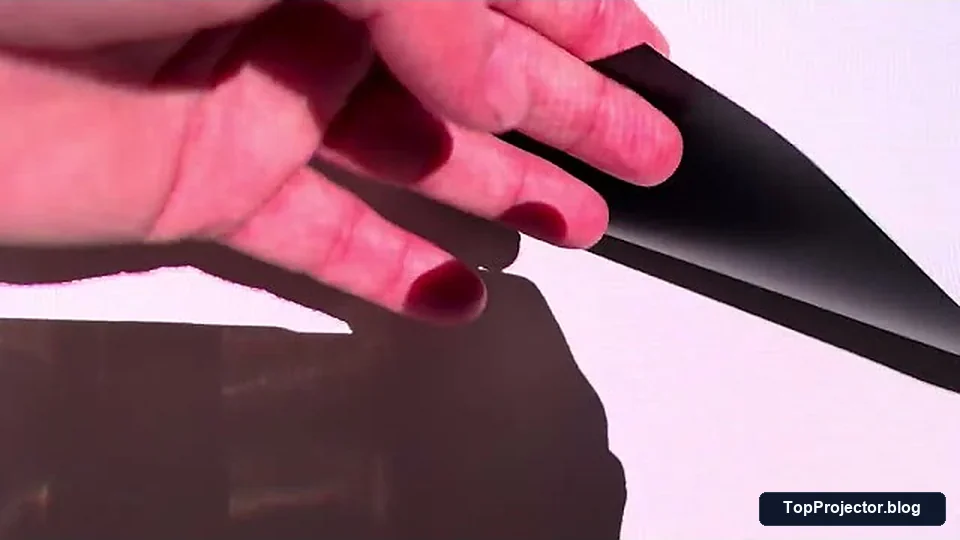
This high reflectivity concentrates the scattered interference patterns, making the grainy texture remarkably prominent. Standard matte white vinyl screens with a 1.0 gain rating scatter light more diffusely, reducing severity.
Acoustically transparent woven screens introduce physical thread patterns that break up coherent light scattering. The micro-perforations naturally disrupt phase alignment, acting as a built-in mechanical defense against visible grain.
Ambient light rejecting screens require careful vetting because microscopic optical structures can worsen speckle. Reviewing a projector throw distance guide ensures your optics setup delivers smooth motion without artifacts.
- High-gain directional screens severely amplify laser speckle visibility.
- Matte white surfaces with unity gain diffuse coherent light more evenly.
- Woven acoustic screens help break up microscopic interference patterns.
- Specialized ALR coatings must be engineered to avoid speckle exacerbation.
Why High-Gain Surfaces Fail With Lasers
Glass-bead and metallic high-gain coatings are designed to boost perceived brightness in lit rooms. Unfortunately, they preserve the directional coherence of laser light, creating an intolerable shimmering texture.
Viewers sitting within narrow cone angles experience severe hot-spotting combined with aggressive speckle grain. Pairing premium laser projectors with matte diffusion surfaces remains the gold standard guideline.
- Glass-bead coatings preserve dangerous levels of optical coherence.
- Narrow viewing cones intensify both hot-spotting and grain artifacts.
Advanced Optical Engineering and Mechanical Speckle Suppression
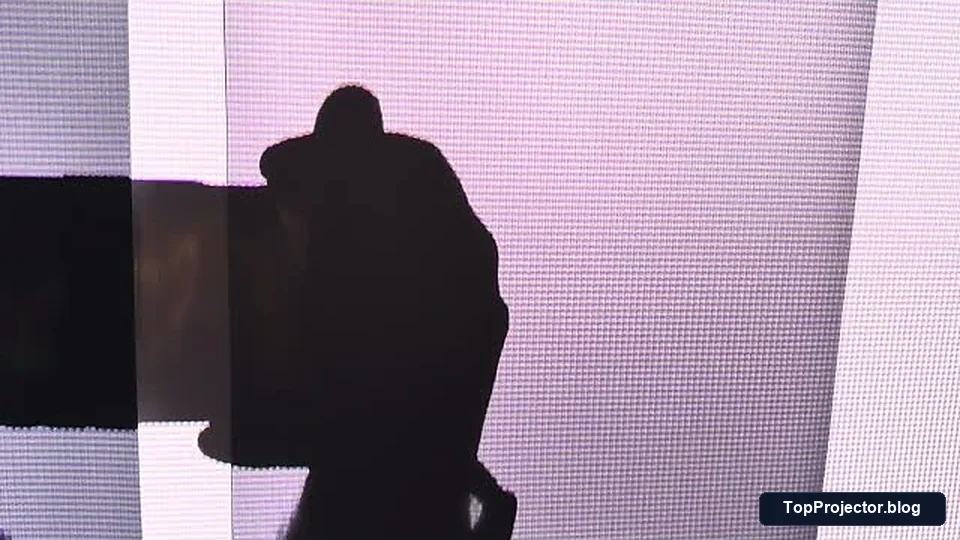
Projector manufacturers deploy sophisticated internal hardware to actively scramble light waves before projection. One industry standard involves high-speed motorized optical shakers placed directly inside the light path.
These rapid mechanical actuators vibrate an internal diffuser glass element at ultrasonic frequencies. By continuously shifting the interference pattern faster than human persistence of vision, the speckle blurs away.
Another effective technique involves polarization rotation optics that split and scramble incoming laser polarizations. This depolarization strategy prevents synchronized wavefronts from reinforcing their chaotic interference patterns on screen.
Implementing these internal suppression mechanisms requires precise engineering tolerances to maintain sharp focus. A quality optical engine must eliminate speckle without compromising critical throw ratios or lens sharpness.
- Motorized optical shakers blur interference patterns via rapid vibration.
- Ultrasonic diffuser elements operate beyond human visual detection limits.
- Polarization rotation optics scramble wavefronts to neutralize grain.
- Internal suppression must preserve native lens focus and throw geometry.
Assessing Active Shaker Reliability
Mechanical actuators must endure thousands of operational hours inside high-heat optical compartments. Premium manufacturers utilize robust magnetic suspension bearings to guarantee long-term reliability and silent operation.
This hardware investment ensures your projector maintains pristine image uniformity over years of heavy use. It separates entry-level laser models from reference-grade home theater projection systems.
- Magnetic suspension bearings ensure silent, durable actuator movement.
- Long-term reliability prevents mechanical degradation inside hot light engines.
Physiological Perception Factors and Individual Sensitivity to Grain
Human perception of laser speckle varies dramatically from one viewer to another. Some individuals remain completely oblivious to the shimmering grain, while others find it immediately distracting during movie viewing.
Factors like age, visual acuity, and seating distance dictate your personal sensitivity threshold. Younger viewers with sharp accommodation often spot high-frequency interference patterns much faster than older adults.
Furthermore, psychological focus plays a role once you learn what laser speckle looks like. Your brain tends to lock onto the static texture once identified, making mitigation essential for critical cinematic viewing.
Testing a projector in your dedicated space is the best way to evaluate personal tolerance. Ensuring proper input lag and color calibration helps maintain overall immersion regardless of minor grain.
- Viewer sensitivity to laser speckle varies based on individual visual acuity.
- Younger audiences often detect high-frequency grain patterns more easily.
- Conscious awareness can make static interference textures harder to ignore.
- Home testing ensures personal comfort before committing to a projection screen.
The Role of Viewing Distance and Screen Size
Sitting closer to a massive projection screen increases the angular subtense of each speckle grain. Moving back past a 1.2x throw distance ratio often pushes the interference texture below visual acuity limits.
Balancing screen dimensions with your layout minimizes optical grain impact. Using our ansi lumens room calculator helps determine optimal seating geometry before finalizing your design.
- Larger screen sizes magnify the physical scale of speckle grain.
- Increasing viewing distance helps mask microscopic interference patterns.
Calibration Strategies to Minimize Visual Impact in Dedicated Dark Rooms

Optimizing your projection environment goes a long way toward masking lingering optical artifacts. Dedicated dark rooms with dark velvet wall treatments reduce ambient scatter and enhance perceived contrast.
Calibrating your projector's white point and gamma curve can also soften the visual prominence of speckle. Avoiding blown-out highlight clipping prevents laser interference from standing out in bright image regions.
Pairing your system with high-end video processors allows for fine-tuning sharpness settings without exaggerating grain. Keeping sharpness sliders moderate prevents artificial edge enhancement from amplifying underlying interference textures.
A holistic approach combining screen selection, internal optical shakers, and precise calibration guarantees stellar results. Enjoying flawless cinematic images is entirely achievable with informed equipment pairing.
- Dark room treatments reduce ambient light scatter to boost black levels.
- Careful white point calibration softens harsh laser speckle highlights.
- Moderate sharpness settings prevent artificial enhancement of optical grain.
- Holistic system pairing guarantees pristine home theater performance.
Fine-Tuning Sharpness and Detail Filters
Aggressive digital sharpness filters artificially boost contrast around microscopic pixel edges. This processing flaw heavily accentuates laser speckle, turning subtle background grain into harsh visual noise.
Calibrating your display with professional test patterns ensures sharp rendering without digital enhancement. Maintaining clean signal processing preserves the natural integrity of your projected films.
- Digital sharpness boosts amplify microscopic laser interference grain.
- Professional test patterns ensure clean, artifact-free video processing.
Frequently Asked Questions
What causes laser speckle in home projectors?
Laser speckle is caused by the interference of coherent laser light bouncing off uneven screen surfaces. This creates a shimmering grain pattern that is visible to viewers.
Do all laser projectors suffer from speckle?
Not equally, as RGB triple-laser systems show the most prominent speckle grain. Single-laser hybrid phosphor models naturally reduce speckle by randomizing light waves.
Can projection screen material fix laser speckle?
Yes, pairing your projector with matte white or acoustic woven screens minimizes speckle. Avoid high-gain directional screens which severely amplify optical interference.
How do manufacturers eliminate speckle internally?
Engineers use high-speed motorized optical shakers and polarization rotators inside the light path. These components blur and scramble wavefronts before they reach the lens.
Does sitting further away help reduce speckle visibility?
Increasing your viewing distance reduces the angular subtense of interference grains. Sitting beyond optimal distance thresholds helps push the texture below visual acuity limits.