What Does 400 ANSI Lumens Mean for Home Theater Projection?
This technical guide decodes 400 ANSI lumens, explaining real-world brightness limits, throw constraints, and optimal viewing environments.
A rating of 400 ANSI lumens delivers watchable images only in pitch-dark rooms on compact screens under 80 inches diagonal maximum.
Ready to compare verified models? Start with our Best Home Projection System: Top Picks for 2026.
Practical Quick-Reference Table
| Scenario / Metric | Recommended Target | Why It Matters |
|---|---|---|
| Peak Brightness | 400 ANSI Lumens | Standardized American National Standards Institute testing metric. |
| Max Screen Size | 70 to 80 Inches | Maintains acceptable foot-lambert punch without dimming. |
| Ambient Light | Complete Darkness | Zero external light pollution preserves low black levels. |
| Throw Distance | 5 to 8 Feet | Maximizes optical light density on smaller screens. |
| Screen Gain | 1.0 to 1.3 Gain | Optimizes reflection efficiency for dim light engines. |
| Contrast Ratio | 3000:1 to 5000:1 | Ensures perceptible shadow detail in dark spaces. |
Understanding ANSI Lumens as the Industry Standard
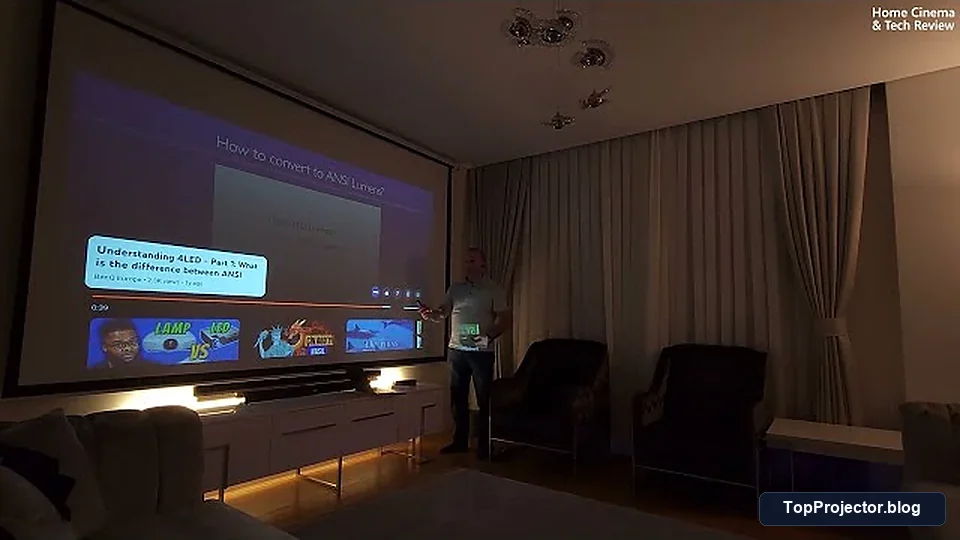
When evaluating home projectors, understanding standardized measurements prevents costly purchasing mistakes regarding brightness. ANSI lumens remain the absolute gold standard for true output.
Traditional marketing terms like LED lumens or source lumens create massive confusion among buyers. Manufacturers frequently inflate these figures by measuring raw diode output rather than screen-bound light.
The American National Standards Institute established a rigorous grid-testing procedure. This protocol measures luminous flux across nine distinct points to yield an honest representation of usable power.
Without this standardized metric, comparing different optical engines becomes practically impossible. Knowing the exact light output helps you match your projector to specific room lighting conditions.
- ANSI standard utilizes a strict nine-point testing grid across the screen.
- Eliminates inflated manufacturer claims based on raw LED diode output.
- Measures actual luminous flux delivered past the internal projection optics.
- Provides a reliable baseline for calculating achievable screen sizes.
The American National Standards Institute Protocol
The testing procedure requires positioning a calibrated light meter at specific coordinates. For example, our Epson Home Cinema 2350 review highlights how 3LCD technology achieves exceptional uniformity across screens.
This mathematical averaging prevents brands from boosting center hotspot brightness to fake high specifications. You get a dependable measure of overall optical performance.
- Divides the projection surface into nine equal rectangles.
- Averages lux readings taken at the center of each zone.
- Multiplies by screen area to derive total ANSI lumen output.
Deconstructing a 400 ANSI Lumen Rating
A light engine producing 400 ANSI lumens occupies the ultra-portable or entry-level LED category. Readers can check out our guide explaining lumen outputs for deep insights into real-world brightness limits.
Physics dictates that photons spread out rapidly as throw distance increases from the lens. A 400-lumen beam loses intensity quickly when projected beyond short distances.
Consequently, attempting to fill a massive cinematic screen results in a severely washed-out picture. Maintaining high visual fidelity demands keeping the diagonal dimension modest.
Understanding this limitation ensures you never deploy a portable projector in bright living rooms. Proper expectation management guarantees satisfying movie-watching experiences.
- Classifies the projector firmly within ultra-portable or lifestyle categories.
- Requires restricted throw distances to preserve adequate light density.
- Struggles significantly against any form of ambient room illumination.
- Demands disciplined management of screen size for optimal contrast.
Inverse Square Law and Light Falloff
Light intensity diminishes in direct proportion to the square of the distance traveled. Doubling your throw distance reduces the luminous energy per square foot by four.
This mathematical reality explains why 400 lumens works well only when placed close. Pulling the projector back transforms a crisp image into a dim haze.
- Illumination drops exponentially as throw distance increases.
- Short throws maintain higher foot-lambert ratings on screen.
- Placement geometry dictates final perceived image brightness.
Video Walkthrough: Introduction
Screen Size Limitations and Ambient Light Control
Pairing a 400 ANSI lumen projector with a massive screen destroys contrast instantly. Ambient room light competes directly with the weak photon stream from the lens.
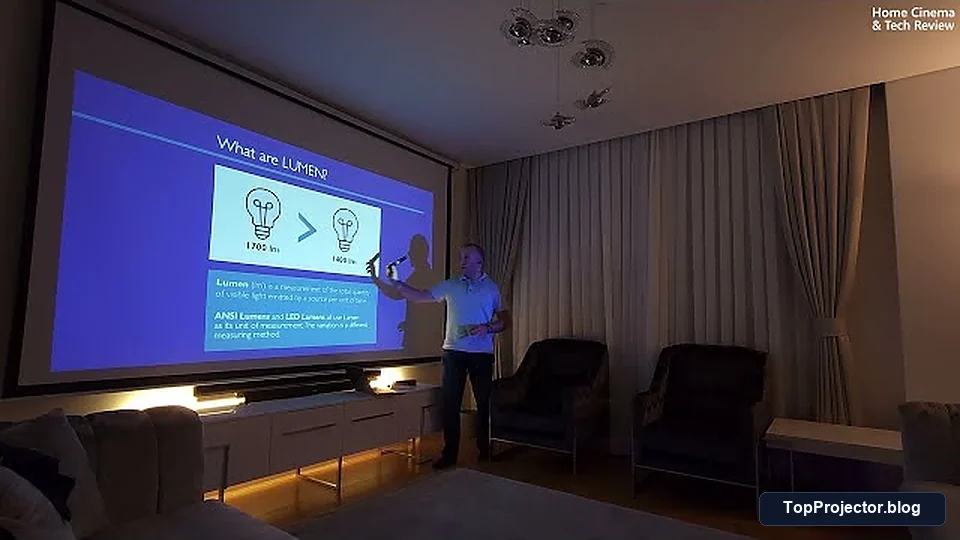
Daylight entering through windows will completely overpower this limited light output. Even interior household lamps wash out dark shadow details on the projection surface.
To achieve a recommended 16 foot-lamberts of brightness, restrict screen sizes. You can consult our screen size viewing distance calculator to map out proper diagonal limits for rooms.
Dedicated light control remains mandatory for enjoying watchable imagery from this class. Total blackout curtains or window treatments are non-negotiable accessories.
- Ambient light acts as a direct enemy to low-lumen projectors.
- Restricting screen size helps preserve perceived image contrast.
- Blackout curtains are mandatory for daytime viewing sessions.
- Matte white or high-gain surfaces help maximize reflected photons.
Gain Factors and Ambient Light Rejection
Specialized projection screens feature reflective coatings designed to bounce light forward. A screen with a gain rating above one can amplify perceived brightness slightly.
However, ambient light rejecting materials generally require higher lumen inputs to function. Pairing them with 400 lumens often creates narrow viewing cone restrictions.
- Reflective coatings redirect photons toward seated viewers.
- Gain ratings above unity boost center-cone luminance.
- ALR fabrics can restrict off-axis viewing angles severely.
Practical Use Cases for Low-Output Projectors
Despite strict brightness limits, 400 ANSI lumens serves specific niches exceptionally well. Ultra-portable camping projectors rely on this spec to balance battery size.
Backyard movie nights after sunset provide an ideal operational envelope for these devices. You can explore options in our best projectors for outside guide to find models featuring reliable battery power.
Children's bedroom installations also benefit from low heat output and quiet fans. The restricted brightness prevents eye strain during late-night animated film viewings.
Recognizing these specialized applications prevents disappointment when unboxing compact lifestyle hardware. Match the hardware capabilities directly to your specific lifestyle requirements.
- Ideal for highly portable battery-powered camping projectors.
- Excels during backyard movie sessions after total sundown.
- Perfect for kids' bedrooms with controlled lighting environments.
- Reduces cooling fan noise through lower thermal output.
Pitch-Dark Dedicated Home Theaters
Basement home theaters stripped of all ambient light welcome low-output engines. Controlling every single light source allows modest lumens to deliver immersive cinema.
Absorbent dark wall treatments prevent stray light reflections from bouncing around. This environment maximizes the available contrast ratio from your optical system.
- Basement setups eliminate unwanted environmental light pollution.
- Dark wall treatments absorb stray optical reflections effectively.
- Preserves delicate shadow detail in cinematic dark scenes.
Contrast Ratio Interaction with Low Lumen Outputs
Perceived picture quality relies heavily on contrast rather than raw lumens alone. A strong native contrast ratio helps 400 lumens look punchy and dynamic.
When blacks appear deep and inky, bright highlights pop with surprising visual impact. Low-cost LCD chips often struggle to produce deep blacks in dark scenes.
DLP light engines generally maintain better ANSI contrast performance in budget brackets. This optical efficiency makes lower lumen ratings look significantly more vibrant.
Evaluating contrast specifications alongside lumen counts prevents purchasing flat-looking images. Always check static contrast figures before finalizing your hardware choice.
- Contrast ratio dictates the perceived depth of projected images.
- Inky blacks make highlight elements appear significantly brighter.
- DLP technology often provides superior ANSI contrast handling.
- Static contrast specs matter just as much as raw lumen counts.
ANSI Contrast Versus Static Contrast
Static contrast measures full-on and full-off black and white performance sequentially. ANSI contrast tests checkerboard patterns simultaneously across the optical chip.
High ANSI contrast ensures mixed scenes retain rich dimensionality and pop. Low-output projectors depend on this metric to avoid muddy pictures.
- Static contrast measures sequential black and white frames.
- ANSI contrast evaluates simultaneous checkerboard light fields.
- Complex scenes reveal the true quality of the optics.
Comparing ANSI Lumens to Marketing Lumen Specs
Navigating consumer electronics specifications requires skepticism toward inflated manufacturer numbers. Brands frequently quote misleading figures like source lumens or lux.
A device advertised with thousands of LED lumens often translates to hundreds. ANSI standards strip away marketing hype to reveal true performance.
Always verify that manufacturers explicitly state their measurement methodology in documentation. True industry leaders rely proudly on standardized ANSI testing protocols.
Educated consumers avoid falling victim to deceptive packaging and misleading advertising claims. Prioritize verifiable specifications over flashy promotional graphics every single time.
- Watch out for deceptive terms like source or LED lumens.
- Marketing figures often exaggerate real-world screen brightness.
- ANSI certification guarantees a standardized testing protocol.
- Always cross-reference specifications with independent expert reviews.
The Trap of Fake Source Lumens
Source lumens measure the raw output directly off the bare LED chip. This metric completely ignores optical path losses and lens absorption.
Real screen brightness drops dramatically once light passes through polarizers. Standardized ANSI testing measures light strictly after it exits the lens.
- Measures raw light directly at the LED diode.
- Ignores significant light loss inside the optical engine.
- ANSI testing measures actual light reaching the screen.
Frequently Asked Questions
Is 400 ANSI lumens bright enough for a normal living room?
No, 400 ANSI lumens is far too dim for illuminated spaces. You need at least 2000 lumens for daytime living room viewing.
What is the maximum recommended screen size for 400 lumens?
Keep your screen size under 80 inches diagonal for watchable images. Anything larger will wash out completely in dark rooms.
Why do some brands advertise LED lumens instead of ANSI lumens?
Manufacturers use LED lumens to inflate specifications on packaging. ANSI lumens provide an honest, standardized measure of real output.
Can I use a 400 ANSI lumen projector for outdoor movies?
Yes, provided you start the screening after total sunset. Outdoor ambient light ruins the dim image instantly.
Does screen gain help improve a 400 lumen projector image?
Yes, a 1.2 gain screen boosts reflective punch in dark rooms. However, high-gain surfaces can narrow your optimal viewing angles.