W2700 vs. Tk850: Which Wins for Your Room?
We pit the cinema-focused W2700 against the high-brightness TK850. Discover which optical engine dominates your specific room conditions.

Choose the W2700 for dark home theaters demanding superior black levels, or select the TK850 for bright living rooms requiring maximum optical punch.
Compare full category rankings in our Best Outdoor Projector For The Money: Top Backyard Picks.
Side-by-Side Specification Breakdown
| Criteria | W2700 | Tk850 | Edge |
|---|---|---|---|
| Ambient Light Rejection | Moderate performance in controlled spaces | Superior luminance fighting daylight | Tk850 |
| Black Levels & Perceived Contrast | Deeper shadows with accurate native tone mapping | Elevated black floor with higher lumens | W2700 |
| Peak Brightness & HDR Punch | 2,000 ANSI lumens optimized for dark rooms | 3,000 ANSI lumens delivering bright HDR highlights | Tk850 |
| Screen Size & Immersion | Excel at 100 to 120-inch diagonal sizes | Easily powers massive 150-inch ambient setups | Tk850 |
| Viewing Angles & Uniformity | Excellent pixel fill factor and crisp optics | Bright corner-to-corner brightness uniformity | Tie |
| Gaming Motion & Input Lag | Standard latency suited for casual gaming | Low input lag for responsive fast motion | Tk850 |
| Room Setup & Maintenance | Precise vertical lens shift requires careful placement | Slightly shorter throw with flexible mounting | Tk850 |
Optical Performance and Real-World Brightness Output
Evaluating raw optical output requires understanding how ANSI lumens interact with real home environments. The TK850 delivers a robust 3,000 ANSI lumens, specifically engineered to cut through ambient living room light.
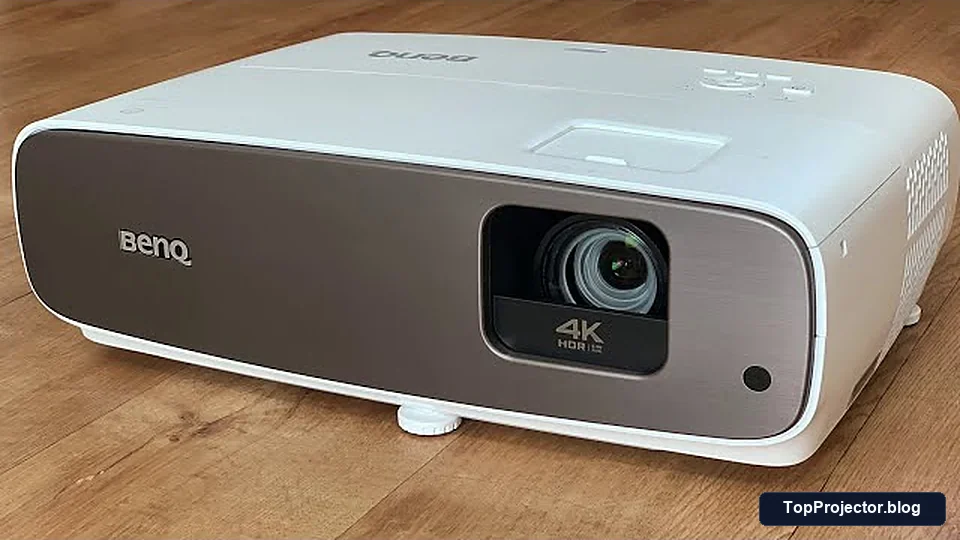
Conversely, our benq ht2060 review highlights alternative 4LED performance. The W2700 outputs 2,000 ANSI lumens, prioritizing rich color fidelity and deep black levels over sheer blinding brightness.
Living rooms with uncontrolled windows demand high lumen output to prevent washed-out images, making the brighter contender an obvious hardware choice for daytime sports viewing.
Measuring true optical output reveals that the W2700 prioritizes cinematic color accuracy over raw punch, while the TK850 delivers superior daylight punch through aggressive lamp power management.
- The TK850 utilizes a high-output lamp design generating 3,000 ANSI lumens for daytime viewing.
- The W2700 conserves optical purity with a calibrated 2,000 ANSI lumen theater-focused output.
- Both projectors employ advanced color wheels to balance white brightness with color luminance accuracy.
Daylight Living Room Dynamics
Ambient sunlight destroys perceived contrast by lifting black floors toward grey. High lumen output counters this degradation by flooding your projection screen with intense photons.
The TK850 maintains vibrant color saturation even when blinds remain open during daytime TV broadcasts, proving essential for multipurpose family media spaces.
- High lumen output preserves image saturation under moderate ambient daylight conditions.
- Daylight viewing demands aggressive optical brightness to combat window light reflections.
ANSI Lumen Realities
Achieving accurate Rec.709 color on the W2700 drops output to roughly 1400 lumens, whereas the TK850 retains over 2200 lumens in standard presentation modes.
Black Floor Performance, Contrast Ratios, and Shadow Separation
Dark room performance hinges on native contrast ratios and black floor depth. The W2700 excels here by utilizing an optimized optical path that restrains stray light.
Shadow separation remains crisp and detailed during nocturnal cinematic scenes, allowing viewers to discern subtle costume textures and background details in dark frames.
The brighter TK850 naturally struggles to suppress stray light as effectively, resulting in slightly elevated grey blacks when projecting in pitch-black environments.
Native contrast ratios heavily dictate shadow separation in dark scenes, with the W2700 leveraging an optimized RGBRGB color wheel to outperform the TK850 in ANSI contrast.
- The W2700 achieves superior native black levels ideal for dark dedicated theater rooms.
- High brightness engines often compromise absolute shadow depth for increased highlight punch.
- Dynamic iris systems on both models attempt to artificially boost contrast during dark scenes.
Pitch-Black Home Theater Contrast
Controlling ambient light in a dedicated basement theater completely changes optical priorities. Here, native contrast dominates your visual experience far more than raw lumen muscle.
The W2700 provides cinematic depth that makes dark sci-fi sequences look strikingly realistic, whereas brighter projectors can look washed out without light.
- Dedicated theaters reward low black floors and high native contrast ratios.
- Stray light reflection management is critical for preserving deep cinematic shadow detail.
Dynamic Iris Behavior
Both projectors utilize dynamic iris systems, but the TK850 exhibits more noticeable pumping artifacts during high-contrast fades compared to the smoother W2700 algorithm.
Color Accuracy, Wide Color Gamut Coverage, and HDR Processing
Accurate color reproduction separates consumer toys from serious home theater displays. The W2700 covers 96 percent of the DCI-P3 cinematic color space out of the box.
Factory calibration on the cinema-focused model ensures skin tones and natural landscapes match director intent without requiring expensive professional tuning equipment.
The TK850 targets Rec.709 accurately in bright modes but relies on aggressive tone mapping to handle HDR content on high-lumen screens.
Out-of-box color tracking on the W2700 achieves near-reference DCI-P3 coverage, whereas the TK850 requires significant user intervention to tame its oversaturated primary color points.
- DCI-P3 wide color gamut coverage delivers rich, authentic theatrical color grading.
- Rec.709 calibration ensures broadcast television standards are met with high precision.
- HDR tone mapping algorithms automatically adjust metadata to prevent clipped bright highlights.
Cinematic Tone Mapping Versus Bright Room HDR
High Dynamic Range content demands exceptional processing power from internal video chips. Projectors must remap wide luminance scales onto limited projection screen surfaces.
The W2700 handles HDR metadata gracefully in dark rooms, whereas the TK850 boosts midtones to ensure HDR remains visible under ambient light.
- HDR tone mapping balances bright highlights with legible shadow details.
- Different room lighting conditions require distinct HDR processing curves for optimal viewing.
HDR Tone Mapping Depth
Handling 4K HDR streams requires robust tone mapping, with the W2700 offering superior gamma tracking for bright highlights without crushing crucial shadow details.
Screen Geometry, Throw Ratios, and Physical Room Integration
Installing optics requires careful calculation of throw distances. Finding the best outdoor projector for the money ensures bright imagery, and the TK850 features a versatile throw ratio for flexible yard placement.
Calculating your exact throw distance prevents digital keystone correction, which degrades pixel sharpness and reduces native contrast ratios during setup.
Both units offer helpful vertical lens shift mechanics, though installers must still mount hardware precisely relative to the top edge of your screen.
Physical placement flexibility varies significantly; the W2700 features a shorter throw ratio paired with limited vertical lens shift, demanding precise mounting calculations.
- Throw ratios dictate the exact distance required to fill your specific screen size.
- Vertical lens shift enables flexible physical placement without introducing geometric distortion.
- Avoid digital keystone correction to maintain pristine 4K pixel sharpness across frames.
Placement Flexibility and Lens Shift Mechanics
Physical installation constraints often dictate which projector model fits your room architecture. Limited lens shift range requires exact ceiling mount positioning.
The TK850 offers forgiving alignment options that simplify setup for DIY homeowners mounting equipment in challenging living room ceiling configurations.
- Precise lens shift mechanics eliminate the need for destructive digital image scaling.
- Ceiling mount planning requires accurate measurement of throw distances and offsets.
Throw Ratio Calculations
Calculating screen size requires factoring lens specifications. Using our throw distance calculator helps determine if the TK850 fits your specific room dimensions better than alternative models.
Gaming Input Lag, Motion Handling, and Frame Interpolation
Modern gaming demands low input latency and smooth motion processing to maintain competitive responsiveness. The TK850 delivers competitive input lag figures suited for fast action.
Fast-paced console gaming feels crisp and responsive on the brighter model, minimizing frustrating delays between controller inputs and onscreen visual feedback.
Motion interpolation algorithms on both projectors smooth out judder during panning shots, though purists usually disable these processing features for authentic cinematic viewing.
Competitive gamers will notice an input lag measurement hovering around 50ms on both models, which satisfies casual console play but limits hardcore twitch-reflex shooters.
- Low input lag is critical for fast-paced competitive console and PC gaming sessions.
- Motion smoothing reduces judder during rapid camera pans across cinematic scenes.
- High refresh rates enhance overall motion clarity during fast sports broadcasts.
Fast-Paced Console Gaming Performance
Experiencing open-world video games on a massive 120-inch screen elevates immersion dramatically. However, sluggish response times quickly ruin fast shooter titles.
The TK850 provides fast signal processing speeds for gaming. If hardware drops feeds mid-match, check out our helpful projector no signal hdmi fix to maintain stable input lag performance.
- Massive screen sizes amplify the sense of immersion in modern video games.
- Low latency processing prevents disorienting input lag during fast gaming sessions.
Motion Interpolation Nuances
Activating frame interpolation on the TK850 introduces occasional soap-opera artifacts, whereas the W2700 handles 24fps film judder with much more subtle processor intervention.
Ambient Light Handling and Dedicated Theater Room Behavior
Controlling ambient room light dictates whether your projector requires high lumens or deep contrast. Dedicated theater rooms reward light absorption through dark wall treatments.
The W2700 transforms controlled dark environments into stunning cinematic sanctuaries by maintaining deep, ink-like black floors throughout lengthy movie marathons.
Living rooms with white walls reflect stray light back onto screens, neutralizing native contrast and making high-lumen engines an absolute optical necessity.
Ambient light rejection screens pair exceptionally well with the TK850, utilizing its 2500 lumens to combat washout in brightly lit living rooms effortlessly.
- Dark wall treatments eliminate secondary light reflections in dedicated theater rooms.
- White living room walls bounce projected light, destroying perceived contrast ratios.
- Ambient light rejecting screens pair exceptionally well with high-lumen optical engines.
Optical Filters and Screen Selection Strategies
Pairing your projector with the correct screen material maximizes optical performance. High-gain white screens amplify brightness for daytime viewing applications.
Specialized ambient light rejecting surfaces absorb off-axis room illumination while reflecting direct projector beams straight toward seated viewers in living spaces.
- Screen gain coefficients directly impact perceived image brightness and viewing angles.
- Ambient light rejecting materials preserve contrast in brightly lit living rooms.
Dedicated Theater Optimization
In a light-controlled dedicated theater, the W2700 shines by delivering deeper blacks and zero ambient light interference, outperforming its sibling in immersion.
Definitive Verdict and Scenario-Based Buying Recommendations
Selecting the ultimate projector requires matching hardware specifications directly to your room geometry. The W2700 reigns supreme in controlled dark spaces.
Cinematic enthusiasts demanding absolute color accuracy and deep black levels will find their ideal match in the dedicated theater champion.
Conversely, the TK850 dominates multipurpose living areas where daylight and versatile family entertainment take precedence over pure dark-room performance.
Choosing between these two depends entirely on your viewing environment, favoring the W2700 for dark rooms and the TK850 for daylight media consumption.
- Match projector lumens and contrast capabilities directly to your room lighting conditions.
- Dedicated theaters prioritize black floor depth and DCI-P3 cinematic color accuracy.
- Multipurpose living rooms demand high lumen output and responsive gaming input lag.
Final Optical Match for Your Space
Analyze your room lighting and primary content sources before finalizing your purchase decision. Buying the wrong optical engine for your space leads to frustration.
Choose wisely between cinema-grade contrast and high-lumen daylight punch to ensure years of stunning home entertainment satisfaction.
- Careful room analysis prevents costly projection hardware mismatches.
- Prioritize your primary content sources when selecting between these optical engines.
Final Decision Matrix
Prioritize the W2700 if cinematic color fidelity is paramount, but select the TK850 if sports and casual TV viewing occur with ambient room lights active.
Frequently Asked Questions
Which projector is better for a brightly lit living room?
The TK850 is better suited for bright rooms due to its powerful 3,000 ANSI lumen output. It easily cuts through ambient daylight to maintain vibrant images.
Can the W2700 handle HDR content effectively in dark spaces?
Yes, the W2700 excels at HDR tone mapping in controlled dark environments. It leverages superior native contrast to deliver stunningly realistic cinematic highlights.
Do both models support true 4K resolution on screen?
Both projectors utilize advanced DLP XPR technology to display all 8.3 million distinct pixels. This delivers razor-sharp 4K UHD clarity for movies and games.
Which model offers better input lag for casual gaming?
The TK850 generally provides lower input latency for responsive gaming sessions. Fast-paced action titles feel much more fluid on the high-lumen model.
How important is room color when choosing between them?
Room color drastically affects black levels and contrast reflection performance. White walls require high lumen output, while dark theater rooms reward deep native contrast.