Ultra Short Throw vs. Long Throw Projector: Which Wins for Your Room?
Choosing the right optical architecture depends entirely on your room layout and ambient light control. We break down the real-world physics of UST and long throw units.
Choose Ultra Short Throw for bright living rooms with zero installation hassle, but select Long Throw Projector systems for ultimate dedicated theater immersion and scale.
Compare full category rankings in our Best Portable Projector For Iphone: Top Picks Reviewed.
Side-by-Side Specification Breakdown
| Criteria | Ultra Short Throw | Long Throw Projector | Edge |
|---|---|---|---|
| Ambient Light Rejection | Exceptional with specialized ALR fresnel screens. | Requires complete room blackout for best results. | Ultra Short Throw |
| Black Levels & Perceived Contrast | Good, but susceptible to ceiling reflections. | Superior in dark rooms with velvet masking. | Long Throw Projector |
| Peak Brightness & HDR Punch | High lumen output designed for daytime viewing. | Scalable brightness based on throw distance. | Ultra Short Throw |
| Screen Size & Immersion | Typically capped at 100 to 120 inches. | Easily scales past 150 inches diagonal. | Long Throw Projector |
| Viewing Angles & Uniformity | Prone to hotspotting if screen alignment is off. | Excellent optical uniformity over long distances. | Long Throw Projector |
| Gaming Motion & Input Lag | Modern models hit sub-15ms input lag. | Traditional low latency with pure HDMI 2.1 paths. | Ultra Short Throw |
| Room Setup & Maintenance | Plugs in directly below the screen like a TV console. | Requires precise ceiling mounting and lens shift calibration. | Ultra Short Throw |
Optical Architecture and Throw Ratio Mechanics
Ultra short throw projectors use complex multi-element folding optics to project massive images from inches away. This innovative throw geometry redefines how we integrate large displays into modern living spaces.
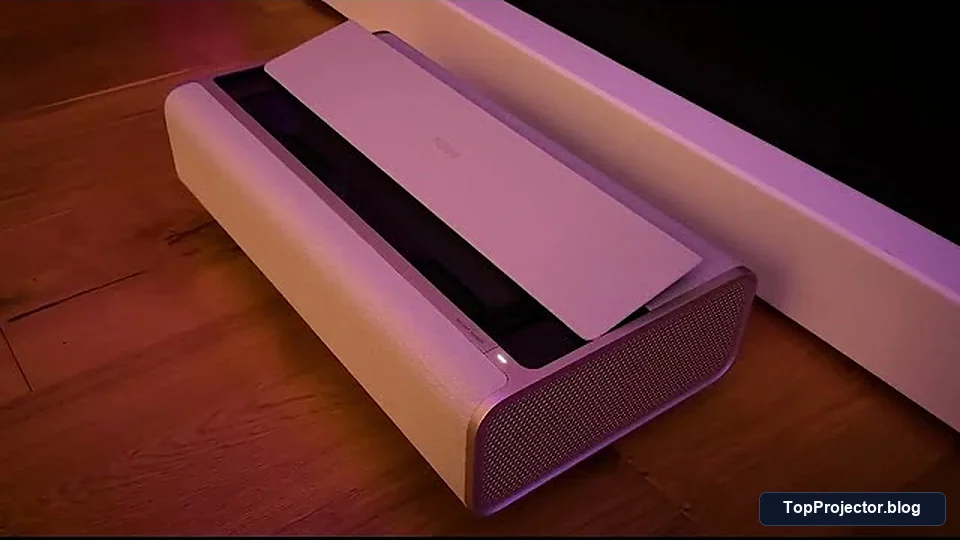
Traditional long throw units rely on standard optical lenses requiring significant distance. This spatial separation lets optical engineers maximize native contrast ratios without severe geometric distortion risks.
Ultra short throw models utilize complex aspheric mirror arrays to achieve a 0.25 throw ratio, projecting massive 100-inch images from inches away. Long throw units rely on traditional glass lenses requiring long projection distances.
- UST throw ratios sit near 0.19:1 to 0.25:1 for extreme proximity.
- Long throw models range from 1.3:1 to 2.0:1 or higher.
- Light path folding in UST lasers introduces minor panel alignment challenges.
The Physics of Light Path Distribution
Light leaving a UST lens travels at severe vertical angles toward the screen surface. This steep angle makes optical matching with specialized ambient light rejection surfaces mandatory.
Long throw projectors beam light horizontally across the room directly into the seating sweet spot. This traditional path preserves pixel geometry and native ANSI contrast uniformity.
- Steep UST projection angles demand perfectly flat walls or tensioned screens.
- Horizontal long throw beams minimize angular distortion across wide screens.
Sub-Lens Calibration Nuances
Precise optical alignment remains critical for ultra short throw setups because minor cabinet shifts distort geometry. Long throw systems forgive slight ceiling mount vibrations due to larger optical tolerances and simpler lens shift mechanics.
Ambient Light Rejection and Daytime Performance
Combating living room daylight requires specialized screen technology rather than raw lumen output alone. Ultra short throw setups leverage optical sawtooth filters to reject overhead illumination.
Traditional long throw projectors struggle in bright rooms unless paired with high-gain white or gray surfaces. Ambient light washes out dark scenes rapidly without dedicated light control.
Pairing an ultra short throw projector with a specialized ceiling-rejecting screen blocks overhead ambient illumination effectively. For mobile entertainment, consult our best portable projector for iphone roundup.
- UST ALR screens block up to 90 percent of overhead light.
- Long throw requires dark paint or blackout curtains for true contrast.
- Laser light sources in both types push past 3000 ANSI lumens easily.
Living Room Daylight Versus Dedicated Blackout
In brightly lit spaces, ultra short throw projectors maintain saturated colors and punchy highlights. The upward-rejecting screen structure absorbs ambient rays effectively from ceiling fixtures.
Dedicated home theaters favor long throw units because uncontrolled light reflections are eliminated. Total darkness lets long throw systems achieve stunning black floor depths.
- Daytime viewing favors UST paired with a micro-serrated ALR screen.
- Dark theater rooms maximize long throw contrast without ambient interference.
Micro-Structure Screen Physics
Specialized lenticular optical layers reject ninety percent of ambient light by absorbing rays striking from above. Standard white matte surfaces lack this directional filtering, resulting in washed-out black levels during daytime viewing sessions.
Black Levels, Native Contrast, and Shadow Detail
Achieving deep black levels is the holy grail of projection optics. Long throw projectors generally maintain superior native contrast ratios due to simpler, purer optical light paths.
Ultra short throw units suffer slightly from light scatter within their complex mirror arrays. This internal reflection can raise the black floor in high-contrast cinematic scenes.
Achieving deep black levels depends heavily on native contrast ratios rather than dynamic iris manipulation. Premium long throw DLPs often deliver superior native contrast exceeding 1500:1 ratio, preserving crucial shadow detail in dark scenes.
- Native contrast on good long throw units can exceed 2000:1 to 5000:1.
- UST projectors rely heavily on dynamic laser dimming to boost dark performance.
- Room reflectivity plays a massive role in perceived contrast for both.
Managing Light Scatter in Dark Scenes
Dark movie sequences expose the optical limitations of cramped mirror housings in UST units. Stray light bounces within the chassis, reducing shadow detail in demanding visual sequences.
Long throw optics project clean beams across open air toward distant screens. This physical separation minimizes internal lens flare and preserves intricate shadow details.
- White ceilings close to UST units can reflect light back onto the screen.
- Black velvet ceiling treatments dramatically improve long throw contrast performance.
Optical Path Light Scatter
Ultra short throw mirrors occasionally introduce internal light scatter that slightly elevates black floors in batcave environments. Dedicated home theater long throw projectors minimize internal reflections using flocked light tunnels for pristine contrast.
Screen Size Limitations and Immersion Scale
Screen size flexibility is a defining characteristic when comparing projector classes. Once you master how to connect ps5 to projector hardware, note that ultra short throw displays lock sizes between 100 and 120 inches.
Long throw projectors offer unmatched scalability, allowing enthusiasts to project images spanning 150 inches or more simply by moving the unit further back.
Maximizing visual immersion requires matching your throw distance to precise screen diagonal boundaries. Use our screen size and viewing distance calculator to map out your room layout before purchasing fixed optics.
- UST maximum size is restricted by fixed focal mirror geometry.
- Long throw lets you scale up dynamically as your room permits.
- Larger projection sizes inherently reduce measured foot-lambert brightness.
The Quest for Massive Cinematic Scale
Cinematic immersion scales directly with field of view expansion in dedicated rooms. Long throw projectors excel here by filling massive acoustically transparent screens with ease.
Living rooms rarely accommodate massive screens beyond one hundred twenty inches safely. Therefore, ultra short throw size caps rarely inconvenience standard residential deployment plans.
- Acoustic transparency requires long throw setups behind woven screens.
- Living room size limits make 120-inch UST setups the sweet spot.
Zoom Lens Flexibility
Long throw projectors feature optical zoom ratios ranging from 1.3x to 2.1x, enabling exact image sizing without digital resolution loss. Fixed ultra short throw lenses demand precise physical placement to match specific screen border alignments.
Color Accuracy, HDR Handling, and Wide Gamut
Modern laser engines in both projector types deliver stunning wide color gamuts. Tri-chroma laser setups achieve near-complete coverage of the demanding BT.2020 color space easily.
HDR tone mapping remains a critical differentiator for realistic highlight rendering. Long throw and UST models alike require aggressive processing to map high-nit mastering to projector outputs.
Accurate HDR tone mapping requires robust color gamut coverage reaching past ninety percent of the DCI-P3 space. Laser-based long throw and ultra short throw models both utilize multi-phosphor wheels to achieve vibrant theatrical hues.
- Triple laser engines produce vibrant colors without color break wheels.
- Rec.709 calibration out of the box varies wildly by manufacturer.
- Dynamic tone mapping helps offset limited projector peak brightness.
Laser Phosphor Versus Triple Laser Engines
Single blue laser phosphor systems offer stable, reliable color output for everyday viewing. They provide accurate skin tones but fall short of ultra-saturated wide color targets.
RGB triple laser architectures unlock brilliant primary colors without optical filters. This modern technology powers flagship UST and long throw units to new visual heights.
- Triple laser units can cause subtle speckle artifacts on matte screens.
- Phosphor engines offer smooth gradients without laser speckle patterns.
Laser Speckle and Color Filters
RGB triple laser engines deliver stunning color saturation but can introduce visible laser speckle on matte white surfaces. Implementing subtle diffusing screens eliminates this artifact while maintaining reference color calibration standards during movie playback.
Gaming Performance, Motion Handling, and Input Lag
Gaming on projectors has evolved into a mainstream reality. As highlighted in our BenQ X3000I review, modern units feature dedicated low input lag modes with rapid response times.
Input lag figures have plummeted across the industry to ensure competitive responsiveness. Fast-paced titles remain fully playable without noticeable controller delay on current hardware.
Competitive gaming demands minimal signal delay, with modern projectors achieving low input lag figures under twenty milliseconds. Dedicated gaming modes bypass advanced image processing pipelines to ensure instant controller response times.
- Competitive gaming requires input lag under 20 milliseconds.
- High refresh rate support at 1080p is common in modern laser units.
- Motion interpolation settings help smooth fast camera pans in games.
Frame Rates and Response Times in Action
Ultra short throw gaming projectors now support 240Hz refresh rates at lower resolutions. This caters directly to PC gamers seeking massive immersive displays without latency penalties.
Long throw home theater models prioritize cinematic 24p frame reproduction over raw gaming speed. However, flagship cinema units increasingly adopt low-latency gaming processors.
- HDMI 2.1 ports enable 4K at 120Hz pass-through capabilities.
- Motion blur reduction modes improve clarity during rapid movement.
High Refresh Rate Integration
Advanced long throw gaming projectors now support 240Hz refresh rates at 1080p resolution for ultra-smooth competitive matches. Ultra short throw models prioritize cinematic fidelity, typically capping high refresh capabilities at lower frame thresholds.
Room Setup, Installation Complexity, and Maintenance
Physical installation represents the starkest contrast between these two projection methods. Ultra short throw units sit directly on a media console, requiring zero professional mounting labor.
Long throw projectors demand precise ceiling alignment, keystone correction avoidance, and optical zoom calibration. Professional installation or careful DIY measurement is always required.
Professional installation involves meticulous calibration of focus, keystone correction, and geometric warping parameters. Ultra short throw units demand flat wall surfaces because minor drywall ripples cause noticeable geometric distortion across the projected image.
- UST setup takes minutes with simple manual image alignment guides.
- Long throw ceiling mounting requires sturdy studs and cable management.
- Dust accumulation on internal optics requires occasional professional cleaning.
Cable Management and Living Room Aesthetics
Integrating a projector into a multi-use living space demands clean aesthetic choices. Ultra short throw consoles hide short HDMI runs easily inside existing entertainment furniture.
Long throw installations require long in-wall HDMI cables routed safely to ceiling mounts. This complexity suits dedicated theater rooms where wires remain permanently concealed.
- UST units double as stylish media console centerpieces.
- Long throw projectors eliminate floor clutter completely via ceiling mounts.
Dust Ingress and Filter Maintenance
Sealed optical engines in modern laser projectors prevent dust accumulation on internal DMD chips, significantly reducing maintenance overhead. Regularly cleaning removable air intake filters ensures optimal thermal management during extended viewing sessions.
Frequently Asked Questions
Can ultra short throw projectors replace a traditional flat-screen television in a bright living room?
Yes, when paired with a specialized ambient light rejection screen, UST projectors punch through daylight effectively. They offer massive screen sizes while maintaining impressive daytime black levels and vibrant color saturation.
Why do long throw projectors still dominate dedicated pitch-black home theater rooms?
Long throw units deliver superior native contrast ratios and clean optical paths without internal mirror scatter. This optical purity ensures maximum shadow detail and cinematic immersion in controlled dark environments.
Are ultra short throw laser projectors difficult to align and set up correctly?
Setup is remarkably simple because they sit inches from the screen like a standard television console. Most units feature built-in electronic geometric correction tools to square up the image effortlessly.
Do long throw projectors require professional installation or can I mount them myself?
While DIY ceiling mounting is possible, it demands precise measurement of throw distance and lens shift. Professional installation guarantees optimal alignment without relying on image-degrading digital keystone correction.
Which projector type offers better longevity and light source maintenance for daily use?
Both modern options utilize solid-state laser phosphor or RGB laser engines rated for 20,000 to 30,000 hours of use. This eliminates traditional lamp replacements, ensuring years of maintenance-free operation.