Ultra Short Throw Projector vs. Tv: Which Wins for Your Room?
Choosing between an ultra short throw projector and a massive flat-panel television requires careful evaluation of room lighting, wall space, and optical performance limits.
Choose an ultra short throw projector for cinema-scale immersion in dedicated spaces, while a television dominates bright living rooms with superior contrast and punchy HDR.
Compare full category rankings in our Best 3D 4K Projector For Home Theater: Top Picks.
Side-by-Side Specification Breakdown
| Criteria | Ultra Short Throw Projector | Tv | Edge |
|---|---|---|---|
| Ambient Light Rejection | Requires specialized ALR screen | Emissive glass resists glare naturally | Tv |
| Black Levels & Perceived Contrast | Prone to raised black floors | Infinite OLED or deep local dimming | Tv |
| Peak Brightness & HDR Punch | Finite lumens spread over huge area | High nits deliver brilliant specular highlights | Tv |
| Screen Size & Immersion | Easily scales to 100-120 inches | Logistical limits past 98 inches | Ultra Short Throw Projector |
| Viewing Angles & Uniformity | Directional ALR limits off-axis views | Wide off-axis viewing without degradation | Tv |
| Gaming Motion & Input Lag | Good latency, minor processing delays | Sub-15ms lag, 120Hz/144Hz support | Tv |
| Room Setup & Maintenance | Sits on console, no wall mounting | Heavy wall studs and careful mounting | Ultra Short Throw Projector |
Optical Mechanics and Ambient Light Interaction
Ultra short throw projectors rely heavily on specialized ambient light rejecting screens to combat overhead illumination, whereas flat-panel televisions emit their own direct light toward your eyes.
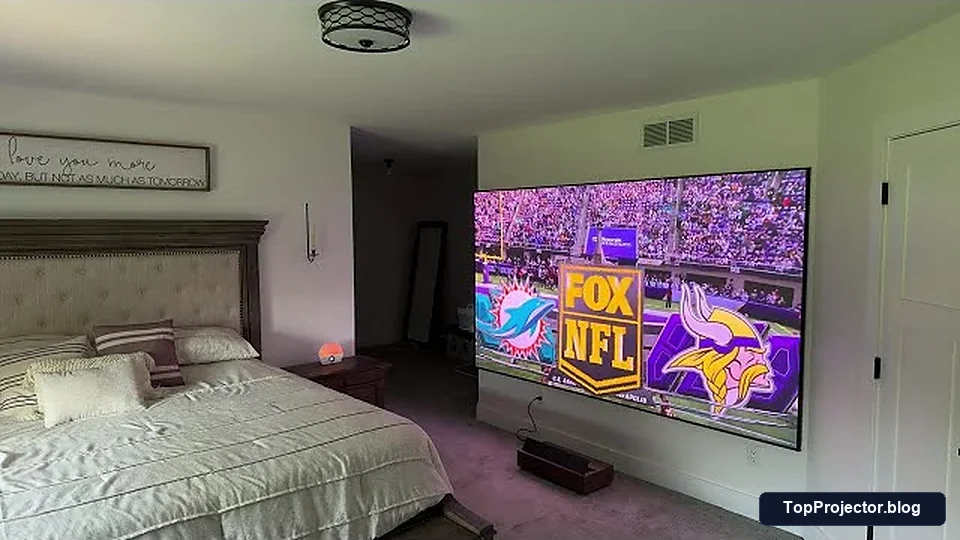
Standard flat-panel displays easily maintain high contrast ratios under harsh daylight conditions, making them exceptionally reliable for casual daytime viewing without closing motorized window blinds.
Ultra short throw models require specialized ALR screens featuring microscopic directional rejection layers to combat overhead ceiling illumination effectively, preserving an acceptable 0.8 gain for optimal off-axis viewing cone uniformity.
- Direct-emission glass beats projected light in bright spaces.
- ALR screens are mandatory for daylight UST performance.
- Window placement dictates daytime optical viability.
Pitch-Black Theater vs. Living Room Daylight
Dedicated home theaters allow ultra short throw units to shine by eliminating stray reflections, and our lumens room calculator helps determine exact brightness needs for a cinematic velvet aesthetic.
Living rooms flooded with natural sunlight quickly wash out projected images, forcing buyers to invest in expensive optical rejection surfaces or settle for compromised contrast levels.
- Controlled lighting unlocks maximum projector fidelity.
- Sunlight washes out standard white projection surfaces.
Fresnel Versus Lenticular Surface Geometries
Choosing between optical structures dictates your daytime performance; lenticular arrays excel at blocking side lighting, whereas Fresnel layers concentrate light vertically, making them superior for traditional living room environments.
Black Floor Depth and Dynamic Contrast Ratios
Flat panels achieve near-infinite black levels through organic pixel dimming or sophisticated local dimming zones, ensuring dark sci-fi scenes retain deep shadow detail without muddy artifacts.
Projectors struggle to produce true black because ambient light bouncing off white screens raises the black floor, reducing perceived contrast during mixed-brightness movie sequences.
Compact laser engines like the one detailed in our epson ef-12 review struggle against high ambient lighting without a dedicated barrier, limiting real-world contrast ratios compared to self-emissive OLED panels.
- OLED and mini-LED panels dominate native black floor depth.
- Projectors require pitch-black rooms to maximize shadow separation.
- Stray light pollution degrades projected contrast instantly.
Shadow Detail in Darkened Environments
Controlled basement environments allow modern laser engines to deliver respectable native contrast, though they still trail premium OLED televisions when rendering subtle shadow gradations.
Dynamic iris systems help bridge this performance gap on projection setups, yet television backlights provide localized precision that optical lenses simply cannot match across mixed frames.
- Laser engines benefit greatly from dark room conditions.
- Local dimming provides superior pixel-level contrast control.
Laser Dimming Algorithms in Dark Rooms
Modern dynamic iris systems actively modulate laser output during dark movie scenes, boosting sequential contrast while occasionally introducing visible brightness pumping artifacts across high-contrast spatial transition areas.
Screen Scaling and Spatial Immersion Dynamics
Ultra short throw units easily scale from one hundred inches to one hundred twenty inches, offering theatrical immersion that flat panels cannot match without incurring exponential costs.
Television manufacturers face severe logistical limits beyond ninety-eight inches, making massive wall-filling display sizes both financially prohibitive and structurally difficult to mount safely in standard spaces.
Transitioning from a standard seventy-five-inch flat panel to a massive 120-inch projection completely transforms your visual field, exponentially increasing immersion for cinematic content and cooperative multiplayer gaming setups.
- UST projectors excel at 100-inch to 120-inch diagonal sizes.
- Flat panels become exponentially heavier and pricier past 98 inches.
- Grand scale enhances cinematic immersion significantly.
The Geometry of Cinematic Field of View
Filling a massive field of view draws viewers directly into the narrative, transforming living room movie nights into authentic cinema experiences that smaller displays fail to achieve.
Smaller televisions offer sharper pixel density from close viewing distances, yet they lack the grand visual scale required for true cinematic suspension of disbelief in large rooms.
- Large diagonals draw viewers into film narratives.
- Pixel density favors TVs at closer viewing distances.
Geometry Calibration and Focus Uniformity
Achieving corner-to-corner sharpness requires precise console placement, and you can learn more using our throw ratio guide to prevent aggressive digital keystone correction that degrades native resolution integrity.
Color Fidelity, Peak Brightness, and HDR Handling
High dynamic range content demands intense peak luminance and wide color gamuts, areas where modern quantum dot televisions comfortably exceed the light output of standard laser engines.
UST projectors utilize advanced phosphor wheels and triple-laser diodes to cover extensive color spaces, but translating that vibrant color palette into impactful HDR punch remains optically challenging.
Achieving wide color gamut coverage exceeding one hundred percent of the DCI-P3 space requires advanced color filter wheels or multi-laser diodes, impacting overall peak lumen output during HDR playback.
- Quantum dot TVs deliver superior specular highlight intensity.
- Triple-laser USTs offer gorgeous wide color gamuts.
- HDR tone mapping is more forgiving on emissive displays.
Managing HDR Metadata on Massive Surfaces
Televisions process HDR metadata dynamically across self-emissive pixels, delivering immediate specular highlights that sparkle realistically against deep nighttime backgrounds without washing out adjacent areas.
Projectors must distribute their finite lumen output across a massive surface area, resulting in muted specular highlights when compared directly to bright flat panels in identical conditions.
- Self-emissive pixels handle specular highlights brilliantly.
- Projectors spread finite lumens across huge screen areas.
Tone Mapping Performance on Large Surfaces
Dynamic tone mapping algorithms must intelligently allocate limited projector brightness across expansive screens, balancing specular highlights against shadow detail without crushing delicate grayscale gradients in dark sequences.
Motion Handling, Input Lag, and Competitive Gaming
Modern televisions feature lightning-fast refresh rates, variable refresh rate support, and ultra-low input lag, making them the undisputed champions for competitive console and PC gaming setups.
While newer ultra short throw projectors incorporate dedicated gaming modes with reduced latency, they generally trail flat panels in response time and fast-moving motion resolution during action sequences.
Modern ultra short throw units achieve impressive responsiveness, reducing competitive input lag down to roughly sixteen milliseconds at 4K/60Hz, though high-refresh 1080p modes can push even lower.
- TVs offer superior refresh rates and HDMI 2.1 features.
- UST gaming modes have improved latency dramatically.
- Motion blur is managed better on self-emissive glass.
Input Lag and High-Framerate Responsiveness
Competitive gamers demand sub-fifteen millisecond input lag to ensure instant visual feedback, a threshold that premium televisions hit effortlessly across multiple modern HDMI input ports.
Projector hardware often introduces slight processing delays while executing geometric keystone correction, making fast-paced twitch shooters feel marginally less responsive on giant projection screens.
- Sub-15ms input lag is standard on high-end TVs.
- Geometric processing adds latency to projection hardware.
MEMC Artifacts and Frame Interpolation
Motion estimation and motion compensation features smooth out cinematic judder effectively, but aggressive processing frequently introduces distracting soap opera effects or halo artifacts around fast-moving gaming objects.
Room Integration, Physical Footprint, and Maintenance
Ultra short throw projectors sit mere inches from the wall on media consoles, eliminating complex ceiling mounting procedures while projecting massive images without casting distracting shadows.
Large televisions demand expansive wall space, heavy-duty mounting hardware, and careful structural planning, yet they maintain a flat profile that integrates seamlessly into minimalist living spaces.
Integrating a massive floor console requires precise wall spacing, demanding exact measurements to maintain your target projection size while avoiding cabinet overhang and ensuring proper passive chassis cooling clearance.
- UST projectors sit close to walls on media consoles.
- Televisions require sturdy wall studs for safe mounting.
- Projectors generate fan noise requiring acoustic clearance.
Acoustic Placement and Thermal Management
Projectors generate internal heat and fan noise that can become audible during quiet movie scenes, whereas televisions operate completely silently without cooling fans or acoustic disturbances.
Audio setup differs significantly because UST units require external soundbars placed on the console, while flat panels accommodate traditional speaker layouts or slim integrated sound systems easily.
- Cooling fans on projectors produce subtle background noise.
- Soundbars pair naturally with console-placed UST units.
Dust Protection and Laser Diode Lifespan
Sealed optical engines prevent airborne dust accumulation on internal mirrors, protecting your long-term light source longevity rated typically around twenty-five thousand hours of continuous operational use.
Determining the Right Display for Your Space
Choosing between these competing technologies ultimately depends on your primary room lighting conditions, desired screen dimensions, and whether casual daytime viewing takes precedence over dark immersion.
Assess your budget, available wall real estate, and viewing habits carefully before purchasing to ensure your chosen display delivers optimal performance for your specific entertainment room environment.
Selecting the ideal visual medium depends entirely on your ambient lighting control; dedicated media rooms favor massive projection scales, while bright living spaces demand emissive displays with high ambient rejection.
- Evaluate ambient light before making your final choice.
- Prioritize screen size for cinematic movie viewing.
- Choose TVs for versatile daylight living room performance.
Final Scenario Recommendations
Check out our curated best 3d 4k projector for home theater choices to achieve massive one-hundred-inch visuals in controlled environments for an authentic movie experience.
Select a large-format television if your room suffers from uncontrolled ambient daylight and you prioritize effortless everyday viewing, deep contrast, and responsive gaming performance.
- Choose UST for massive theater-scale projection.
- Choose TVs for bright, hassle-free daily television use.
Total Cost of Ownership Considerations
Factor in specialized ALR screen investments alongside the core projector hardware, ensuring your total system budget matches the structural requirements for a true cinema-grade installation.
Frequently Asked Questions
Can ultra short throw projectors replace living room televisions entirely?
Ultra short throw projectors can successfully replace living room televisions if they are specifically paired with a specialized ambient light rejecting screen to effectively combat harsh daytime glare.
However, prospective buyers must still manage stray window illumination and accept slightly lower black levels compared to traditional emissive OLED panels during bright afternoon viewing sessions.
Do ultra short throw projectors require a special screen, or can I project onto a plain white wall?
While ultra short throw projectors can technically project onto a smooth white wall, doing so severely degrades contrast and washes out colors under ambient room light.
Investing in a tensioned ALR screen is therefore mandatory to achieve deep black levels, vibrant color saturation, and optimal optical performance in normal living spaces.
How long do the light sources last on ultra short throw projectors compared to televisions?
Modern laser and LED light sources found in ultra short throw projectors typically deliver twenty thousand to thirty thousand hours of operational lifespan before degrading.
This exceptional optical longevity easily matches or exceeds the typical operational lifespan of traditional flat-panel televisions, ensuring decades of reliable daily entertainment without requiring expensive lamp replacements.
Why are televisions better for competitive gaming than ultra short throw projectors?
Televisions excel at competitive gaming because they feature native high refresh rates, multiple HDMI two point one ports, and extremely low input lag measured in single digits.
Ultra short throw projectors often introduce minor processing delays during geometric scaling, making fast-paced twitch shooters feel slightly less responsive on massive projection screens.
What is the main maintenance difference between owning a large TV and an UST projector?
Owning a large television requires minimal physical maintenance beyond occasionally dusting the glass panel and checking secure wall-mounting hardware.
In contrast, ultra short throw projectors require regular dust filter cleaning, precise optical alignment calibration, and careful management of internal cooling fans to prevent overheating issues over extended usage periods.