Tv vs. Projector For Home Theatre: Which Wins for Your Room?
Choosing between a flat-panel display and a dedicated projection system requires balancing ambient room lighting against cinematic immersion. Optical physics dictates distinct trade-offs for every viewing environment.

Modern OLED televisions dominate bright living rooms with unmatched black levels, while high-output projectors provide superior cinematic scale and immersion in dedicated, pitch-black media rooms.
Compare full category rankings in our Best Acoustically Transparent Screen: Top Picks.
Side-by-Side Specification Breakdown
| Criteria | Tv | Projector For Home Theatre | Edge |
|---|---|---|---|
| Ambient Light Rejection | Superior native contrast in high-lux rooms | Requires specialized ALR screens or dark control | Tv |
| Black Levels & Perceived Contrast | Absolute zero black floor with self-emissive pixels | Dependent on room reflections and black floor limits | Tv |
| Peak Brightness & HDR Punch | High specular highlights exceeding 1500 nits | Limited ANSI lumens requiring strict light control | Tv |
| Screen Size & Immersion | Capped economically around 85 to 98 inches | Easily scales from 120 to 150 inches natively | Projector For Home Theatre |
| Viewing Angles & Uniformity | Perfect off-axis viewing with zero color shift | Subject to hot-spotting and gain drop-off off-axis | Tv |
| Gaming Motion & Input Lag | Sub-10ms response times with 120Hz refresh support | Good modern latency but limited high refresh rates | Tv |
| Room Setup & Maintenance | Simple wall mounting with zero optical alignment | Requires precise throw ratio calculation and calibration | Tv |
Ambient Light Performance and Room Lighting Dynamics
Evaluating how displays handle natural daylight is critical for mixed-use living spaces. Flat-panel displays emit their own light, allowing them to punch through high ambient lux environments without washing out.
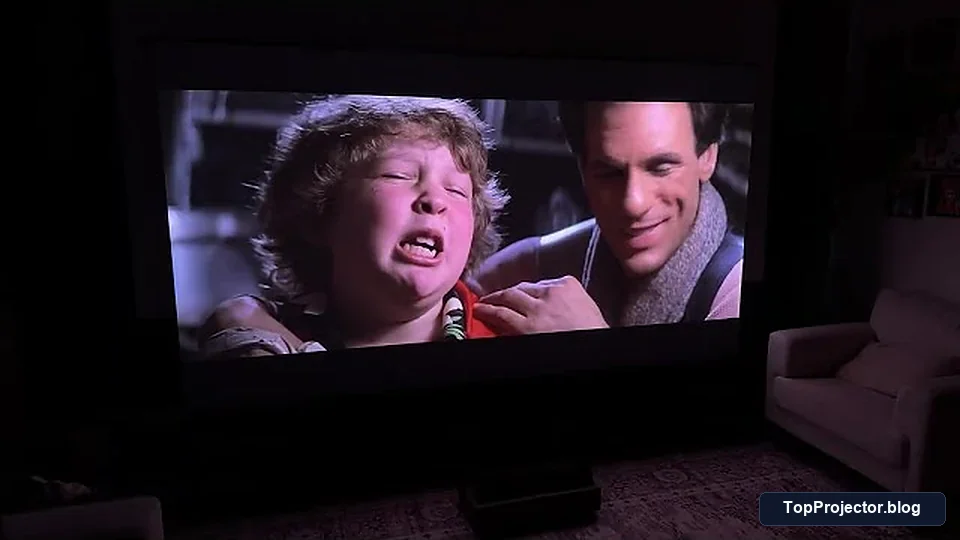
When pairing a projector, checking our best acoustically transparent screen guide helps maintain a 1.0 gain surface while hiding center channel speakers behind the fabric.
Standard flat-panel displays easily overcome bright living rooms via 2,000 nits of peak luminance. Conversely, projectors struggle without dedicated Ambient Light Rejecting screen materials to diffuse overhead environmental glare.
- Televisions maintain deep contrast in brightly lit family rooms.
- Projectors require dedicated light control or specialized ambient light rejecting screens.
- Windows directly opposite projection screens severely degrade color saturation.
- Target specialized ALR material featuring advanced angular reflection profiles for bright living spaces to guarantee optimal daytime contrast performance without washing out.
- Maintain strict control over motorized window shades throughout the day to prevent unwanted natural light from washing out dark shadow performance.
Pitch-Black Theater vs Living Room Daylight
In controlled basement environments, projectors excel by eliminating ambient wash. Light control transforms standard white walls into immersive cinematic canvases.
Living rooms with uncontrolled windows make standard projection nearly impossible. Specialized ALR materials help, but televisions remain the practical choice for daytime viewing.
- Basement theaters maximize projector contrast ratios.
- Daytime living rooms demand high-nit television panels.
Controlling Environmental Lux Levels
Measuring room lighting in lux helps determine whether a standard white screen or a specialized micro-serrated optical material is required for optimal daytime viewing fidelity without washing out.
- Carefully measure ambient foot-candles using a digital meter before selecting projector output capabilities to ensure proper room matching during daytime sessions.
Black Floor Depth, Contrast Ratios, and Shadow Details
Achieving true black levels defines modern immersion. If you use portable gear, consult our tutorial on how to watch netflix on xgimi halo to maximize your native contrast.
Projectors rely on blocking light from a central lamp or laser engine. Even the best laser units struggle to match emissive black floors when room reflections bounce light back onto the screen.
OLED televisions deliver infinite contrast through self-emissive pixels yielding 0.000 nits black floors. Projectors reflect light off screens, making absolute blackness impossible when stray photons bounce around untreated white walls.
- Self-emissive pixels deliver pristine dark-scene shadow detail.
- Projector black floors are limited by ambient room reflectivity.
- Laser dimming algorithms help projectors improve perceived native contrast.
- Install absorbing velvet wall treatments around your screen to prevent unwanted light reflections from lowering critical ANSI contrast ratios.
- Advanced dynamic iris systems help modern laser projectors significantly improve perceived dark-scene performance during complex cinematic sequences in dedicated rooms.
Dark Room Contrast Reality
Even in pitch-black rooms, white screen borders reflect light back onto the projection surface. This phenomenon limits dark-room native contrast compared to modern flat panels.
High-end home theater projectors utilize dynamic iris systems to clamp down black levels during dark cinematic sequences, narrowing the visual performance gap.
- Room boundary reflections degrade native projector contrast.
- Dynamic iris systems enhance dark-scene performance.
Optimizing Dark Room Cavities
Implementing a batcave theater design with dark matte black paint absorbs stray optical scatter, dramatically enhancing perceived ANSI contrast ratios compared to traditional high-reflectivity living room environments.
- Apply black acoustic velvet on all surrounding walls immediately adjacent to the projection screen to eliminate optical reflections.
Peak Brightness, Screen Gain, and HDR Tone Mapping
High dynamic range content demands significant peak luminance for realistic specular highlights. Modern TVs routinely push past 1500 nits, making explosions and sun glints exceptionally vibrant.
Home theater projectors measure output in ANSI lumens, rarely matching television nit output across massive 130-inch canvases. Tone mapping is crucial to preserve highlight detail.
Projectors process High Dynamic Range signals by compressing luminance curves. Evaluating optimal dimensions via our screen size and viewing distance calculator helps prevent severe hotspotting artifacts during playback.
- Televisions deliver superior specular highlight intensity for HDR.
- Projectors spread finite lumens across enormous surface areas.
- Advanced laser engines provide stable long-term light output.
- Powerful dynamic tone mapping processors analyze incoming video frames continuously to establish optimal white clipping points during playback.
- High-output solid-state laser light engines routinely exceed 3,000 ANSI lumens to properly illuminate larger screen setups in mixed-light environments.
Screen Gain and Viewing Cone Trade-offs
Using high-gain projection screens increases center brightness but narrows the effective viewing cone. Viewers seated off-axis will experience noticeable brightness drop-off and color shifting.
Televisions maintain uniform brightness and color accuracy across extreme 178-degree viewing angles without optical compromises or hot-spotting artifacts.
- Gain screens boost center brightness at the cost of viewing angles.
- Flat panels guarantee uniform off-axis color fidelity.
Screen Gain Versus Viewing Cone Tradeoffs
Selecting a negative gain screen improves black levels in controlled environments, while positive gain amplifies center-cone luminance at the direct expense of off-axis color accuracy and uniform brightness distribution.
- Carefully calculate your viewing distance relative to screen gain characteristics to prevent noticeable optical hot-spotting issues.
Cinema-Scale Image Size and Immersive Field of View
True cinematic immersion requires filling your peripheral vision. While large televisions exist, they become exceptionally heavy, expensive, and difficult to transport through standard doorways.
A home theater projector effortlessly scales from 120 to 150 inches. For reference, read our detailed epson 5050ub projector review to see how a premium optical engine delivers phenomenal performance.
Achieving a cinematic 40-degree field of view requires massive screen dimensions exceeding one hundred inches. Televisions become exponentially more expensive at these scales, whereas ultra-short-throw projectors deliver immense sizing economically.
- Projectors provide unmatched field-of-view immersion.
- Large televisions present severe logistical and weight challenges.
- Cinematic aspect ratios look exceptionally grand on massive screens.
- Calculate exact throw distance measurements carefully prior to purchasing to ensure proper pixel density coverage across the surface.
- Premium anamorphic lens setups unlock true 2.35:1 aspect ratio movie viewing without annoying black letterbox bars appearing onscreen.
The Scale Versus Clarity Equation
Stepping up to massive image sizes magnifies source resolution flaws. 4K content remains essential when projecting onto screens exceeding 120 inches diagonal.
Televisions maintain incredible pixel density at smaller sizes, but they cannot replicate the visceral physical scale of a dedicated projection screen.
- Large projection requires pristine 4K source material.
- Projectors win decisively on sheer cinematic scale.
Calculating Optimal Seating Distances
THX recommendations suggest sitting closer to large projection screens to maximize immersion, but pushing past 120 inches demands higher source resolutions to prevent pixel grid visibility from distracting viewers.
- Always verify that the chosen projector throw ratio matches your available room depth before mounting equipment.
Viewing Angles, Uniformity, and Off-Axis Reflections
Panel uniformity affects how clean solid color fields appear across the display. Televisions feature uniform backlighting or emissive pixels, minimizing dirty screen effect or vignetting.
Projectors depend heavily on pristine lens optics and screen flatness. Any warping in motorized tensioned screens can introduce slight geometric distortion or brightness non-uniformity.
Flat-panel displays maintain stable color fidelity across extreme off-axis viewing positions. Conversely, high-gain projection setups suffer from severe brightness drop-off and color shift when observers sit outside the central cone.
- Flat panels offer superior panel and color uniformity.
- Projectors require careful lens focus and optical calibration.
- Screen tensioning is vital to prevent permanent wrinkles.
- Standard matte white projection screens offer broad 160-degree viewing angles without introducing noticeable color shifting for side-seated viewers.
- Detailed screen uniformity testing reveals edge-to-edge brightness variations that are completely typical in large projection optics.
Multi-Viewer Seating Geometry
Wide home theater seating arrangements test display viewing limits. Flat panels allow every seat in the room to enjoy identical contrast and color saturation.
Standard projection setups require careful consideration of screen gain to ensure side-seated viewers do not experience washed-out images or severe hot-spotting.
- Side seating benefits from flat-panel wide viewing angles.
- Projector placement requires calculating optimal seating cones.
Mitigating Off-Axis Brightness Falloff
Choosing a Lambertian diffusion surface ensures uniform light dispersion across wide seating arrangements, preventing guests seated on the extreme left or right from experiencing washed-out images or severe solarization.
- Strictly avoid high-gain optical coatings when designing home entertainment spaces featuring exceptionally wide multi-row room layouts.
Motion Handling, Input Lag, and Console Gaming Performance
Modern gaming requires lightning-fast responsiveness and high refresh rates. Gaming televisions feature sub-10ms input lag, variable refresh rate support, and rapid pixel response times.
Home theater projectors have made huge strides in gaming latency, but many models still lag behind televisions regarding high-refresh-rate 4K console compatibility and motion blur reduction.
Modern gaming monitors and televisions feature near-instantaneous pixel response times alongside sub-10ms input lag. Projectors often introduce higher latency unless specific low-latency gaming modes are engaged by the user.
- Televisions dominate competitive fast-twitch console gaming.
- Modern laser projectors offer low-latency game modes.
- Motion interpolation settings help smooth out cinematic frame rates.
- Native high refresh rate support ensures exceptionally smooth motion tracking during fast-paced competitive multiplayer first-person shooter matches.
- Aggressive frame interpolation processing introduces undesirable visual artifacting commonly known as the soap opera effect during movies.
Immersive RPG Gaming on Big Screens
While competitive shooters favor gaming monitors or TVs, role-playing games look stunning on a massive projector screen. The sheer scale outweighs minor latency differences for casual titles.
High-end projectors now include dedicated low-latency modes that strip out heavy video processing to keep competitive twitch gaming responsive and smooth.
- Cinematic RPGs shine on large projection screens.
- Dedicated low-latency modes improve projector gaming response.
Minimizing Latency for Competitive Gaming
Disabling heavy image processing pipelines on modern laser projectors drops input lag down to 15 milliseconds, making them exceptionally viable for casual console gaming on massive 120-inch displays without noticeable delays.
- Always check for native 4K/120Hz HDMI 2.1 input compatibility to ensure next-generation console gaming performance.
Physical Installation, Throw Ratios, and Long-Term Maintenance
Setting up display hardware involves vastly different physical commitments. Televisions are straightforward to mount on walls or place on media consoles with minimal calibration.
Projectors require precise throw ratio calculations, ceiling mounts, lens shift adjustments, and meticulous screen alignment to achieve a perfectly rectangular image.
Permanent television mounts require precise wall stud alignment but demand zero ongoing upkeep. Projectors involve complex ceiling placement calculations, precise throw ratio alignments, and periodic filter cleanings to prevent overheating failures.
- Televisions offer plug-and-play installation simplicity.
- Projectors demand precise optical geometry and throw calculations.
- Lamp replacements or laser engine lifespans must be factored in.
- Solid-state laser light sources completely eliminate expensive mercury bulb replacement cycles over many years of operation.
- Robust motorized lens shift capabilities significantly simplify physical image alignment procedures during complicated ceiling mount installations.
Ultra-Short-Throw Projector Alternatives
Ultra-short-throw projectors sit inches from the wall, bridging the gap between traditional projectors and large televisions while simplifying complex ceiling installations.
These specialized units pair exceptionally well with ambient light rejecting floor-rising screens, offering big-screen immersion without running cables through ceilings.
- UST projectors eliminate complex ceiling mounting.
- Floor-rising ALR screens complete modern living room setups.
Calculating Precise Throw Ratios
Multiplying the screen width by the projector's throw distance ratio determines exact placement limits, preventing costly mounting mistakes that require awkward digital keystone correction and degrade native resolution fidelity.
- Account for the exact optical lens shift range when planning permanent projector placement locations across your ceiling.
Frequently Asked Questions
Can I use a home theater projector in a room with windows?
Yes, but you will need specialized ambient light rejecting screens and high-lumen laser light engines to combat daytime washout. For truly bright living rooms, a large television remains far more practical.
Do projectors require more maintenance than flat-panel televisions?
Traditional lamp-based projectors require periodic bulb replacements every few thousand hours. Modern laser projectors and televisions offer virtually maintenance-free lifespans exceeding twenty thousand operating hours.
Why do televisions look brighter than projectors of the same lumen rating?
Televisions measure output in nits directly to your eyes, whereas projectors reflect light off a massive surface area. This fundamental optical difference makes television HDR punch feel significantly more intense.
Are projectors suitable for competitive fast-paced video gaming?
While modern home theater projectors feature low-latency game modes, competitive gamers generally prefer gaming televisions for their superior refresh rates and sub-10ms response times.
What is the primary advantage of choosing a projector over a TV?
The ultimate benefit is unmatched cinematic scale and immersion. Projectors effortlessly deliver theater-sized 120-inch visuals that flat-panel TVs cannot match economically.