Theater Room Tv vs. Projector: Which Wins for Your Room?
Choosing between flat-panel displays and optical projection depends entirely on ambient light control and screen size desires. Mastering these optical tradeoffs ensures cinematic fidelity in any room.
For bright living rooms, a Theater Room Tv dominates with high peak brightness. For dedicated black-out caves, a Projector provides unmatched cinematic scale and true film immersion.
Compare full category rankings in our Best Projector For Tabletop Gaming: Top Picks.
Side-by-Side Specification Breakdown
| Criteria | Theater Room Tv | Projector | Edge |
|---|---|---|---|
| Ambient Light Rejection | Superior panel filters reject 90% of overhead light. | Requires ALR screen fabric or total darkness. | Theater Room Tv |
| Black Levels & Perceived Contrast | Deep native black floors with local dimming zones. | Dependent on room reflections and native optical contrast. | Theater Room Tv |
| Peak Brightness & HDR Punch | Exceeds 1500 nits for searing specular highlights. | Typically ranges from 1500 to 3000 ANSI lumens. | Theater Room Tv |
| Screen Size & Immersion | Capped practically at 85 to 98 inches for most homes. | Easily scales from 120 to 150 inches diagonally. | Projector |
| Viewing Angles & Uniformity | Maintains vivid color off-axis with zero drop-off. | Subject to hot-spotting or viewing cone constraints. | Theater Room Tv |
| Gaming Motion & Input Lag | Sub-10ms input lag with blistering 120Hz refresh rates. | Modern lasers hit 15-20ms lag at 4K/60Hz. | Theater Room Tv |
| Room Setup & Maintenance | Simple wall-mounting with zero optical alignment needed. | Requires precise throw calculations and lens shift. | Theater Room Tv |
Optical Physics Under Ambient Light vs. Controlled Darkness
Evaluating display technologies starts with how they handle environmental photons. Emissive displays generate their own light directly toward the viewer, making them immune to moderate room illumination.
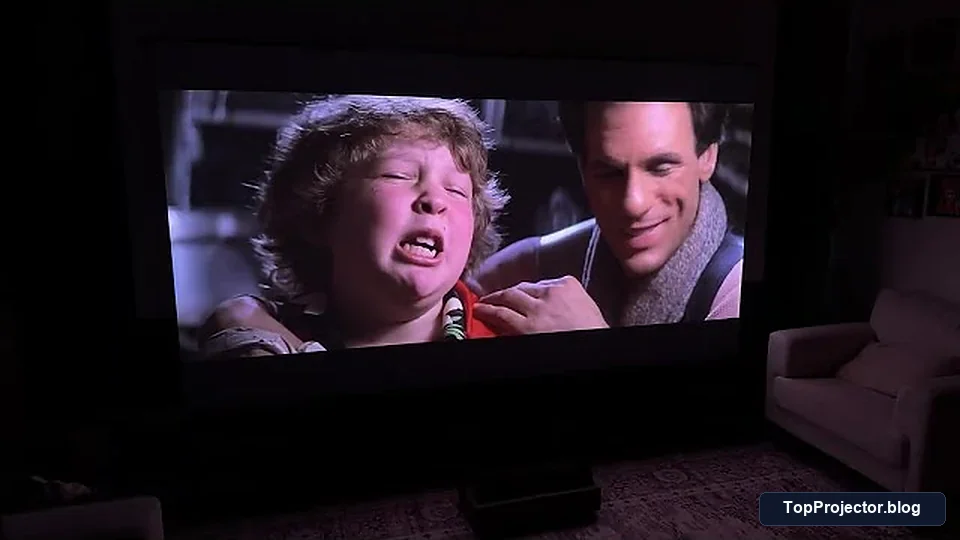
Conversely, projection systems reflect light off a secondary surface. Any stray ambient light hitting that screen washes out contrast, destroying dynamic range and shadow fidelity instantly.
Projectors rely entirely on reflected ambient light, making ceiling bounce and wall reflections critical enemies of contrast in untreated living rooms with white surfaces, unlike self-emissive televisions that dominate ambient spaces.
- Emissive panels maintain black saturation in sunlit rooms.
- Projectors require specialized ALR screens to combat ceiling glare.
- Controlling room lighting shifts the performance balance dramatically.
- Specialized ALR fabric screens reject up to ninety percent of ambient ceiling illumination, drastically rescuing washed-out contrast ratios during daytime viewing without requiring total room blackout curtains.
- Traditional white matte projection screens demand absolute darkness caves featuring dark velvet wall treatments to prevent secondary optical reflections from seriously degrading your native ANSI contrast performance.
Pitch-Black Theater vs. Living Room Daylight
In a dedicated light-controlled vault, reflection ceases to be an issue. High-end laser projectors deliver breathtaking cinematic immersion that flat panels simply cannot replicate.
Daylight environments demand aggressive gain screens or high-output panels. Without light control, projection loses its punch while flat panels maintain piercing brightness.
- Dark rooms let projectors shine with organic film grain.
- Daylight rooms choke projection contrast without high gain.
The Role of Lumen Output in Mixed-Light Environments
Achieving punchy daytime images requires exceeding 3000 ANSI lumens from high-output laser engines. Use our ansi lumens room calculator to determine exact brightness requirements for your specific living room.
- High-lumen laser engines often compromise native black levels, forcing optical iris adjustments to maintain cinematic depth during dark movie scenes viewed in mixed-light spaces.
- Ambient light-rejecting materials reduce off-axis glare, but they introduce narrow viewing cones that severely restrict seating arrangements compared to wide-angle flat-panel televisions.
Black Floors, Native Contrast, and Shadow Detail Performance
Achieving deep black levels defines modern cinematic realism. Flat panels utilize microscopic pixel dimming or advanced local dimming zones to achieve near-infinite native contrast ratios.
Projectors struggle more with black floors because ambient room reflections bounce off white walls. Models like those analyzed in our epson 2350 projector review demonstrate strict native contrast limits under bright conditions.
Televisions achieve near-infinite black levels using organic pixel dimming, whereas even high-end projectors struggle with grey black floors caused by residual light leakage through DLP or LCoS panels.
- Local dimming zones minimize blooming around bright objects.
- Projector black levels rely heavily on room paint reflectivity.
- Shadow detail suffers when ambient light contaminates the optical path.
- Advanced dynamic iris systems help compensate for native optical limitations, but they can introduce noticeable pumping artifacts during high-contrast transitions within demanding cinematic sequences.
- Shadow detail differentiation requires precise gamma calibration to prevent dark cinematic scenes from crushing into indistinguishable black masses across standard projector setups.
Evaluating ANSI Contrast Versus On-Off Measurements
ANSI contrast tests mixed checkerboard patterns, challenging optical engines. Flat panels easily maintain high ANSI contrast regardless of room wall colors.
Projectors suffer from intra-image light scatter in untreated rooms. Light bounces off bright screen areas and degrades adjacent dark shadow regions.
- Checkerboard test patterns reveal real-world intra-image contrast.
- White walls destroy projector ANSI contrast performance.
LCoS Versus DLP Native Contrast Capabilities
High-end LCoS optical engines naturally deliver superior native contrast ratios exceeding 5000:1, easily outperforming standard single-chip DLP projectors that rely on fast color wheels.
- Single-chip DLP projectors excel at motion clarity and sharp pixel alignment, but their native black levels remain inferior to premium LCoS competitors in dark environments.
- Native contrast performance dictates how convincingly a display renders deep night scenes without washing out subtle atmospheric fog surrounding central cinematic actors.
Massive Screen Geometries, Viewing Distances, and Scale Immersion
Human cinematic immersion correlates directly to visual field occupation. While large televisions have grown increasingly affordable, they hit a severe logistical wall past ninety-eight inches.
Projectors easily scale to 120 inches and beyond without structural wall reinforcement. This massive canvas delivers true commercial movie theater scale inside residential basements.
Projectors effortlessly scale beyond 120-inch diagonals, delivering true cinematic immersion that flat-panel televisions cannot match without incurring prohibitive manufacturing costs and structural reinforcement hurdles.
- Television transport is restricted by standard residential doorways.
- Projection screens roll up or assemble easily in tight spaces.
- Wider fields of view dramatically elevate science fiction and action films.
- SMPTE and THX immersion recommendations suggest a wide forty-degree field of view, which requires massive projection screen sizes that dwarf standard living room televisions.
- Calculating correct seating distances prevents individual pixel visibility while maintaining optimal angular resolution across ultra-large cinemascope aspect ratio screen setups.
Calculating Throw Ratios and Room Dimensions
Standard throw ratios require significant distance between lens and screen. Ultra-short-throw models sit inches away, solving space constraints in urban living rooms.
Calculating precise seating distances prevents pixel visibility. A 135-inch projection screen requires sitting at least ten feet away for optimal pixel blending.
- Ultra-short-throw units rest directly on media consoles.
- Long-throw models demand dedicated ceiling mount brackets.
Cinemascope Versus 16:9 Screen Format Math
Choosing an ultra-wide 2.40:1 screen eliminates annoying black letterbox bars on blockbuster movies, but it requires motorized masking or anamorphic lenses to handle standard television content.
- Advanced masking systems prevent ambient light scatter from illuminating unused screen borders during mixed-format viewing sessions in dedicated home theater rooms.
- Standard sixteen-by-nine screens remain superior for mixed console gaming and television broadcasts, avoiding the annoying side pillarboxing issues inherent to cinematic ratios.
Color Gamut Volume, HDR Metadata Handling, and Peak Luminance
High dynamic range content pushes displays to their absolute limits. Televisions easily generate 1500+ nits of peak brightness, mapping HDR specular highlights with dazzling intensity.
Projectors rely on lumens rather than nits, spreading light over huge surfaces. Consequently, HDR tone mapping on projectors requires careful calibration to avoid muddy highlights.
Projectors often struggle to hit 100% DCI-P3 coverage without engaging color filters that severely reduce peak lumen output, complicating HDR tone mapping in bright rooms.
- Wide color filters expand projector gamuts to match DCI-P3.
- Panel backlights deliver instantaneous specular punch for HDR.
- Projectors utilize dynamic tone mapping to preserve bright scene details.
- Advanced dynamic tone mapping algorithms analyze incoming metadata frame-by-frame to optimize highlight clipping specifically for projectors with limited peak brightness capabilities.
- Modern televisions deliver true specular highlights exceeding one thousand nits, whereas most home theater projectors max out around one hundred nits on massive screens.
Laser Phosphor Engines Versus RGB LED Light Sources
Modern laser projection utilizes solid-state phosphor wheels to boost color longevity. These engines maintain consistent brightness across thousands of operational viewing hours.
Traditional lamp-based projectors dim rapidly, requiring expensive bulb replacements every few thousand hours. Laser technology ensures maintenance-free operation for a decade.
- Laser engines eliminate traditional lamp replacement cycles.
- Phosphor wheels deliver vibrant greens and reds reliably.
Laser Phosphor vs. RGB Laser Color Purity
Modern triple-laser RGB engines achieve wider color volumes without needing brightness-sapping filters, delivering stunning wide color gamuts that rival high-end reference televisions.
- Laser speckle can occasionally introduce subtle texture artifacts on standard matte white screens, requiring specialized vibrating screens to smooth out the image.
- Wider color gamuts enhance animated film realism, but they demand careful calibration to prevent human skin tones from appearing oversaturated during live-action content.
Competitive Input Lag, Refresh Rates, and Motion Processing
Modern gaming requires responsive displays with minimal latency. Choosing the best projector for tabletop gaming ensures sub-16ms input lag for instant controller registration during fast-paced competitive sessions.
Most consumer projectors run between 15ms and 40ms of input lag. While acceptable for casual gaming, twitch-reaction titles feel slightly sluggish compared to gaming monitors.
Modern gaming projectors now achieve competitive input lag below 15ms at 4K/60Hz, bridging the historical responsiveness gap between massive projection systems and fast desktop monitors.
- High refresh rates up to 120Hz smooth out fast motion.
- Black frame insertion reduces motion blur on premium panels.
- Projectors handle 24p cinema cadence naturally without stutter.
- High refresh rate support up to two hundred forty hertz at 1080p ensures ultra-smooth competitive gaming performance for twitch-reaction titles played on huge screens.
- Advanced frame interpolation algorithms reduce cinematic judder during panning shots, but purists disable these motion smoothing settings to avoid artificial soap-opera effects.
Console Gaming and Cinematic Motion Cadence
Consoles like PlayStation 5 leverage variable refresh rates seamlessly. Televisions handle VRR natively across wide windows, preventing screen tearing during intense action.
Projectors increasingly support low-latency gaming modes at 4K resolution. However, high refresh rate support remains less common on standard cinema models.
- VRR eliminates stutter in demanding open-world games.
- Cinema motion interpolation removes judder from 24fps movies.
HDMI 2.1 Bandwidth and VRR Implementation
Full 48Gbps HDMI 2.1 ports enable variable refresh rate technology, preventing screen tearing during intense gaming sessions with fluctuating console frame rates.
- Auto low latency mode switches display profiles instantly when launching compatible PlayStation or Xbox titles, optimizing system responsiveness without manual menu adjustments.
- Hardware bandwidth limitations in older projector models often force chroma subsampling compromises that slightly blur fine desktop text and UI elements.
Structural Integration, Throw Ratios, and Room Geometry
Physical installation complexity varies wildly between these two display formats. Wall-mounting a television requires heavy-duty stud finders and precise height alignment.
Projectors demand meticulous optical geometry calculations. Lens shift, keystone correction, and throw distance must align perfectly to avoid geometric distortion.
Modern ultra-short throw UST projectors eliminate ceiling mounting complexities by sitting mere inches from the wall, transforming traditional media rooms without running cables overhead.
- Vertical and horizontal lens shift ease physical placement.
- Keystone correction degrades image resolution and should be avoided.
- Acoustic transparency lets speakers hide behind woven projector screens.
- Calculating precise throw ratios ensures the projected image fills your screen boundary perfectly without requiring excessive digital keystone correction that degrades resolution.
- Traditional ceiling-mounted standard throw units require careful structural joist location and precise lens shift adjustments to achieve correct geometric image alignment.
Acoustic Transparency and Concealed Speaker Placement
Dedicated theaters utilize acoustically transparent screens. This allows front soundstage speakers to sit directly behind the image, anchoring dialogue to actor mouths.
Televisions force speakers to flank the display panel. Sound localization feels less natural compared to true center-channel placement behind a woven screen.
- Woven projection screens pass high frequencies cleanly.
- Center channel placement improves movie dialogue realism.
Lens Shift Flexibility vs. Keystone Correction Limits
Optical lens shift moves the projected image physically without losing pixels, whereas digital keystone correction degrades resolution and lowers native contrast performance.
- Extensive horizontal and vertical lens shift capabilities provide immense installation flexibility, letting you place your projector off-center from the screen.
- Rigid room geometry in older residential homes often mandates compromise placement solutions that rely on digital correction tools despite their optical drawbacks.
Ultimate Scenario Verdicts for Dedicated Spaces vs Living Rooms
Selecting the right display format depends on your room architecture. Multi-purpose living rooms flooded with natural daylight overwhelmingly favor the punchy brightness of a flat panel.
Dedicated subterranean home theaters with dark velvet walls reward optical projection. The massive scale creates an authentic cinematic experience that flat screens cannot touch.
Dedicated dark theaters heavily favor large-format projectors paired with acoustically transparent screens, maximizing both visual immersion and multi-channel audio staging for cinematic experiences.
- Choose a television for everyday family room viewing.
- Choose a projector for dedicated weekend movie nights.
- Analyze your room lighting before making a final investment.
- Bright multi-purpose living rooms benefit immensely from giant flat-panel televisions that conquer ambient daylight without requiring specialized lighting control or motorized screens.
- Hybrid setups utilizing ultra-short throw lasers and ALR screens offer a compelling compromise for users wanting massive screen sizes in mixed-light environments.
Making Your Final Display Technology Selection
Balance your viewing habits between casual streaming and cinematic movie nights. Reviewing guides on how to use hdmi on laptop to projector guarantees seamless source connectivity for your primary use case.
Consult professional installation guidelines to verify throw distances and ambient light levels. Proper planning guarantees breathtaking visual performance for years ahead.
- Weigh your percentage of daytime versus nighttime viewing.
- Consult throw calculators before purchasing projection gear.
Cost-Per-Inch Economics in Large Displays
Projection systems offer unbeatable cost-per-inch value once image sizes exceed eighty-five inches, making them vastly more economical than ultra-large consumer flat-panel televisions.
- Television manufacturing costs scale exponentially above ninety-eight inches, whereas projector hardware prices remain relatively stable across massive image diagonal increases.
- Total cost of ownership must factor in costly lamp or laser diode replacements alongside specialized screen purchases over the extended projector lifecycle.
Frequently Asked Questions
Can I use a projector with the lights turned on during the day?
You can use a projector in daylight if you install an ALR ambient light rejecting screen and purchase a high-lumen laser model. However, contrast will still lag behind a traditional television.
Do laser projectors require expensive replacement lamps like old models?
Modern laser and LED light engines typically last 20,000 to 30,000 hours. This eliminates the need for traditional bulb replacements during the operational lifespan of the unit.
Why do televisions look much brighter than projectors in side-by-side tests?
Televisions are self-emissive panels generating high nit counts directly into your eyes. Projectors reflect light off a surface, making them vulnerable to ambient room reflections.
Is input lag on modern projectors low enough for competitive gaming?
Most modern gaming projectors achieve 15 to 20 milliseconds of input lag at 4K/60Hz. While great for casual play, competitive gamers may prefer sub-10ms television panels.
What is the primary advantage of ultra-short-throw projectors?
Ultra-short-throw models sit inches from the wall, eliminating shadow obstructions and complex ceiling mounting requirements in standard living rooms.