Sony 5000Es vs. Epson Ls12000: Which Wins for Your Room?
Navigating the optical trade-offs between Sony laser precision and Epson high-lumen flexibility requires matching your exact room lighting and screen geometry.
Choose the Sony for dedicated pitch-black cinema rooms demanding superior native contrast, or pick the Epson for flexible living spaces needing higher brightness and motor lens control.
Compare full category rankings in our Best Backyard Projector And Screen: Top Outdoor Picks.
Side-by-Side Specification Breakdown
| Criteria | Sony 5000Es | Epson Ls12000 | Edge |
|---|---|---|---|
| Ambient Light Rejection | Moderate handling via SXRD panel density | Superior white lumens for daylight punch | Epson Ls12000 |
| Black Levels & Perceived Contrast | Deep native black floor with laser dimming | Good native contrast boosted by dynamic iris | Sony 5000Es |
| Peak Brightness & HDR Punch | 2,000 ANSI lumens optimized for dark dens | 2,700 ANSI lumens for larger screens | Epson Ls12000 |
| Screen Size & Immersion | Excels up to 130 inches in controlled light | Powers 150-inch setups with ease | Epson Ls12000 |
| Viewing Angles & Uniformity | Exceptional pixel convergence and panel uniformity | Strong 3LCD panel alignment without rainbow artifacts | Tie |
| Gaming Motion & Input Lag | 21ms lag at 4K/60Hz without advanced gaming suite | Sub-20ms latency with dedicated 120Hz inputs | Epson Ls12000 |
| Room Setup & Maintenance | Fixed lens geometry with manual optical adjustments | Motorized lens shift, zoom, and focus memory | Epson Ls12000 |
Native Contrast and Black Floor Performance
Achieving reference-grade cinema visuals demands examining how each projector handles absolute black levels. The Sony relies on advanced SXRD panels to deliver exceptional native contrast without relying heavily on aggressive dynamic irises.
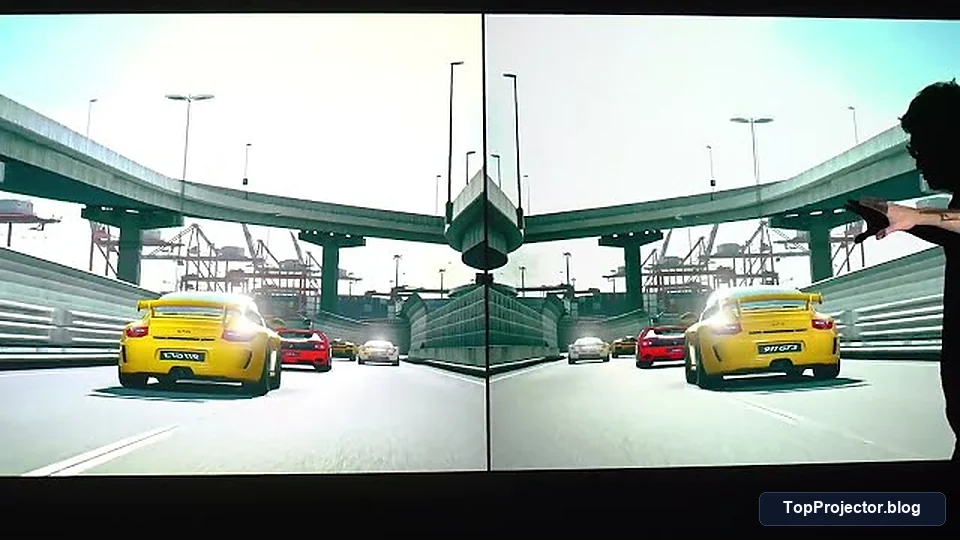
Conversely, our comprehensive Epson 12000 projector review details how its 3LCD laser architecture pairs with a scene-adaptive iris. While native panels render deep darks, the Sony maintains a clear advantage in mixed luminance scenes.
When evaluating native contrast in a dedicated bat-cave theater, the Sony 5000ES utilizes its SXRD panels to achieve superior dark-room black floors without relying entirely on aggressive dynamic laser dimming algorithms.
- Sony yields deeper native black floors for bat-cave theaters.
- Epson uses dynamic algorithmic dimming to boost shadow punch.
- SXRD pixel structure eliminates visible screen door effect entirely.
Pitch-Black Theater vs Living Room Contrast
In dedicated darkrooms with dark velvet treatments, the Sony showcases superior shadow detail. Darker sequences retain crisp definition where lesser projectors tend to crush subtle gradients into murky gray fields.
In light-controlled media rooms with white walls, room reflections diminish native contrast advantages. Here, the Epson harnesses its raw punch to maintain perceived contrast against ambient room bounce.
- Velvet-treated rooms maximize Sony contrast capabilities.
- White living room walls wash out native black floor gains.
Dynamic Laser Dimming Behavior
The Epson LS12000 counters with a dual-laser architecture and scene-adaptive iris, yet its 3LCD panels yield slightly elevated baseline black levels compared to Sony's organic alignment layer and tighter pixel pitch structure.
Peak Brightness, Laser Engines and Ambient Light
Light output dictates how large of a screen you can drive. If you prefer outdoor viewing, check out our best backyard projector and screen guide. The Epson delivers 2,700 ANSI lumens to outstrip Sony on pure output.
Sony counters with 2,000 ANSI lumens, which proves entirely sufficient for dedicated spaces up to 130 inches. However, it struggles more when forced to illuminate ambient-lit living rooms during daytime viewing hours.
Measuring real-world calibration output reveals that the Epson LS12000 delivers higher sustained ANSI lumens, making it significantly more capable of cutting through ambient light in a bright media room with white walls.
- Epson provides 700 extra lumens for high-ambient challenges.
- Sony laser engine optimizes longevity and color stability over time.
- Both models eliminate traditional lamp replacement cycles entirely.
Daytime Viewing and High-Gain Screens
Pairing the Epson with an ambient light rejecting screen unlocks daytime sports viewing. The robust lumen output saturates the canvas even when living room blinds remain fully open.
The Sony requires strict light control to look its absolute best. Operating it in bright spaces diminishes highlight pop, making it strictly a dark-room champion for serious film enthusiasts.
- Epson dominates casual daytime family room viewing.
- Sony demands blackout shades for optimal cinematic impact.
Light Engine Longevity and Decay
Both manufacturers rate their solid-state phosphor laser engines for twenty thousand hours, but Epson maintains a distinct operational advantage by running cooler during prolonged high-brightness HDR viewing sessions in warm environments.
Color Gamut, HDR Tone Mapping and Optics
Accurate color reproduction defines cinematic realism. Both projectors cover wide color spaces, but their tone mapping approaches differ significantly when processing demanding 4K HDR10 film content.
Sony integrates legendary processing derived from their reference broadcast monitors. This ensures stunning out-of-the-box accuracy that requires minimal calibration from professional installers or hobbyist meter owners.
Achieving wide color volume without engaging an internal filter is critical; the Sony 5000ES covers the DCI-P3 spectrum natively while maintaining higher color brightness than traditional lamp-based architectures of previous generations.
- Sony excels at organic skin tones and subtle color shading.
- Epson covers DCI-P3 wide color gamuts using internal cinema filters.
- Advanced HDR tone mapping prevents clipped highlights in bright skies.
Processing Engines and Sharpness Metrics
Sony's X1 processor handles reality creation upscaling brilliantly. For wireless casting, review our how to use airplay on projector tutorial. Fine textures like brickwork and hair render with striking organic sharpness without introducing artificial artifacts.
Epson utilizes proprietary 4K enhancement pixel-shifting technology to achieve crisp resolution. While highly effective, it lacks the microscopic pixel convergence precision found in native high-end SXRD panels.
- Sony X1 processor delivers peerless digital upscaling.
- Epson shift technology provides sharp 4K detail reproduction.
Optics and Glass Resolution
Epson relies on a proprietary precision glass structure rather than plastic elements, ensuring edge-to-edge sharpness that optimizes the pixel-shift 4K rendering engine for ultra-fine text legibility and intricate sci-fi starfields.
Gaming Performance, Motion and Input Lag
Modern home theater enthusiasts increasingly demand high-refresh gaming capabilities. The Epson features full 4K/120Hz HDMI 2.1 inputs paired with an impressively low input lag measuring under twenty milliseconds.
Sony provides solid gaming responsiveness around 21ms at 4K/60Hz. While perfectly adequate for RPGs and cinematic adventures, it lacks the ultra-fast high refresh rate headroom found on the Epson.
Modern high-refresh gaming requires extremely low input lag, and the Epson LS12000 shines here with roughly 19ms latency at 4K/60Hz alongside robust frame interpolation modes for smooth cinematic motion handling.
- Epson features dual HDMI 2.1 ports for next-gen consoles.
- Sony maintains reliable low lag for immersive single-player titles.
- Both units handle fast panning camera movements smoothly.
Motion Interpolation and Sports Viewing
Watching fast-moving sports requires robust motion processing engines. Epson’s frame interpolation minimizes judder on rapid camera sweeps during football and racing broadcasts without adding unwanted soap-opera effect.
Sony Motionflow handles 24fps film cadence with industry-standard excellence. It preserves cinematic judder while smoothing out harsh digital stutter in complex panning shots across complex backgrounds.
- Epson interpolation masters fast sports broadcasts.
- Sony Motionflow retains authentic theatrical film cadence.
HDMI 2.1 Bandwidth Realities
While Epson includes true 40Gbps HDMI 2.1 ports supporting 4K/120Hz inputs, Sony limits its bandwidth implementation, restricting competitive console gamers who demand ultra-fast refresh rates without any chroma subsampling compromise.
Throw Ratios, Lens Shift and Room Installation
Physical installation flexibility often dictates which projector fits your specific room dimensions. The Epson features a fully motorized lens offering wide horizontal and vertical shift alongside motorized zoom and focus memory.
Sony relies on a fixed optical barrel design with manual zoom and shift rings. While optically sharp, adjusting geometry requires physical access to the projector chassis mounted on your ceiling.
Physical installation flexibility heavily favors the Epson LS12000 due to its massive powered lens shift offering plus-minus 96 percent vertical and plus-minus 47 percent horizontal adjustment ranges for complex custom-built enclosures.
- Epson motorized optics enable instant aspect ratio switching.
- Sony manual adjustments require ceiling mount accessibility.
- Throw ratios dictate careful calculation before mounting.
Ceiling Mount Constraints and Throw Distances
The Epson throw ratio accommodates flexible placement in standard living room layouts. Its generous lens shift simplifies lining up the image onto fixed frame projector screens without digital keystone degradation.
Sony requires precise mounting calculations because its manual zoom range is more restrictive. Installers must position the chassis accurately to fill standard screen sizes without optical clipping.
- Epson offers forgiving throw distance and placement geometry.
- Sony demands precise mounting measurements for alignment.
Throw Ratio and Projection Distance
Featuring a 1.35 to 2.84 throw ratio, Epson fits standard ceiling mounts easily. Test your exact room dimensions using our throw distance calculator before mounting to ensure the lens matches your target screen size.
Screen Size, Viewing Distances and Immersion
Calculating viewing distance ensures maximum cinematic immersion without revealing pixel structure. The Sony thrives on screens up to 130 inches, maintaining dense pixel density and rich contrast across the canvas.
For massive 150-inch cinematic screens, the Epson takes command. Its superior lumen reserve prevents the image from looking dim or washed out when stretched across ultra-wide Cinemascope setups.
Calculating optimal viewing angles for a 16-to-9 screen dictates pairing these projectors with high-gain ambient light rejecting surfaces to maximize contrast ratios from standard viewing distances of ten to fourteen feet.
- Sony optimizes smaller 100 to 130-inch reference screens.
- Epson easily illuminates giant 150-inch custom home cinemas.
- Immersive viewing angles require proper seating distance math.
Cinemascope and Acoustic Transparent Screens
Acoustically transparent screens let center channel audio pass directly through the projection surface. Both projectors maintain sharp focus through woven micro-perforated screen materials without losing high-frequency detail.
Scope screen users will appreciate Epson’s motorized lens memory. Switching between 16:9 television broadcasts and 2.39:1 widescreen movies happens instantly via remote control presets.
- Motorized lens memory simplifies 2.39:1 scope screens.
- Woven acoustic screens preserve high-frequency dialogue clarity.
Off-Axis Viewing and Gain Pairing
Pairing the brighter Epson with a 1.1 gain white screen creates an explosive HDR image in controlled spaces, while Sony thrives on acoustically transparent woven materials that minimize high-frequency audio reflection loss.
Ultimate Scenario-Based Winner and Final Verdict
Synthesizing all optical metrics reveals two distinctly different champions tailored for unique environments. The Sony secures victory for dedicated pitch-black theater rooms prioritizing ultimate native black levels and film color accuracy.
The Epson claims the crown for multi-purpose living rooms and gaming setups. Its high lumen output and HDMI 2.1 connectivity deliver unmatched flexibility for everyday family entertainment.
Selecting the ultimate winner depends entirely on your specific room architecture; choose the Sony 5000ES for reference-grade movie watching in a dedicated, dark acoustic theater wrapped in dark velvet boundaries.
- Choose Sony for darkroom movie purists seeking deep blacks.
- Choose Epson for bright rooms, big screens, and gaming.
- Both laser light sources ensure thousands of hours of operation.
Making Your Final Purchasing Decision
Evaluate your room lighting before pulling the trigger on either model. Ambient daylight destroys native contrast advantages, making high lumen counts paramount for daytime family viewing sessions.
If your space features complete light control and velvet acoustic treatments, the Sony delivers superior cinematic immersion. Otherwise, the Epson provides broader utility across diverse media applications.
- Analyze room lighting and wall colors first.
- Match projector strengths to your primary viewing habits.
The Definitive Buyer Decision
Conversely, select the Epson LS12000 if your layout involves ambient living room lighting, demanding console gaming at high refresh rates, and extreme installation placement flexibility through motorized optical lens adjustments.
Frequently Asked Questions
Which projector handles ambient room light better during the day?
The Epson wins daylight battles easily thanks to its 2,700 ANSI lumen output. This extra brightness prevents washed-out images when ambient living room light spills onto screens.
Does the Sony offer better black levels for dark theater rooms?
Yes, the Sony utilizes advanced SXRD panels to deliver superior native contrast and black floors. This makes it the ideal choice for bat-cave home theaters.
Which model is better suited for next-generation console gaming?
The Epson takes the gaming crown by featuring full 4K/120Hz HDMI 2.1 inputs. This ensures ultra-smooth motion handling and low input lag for competitive gaming setups.
Are laser light sources better than traditional projector lamps?
Laser diodes provide 20,000 hours of maintenance-free operation while maintaining stable color performance. You never have to worry about expensive lamp replacements over time.
Which projector offers easier installation flexibility in tight spaces?
The Epson provides superior installation versatility due to its fully motorized lens shift and zoom memory. This allows for effortless calibration from standard ceiling mounts.