Short Throw vs. Standard Projector: Which Wins for Your Room?
Short Throw and standard projection architectures demand completely different spatial planning. Choosing the right optical engine dictates your ambient light rejection and ultimate home theater immersion.
Choose Short Throw for bright living rooms utilizing specialized ALR screens, while standard throw dominates dedicated black-out theaters requiring maximum throw distance flexibility.
Compare full category rankings in our Best Projector Under $200: Top Picks for Movie Nights.
Side-by-Side Specification Breakdown
| Criteria | Short Throw | Standard Projector | Edge |
|---|---|---|---|
| Ambient Light Rejection | Exceptional with ceiling-rejecting ALR | Requires dedicated dark room control | Short Throw |
| Black Levels & Perceived Contrast | Good, depends on surface grain | Superior in bat-cave environments | Standard Projector |
| Peak Brightness & HDR Punch | High lumen output for daylight | Scalable via long throw lenses | Short Throw |
| Screen Size & Immersion | Fixed up to 120-inch limits | Scalable up to 300 inches | Standard Projector |
| Viewing Angles & Uniformity | Susceptible to horizon hot-spotting | Even distribution across large throws | Standard Projector |
| Gaming Motion & Input Lag | Sub-15ms latency on flagship models | Varies widely by optical engine | Short Throw |
| Room Setup & Maintenance | Placed inches from the wall | Ceiling or rear shelf mounting needed | Short Throw |
Optical Geometries and Room Layout Realities
Short throw projectors sit mere inches from your projection surface. This ultra-tight geometry eliminates shadow interruptions from walking viewers and simplifies furniture arrangement in modern media rooms.
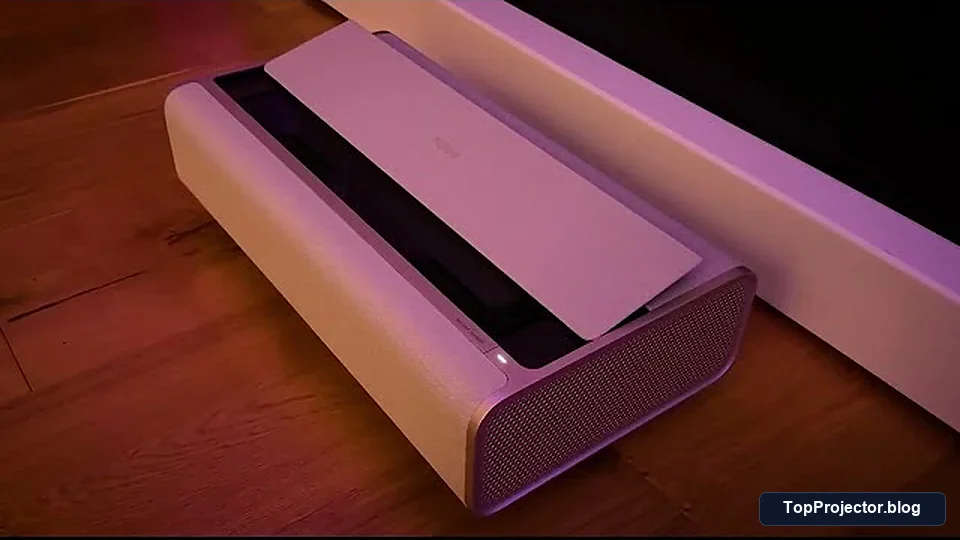
Standard projectors require generous throw distances across the room. This traditional setup demands dedicated ceiling mounts or rear shelving, but offers unmatched flexibility for variable image sizing.
Standard projectors require a throw ratio above 1.5:1, demanding careful ceiling mounts or back-shelf placements to fill a 120-inch screen without casting unwanted shadows across your home theater room.
- Short throw places hardware inches from the wall.
- Standard throw requires multi-foot throw ratios.
- Spatial constraints dictate your primary hardware choice.
- Calculate precise lens shift ranges to avoid digital keystone degradation.
- Factor in ceiling height limitations for long-throw setups.
Living Room Spatial Constraints
Modern living spaces rarely accommodate long optical paths without obstruction. Short throw systems conquer tight spaces by utilizing specialized aspheric mirrors to project massive images downward.
Standard projectors struggle in compact rooms because coffee tables and seating positions intercept the light beam. Dedicated media rooms remain the primary domain for traditional long-throw lenses.
- Aspheric mirrors bend light aggressively.
- Coffee tables block standard throw paths.
Ultra-Short Throw Math
Ultra-short throw models sit inches from the wall, featuring an aggressive throw ratio under 0.25:1 to project massive images while completely eliminating disruptive foot traffic shadows in compact living rooms.
- Ensure absolute cabinet levelness to prevent geometric skewing.
- Verify exact offset measurements before drilling wall mounts.
Ambient Light Handling and Surface Physics
Ambient light destroys perceived contrast in any projection setup. Short throw units pair exclusively with specialized fresnel screens designed to reject overhead living room illumination effectively.
Standard projectors rely on traditional white or gray matte surfaces. Without sophisticated ambient light rejection fabrics, standard setups wash out completely under typical daytime domestic lighting conditions.
Ambient light rejection screens are mandatory for ultra-short throw units, using specialized optical layers that capture overhead illumination while reflecting ANSI lumens directly toward seated viewers.
- Fresnel ALR screens rescue daytime viewing.
- Matte white walls require total darkness.
- Optical rejection changes living room usability.
- Pair high-gain white screens with dark-room standard throws.
- Avoid matte white surfaces in bright living spaces.
Daytime Living Room Performance
Daytime performance separates casual media rooms from serious home theaters. Short throw lasers output high ANSI lumens directly into upward-rejecting optical layers for punchy daytime images.
Standard throw systems cannot utilize bottom-rejecting screen materials effectively due to shallow light incidence angles. Achieving daytime clarity with standard throw requires high-gain white screens.
- High ANSI lumens combat ambient washout.
- Shallow light angles demand specialized fabrics.
Fresnel Versus Lenticular Screen Layers
Fresnel screens utilize concentric semi-circular ridges providing superior ambient light rejection from top-down living room sources compared to traditional horizontal lenticular optical surfaces.
- Match projector placement angles precisely with screen directional properties.
- Evaluate off-axis viewing cone limitations carefully.
Black Floor Dynamics and Contrast Performance
Achieving deep black levels requires strict light control. Standard projectors excel in dedicated bat-cave theaters by minimizing internal light scatter across long optical paths.
Short throw architectures bounce intense light at steep angles onto the screen. This aggressive angle occasionally introduces slight specular glare and compromises native black floor depth.
Native contrast ratios dictate shadow detail reproduction, where standard laser or lamp projectors often achieve deeper black floors than ultra-short throw counterparts due to reduced optical compromises in the light engine.
- Long throw paths reduce internal reflection.
- Steep projection angles risk surface glare.
- Dedicated theaters favor traditional optics.
- Control room reflectivity with dark wall paint and ceiling treatments.
- Measure dynamic iris engagement times during dark cinematic sequences.
Pitch-Black Theater Contrast
In absolute darkness, traditional units produce superior native contrast ratios when configured properly using our screen size and viewing distance calculator to optimize your seating layout.
Short throw units pack complex internal mirrors that can elevate black floors slightly. Enthusiasts demanding reference-grade shadow detail usually prefer standard ceiling-mounted projectors.
- Reference black floors require distance.
- Complex mirrors impact native contrast.
Laser Dimming and Dynamic Contrast
Advanced laser dimming algorithms actively modulate light output during dark scenes, pushing dynamic contrast metrics higher while occasionally introducing subtle pumping artifacts in high-contrast HDR movie content.
- Test adaptive laser modes on mixed-content test patterns.
- Disable aggressive dimming if brightness pulsing becomes distracting.
Color Fidelity, HDR Mapping, and Gamut Coverage
Modern laser engines power both throw types with impressive color volumes, perfectly complementing options found in our best projector under 200 guide to achieve wide Rec.2020 coverage for vibrant movie nights.
Standard projectors utilize dynamic iris systems to optimize HDR tone mapping across large canvases. Lamp-based standard units require regular bulb replacements to maintain accurate color calibration.
Achieving accurate Rec.709 color fidelity requires robust calibration controls, as many high-lumen standard projectors sacrifice native color volume to maximize overall peak brightness outputs for daylight viewing.
- Tri-chroma lasers deliver saturated wide gamuts.
- Dynamic irises enhance HDR tone mapping.
- Lamp degradation affects standard color accuracy.
- Verify DCI-P3 color gamut coverage percentages in spec sheets.
- Calibrate white balance targets to a strict 6500K standard.
HDR Tone Mapping Realities
High dynamic range content stresses projector processing engines. Short throw units apply aggressive tone mapping algorithms to compensate for bright living room surroundings.
Standard home theater projectors handle HDR with sophisticated lens shifts and wider native color spaces. This delivers smoother gradient steps in dark cinematic sequences.
- Aggressive tone mapping suits bright rooms.
- Sophisticated lens shifts refine gradients.
Tone Mapping Performance in HDR10
Effective tone mapping handles high dynamic range signals by preserving highlight details without crushing dark scenes, a critical capability for projectors with limited brightness ceilings compared to direct-view TVs.
- Adjust static metadata settings manually for optimal black retention.
- Compare dynamic tone mapping implementations across different firmware versions.
Motion Processing, Refresh Rates, and Input Latency
Competitive console gaming demands lightning-fast response times. Flagship short throw projectors achieve remarkably low input lag figures under 16 milliseconds at 4K resolution.
Standard home theater projectors historically prioritized cinematic motion interpolation over gaming speed. Modern models now feature dedicated gaming modes with rapid refresh rates.
Competitive gaming demands ultra-low input lag, where specialized standard-throw projectors achieve responsive sub-16ms delays at 4K/60Hz inputs, outperforming many living room entertainment models.
- Sub-16ms input lag ensures responsive gaming.
- High refresh rates reduce motion blur.
- Cinematic interpolation smooths 24fps film.
- Enable game mode settings to bypass complex video processing pipelines.
- Check maximum supported refresh rates for PC gaming rigs.
Console Gaming Immersion
Playing fast-paced titles on a massive projected screen transforms gaming immersion. Short throw setups allow players to sit close without casting shadows across the display.
Standard projectors require careful seating placement so players never block the primary light beam. Input lag performance remains comparable once dedicated gaming modes are activated.
- Close seating enhances gaming immersion.
- Shadow blocking ruins standard setups.
MEMC Frame Interpolation Trade-offs
Motion estimation and motion compensation algorithms smooth out fast camera pans during sports broadcasts, but they frequently introduce artifacting and the undesirable soap opera effect in cinematic movies.
- Disable frame interpolation entirely for 24fps movie viewing.
- Test sports mode settings to evaluate motion clarity enhancements.
Installation Precision, Alignment, and Maintenance
Physical installation complexity divides these two projector categories sharply. Short throw systems demand millimeter-precise wall placement to eliminate geometric image distortion.
Standard projectors offer generous optical zoom lenses and wide lens shift ranges. This mechanical flexibility makes ceiling alignment significantly more forgiving during setup.
Standard projectors offer generous optical zoom ranges and flexible lens shift adjustments, making physical alignment much easier than ultra-short throw units that demand micrometric wall bracket calibration.
- Millimeter precision required for short throw.
- Optical zoom eases standard ceiling mounting.
- Geometric alignment tests installer patience.
- Inspect air filters regularly to prevent overheating dust accumulation.
- Verify optical alignment using professional grid test patterns.
Alignment and Geometry Challenges
Aligning an ultra-short throw image onto a fixed frame tests professional calibration skills. Even tiny cabinet shifts distort rectangular geometry across the screen surface.
Standard throw systems utilize physical lens shift knobs to move images horizontally and vertically without digital keystone degradation. This preserves absolute pixel integrity during installation.
- Cabinet shifts distort short throw geometry.
- Physical lens shift preserves pixel integrity.
Thermal Management and Fan Acoustics
High-lumen light engines generate significant heat, requiring robust cooling fans that can elevate ambient noise levels above 30dB, directly impacting your home theater audio immersion during quiet soundtrack passages.
- Position seating distances away from rear exhaust vents.
- Monitor operating temperatures inside enclosed custom AV cabinets.
Definitive Scenario-Based Buying Recommendations
Selecting the correct projector depends on your room acoustics, especially when learning how to use a soundbar with a projector to conquer fan noise and enhance audio immersion.
Choose standard projection if you are building a dedicated, windowless home theater room. Traditional long throw optics deliver unbeatable black levels and ultimate screen scalability.
Dedicated dark-room home theaters benefit most from long-throw lamp or laser projectors paired with large acoustically transparent screens for maximum cinematic immersion and accurate color performance.
- Bright living rooms demand short throw lasers.
- Dedicated theaters reward standard long throws.
- Match optics to your room lighting profile.
- Prioritize native contrast over peak brightness for dark rooms.
- Select standard throw models for ultimate placement flexibility.
Making Your Final Choice
Evaluate your available wall space and lighting control before purchasing. Short throw units replace traditional living room televisions with minimal aesthetic disruption.
Standard projectors provide the ultimate cinematic canvas for enthusiasts prioritizing pure contrast and flexible screen sizing in controlled environments.
- Evaluate ambient light and wall space.
- Prioritize contrast for dedicated spaces.
Living Room Entertainment Deployments
Modern living rooms require ultra-short throw UST laser televisions, much like the model in our Eh Ls800W review paired with ambient light rejection screens to maintain punchy contrast ratios.
- Choose high-lumen UST units for multi-purpose daytime living spaces.
- Integrate dedicated soundbars for streamlined audio setups.
Frequently Asked Questions
Can short throw projectors completely replace a standard living room television?
Yes, pairing an ultra-short throw laser with an ALR screen delivers fantastic daytime brightness and vibrant colors that easily rival traditional flat-panel displays.
Why do standard projectors achieve better contrast in dark rooms?
Long throw distances allow internal light paths to dissipate efficiently, minimizing internal scatter and producing superior native black floor performance.
Do short throw projectors require specialized projection screens?
They perform best with specialized fresnel ALR screens designed to reject overhead living room illumination and enhance image contrast.
Are standard projectors difficult to mount on living room ceilings?
They require secure ceiling joist mounting and precise cable routing, but generous optical zoom ranges simplify final image alignment.
Which projector type offers better input lag for modern console gaming?
Flagship short throw models routinely feature optimized gaming chipsets delivering sub-16ms latency for responsive competitive gaming sessions.