Short Throw Projector vs. Regular: Which Wins for Your Room?
Short throw models leverage ultra-tight optics for compact spaces, whereas regular long-throw units demand dedicated distance to maximize massive screen geometries.
Choose a short throw projector for space-constrained living rooms with integrated ALR screens, or select a regular long-throw unit for dedicated, light-controlled home theaters with absolute maximum image scaling flexibility.
Compare full category rankings in our Best Projector Under 500: Top Picks for Home Cinema.
Side-by-Side Specification Breakdown
| Criteria | Short Throw Projector | Regular | Edge |
|---|---|---|---|
| Ambient Light Rejection | Exceptional when paired with specialized ALR screens | Vulnerable to ambient light without ceiling rejection | Short Throw Projector |
| Black Levels & Perceived Contrast | Good native contrast, prone to hotspotting | Superior dark-room native contrast and uniformity | Regular |
| Peak Brightness & HDR Punch | High output ranging from 2400 to 3200 ANSI lumens | Varies widely from 2000 to 4000 ANSI lumens | Tie |
| Screen Size & Immersion | Fixed short throw distances limit scaling flexibility | Massive zoom range allows extreme diagonal sizing | Regular |
| Viewing Angles & Uniformity | Steep projection angles require flawless surface flatness | Standard throw angles offer superior focus uniformity | Regular |
| Gaming Motion & Input Lag | Advanced processing achieves low sub-20ms lag | Traditional processing varies by bulb vs laser engine | Short Throw Projector |
| Room Setup & Maintenance | Placed inches from the wall, eliminating foot traffic | Requires ceiling mounts or rear table placement | Short Throw Projector |
Optical Geometries and Throw Ratio Mechanics
Understanding throw ratios fundamentally dictates how your home theater hardware interacts with available physical space. Short throw systems utilize specialized lens arrays to project large images from mere inches away.
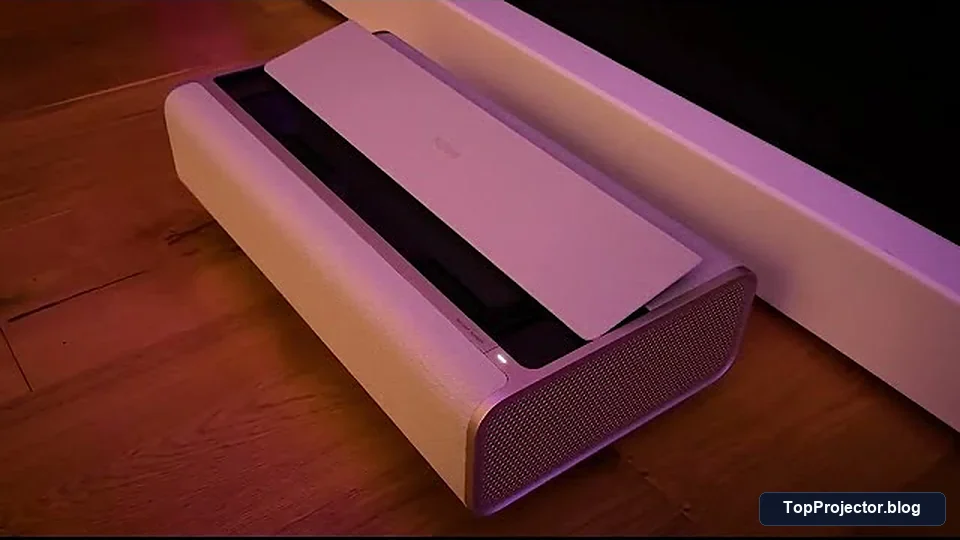
Traditional long-throw projectors require substantial distance, often spanning ten to fifteen feet across the room. You can precisely map spatial requirements using our throw distance calculator before mounting.
Optical distortion management differs significantly between these two distinct form factors. Ultra-short optics demand extreme panel alignment precision to eliminate geometric warping across wide screens.
Ultra-short throw units utilize a 0.25 throw ratio to project massive images inches from the wall, while standard long-throw models demand a 1.5 throw ratio requiring dedicated ceiling mounts.
- Short throw ratio typically falls below 0.5:1 for extreme proximity.
- Regular throw ratios range from 1.2:1 to 2.0:1 for standard rooms.
- Placement proximity eliminates shadow interference from walking viewers.
Calculating Throw Distances in Practice
Calculating precise throw distances ensures your projected image fills the screen without wasting valuable light. Short throw units eliminate shadow obstructions entirely when viewers cross the room.
Standard long-throw configurations demand careful ceiling mounting to keep light paths unobstructed by furniture and human traffic. Precise lens shift capabilities become essential during this installation phase.
- Measure exact throw distance from lens glass to screen surface.
- Factor in physical offset requirements for ceiling versus table setups.
Lens Shift Precision
Standard throw setups offer optical lens shift exceeding plus-minus 50 percent, whereas ultra-short throw architectures lack mechanical shift, forcing absolute physical wall alignment and precise bracket calibration.
Ambient Light Rejection and Daytime Performance
Battling ambient living room light requires careful hardware selection, especially when exploring choices via our best projector under 500 guide to pair with specialized ALR screen materials.
Standard projectors shoot light from across the room, making them highly susceptible to overhead illumination washouts. Without dedicated light control, dark scenes lose punch and shadow details completely vanish.
Light engine output measured in ANSI lumens dictates daytime viability across both categories. Modern laser diodes push past traditional bulb limitations to maintain vibrant color saturation.
Standard projectors fighting ambient daylight require at least 3000 ANSI lumens paired with a high-gain white screen, while ultra-short throw setups demand specialized ALR lenticular screens to reject ceiling light effectively.
- ALR rejection layers block up to 90 percent of overhead ambient light.
- Standard throw projectors need pitch-black environments for maximum contrast punch.
- High lumen output helps mitigate washing effects in unmanaged spaces.
Living Room Daylight Versus Dedicated Theater Rooms
Deploying a display in an active family space demands robust ambient light rejection technology. Short throw configurations direct light upward from below, optimizing rejection characteristics.
Dedicated theaters eliminate ambient variables entirely, allowing regular projectors to deliver reference-grade cinematic contrast without fighting stray light reflections from nearby walls.
- Ambient rejection screens are mandatory for daytime short throw usage.
- Velvet-treated dark rooms maximize ANSI contrast on standard throw models.
Angular Reflection Physics
Lenticular ambient light rejection layers feature microscopic sawtooth structures that actively block overhead illumination while reflecting the downward-projected ultra-short throw rays directly toward the primary viewer seating position.
Black Floor Dynamics, Contrast, and Shadow Precision
Achieving deep, inking black levels remains the holy grail of high-end home theater projection. Regular long-throw units generally achieve superior native contrast ratios due to simpler light paths.
Short throw lenses introduce complex optical refractions that can scatter stray light across the DMD chip. This optical scattering slightly elevates the black floor in dark viewing environments.
Dynamic iris systems help mitigate native contrast limitations by actively modulating light output during dark sequences. Proper calibration ensures shadow details remain discernible without crushing blacks.
Native contrast ratios hovering around 2000:1 to 5000:1 dictate shadow depth, though maintaining peak optical output eventually requires consulting an epson lamp replacement guide when brightness dips.
- Native contrast ratios often exceed 2000:1 on quality standard throw units.
- Optical scattering in short throw lenses can elevate baseline black levels.
- Dark room calibration unlocks hidden shadow details in complex cinematic sequences.
Maximizing Shadow Detail in Dark Environments
Calibrating gamma curves correctly prevents dark movie scenes from collapsing into muddy shadows. Regular projectors benefit from controlled theater lighting to maximize perceived contrast performance.
Short throw setups require matte black surrounding walls to prevent light bouncing back onto projection surfaces. Managing internal reflections preserves critical shadow fidelity during cinematic viewings.
- Target a 2.4 gamma response for dark room cinematic viewing.
- Control room reflections to preserve high contrast performance.
Dynamic Iris Impact
Standard long-throw models frequently incorporate advanced dynamic iris mechanisms to clamp down the black floor during dark cinematic sequences, a feature rarely found in compact ultra-short throw chassis.
Color Gamut, HDR Mapping, and Panel Technologies
Modern laser phosphor engines deliver expansive color gamuts covering the DCI-P3 standard, a capability analyzed in our xgimi horizon pro 4k review highlighting vibrant laser illumination.
High Dynamic Range tone mapping requires immense peak brightness to render specular highlights accurately. Regular long-throw units often provide larger optical light paths for handling thermal loads.
DLP and 3LCD display chips handle motion and color differently depending on optical design. Understanding these underlying display technologies ensures you select hardware matching your viewing preferences.
Laser phosphor engines in modern projectors achieve nearly 100 percent Rec. 709 coverage, though high-end triple-laser ultra-short throw models push past 90 percent BT.2020 for breathtaking HDR color saturation.
- Laser light sources offer over 20000 hours of maintenance-free operation.
- DCI-P3 color coverage creates rich, lifelike cinematic skin tones.
- HDR tone mapping preserves bright highlights without clipping details.
Evaluating Color Accuracy and Laser Phosphor Engines
Laser phosphor engines eliminate the fading issues associated with traditional mercury lamps. Color accuracy remains remarkably stable throughout the operational lifespan of the laser diode.
Advanced calibration software allows enthusiasts to tune white balance and color primaries to reference standards. Accurate color reproduction enhances overall realism across all media formats.
- Laser engines maintain consistent brightness across thousands of hours.
- Rec.709 calibration ensures accurate color representation for standard media.
Tone Mapping Hardware
Dedicated video processing chips handle real-time HDR10 static tone mapping, ensuring peak highlights retain clipping detail without crushing shadow gradations during high-contrast 4K movie viewing sessions.
Gaming Latency, Refresh Rates, and Motion Handling
Competitive gaming demands ultra-low input lag and high refresh rates to maintain fluid responsiveness. Modern short throw gaming projectors achieve latency figures dipping below 20 milliseconds.
Traditional long-throw projectors traditionally prioritized cinematic frame interpolation over fast-twitch gaming metrics. However, recent releases bridge this gap with dedicated high-refresh gaming modes.
Motion handling relies heavily on internal processing power and response times of the imaging chips. Fast pixel switching prevents motion blur during high-speed camera pans and action sequences.
Competitive console gaming requires ultra-low input lag under 15ms at 4K/60Hz, a performance benchmark that modern gaming projectors achieve by completely bypassing heavy internal image processing pipelines.
- Sub-20ms input lag ensures responsive competitive console gaming sessions.
- High refresh rate modes support fast frame rendering for PC players.
- Frame interpolation settings smooth out jittery cinematic motion artifacts.
Console Gaming and High-Refresh PC Performance
Console players benefit greatly from short throw setups placed near entertainment centers. Connecting HDMI 2.1 sources unlocks advanced gaming features like variable refresh rates effortlessly.
PC gamers seeking massive diagonal screen sizes utilize high-refresh standard throw units. Ensuring low input lag keeps competitive multiplayer matches snappy and frustration-free.
- HDMI 2.1 connectivity supports 4K at 120Hz gaming inputs.
- Variable refresh rate technology eliminates screen tearing artifacts.
High Refresh Advantages
Selecting models supporting 240Hz at 1080p resolution drastically reduces motion blur and ghosting during fast-paced competitive esports matches, providing a tangible tactical advantage over standard home theater units.
Installation Complexity, Alignment, and Physical Space
Physical installation requirements represent one of the starkest contrasts between these two projector categories. Short throw units simply sit on a media console inches from the wall surface.
Regular projectors demand careful ceiling mounting, precise angle adjustments, and long cable runs. Getting the image geometry square requires robust optical lens shift and keystone correction.
Wall flatness is critical for short throw displays because extreme projection angles exaggerate surface imperfections. Standard throw configurations are far more forgiving of minor wall texture variations.
Ceiling mounting a standard long-throw projector involves precise keystone correction avoidance and exact distance measurements, whereas ultra-short throw hardware sits discreetly on a standard media console furniture piece.
- Media console placement eliminates complex ceiling mounting hardware.
- Lens shift flexibility simplifies image alignment on standard projectors.
- Absolute wall flatness is mandatory to prevent geometric distortion.
Overcoming Room Constraints and Wall Texture Challenges
Addressing uneven wall textures prevents wavy image distortion on ultra-short throw setups. Using tensioned motorized screens solves this challenge completely in modern living spaces.
Ceiling installation for regular projectors requires concealing long power and HDMI cables. Planning cable management during early room construction saves considerable effort later.
- Tensioned screens guarantee a perfectly flat optical projection surface.
- Conceal long HDMI cables neatly within ceiling channels.
Surface Flatness Tolerances
Ultra-short throw geometry amplifies wall ripples into severe geometric warping, demanding a rigid tensioned screen rather than projecting directly onto uneven drywall surfaces for optimal geometric accuracy.
Scenario-Based Value and Final System Deployment
Choosing between these technologies depends entirely on your specific room architecture and lighting conditions. Living rooms with abundant windows heavily favor specialized short throw laser televisions.
Dedicated dark theater rooms with controlled lighting setups maximize the optical strengths of regular projectors. Ultimate image scaling flexibility makes long-throw units ideal for custom home cinemas.
Balancing budget, available space, and ambient light control ensures you achieve maximum cinematic immersion. Investing in the correct screen material protects your overall optical hardware investment.
Dedicated dark-room home theaters benefit enormously from traditional long-throw setups and acoustically transparent screens, whereas multi-purpose living spaces thrive using ultra-short throw laser televisions.
- Short throw wins for multipurpose living spaces with ambient light.
- Regular throw dominates dedicated dark rooms with massive screens.
- Proper screen matching guarantees optimal optical performance.
Making Your Final Buying Decision
Assess your room lighting and available floor space before purchasing any projection hardware. Short throw units offer convenience and daytime usability for active family spaces.
Select a regular long-throw projector if you possess a dedicated basement theater room. Uncompromising black levels and massive screen scalability reward traditional projector installations.
- Prioritize short throw for living room convenience and daytime use.
- Choose regular throw for ultimate dedicated theater immersion.
Acoustic Placement Harmony
Positioning audio gear underneath an ultra-short throw console simplifies multi-channel surround sound integration, contrasting sharply with long-throw ceiling setups requiring lengthy in-wall speaker wire routing.
Frequently Asked Questions
Can short throw projectors completely replace traditional televisions in bright living rooms?
Yes, when paired with an ambient light rejecting screen, short throw units deliver vibrant daytime viewing that easily rivals standard flat-panel televisions.
Do regular long-throw projectors offer better contrast than short throw models?
Generally, regular projectors achieve superior native contrast ratios due to simpler optical paths that minimize stray light scattering inside the lens barrel.
How difficult is it to align a short throw projector compared to a regular unit?
Short throw units demand absolute wall flatness and precise placement, whereas regular units offer flexible lens shift adjustments for easier alignment.
Are short throw projectors suitable for fast-paced competitive gaming?
Modern gaming short throw models feature advanced processing that achieves low sub-20ms input lag, making them exceptionally responsive for console and PC gaming.
What is the primary maintenance advantage of laser light engines?
Laser phosphor engines eliminate traditional lamp replacements, delivering over 20000 hours of consistent brightness and stable color performance throughout their operational lifespan.