Rear Projection Tv vs. Led: Which Wins for Your Room?
Comparing legacy rear projection displays against modern LED flat panels reveals stark differences in ambient light handling, form factor, and optical performance.
Modern LED panels easily win for bright living rooms, while vintage rear projection TVs remain a niche curiosity for nostalgic enthusiasts.
Compare full category rankings in our Best Digital Projector: Top Home & Outdoor Picks (2026).
Side-by-Side Specification Breakdown
| Criteria | Rear Projection Tv | Led | Edge |
|---|---|---|---|
| Ambient Light Rejection | Poor (washes out easily) | Excellent (high nit output) | Led |
| Black Levels & Perceived Contrast | Moderate native contrast | Deep blacks with local dimming | Led |
| Peak Brightness & HDR Punch | Under 300 nits typical | Exceeds 1000 to 2000 nits | Led |
| Screen Size & Immersion | Fixed 50 to 70 inches | Scalable from 32 to 98 inches | Led |
| Viewing Angles & Uniformity | Narrow vertical viewing angles | Wide IPS or VA viewing angles | Led |
| Gaming Motion & Input Lag | High lag, fixed 60Hz | Sub-10ms lag with 120Hz support | Led |
| Room Setup & Maintenance | Bulky cabinet, aging lamps | Slim wall mount, solid-state | Led |
Understanding Fundamental Optical Architectures
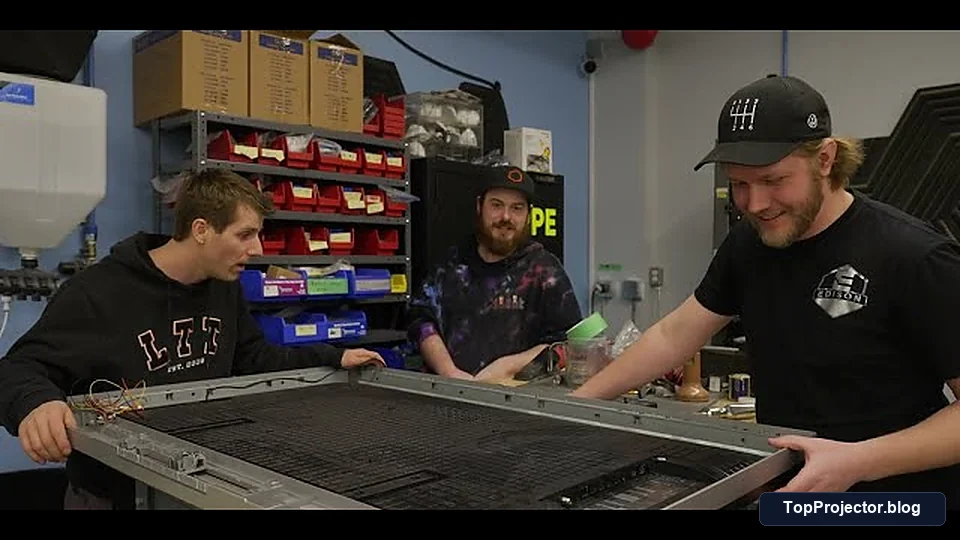
Vintage rear projection television units utilized internal lamps, mirrors, and microdisplay chips to beam images onto a translucent plastic screen. This bulky cabinet design fundamentally constrained optical engineering limitations.
In contrast, modern LED displays rely on solid-state semiconductor pixels or direct LED backlighting. This lightweight flat-panel architecture eliminates deep chassis requirements entirely for seamless wall installation.
Rear projection systems rely on enclosed optical engines reflecting light off internal mirrors, whereas modern flat-panel LEDs use direct or edge-lit backlighting paired with IPS or VA panels for direct illumination.
- Rear projection relies on internal projection engines
- LED technology uses direct emission or backlighting
- Cabinet depth differs by several feet
Internal Light Paths versus Direct Emission
Rear projection systems forced light through complicated mirror assemblies before hitting the viewing screen. This long optical path introduced severe brightness degradation over time.
LED panels project photons directly toward your eyes with minimal intervening optical layers. This direct path preserves maximum luminous efficacy and ensures high visual clarity.
- Complex mirror bounces degrade light
- Direct LED panels maximize photon output
Light Path Engineering
Evaluating the light path reveals why older rear projection chassis required significant cabinet depth compared to ultra-slim LEDs utilizing advanced mini-LED local dimming zones to control blooming and improve native contrast.
Ambient Light Rejection and Daytime Performance
Deploying a screen in bright living spaces demands exceptional ambient light rejection, a metric you can evaluate using our lumens room calculator to prevent washed-out, grey imagery under active room lighting.
Modern LED panels easily conquer sunlit environments by pushing massive peak luminance thresholds exceeding 1000 nits. They overpower reflections effortlessly without sacrificing color saturation.
Ambient light rejection fundamentally alters daytime viewing viability, forcing rear projection setups to rely on specialized Fresnel screens while direct-view LEDs easily punch through high-lux environments using 2000-nit peak brightness.
- Rear projection lacks effective daytime optical filters
- LED panels utilize high nit output to fight glare
- Sunlight destroys contrast on translucent plastic
Pitch-Black Theater versus Sunlit Living Room
Inside a pitch-black basement theater, older projection technologies could deliver acceptable cinematic contrast. However, daytime ambient illumination completely collapses their dynamic range.
LED displays maintain vibrant contrast ratios regardless of whether your room features heavy blackout curtains or blazing afternoon sunlight streaming through large windows.
- Basements favored old projection systems
- Daytime rooms demand high-output LEDs
Surface Reflection Dynamics
Direct-view LED panels feature glossy or semi-matte polarizers that manage specular highlights effectively, whereas traditional projection screens suffer severe washout without high ambient light rejection gains during midday sports viewing.
Black Floor Performance and Native Contrast
Achieving deep black levels dictates how realistic dark cinematic scenes appear on your display. Rear projection systems suffered from stray internal light leaking across their translucent viewing surfaces.
Contemporary LED televisions incorporate advanced local dimming zones that turn off backlight sections entirely. This delivers inky blacks that legacy projection boxes simply could not achieve.
While browsing our best digital projector selections, remember that achieving deep black floors remains challenging for aging light engines, whereas modern local dimming LEDs routinely hit stellar 0.05 nits black levels.
- Stray internal light plagues rear projection screens
- LED local dimming creates true shadow depth
- Contrast ratios favor modern semiconductor panels
Shadow Detail and Dynamic Backlighting
Dissecting complex shadow details requires precise pixel control. Older optical engines blurred fine dark transitions due to light scatter inside the massive plastic chassis.
Mini-LED backlighting arrays apply hundreds of localized dimming clusters across the panel. This eliminates blooming while retaining crisp highlight intensity in dark sequences.
- Light scatter ruins shadow detail
- Mini-LED zones control highlights perfectly
ANSI Contrast Metrics
Standard ANSI contrast measurements demonstrate that direct-view LED panels deliver superior intra-scene pop, outperforming legacy projection technologies that suffer from internal light scatter within the light engine enclosure.
Physical Form Factor and Room Integration
Physical cabinet depth represents a massive logistical hurdle for vintage rear projection units. They demanded heavy, floor-standing furniture pieces occupying significant living space.
LED flat panels offer ultra-slim profiles that mount flush against drywall surfaces. Their minimalist footprint preserves valuable floor space in modern urban apartments.
Spatial footprint dictates room integration limits, forcing bulky rear projection cabinets to consume massive floor space while ultra-thin LEDs mount flush against walls using minimal VESA bracket clearances.
- Rear projection requires heavy floor cabinets
- LED panels hang flush on standard walls
- Weight differences exceed one hundred pounds
Weight, Portability, and Wall Mounting
Moving a vintage projection television usually required multiple adults and careful vehicle transport. Their heavy glass lenses and wooden chassis made rearrangement nearly impossible.
Lightweight LED displays feature VESA mounting compatibility for effortless installation. A single person can often mount a large screen safely using basic hardware.
- Vintage units weigh over one hundred pounds
- LED screens support simple VESA wall mounts
Weight Distribution and Framing
Wall-mounting a large LED panel requires careful stud placement to support moderate chassis weight, contrasting sharply with the immovable floor-standing footprint demanded by legacy rear projection housings.
Color Fidelity, HDR, and Peak Brightness
High Dynamic Range content demands expansive color gamuts and high luminance. Rear projection lamps aged rapidly, causing severe color shifting and drastic brightness decay within thousands of hours.
Modern LED panels support wide color gamuts utilizing quantum dot enhancement films. They maintain factory calibration accurately across years of heavy daily usage without degradation.
Wide color gamuts and high dynamic range metadata push display hardware to its absolute limits, with modern LEDs achieving robust DCP-P3 color coverage alongside blistering white luminance levels.
- Projection lamps degrade quickly over time
- Quantum dot LEDs deliver pristine color accuracy
- HDR metadata thrives on high-nit panels
Lamp Aging versus Solid-State Stability
Traditional projector lamps required expensive replacement bulbs every few thousand hours, which often prompted users to consult our soundbar setup guide before upgrading audio alongside new solid-state panels.
Solid-state LED backlights operate for tens of thousands of hours without noticeable color drift. This guarantees predictable, calibration-ready performance throughout the display lifespan.
- Bulb replacements add ongoing maintenance costs
- Solid-state diodes last for decades
Color Volume Realism
Maintaining color saturation at high brightness levels challenges traditional projection lamps, whereas quantum dot LED panels sustain vibrant hues without losing crucial color volume accuracy during HDR scenes.
Motion Handling and Competitive Gaming Latency
Responsive gaming requires minimal input lag and high refresh rates to prevent motion blur. Vintage rear projection TVs operated strictly at fixed sixty-hertz rates with terrible latency.
Modern LED screens feature lightning-fast response times alongside sub-10ms input lag. Features like variable refresh rate ensure ultra-smooth competitive console and PC gaming sessions.
Fast-paced gaming environments demand rapid pixel response times, leaving rear projection sets at a severe disadvantage against modern LEDs featuring sub-millisecond pixels and ultra-low input lag metrics.
- Rear projection introduces severe input lag
- LED panels support 120Hz and variable refresh rates
- Fast response times eliminate ghosting
Console Gaming and Variable Refresh Rates
Connecting modern gaming consoles to legacy projection hardware results in unplayable input delays. Fast-paced shooter titles expose the sluggish processing pipelines of older units.
Advanced LED televisions optimize signal pathways automatically via auto low latency modes. Gamers enjoy instantaneous visual feedback and silky smooth motion rendering.
- Legacy processing creates noticeable controller lag
- ALLM features streamline modern gaming setups
Refresh Rate Benchmarks
Competitive gaming heavily favors modern flat panels supporting variable refresh rate technologies and native 120Hz refresh rates, completely eliminating the motion blur inherent in legacy projection setups.
Installation Complexity and Long-Term Maintenance
Owning legacy display technology involves sourcing increasingly rare replacement projection bulbs and optical cleaning supplies. Maintenance headaches multiply as aging internal components inevitably fail.
LED flat panels demand virtually zero ongoing maintenance beyond dusting exterior glass. Their solid-state reliability represents the gold standard for hassle-free home entertainment.
Hardware longevity depends heavily on component maintenance, requiring regular lamp replacements in projection systems whereas solid-state LED backlights offer tens of thousands of hours of lifespan.
- Projection bulbs become harder to source
- LED displays require zero routine maintenance
- Solid-state electronics ensure long-term reliability
Troubleshooting Optical Alignment Issues
Older projection systems often required tedious manual convergence alignments to correct color fringing. Shifting internal mirrors caused permanent geometric distortion over time.
Digital LED panels feature fixed-pixel arrays that never require optical alignment. Every single pixel remains locked in place permanently for flawless geometric integrity.
- Mirrors shift and cause geometric distortion
- Fixed-pixel displays never require manual alignment
Optical Alignment Procedures
Maintaining optimal geometry on projection systems often demands meticulous convergence tweaks, bypassing the plug-and-play reliability of modern LEDs that feature completely factory-calibrated panels.
Definitive Scenario-Based Buying Recommendations
Choosing between these technologies depends entirely on your specific room environment and performance expectations. Anyone seeking modern reliability should avoid vintage projection cabinets completely.
Invest in a contemporary LED flat panel to secure unmatched brightness, stunning HDR contrast, and flawless gaming responsiveness in any living space.
Selecting the ideal display technology requires balancing room lighting, available space, and content preferences, ultimately steering most modern buyers toward versatile direct-view LEDs over outdated rear projection units.
- Avoid rear projection for primary modern home theaters
- Select LED panels for ultimate versatility and performance
- Match your display choice strictly to room lighting
When to Choose LED Over Everything Else
If your room features standard ambient lighting or large windows, LED technology provides the only viable viewing experience. Its high luminance defeats glare effortlessly.
For cinematic immersion paired with modern smart features, high-end LED displays deliver superior value, though enthusiasts should read the Epson laser review before abandoning dedicated projection hardware entirely.
- Daylight rooms require high-nit LED displays
- Smart features and longevity favor modern panels
Optimal Use Case Matrix
Choose direct-view LEDs for bright living rooms and competitive gaming sessions, reserving projection alternatives strictly for dedicated, completely dark home theater spaces requiring massive cinematic screen sizes.
Frequently Asked Questions
Can rear projection televisions compete with modern LED displays in bright rooms?
No, rear projection displays lack the necessary luminance to fight ambient light. LED displays easily outperform legacy projection units in sunlit living spaces.
Are replacement bulbs still manufactured for vintage rear projection TVs?
Finding replacement lamps for older projection units is increasingly difficult. Solid-state LED panels eliminate this maintenance hassle entirely for home buyers.
Which technology offers better contrast ratios for watching movies?
Modern LED panels with local dimming offer vastly superior contrast. Deep black levels make contemporary flat screens much better for cinematic viewing.
Is input lag low enough for gaming on rear projection TVs?
Vintage projection televisions suffer from terrible input lag and slow processing. LED gaming monitors provide sub-10ms response times for competitive play.
Why did the home theater industry abandon rear projection technology?
Bulky cabinets and fragile optical light paths became obsolete. Flat-panel LED screens deliver superior performance in a fraction of the physical depth.