Projector vs. Tv Which Is Better: Which Wins for Your Room?
Choosing between massive projection screens and ultra-bright flat panels requires balancing room illumination and contrast ratios. Understanding optical physics ensures you get the best image fidelity.
Projectors dominate dedicated dark theaters with cinema-scale immersion. Flat-panel TVs win in bright family rooms where ambient light destroys contrast.
Compare full category rankings in our Best Sub 1000 Projector: Top Home Cinema Picks.
Side-by-Side Specification Breakdown
| Criteria | Projector | Tv Which Is Better | Edge |
|---|---|---|---|
| Ambient Light Rejection | Requires specialized ALR screens or dark rooms | Handles high ambient light effortlessly with peak luminance | Tv Which Is Better |
| Black Levels & Perceived Contrast | Dependent on room reflections and black floor limits | Exceptional native contrast and true black floors via OLED | Tv Which Is Better |
| Peak Brightness & HDR Punch | Typically 1500 to 3000 ANSI lumens on high-end models | Exceeds 2000 nits for dramatic specular highlights | Tv Which Is Better |
| Screen Size & Immersion | Easily scales from 100 to 150 inches diagonally | Cost prohibitive and difficult to install above 98 inches | Projector |
| Viewing Angles & Uniformity | Depends heavily on throw angle and screen gain specs | Consistent off-axis viewing with zero hot-spotting | Tv Which Is Better |
| Gaming Motion & Input Lag | Modern lasers achieve sub-15ms input lag at 4K/60Hz | Delivers 4K/120Hz with variable refresh rate support | Tv Which Is Better |
| Room Setup & Maintenance | Requires precise throw distance and ceiling mounting | Simple VESA wall mounting or tabletop placement | Tv Which Is Better |
Evaluating Ambient Light Rejection and Optical Physics
Traditional projection systems reflect ambient environmental illumination directly back to the viewer. This washes out black floors and destroys perceived contrast ratios in typical living spaces.
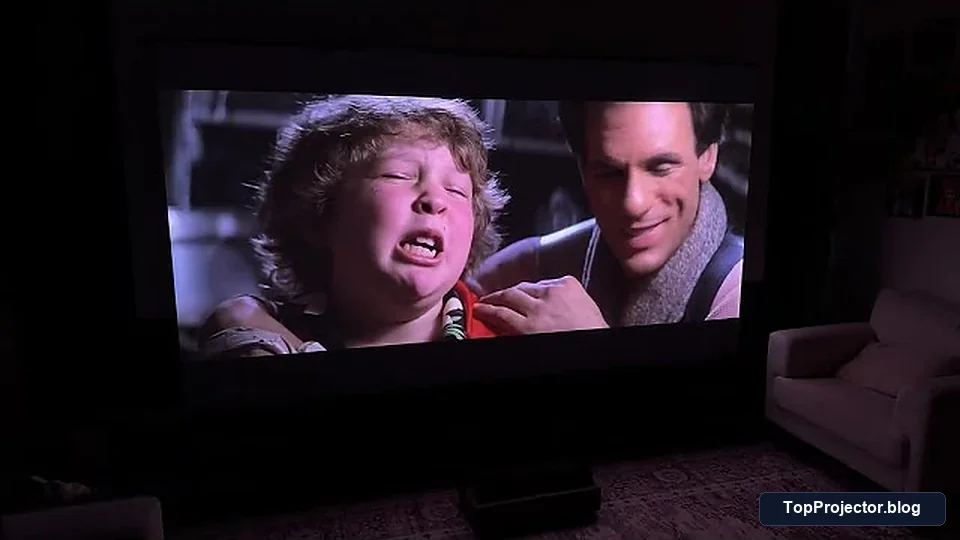
Pairing your optical setup with a quality model from our best sub 1000 projector guide ensures high peak ANSI lumens output without breaking your overall theater budget.
Modern ALR screens use microscopic sawtooth optical layers to reject overhead ambient light while reflecting ultra-short-throw projector beams directly toward seated viewers, preserving contrast ratios in bright living rooms.
- Standard white walls ruin contrast in daylight
- Fresnel ALR materials reject overhead ceiling lights
- Ultra-short-throw lasers pair best with specialized rejection fabric
- Zero-frame tensioned fixed-frame designs eliminate surface ripples for razor-sharp pixel geometry.
- High-gain white screens amplify lumens but drastically degrade off-axis black levels.
Pitch-Black Theater vs Living Room Daylight
A controlled basement environment allows projectors to achieve reference cinema contrast without interference. Stray wall reflections remain minimal when using matte black paint.
Daylight-flooded family rooms render standard projection unwatchable due to low surface luminance. Televisions maintain vibrant saturation under high lux conditions easily.
- Basement caves maximize dynamic range
- Daylight forces high-lumen laser reliance
Microscopic Lens Structures
Selecting the correct gain material requires calculating your exact throw ratio and seating distance to prevent hot-spotting and maintain wide 160-degree viewing angles across the entire couch.
- Specialized angular reflective surfaces block ceiling illumination effectively.
- Gain uniformity ensures accurate color saturation across broad seating layouts.
Black Floor Depth and Dynamic Contrast Mechanics
Achieving deep black levels remains the holy grail of display technology. Projectors struggle because ambient light in the room bounces off white screens and raises the black floor.
Emissive OLED televisions turn off individual pixels completely to achieve infinite native contrast. This delivers three-dimensional depth that reflective projection struggles to replicate in lit spaces.
While direct-view panels dominate lit environments, compact laser options like those detailed in our Epson EF12 review deliver impressive ANSI lumens output for portable home entertainment setups.
- Projector black floors rely on room darkness
- Emissive panels offer true pixel-level dimming
- Dynamic iris systems help laser units improve contrast
- Dedicated bat-cave rooms with matte black paint maximize ANSI contrast performance.
- Ambient room reflection severely washes out projected dark scenes unlike emissive flat panels.
Native Contrast vs Dynamic Iris Solutions
High-end LCoS projectors achieve respectable native black floors through superior optical engine design. Dynamic irises modulate light output during dark scenes to enhance shadow detail.
Micro-lens arrays on premium TVs minimize blooming artifacts entirely. This ensures high-contrast scenes remain pristine without distracting halos around bright objects.
- LCoS engines maximize native contrast
- Dynamic iris algorithms reduce black floor luminance
Laser Dimming Algorithms
Advanced laser phosphors modulate output rapidly during dark cinematic sequences, improving perceived sequential contrast without introducing distracting brightness pumping artifacts during mixed-content movie viewing.
- Laser modulation improves shadow detail visibility significantly in dark scenes.
- Dynamic black features adapt laser output to average picture level changes.
Peak Brightness, Spectral Gain, and HDR Delivery
High dynamic range demands immense peak luminance for specular highlights. While premium TVs routinely exceed 2000 nits, standard projectors struggle to match that sheer output intensity.
Laser light engines in modern projectors now push past 3000 ANSI lumens. This increased output allows for compelling HDR presentation on screens up to 120 inches.
High-end LED televisions effortlessly push 2000 nits of sustained peak brightness, easily overpowering sunlit spaces, while high-output laser projectors struggle to deliver equivalent specular highlights on massive screens.
- Laser phosphors improve long-term lumen maintenance
- HDR mapping requires careful tone-curve calibration
- Screen gain multipliers trade viewing angles for brightness
- RGB triple-laser engines achieve wider Rec. 2020 color volume than standard lamp units.
- Flat panels maintain consistent brightness regardless of image size or diagonal scaling.
Screen Gain and Viewing Cone Trade-offs
High-gain projection screens concentrate reflected light toward the primary seating sweet spot. However, this creates noticeable hot-spotting and degrades off-axis viewing uniformity significantly.
Flat-panel displays utilize wide polarizing filters to maintain uniform color and brightness across extreme angles. Viewers seated off to the side experience zero degradation.
- Positive gain amplifies central brightness
- Wide viewing angles preserve image integrity
HDR Tone Mapping
Projectors require robust onboard dynamic tone mapping processors to accurately scale HDR10 metadata down to limited lumen output capabilities without crushing vital shadow details in bright scenes.
- Dynamic tone mapping preserves highlight detail across complex film scenes.
- High ANSI lumen output prevents HDR mastering from appearing unnaturally dim.
Display Scaling, Viewing Geometry, and Immersion
The primary advantage of projection technology is uncompromised scale. Stepping up to a 150-inch diagonal screen transforms casual movie nights into genuine commercial cinema experiences.
Televisions scale economically up to 85 inches, but pricing skyrockets exponentially beyond that threshold. Transporting and mounting massive panels requires specialized professional installation teams.
Cinema-scale projection easily surpasses 120-inch diagonals, matching commercial IMAX viewing angles of 40 degrees, whereas large flat panels remain financially prohibitive once you exceed standard 98-inch sizes.
- Projection delivers unbeatable cinematic scale per dollar
- Viewing distance dictates optimal screen size formulas
- Cinematic immersion requires a 40-degree field of view
- OLED panels offer superior pixel density and sharpness at close desktop ranges.
- Projectors deliver unmatched kinetic scale that triggers genuine cinematic emotional immersion.
Calculating Throw Ratios and Room Dimensions
Determining exact lens placement requires careful arithmetic based on optical zoom. You can quickly map your room dimensions using our interactive throw distance calculator tool for optimal screen sizing.
Ultra-short-throw projectors sit inches from the wall, making them ideal for media rooms with limited floor space. They eliminate the shadow hazard completely.
- Throw ratios dictate projector placement geometry
- UST models fit snugly on media consoles
Calculating Viewing Angles
SMPTE recommendations suggest sitting close enough that the screen fills a massive 40-degree field, an immersive threshold easily achieved with a motorized tensioned screen paired with a short-throw lens.
- Wider fields of view dramatically increase perceived cinematic engagement.
- Proper screen sizing prevents eye strain during extended movie viewing sessions.
Color Fidelity, Color Gamut, and Motion Processing
Accurate color reproduction is essential for critical film viewing. Advanced triple-laser projectors cover over 100% of the BT.2020 color space, delivering hyper-saturated cinematic palettes.
Motion handling in fast-paced action sequences benefits greatly from rapid pixel response times. While TVs excel at instantaneous pixel transitions, high-end projectors use frame interpolation effectively.
Professional calibration transforms modern laser projectors, utilizing CMS controls to track Rec. 709 targets flawlessly while achieving cinematic color accuracy that rivals studio mastering reference monitors.
- Triple-laser engines expand wide color gamuts
- Frame interpolation reduces cinematic motion judder
- Color calibration ensures director intent is met
- Triple-laser engines bypass color wheels to eliminate distracting rainbow artifacts.
- Flat panel televisions often feature superior native response times for panning shots.
Wide Color Gamut Filters and Lamp Life
Activating internal cinema filters on projectors often reduces peak lumen output to achieve accurate white points. Laser diodes maintain stable chromaticity across 20,000 hours of operation.
OLED and Mini-LED panels maintain pristine color volume at maximum brightness levels without mechanical filters. Their solid-state architecture ensures zero color fading over time.
- Cinema filters sacrifice lumens for accuracy
- Solid-state lasers ensure long-term stability
Handling Motion Interpolation
Fast-moving sports footage demands clean motion interpolation settings; quality MEMC algorithms eliminate judder and blur without introducing unwanted soap-opera artifacts on large projected canvases.
- Black frame insertion improves motion clarity during fast action scenes.
- Customizable motion settings allow fine-tuning for movies versus sports.
Input Latency, Refresh Rates, and Competitive Gaming
Modern gaming demands lightning-fast responsiveness and high refresh rates. Premium televisions support 4K at 120Hz with variable refresh rates and sub-5ms input lag metrics.
Gaming on a massive projection screen provides unmatched tactical immersion. Recent laser projectors achieve competitive input lag under 15ms at 4K/60Hz for smooth play.
Competitive gamers require ultra-low input lag; modern gaming projectors now achieve competitive 4ms latency at 240Hz, matching high-end gaming monitors and eliminating frustrating controller delay during intense shooters.
- Low input lag prevents frustrating controller delay
- High refresh rates ensure fluid motion clarity
- Massive screen size enhances competitive awareness
- OLED TVs still hold the crown for instantaneous pixel response times.
- Large projection gaming provides unbeatable scale for immersive RPG adventures.
Console Integration and HDMI 2.1 Performance
Full HDMI 2.1 bandwidth is standard on flagship TVs, enabling advanced gaming features seamlessly. Projectors are gradually adopting these chipsets for next-gen console compatibility.
Auto Low Latency Mode simplifies switching between cinematic and gaming presets. This ensures optimal picture processing settings without manual menu adjustments.
- HDMI 2.1 bandwidth supports high frame rates
- ALLM automates optimal game settings
Variable Refresh Rate Support
HDMI 2.1 integration enables critical ALLM and VRR protocols, synchronizing console refresh rates directly with the projector to eradicate screen tearing during fast-paced multiplayer gaming sessions.
- Low latency modes bypass image processing overhead for rapid response.
- High refresh rate support ensures butter-smooth competitive gameplay experiences.
Structural Installation, Acoustics, and Maintenance Realities
Proper physical setup demands precise optical alignment and secure hardware. Follow our detailed projector ceiling mount guide to ensure safe throw ratio positioning above your seating area.
Televisions offer plug-and-play simplicity with straightforward tabletop stands or VESA wall mounts. Integrated smart TV interfaces provide immediate access to streaming apps.
Ceiling mounting a heavy 4K projector demands secure joist anchoring, precise lens shift calibration, and acoustic management to keep fan noise below thirty decibels during quiet movie dialogue scenes.
- Ceiling mounts require structural stud anchoring
- Air filters need periodic cleaning to prevent overheating
- Smart TV platforms offer streamlined user interfaces
- Flat panels mount flush to drywall with minimal structural reinforcement requirements.
- Projector alignment requires patience and precise optical zoom adjustments.
Fan Noise vs Integrated Audio Systems
High-lumen laser projectors generate audible cooling fan noise during intensive HDR playback sessions. Positioning the unit away from seating maintains a quiet room.
Modern flat panels include surprisingly robust internal speakers with Dolby Atmos processing. Projectors typically require dedicated external sound systems for proper immersion.
- Cooling fans can introduce distracting ambient noise
- External audio is mandatory for projection setups
Long-Term Maintenance
Solid-state laser diodes eliminate expensive lamp replacements, offering 20,000 hours of maintenance-free operation while requiring occasional filter cleaning to prevent thermal shutdowns in dusty home environments.
- Sealed optical engines protect sensitive internal mirrors from dust contamination.
- Efficient cooling designs prolong projector lifespan under heavy daily use.
Frequently Asked Questions
Can I use a projector in a bright living room?
Standard projectors wash out completely in bright daylight without specialized gear. Using a high-lumen laser paired with an ambient light rejection screen makes daytime viewing viable.
Which display technology offers better longevity?
Solid-state laser projectors and modern televisions offer exceptional durability exceeding twenty thousand hours. Traditional lamp-based projectors require expensive bulb replacements every few thousand hours.
Is input lag noticeable when gaming on a projector?
Modern gaming projectors feature dedicated low-latency modes achieving under 15 milliseconds of lag. This ensures casual and competitive titles remain responsive and highly playable.
Why do TVs look better for watching HDR content?
Televisions achieve extreme peak brightness levels exceeding 2000 nits alongside infinite contrast. This allows specular highlights to pop with dramatic realism that projectors struggle to match.
What is the primary benefit of choosing a projector?
The ultimate advantage is uncompromised cinema-scale immersion spanning 100 to 150 inches. Televisions cannot match that sheer physical size affordably or easily.