Projector vs. Tv For Outdoors: Which Wins for Your Backyard?
Choosing between an outdoor projection system and a weather-resistant TV dictates backyard movie nights. We evaluate optical performance, ambient light resilience, and structural durability.
Outdoor TVs dominate sunlit patios with massive peak brightness, while projectors deliver unrivaled cinematic screen scaling for nighttime backyard viewings. Choose your hardware based entirely on your primary viewing hours.
Compare full category rankings in our Best Mini Home Projector: Top Portable Picks.
Side-by-Side Specification Breakdown
| Criteria | Projector | Tv For Outdoors | Edge |
|---|---|---|---|
| Ambient Light Rejection | Poor in daylight | Exceptional in full sun | Tv For Outdoors |
| Black Levels & Perceived Contrast | Washed out outdoors | Deep blacks via local dimming | Tv For Outdoors |
| Peak Brightness & HDR Punch | Limited by throw distance | Exceeds 2000 nits easily | Tv For Outdoors |
| Screen Size & Immersion | Massive 120-inch plus scale | Capped around 85 inches typically | Projector |
| Viewing Angles & Uniformity | Dependent on screen gain | Wide off-axis consistency | Tv For Outdoors |
| Gaming Motion & Input Lag | Higher latency in older units | Low lag with high refresh | Tv For Outdoors |
| Room Setup & Maintenance | Portability requires setup | Permanent heavy installation | Projector |
Optical Performance Under Sunlight and Evening Skies
Backyard daylight severely challenges optical equipment through extreme ambient illumination. Projectors struggle without specialized high-gain screens, whereas outdoor televisions leverage direct-emitting panels to punch through harsh daytime glare.
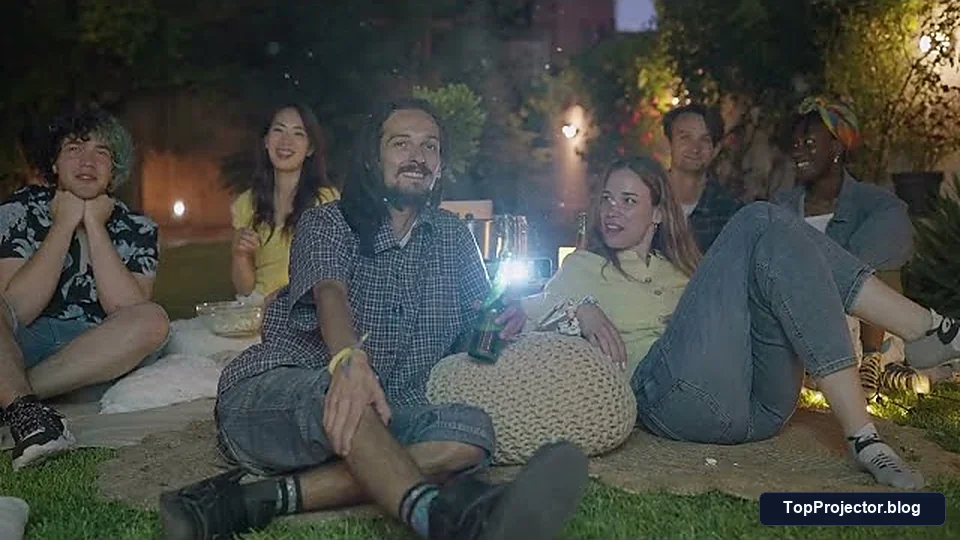
Nighttime changes the optical equation entirely for backyard setups. Following our how to replace bulb in nec projector guide ensures your optical engine delivers peak brightness.
Fighting ambient outdoor light requires robust ANSI lumens output exceeding 3,000 units to maintain decent saturation before complete dusk settles across your open backyard patio viewing environment.
- Daytime viewing requires high-nit direct-view panels
- Evening viewing favors reflected light projection
- Ambient light destroys projected contrast ratios
- Ambient light rejection screens recover contrast during late afternoon hours.
Daytime and Twilight Limitations
Direct sunlight washes out projected images completely, destroying color saturation. High-nit outdoor displays maintain vibrant contrast even under bright afternoon skies, rendering projectors useless before dusk.
Twilight creates an awkward transition phase for projection systems. Ultra-short throw units handle late afternoon slightly better, but traditional setups demand complete darkness.
- Direct sun blinds standard projection setups
- Shaded patios offer moderate projector relief
Dusk Transition Math
As twilight deepens, screen gain plays a massive role; pairing a 1.1 gain white screen with laser engines delivers optimal peak white luminance without washing out shadow details.
- Laser illumination sources maintain color accuracy during long evening viewing sessions.
Black Floor Performance and Contrast in Open Air
Open-air environments lack the reflective ceiling boundaries of indoor theaters. Using our ANSI lumens room calculator helps you gauge exact brightness needed for outdoor evening environments.
Black levels dictate perceived image depth during dark movie scenes. Direct-view LED panels achieve near-infinite contrast in evening hours, easily outperforming standard backyard projection screens.
Open-air environments lack reflective boundary walls, causing projected blacks to appear washed out because ambient outdoor photons scatter directly across your portable projection surface.
- Outdoor TVs utilize aggressive local dimming algorithms
- Projectors suffer from stray light bouncing outdoors
- Shadow detail vanishes under ambient patio lighting
- Specialized optical coatings absorb off-axis stray illumination effectively.
Managing Stray Ambient Light
Neighboring porch lights and streetlamps wreak havoc on outdoor projection setups. Ambient light rejecting screens help, but they cannot match the self-emissive contrast of dedicated outdoor panels.
Controlling your immediate patio environment remains essential for projection fidelity. Shade sails and fences block unwanted vectors, preserving minimal contrast for evening movie screenings.
- Stray lighting degrades projected black floors
- Self-emissive pixels resist environmental light pollution
Preserving Shadow Detail
Utilizing specialized dual-layer ALR material blocks off-axis overhead light, helping preserve a usable static contrast ratio even when nearby landscape lighting remains fully activated.
- Darker screen surrounds enhance perceived black levels significantly outdoors.
Massive Scale Versus High-Brightness Direct View Panels
Screen size defines backyard immersion for large gatherings. Projectors easily scale past 120 inches, delivering authentic IMAX proportions that make outdoor sports and blockbuster films truly spectacular.
Televisions face severe manufacturing and structural limits regarding physical size. Checking our Cosmos Max review highlights how ultra-bright laser engines deliver massive outdoor scale easily.
Direct-view outdoor televisions achieve staggering peak brightness figures, yet traditional projectors easily conquer massive 120-inch diagonals that consumer flat panels cannot physically match cost-effectively.
- Projectors scale effortlessly beyond 150 inches
- Outdoor TVs are physically constrained past 85 inches
- Scale directly impacts backyard cinematic immersion
- Scale advantages outweigh raw panel brightness for cinematic night events.
Scaling for Backyard Audiences
Large groups scattered across a lawn require expansive diagonal measurements. Projection setups accommodate wide seating arrangements effortlessly by simply moving the chassis further back.
Televisions force viewers to cluster closely within a narrow viewing cone. Compact outdoor panels fail to provide the grand visual scale necessary for large backyard parties.
- Wide lawns demand massive projection diagonals
- TV viewing angles restrict large group setups
Throw Ratio Geometry
Evaluating precise throw ratios becomes essential when positioning ultra-short-throw hardware against specialized exterior walls to completely eliminate annoying backyard foot traffic shadows during movie nights.
- Short-throw optics prevent viewers from walking directly into the light beam.
Color Fidelity, HDR Mapping, and Outdoor Gamut
High dynamic range content requires immense luminance to look correct. Outdoor televisions deliver thousands of nits for specular highlights, whereas projectors struggle to reproduce HDR outdoors.
Color volume collapses when ambient light mixes with projected light. Laser light sources help projectors maintain richer saturation, but TVs still dominate color vibrancy under varying skies.
Wide color gamuts often collapse under high-output daylight projection, forcing calibrators to prioritize aggressive Rec.709 color tracking over expansive DCI-P3 volumes during golden hour presentations.
- Outdoor TVs excel at high-nit HDR rendering
- Projectors require dark environments for accurate color
- Laser engines improve wide color gamut performance
- Colorimeter profiling ensures natural skin tones under mixed outdoor lighting.
Handling HDR in Open Spaces
Standard dynamic range content is safer for casual backyard movie nights. HDR metadata mapping on projectors often appears dim outdoors unless paired with high-gain material.
Televisions process HDR automatically using onboard ambient light sensors. Dynamic tone mapping ensures bright scenes pop without crushing shadow detail in the evening.
- Projector HDR looks dim without complete darkness
- TV light sensors adjust brightness dynamically
HDR Mapping Adjustments
Advanced dynamic tone mapping processors must be configured carefully to handle sudden brightness shifts caused by passing clouds across wide open backyard screening environments.
- Clipping bright highlights ruins high dynamic range outdoor performance.
Motion Handling, Refresh Rates, and Backyard Gaming
Fast-moving sports and competitive video games demand low latency and high refresh rates. Outdoor televisions offer rapid response times alongside 120Hz refresh rates for smooth motion.
Projectors have historically suffered from higher input lag numbers. Modern gaming projectors feature dedicated low-latency modes, though fast frame rates remain easier to drive on televisions.
Responsive backyard gaming demands exceptionally low input lag measurements falling below 16 milliseconds to ensure competitive twitch shooters remain playable on giant screens.
- Outdoor TVs feature sub-15ms input lag
- Gaming projectors require specialized low-latency modes
- Sports motion handling favors high refresh TVs
- High-speed HDMI connectivity prevents signal drops across long cable runs.
Console Gaming Under the Stars
Playing video games on a massive outdoor screen provides unmatched excitement. Low input lag ensures competitive twitch shooters remain playable on large projection setups.
Motion blur can distract viewers during fast football passes on cheap gear. High frame rate processing keeps motion crisp across both display categories.
- Massive screens amplify gaming immersion
- Motion processing prevents blurring during sports
Refresh Rate Performance
Robust high refresh rate support up to 120Hz significantly reduces perceptible motion blur during fast-paced sports broadcasts viewed under clear starry night skies.
- Frame interpolation settings require careful tuning for live sports.
Weatherproofing, Installation, and Structural Requirements
Exposing electronics to rain, humidity, and temperature swings requires robust engineering. Outdoor televisions feature sealed, weather-resistant chassis built to withstand harsh year-round elements permanently.
Projectors demand careful storage and weather protection when not in use. Choosing from our best mini home projector roundup keeps your temporary gear safe from unexpected rain.
Outdoor deployment requires rigorous ingress protection ratings alongside stable mounting structures capable of withstanding unexpected heavy winds without compromising geometric alignment.
- Outdoor TVs are permanently weather-sealed
- Projectors require indoor storage after use
- Permanent mounts demand structural reinforcement
- Water-resistant chassis enclosures protect sensitive internal optical components.
Permanent Versus Portable Deployments
Leaving equipment outside permanently requires industrial ingress protection ratings. Weatherproof TV enclosures protect standard screens, while specialized TVs resist bugs and moisture natively.
Portability gives projection systems unmatched flexibility across different yards. Inflatable screens and portable units break down quickly for winter storage or travel.
- Weather ratings prevent catastrophic hardware failures
- Portability allows flexible backyard placement
Thermal Management Realities
Thermal management remains critical since elevated ambient temperatures degrade laser diode lifespan and trigger noisy internal cooling fans during prolonged summer movie marathons.
- Adequate ventilation clearance prevents premature hardware thermal shutdown events.
Definitive Scenario-Based Buying Recommendations
Selecting the correct hardware depends entirely on your viewing schedule and patio layout. Outdoor televisions suit patios used heavily during afternoon hours and sports events.
Cinematic enthusiasts prioritizing late-night movie events should choose high-output projectors. Screen scaling and immersion easily outweigh daytime limitations for dedicated night owls.
Choose dedicated outdoor televisions if daytime sports viewing is your primary priority, whereas cinema enthusiasts should prioritize ambient light rejection projection setups.
- Choose outdoor TVs for daytime and sports
- Choose projectors for massive nighttime movie nights
- Evaluate your local ambient lighting conditions
- Evaluate your primary viewing schedule before purchasing outdoor entertainment hardware.
Making Your Final Backyard Choice
Analyze your typical entertainment routine before purchasing expensive outdoor gear. Nighttime movie watchers save money and gain size with projectors.
Sun-drenched patios demand rugged, high-nit direct displays. Investing in a weather-resistant TV guarantees year-round performance regardless of afternoon sunlight.
- Match hardware capabilities to your local climate
- Prioritize screen size or brightness based on habits
Long-Term System Longevity
Carefully balancing structural installation complexity against maximum image size guarantees long-term backyard entertainment satisfaction regardless of frequently changing regional weather patterns throughout the year.
- Proper storage covers protect outdoor gear from environmental elements.
Frequently Asked Questions
Can I use a regular indoor projector outside?
You can use standard indoor projectors outdoors if you wait for complete darkness. Low lumen output makes them completely washed out during daytime hours.
Do outdoor TVs need special weatherproof enclosures?
Dedicated outdoor televisions feature factory-sealed waterproof chassis designed to withstand rain. Standard indoor TVs will fail quickly if exposed to moisture and humidity.
How many lumens do I need for an outdoor projector?
Achieving a viewable image at dusk requires at least 3000 ANSI lumens. Complete darkness lets lower-output models perform adequately.
Are outdoor TVs viewable in direct sunlight?
High-end outdoor displays exceed 2000 nits of peak brightness, allowing clear visibility even under harsh afternoon sun. Anti-glare coatings further reduce reflections.
What is the best screen material for outdoor projection?
White matte vinyl screens offer wide viewing angles for large backyard audiences. Ambient light rejecting material helps if streetlamps are nearby.