Projector vs. Tv For Living Room: Which Wins for Your Room?
Choosing between a high-output projector and a modern flat-panel television involves weighing ambient light rejection against massive screen scaling in typical residential living rooms.
Flat-panel televisions dominate bright daytime living rooms with superior contrast, while dedicated UST projectors win for cinematic scale in controlled ambient light environments.
Compare full category rankings in our Best Projection Television: Top Picks for 2026.
Side-by-Side Specification Breakdown
| Criteria | Projector | Tv For Living Room | Edge |
|---|---|---|---|
| Ambient Light Rejection | Poor on standard white walls | Exceptional via high peak nits | Tv For Living Room |
| Black Levels & Perceived Contrast | Compromised by stray room reflections | Absolute zero-nit black floor | Tv For Living Room |
| Peak Brightness & HDR Punch | Limited by throw distance optics | Sustained 2000+ nit highlights | Tv For Living Room |
| Screen Size & Immersion | Breathtaking 120-inch diagonal scale | Capped around 85 inches practically | Projector |
| Viewing Angles & Uniformity | Depends entirely on screen gain | Wide off-axis viewing stability | Tv For Living Room |
| Gaming Motion & Input Lag | Sub-15ms 4K/60Hz latency | Lightning-fast 120Hz/144Hz refresh rates | Tv For Living Room |
| Room Setup & Maintenance | Requires precise throw calculations | Simple plug-and-play wall mounting | Tv For Living Room |
Ambient Light Rejection and Daylight Performance Dynamics
Standard projection systems struggle terribly when ambient room illumination washes out black floors, destroying perceived contrast unless paired with specialized ALR screens boasting directional light rejection.
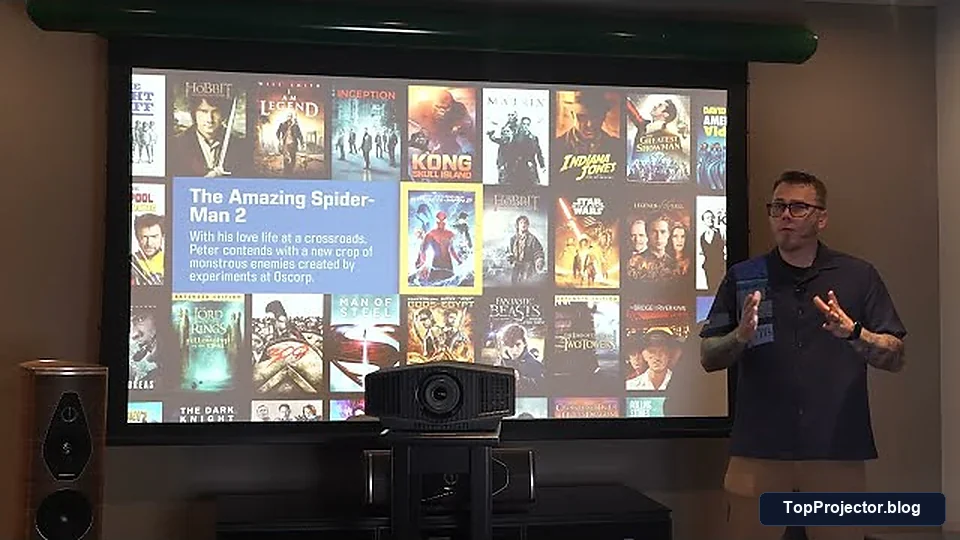
Televisions naturally combat bright living room windows using ultra-high peak luminance outputs exceeding 2000 nits, completely overpowering domestic sunlight without sacrificing color saturation.
While exploring alternatives like the best projection television options, remember that engineers design modern laser models to push higher ANSI lumens against ambient daylight.
Traditional matt-white screens collapse in bright spaces because ambient light washes out the projected image. Deploying an ALR screen with a 0.6 gain redirects overhead light away from seated viewers.
- ALR screens are mandatory for daylight projector use.
- Flat panels maintain high contrast in sunlit rooms.
- High lumen output overcomes domestic ambient wash.
- Pair ultra-short-throw projectors exclusively with specialized fresnel ambient light rejection materials.
Pitch-Black Theater vs. Living Room Daylight
Controlled basement theaters let traditional long-throw projectors shine with flawless dark-room performance, whereas open-concept family spaces demand extreme panel brightness.
Ultra-short-throw laser units paired with specialized Fresnel screens bridge this gap admirably, yet traditional panels still hold the crown for daytime viewing.
- Basements maximize projector contrast potential.
- Daylight spaces favor bright flat-panel displays.
Daylight Calibration Protocols
Calibrating a living room projector requires shifting the white point toward D65 while boosting laser phosphor output. Selecting High Brightness mode pushes past 3000 ANSI lumens to combat direct window glare effectively.
- Always enable dynamic contrast features during high ambient light viewing sessions.
Black Floor Depth and ANSI Contrast Physics
Achieving deep black levels remains challenging for projection technology because ambient reflections bounce off white projection screens, raising the native black floor considerably.
Modern OLED televisions utilize self-emissive pixels that completely power off, delivering absolute zero-nit blacks and infinite contrast ratios impossible for standard projection systems.
Contrast perception relies heavily on room boundary reflectivity, meaning white living room walls will scatter projector light back onto the screen surface.
Flat panels naturally achieve deep black levels through local dimming zones, whereas projectors rely entirely on room darkness. Achieving true 0.05 nits black floors demands specialized velvet acoustic screens to absorb stray light.
- Projectors suffer from raised black floors in light rooms.
- OLED panels deliver absolute zero-nit black levels.
- Room reflectivity degrades projected image ANSI contrast.
- Avoid high-gain white screens if your primary goal is maximizing perceived black depth.
Measuring Real-World Contrast Performance
ANSI contrast metrics test checkerboard patterns to reveal how stray light degrades image fidelity inside typical domestic living environments.
High-end laser engines incorporate dynamic iris controls to mitigate native contrast limitations during dark scenes. Read our Nebula Cosmos Laser 4K review for black level insights.
- ANSI contrast tests reflect true room performance.
- Dynamic iris systems help improve dark scenes.
ANSI Contrast Measurements
Standard full-on/full-off contrast specs often inflate performance compared to real-world ANSI contrast ratios. A high-end DLP optical engine typically delivers a solid 500:1 ANSI contrast inside treated home theaters.
- Matte black ceiling paint drastically improves ANSI contrast by eliminating unwanted secondary reflections.
Massive Screen Scaling Versus Flat-Panel Physical Limits
Projectors easily eclipse traditional televisions by projecting jaw-dropping images exceeding 120 inches diagonal, transforming standard living rooms into authentic commercial movie theaters.
Flat-panel televisions face severe logistical limits once you cross 85 inches, making massive screen sizes prohibitively expensive and difficult to navigate through doorways.
Scaling display size upwards via projection optics delivers unmatched cinematic immersion per dollar spent on sheer square footage.
Commercial televisions hit a hard physical wall at ninety-eight inches due to freight constraints. Projectors effortlessly scale past 120 inches, transforming standard suburban living rooms into genuine commercial-grade cinematic environments.
- Projectors scale effortlessly beyond 120 inches.
- Televisions become unwieldy past 85 inches diagonal.
- Large-scale projection delivers true theater immersion.
- Measure wall studs carefully before hanging fixed-frame projection screens of massive proportions.
The Field of View Immersion Factor
Field-of-view physics dictate that cinematic immersion scales exponentially once display sizes exceed one hundred inches within normal seating layouts.
Televisions provide sharper pixel density at close range, but they lack the breathtaking scale of large projection setups.
- Wide fields of view enhance cinematic impact.
- Pixel density remains superior on smaller panels.
Throw Distance Mathematics
Calculating correct placement requires multiplying screen width by the designated throw ratio. Use our throw distance calculator tool to find exact room measurements.
- Double-check manufacturer focal length charts to avoid unexpected image cropping issues.
Color Accuracy, Color Volume, and HDR Tone Mapping
Advanced laser projectors leverage wide color filters to cover over ninety percent of the demanding BT.2020 color space with exceptional cinematic fidelity.
Televisions excel at HDR tone mapping, sustaining bright specular highlights across the entire screen without dimming surrounding dark picture elements.
Mastering wide color gamuts requires sophisticated processing engines in both display categories to render accurate skin tones and vibrant fantasy worlds.
Modern laser light sources cover vast color spaces, easily surpassing standard DCI-P3 coverage targets. However, projecting high dynamic range content requires aggressive dynamic tone mapping to prevent clipped specular highlights.
- Laser engines achieve massive BT.2020 color coverage.
- Televisions sustain specular highlights effortlessly.
- HDR tone mapping requires careful processor tuning.
- Calibrate grayscale tracking thoroughly before evaluating wide color gamut performance metrics.
Handling Complex High Dynamic Range Content
Projectors must compromise between HDR brightness and wide color gamut coverage, frequently requiring aggressive dynamic tone mapping algorithms.
Self-emissive displays apply per-pixel luminance control, handling complex HDR metadata effortlessly without washing out midtones.
- Projectors rely on aggressive tone mapping algorithms.
- Pixel-level control ensures accurate HDR midtones.
Color Gamut Filters
Engaging internal cinema filters expands color saturation closer to Rec. 2020 parameters. This optical enhancement inevitably sacrifices roughly twenty percent of total lumen output during dark-room calibration sessions.
- Disable cinema filters during daytime viewing to preserve necessary brightness levels.
Gaming Responsiveness, Input Lag, and Motion Handling
Modern gaming projectors feature specialized low-latency modes dropping input lag below 15 milliseconds at 4K/60Hz, satisfying casual console enthusiasts nicely.
Televisions remain the undisputed kings for competitive gaming, frequently supporting 120Hz and 144Hz refresh rates alongside instant pixel response times.
Fast-paced competitive multiplayer games demand ultra-low response times that traditional projection light valves cannot always match cleanly.
Competitive gaming demands lightning-fast reflexes that historically plagued standard long-throw projection hardware. Contemporary gaming projectors now achieve a stellar 16ms input lag at 4K/60Hz resolution settings.
- Gaming projectors achieve low sub-15ms input lag.
- Televisions offer superior 120Hz/144Hz refresh rates.
- Competitive gaming favors instant pixel responses.
- Always toggle game mode to bypass heavy internal video processing pipelines.
Motion Resolution and Refresh Rate Physics
Fast-paced shooter games demand rapid pixel transitions that traditional LCD projection panels struggle to match cleanly without ghosting artifacts.
OLED panels eliminate motion blur completely, offering ultra-crisp tracking during frantic multiplayer sessions.
- LCD projectors can suffer from visible motion blur.
- OLED displays ensure crisp motion tracking.
Frame Interpolation Metrics
Fast-moving camera pans can trigger judder without proper processing. Utilizing a specialized MEMC algorithm smooths out motion artifacts while maintaining a responsive low latency mode for twitch shooters.
- Turn off motion smoothing when watching traditional twenty-four frames per second cinematic content.
Physical Installation, Throw Ratios, and Room Geometry
Setting up a ceiling-mounted unit requires precise throw ratio calculations and careful lens shift adjustments. Consult our Epson lens calculator tool for exact placement.
Televisions offer straightforward plug-and-play simplicity, mounting flush against living room walls with minimal hardware and rapid initial calibration steps.
Architectural planning plays a massive role when integrating complex projection optics into finished residential living spaces.
Mounting a ceiling projector requires precise calculations regarding vertical lens shift capabilities. A generous 60 percent vertical shift simplifies alignment without needing digital keystone correction, which degrades sharpness.
- Projectors demand precise throw ratio calculations.
- Televisions provide simple wall-mounting convenience.
- Cabling requires careful architectural planning.
- Use heavy-duty drop-down ceiling mounts to eliminate micro-vibrations during playback.
Ultra-Short-Throw Laser Alternatives
Ultra-short-throw laser projectors sit inches from the wall, simplifying installation while mimicking traditional television placement convenience.
Despite easier placement, UST systems still demand meticulously flat walls or specialized tensioned ambient light rejection screens.
- UST projectors sit directly against walls.
- Specialized screens remain necessary for UST lasers.
Acoustic Placement Boundaries
High lumen output generates noticeable fan noise during intense operating modes. Keeping ambient fan noise below 28 decibels ensures quiet immersion during soft dialogue scenes in movies.
- Maintain adequate clearance around ventilation ports to prevent thermal throttling shutdowns.
Ultimate Buying Decision for Living Room Deployments
Choose a bright television if your living room floods with daylight and you prioritize effortless setup for casual daytime viewing.
Invest in a dedicated laser projection system if you watch primarily at night and crave massive cinematic screen sizes.
Evaluating your primary viewing habits and room lighting conditions ensures you select the optimal display technology for your space.
Selecting between flat panels and projection systems boils down to your primary viewing schedule. Dedicated evening watchers should prioritize ALR projector bundles for unmatched immersion.
- Select TVs for bright, multi-use living spaces.
- Choose projectors for dedicated cinema scaling.
- Match display tech to your room lighting.
- Prioritize OLED televisions if casual daytime viewing dominates your family routine.
Making Your Final Display Choice
Balance your specific room lighting conditions carefully against your personal desire for true theater-scale immersion before purchasing any display hardware.
Both display categories deliver phenomenal visual performance when matched correctly to their specific architectural and lighting environment.
- Balance room lighting against desired screen scale.
- Both technologies excel in correct environments.
Final Hardware Summary
Evaluate your room lighting conditions carefully before purchasing any display hardware. Balancing peak ANSI lumens against room windows guarantees long-term satisfaction for all family members.
- Consult professional optical calculators before finalizing your projection screen size.
Frequently Asked Questions
Can I use a projector in a bright living room?
Projectors work in bright rooms only if you use specialized ALR screens and high-lumen laser engines. However, flat-panel TVs still outperform them in daylight.
Are laser projectors better than bulb-based models?
Laser models offer instant on-off capability and twenty thousand hours of maintenance-free operation. They also maintain better color accuracy over time.
Do televisions provide better gaming performance?
Televisions offer superior refresh rates up to 144Hz and instant pixel response times. Projectors handle casual gaming well but lag behind in competitive genres.
How difficult is projector installation compared to a TV?
Televisions feature straightforward plug-and-play wall mounting, whereas traditional projectors require precise throw ratio calculations and ceiling cable routing.
What screen size makes a projector worth it?
Projectors become truly worthwhile once you cross 100 inches diagonal, delivering cinematic immersion that flat-panel televisions cannot match economically.