Home Theater Projector vs. OLED TV: Which Wins for Your Room?
Choosing between a massive projected image and an emissive flat-panel display depends entirely on your room lighting, throw distance, and optical environment. We analyze the physics of light to help you decide.
OLED TVs completely dominate for bright living rooms with infinite black levels, while dedicated projectors win for immersive giant screen cinemas in pitch-black media rooms.
Compare full category rankings in our Best Projector Tv For Home Theater: Top Picks.
Side-by-Side Specification Breakdown
| Criteria | Home Theater Projector | OLED TV | Edge |
|---|---|---|---|
| Ambient Light Rejection | Poor on matte white; good with ALR screens | Exceptional due to emissive panels | OLED TV |
| Black Levels & Perceived Contrast | Dependent on laser dimming and room reflections | True zero-nit absolute blacks | OLED TV |
| Peak Brightness & HDR Punch | High ANSI lumens for big screens | High local highlight nits | OLED TV |
| Screen Size & Immersion | Easily spans 120 to 150 inches | Capped around 83 inches affordably | Home Theater Projector |
| Viewing Angles & Uniformity | Dependent on screen gain and viewing cone | Flawless off-axis 180-degree viewing | OLED TV |
| Gaming Motion & Input Lag | Good, but limited to 60Hz or 240Hz 1080p | Sub-5ms lag with 4K 120Hz support | OLED TV |
| Room Setup & Maintenance | Requires precise throw ratios and ceiling mounting | Simple stand or wall mount plug-and-play | OLED TV |
Optical Black Floors and Contrast Depth in Dedicated Spaces
Achieving true cinematic depth relies heavily on how well a display handles dark scenes. Projectors struggle with ambient bounce in untreated rooms, raising the black floor significantly.
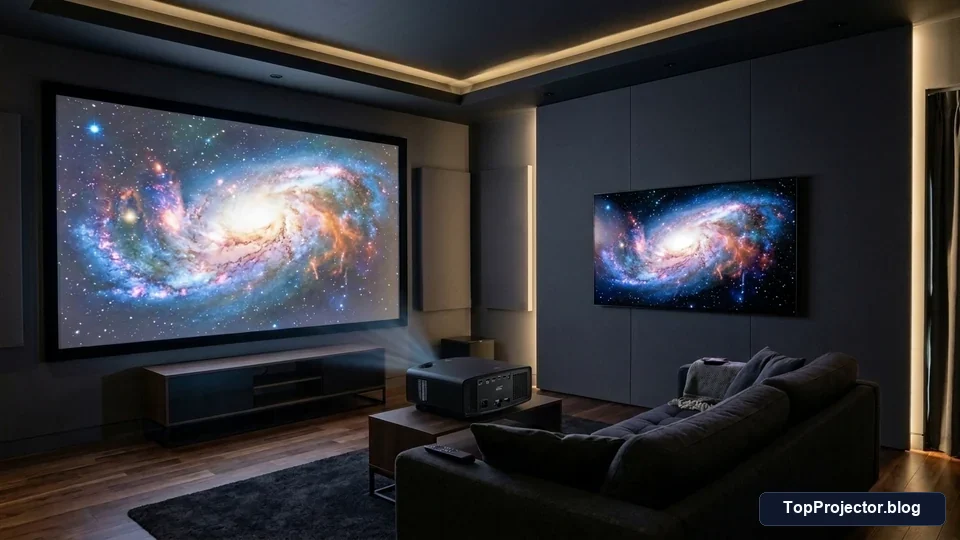
OLED technology operates differently by turning off individual pixels completely. This yields infinite contrast ratios that no lamp-based or laser projector can physically replicate in mixed light.
Dedicated bat-cave theaters equipped with black velvet velvet walls allow high-end LCoS projectors to close this contrast gap. Still, emissive pixels maintain an inherent advantage for shadow detail.
- OLED provides true zero-nit black levels
- Projectors require dark, light-absorbing room treatments
- Laser dimming algorithms help projectors improve contrast
The Dark Room Advantage
When ambient light is eliminated, high-end 4K projectors deliver a remarkably organic cinematic look. The reflected light feels more natural for long viewing sessions than direct panels.
However, even in controlled spaces, bright highlights can scatter light off white ceilings. You can evaluate output needs using our ansi lumens room calculator to maintain strong ANSI contrast.
- Reflected light mimics commercial cinemas
- Ceiling reflections can wash out dark sequences
Ambient Light Rejection and Daytime Performance Realities
Daytime viewing introduces harsh challenges for projection systems. Standard white matte surfaces catch all incoming room light, washing out images and ruining color saturation.
Specialized ambient light rejecting screens help mitigate this issue by absorbing off-axis light. They successfully boost perceived contrast, though they cannot compete with direct emissive brightness.
OLED displays feature glossy or semi-matte anti-reflective coatings that diffuse sunlight brilliantly. They maintain rich, punchy colors even when placed directly opposite floor-to-ceiling windows.
- Standard screens fail in bright daylight
- ALR screens rescue projectors in family rooms
- OLED panels conquer high-glare environments easily
Living Room Daylight Survival
If your setup resides in a sunlit living room, an OLED is the safer bet. Projectors require high lumen output exceeding three thousand lumens to punch through daylight.
Pairing a high-lumen laser projector with a specialized ceiling-rejecting screen bridges the gap. Yet, the overall image will still look muted compared to a punchy OLED panel.
- High lumen counts are mandatory for daylight
- OLED maintains contrast under direct sunlight
Peak Brightness, Color Volume, and HDR Highs
High dynamic range content demands intense peak highlights paired with deep shadows. OLED panels deliver exceptional specular highlights due to high pixel-level luminance control.
Projectors must spread their total light output across massive screen areas. Consequently, their actual nits per square foot fall far below what modern televisions achieve.
Despite lower peak nits, projectors excel at large-scale color volume. They deliver sweeping, comfortable vistas that make cinematic HDR feel vast and truer to life.
- OLED masters small specular HDR highlights
- Projectors spread lumens over huge surface areas
- Wide color gamuts look stunning on modern lasers
Evaluating HDR Tone Mapping
Projectors utilize complex dynamic tone mapping to handle HDR metadata. Because they lack TV-level brightness, processors must aggressively remap highlights to prevent clipping.
OLED televisions map HDR effortlessly because their peak brightness aligns with standard mastering targets. This results in plug-and-play accurate tone reproduction without complex user calibration.
- Dynamic tone mapping is essential for projectors
- OLED displays handle HDR metadata natively
Screen Scaling, Form Factor, and Cinematic Immersion
Immersion scales exponentially with image size, supported by understanding ansi lumens specifications for your space. Modern units easily achieve 120 to 150-inch diagonals, filling your entire field of view.
OLED televisions offer breathtaking sharpness and clarity, but physical size limits remain an issue. Standard large panels max out around 83 inches before pricing becomes astronomical.
Achieving true IMAX-style immersion at home is financially out of reach with flat panels. Projectors deliver that authentic theater scale at a fraction of the cost per inch.
- Projectors scale effortlessly past 120 inches
- OLED TVs offer unmatched sharpness at smaller sizes
- Cost per square inch favors projection systems
The Ultimate Big Screen Experience
Nothing replicates the sheer scale of a perforated acoustically transparent screen. Audio matches the visual cues precisely when speakers are placed behind the projection surface.
Flat panel displays force you to compromise on center channel speaker placement. Sound must emanate from below or above the frame, reducing acoustic realism.
- Acoustically transparent screens enhance audio
- TVs restrict central sound localization
Viewing Angles, Off-Axis Uniformity, and Seating Geometry
Seating geometry dictates display choice when hosting large groups. OLED panels provide flawless 180-degree viewing angles with zero color shift or brightness drop-off.
Projector screens rely on specific gain ratings that restrict optimal viewing cones. Sitting too far off-axis results in significant image dimming and loss of perceived contrast.
High-gain screens introduce hot-spotting where the center appears much brighter than the edges. Flat panels maintain perfect luminance uniformity across the entire display matrix.
- OLED delivers perfect off-axis viewing
- Projector screens have strict viewing cones
- Hot-spotting affects high-gain projection surfaces
Multi-Row Seating Dynamics
Dedicated theaters with stadium seating require wide dispersion properties. Matte white unity gain surfaces work best here to ensure back-row viewers see adequate brightness.
Living rooms with wrap-around sectional sofas benefit greatly from OLED technology. Every seat in the house enjoys identical contrast, color fidelity, and sharpness.
- Unity gain screens suit multi-row seating
- Sectional sofas demand wide viewing angles
Competitive Gaming Latency and Motion Resolution
Modern gamers demand ultra-low input lag and advanced features. As highlighted in our Hisense C2 Ultra review, high-end optical systems now achieve stellar 4K 120Hz support for fast-paced titles.
Projectors are catching up with dedicated gaming modes achieving 15ms to 20ms lag. However, true 4K high refresh rate projection remains rare and expensive.
Motion handling also favors emissive panels. OLED pixel transitions happen instantaneously, eliminating ghosting and motion blur without relying on aggressive black frame insertion.
- OLED features sub-5ms input lag
- Gaming projectors target 15ms to 20ms latency
- Instant pixel response prevents motion blur
High Refresh Rate Performance
PC gamers and next-gen console owners thrive on high frame rates. OLED TVs handle 120Hz and 144Hz signals smoothly with Variable Refresh Rate technology enabled.
Most projectors sacrifice resolution to achieve high refresh rates, dropping down to 1080p at 240Hz. This trade-off impacts visual fidelity for immersive open-world titles.
- OLED supports native 4K 120Hz gaming
- Projectors often compromise resolution for speed
Physical Installation, Acoustics, and Long-Term Maintenance
Selecting the right hardware starts by exploring our best home projector picks for dedicated media rooms. You must carefully calculate throw ratios, lens shift limits, and secure proper ceiling mount stability.
OLED TVs offer straightforward out-of-the-box installation on media stands or wall mounts. Maintenance is minimal, requiring only occasional dusting compared to filter cleanings on projectors.
Fan noise is another critical factor for projection systems. High-output lamps generate noticeable acoustic hum during quiet movie scenes, whereas OLED panels operate in complete silence.
- Projectors require precise throw distance calculations
- OLED panels offer simple plug-and-play setup
- Cooling fans add noticeable ambient noise
Maintenance and Lifespan Realities
Lamp-based projectors require bulb replacements every few thousand hours. Laser light engines alleviate this concern by offering 20,000 hours of maintenance-free operation.
OLED panels last indefinitely under normal use, though static HUD elements can cause permanent burn-in. Proper care routines mitigate this risk effectively in modern sets.
- Laser engines provide long operational lifespans
- OLED panels require burn-in prevention care
Frequently Asked Questions
Can a home theater projector replace an OLED TV in a bright living room?
Projectors generally struggle against strong daylight unless paired with high-lumen lasers and specialized ambient light rejecting screens. For bright spaces, an OLED TV remains the superior choice.
Why do OLED TVs offer better contrast than high-end laser projectors?
OLED pixels turn completely off to achieve true zero-nit black levels and infinite contrast ratios. Projectors always reflect some ambient light, which raises the black floor.
Are projectors better for watching movies than flat-panel OLED displays?
Projectors deliver an authentic commercial cinema scale exceeding 120 inches that flat panels cannot match affordably. Movie enthusiasts prioritize this massive screen immersion above all else.
Do home theater projectors suffer from high input lag for modern console gaming?
Modern gaming projectors achieve respectable input lag around 15ms to 20ms in fast response modes. However, OLED displays remain faster with sub-5ms latency and 4K 120Hz support.
What is the typical lifespan of a modern laser home theater projector?
Solid-state laser phosphor engines typically deliver between 20,000 and 30,000 hours of continuous operation. This ensures years of maintenance-free movie watching without bulb changes.