Projector On Screen vs. Wall: Which Wins for Your Room?
Choosing a dedicated projection surface over a bare wall fundamentally transforms your home theater experience by optimizing optical gain and controlling stray ambient light for superior contrast.
A dedicated projection screen easily wins for dedicated theaters and bright rooms due to enhanced ambient light rejection, while bare walls only suffice for ultra-budget temporary setups.
Compare full category rankings in our Best Outdoor Movie Projector: Top Backyard Picks.
Side-by-Side Specification Breakdown
| Criteria | Projector On Screen | Wall | Edge |
|---|---|---|---|
| Ambient Light Rejection | High ALR fabric blocks 80% overhead light | Bare drywall reflects ambient light freely | Projector On Screen |
| Black Levels & Perceived Contrast | Deepens black floor via micro-serrated optical ridges | Washes out completely under any ambient light | Projector On Screen |
| Peak Brightness & HDR Punch | Optimizes retro-reflection for high specular highlights | Scatters light randomly, destroying HDR punch | Projector On Screen |
| Screen Size & Immersion | Fixed frame dimensions lock in crisp geometry | Limited only by wall space but poor uniformity | Projector On Screen |
| Viewing Angles & Uniformity | Wide 160-degree viewing cone with zero hot-spotting | Prone to texture hotspots and uneven paint sheen | Projector On Screen |
| Gaming Motion & Input Lag | Maintains native response times with zero lag | No electronic lag, but motion looks washed out | Projector On Screen |
| Room Setup & Maintenance | Requires precise wall mounting and tensioning | Zero setup cost but prone to stains and scuffs | Projector On Screen |
Optical Performance and Black Floor Dynamics
Projector screens utilize specialized optical coatings designed to absorb off-axis light while precisely returning projector beams to viewers, drastically lowering your black floor for cinematic depth.
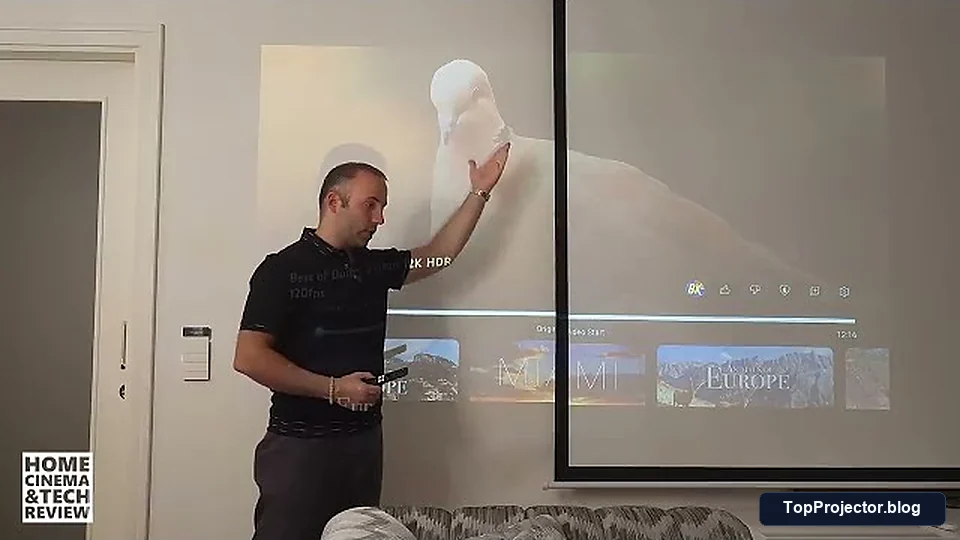
When upgrading for backyard movie nights, choosing the best outdoor movie projector paired with a portable screen prevents bare drywall diffusion issues and preserves native contrast ratios.
Projecting directly onto a painted living room wall introduces severe light scatter across the microscopic texture, destroying native contrast ratios below 500:1 in dark scenes.
Dedicated projection screens utilize specialized optical vinyl or flexible PVC substrates that absorb ambient scatter, preserving deep shadow detail and lowering black floors significantly.
- Micro-serrated optical ridges
- Diffuse drywall scattering
- Enhanced black level retention
Pitch-Black Dedicated Theaters
In a completely blacked-out room with velvet walls, a matte white screen delivers reference-grade color neutrality and accurate gamma tracking without introducing artifacts.
Even in pitch darkness, a raw painted wall retains microscopic texture imperfections that visibly interfere with ultra-sharp 4K pixel grids.
- Reference matte white surfaces
- Textured wall interference
Subsurface Micro-Structure Analysis
Wall plaster contains uneven aggregate particles that reflect light chaotically, creating a fuzzy halo around bright highlights and washing out dark cinematic sequences completely.
Premium matte white screens feature a smooth calendared surface designed to maintain sharp pixel boundaries, ensuring pristine 4K resolution delivery without any optical distortion.
Ambient Light Rejection in Living Room Environments
Modern living rooms present massive lighting challenges that completely overwhelm standard white walls, turning dark cinematic scenes into an unwatchable washed-out gray haze.
Before deployment, ensure optimal light transfer by checking out how to clean projector lens surfaces, allowing specialized ambient light rejection filters to maximize your ANSI lumens.
Standard walls act as diffuse reflectors, bouncing every stray photon from living room windows and overhead lamps directly back into your eyes, ruining picture saturation.
Ambient Light Rejecting screens employ microscopic optical filters that actively reject ceiling light while reflecting ultra-short throw projector beams toward seated home theater viewers.
- Triangular optical filters
- Ceiling light rejection
- Washed-out gray prevention
Daytime Viewing Dynamics
Daytime streaming through windows destroys bare wall contrast instantly, whereas high-gain ALR materials maintain vibrant specular highlights and rich color saturation.
Attempting daytime viewing on a standard wall requires blackout curtains, whereas premium ALR surfaces preserve image integrity under moderate ambient room lighting.
- Daytime contrast preservation
- Blackout curtain reliance
Angular Light Rejection Efficiency
True ALR surfaces achieve up to 85% ambient light suppression, making daylight viewing viable without requiring expensive motorized blackout shades across every single window.
Painted walls lack directional filtering physics, meaning a single table lamp washes out your entire image, dropping ANSI contrast levels to unusable levels immediately.
Peak Brightness, Gain, and Off-Axis Viewing Angles
Calculating your ideal screen size and viewing distance helps determine whether 1.1 gain materials or specialized high-gain surfaces best suit your room layout.
Painted walls offer inconsistent gain across their surface area, resulting in unpredictable hot-spotting and severe brightness drop-off when viewed from wide seating angles.
Screen gain dictates how intensely a surface bounces light forward, with 1.1 gain white screens offering wide viewing angles versus specialized high-gain retroreflective options.
Textured drywall absorbs variable amounts of light unevenly, creating hotspots and severe brightness drops when you sit outside the central narrow 30-degree viewing cone.
- Predictable gain ratings
- Unpredictable wall hot-spotting
Wide Seating Arrangements
Accommodating large families requires wide off-axis viewing angles where specialized angular-reflective screens maintain uniform brightness across all primary seating positions.
Walls suffer from drastic color shifting and luminosity drops as viewers move away from the central optical axis, ruining side-seat experiences.
- Uniform off-axis brightness
- Central axis luminosity drop
Hotspotting and Cone Limitations
High-gain directional screens often suffer from visible hotspotting in the center, requiring careful matching with projector throw distances exceeding standard 1.5:1 throw ratios.
Painted walls avoid directional hotspotting entirely due to uniform matte scattering, but they sacrifice the peak brightness boost necessary for punchy HDR specular highlights.
Color Fidelity, HDR Impact, and Gamma Tracking
Advanced laser models examined in our Hisense C2 Ultra review deliver the necessary white point accuracy and deep contrast ratios to make HDR highlights pop.
Standard walls introduce yellowish or bluish tint variations depending on your base paint color, permanently distorting DCI-P3 color calibration targets and HDR tone mapping.
Wall paint formulas frequently introduce unwanted color tints like warm yellow or cool blue, completely skewing white balance and ruining calibrated Rec.709 color accuracy.
Reference screens use neutral gray or white PVC formulas that maintain precise spectral neutrality, ensuring your projector tone mapping matches strict director intent accurately.
- DCI-P3 color calibration
- Base paint tint distortion
Color Accuracy in Dark Rooms
Neutral gray or white screens ensure your projector's factory calibration remains completely untainted, delivering director-intended color fidelity straight to your eyes.
Textured drywall absorbs specific light frequencies unevenly, causing subtle color banding and muddy shadow details during complex cinematic sequences.
- Director-intended color fidelity
- Subtle color banding
HDR Tone Mapping Precision
High dynamic range content demands strict gamma tracking around 2.4 gamma, which textured walls disrupt by scattering specular highlights across uneven plaster surface grains.
Dedicated screens preserve peak specular highlights without clipping, allowing modern laser projectors to display dazzling contrast transitions in demanding dark room thriller movies.
Gaming Motion, Response Times, and Input Lag
Fast-paced gaming requires pristine motion clarity and sharp pixel geometry to track fast-moving targets without blurring or ghosting artifacts.
While screens do not introduce electronic input lag, their smooth micro-textured surfaces allow high-refresh-rate ultra-short-throw projectors to render crisp HUD elements flawlessly.
Fast-paced competitive gaming requires ultra-low input lag under 16ms, ensuring your controller inputs translate instantly to on-screen actions without noticeable motion display stutter today.
While screens do not process digital signals, their optical clarity prevents motion smearing that often occurs when projectors interact with uneven textured wall surfaces.
- Pristine motion clarity
- Zero electronic input lag
High-Refresh Console Sessions
Modern gaming projectors pushing high frame rates demand perfectly flat tensioned surfaces to prevent geometric warping during rapid camera pans.
Wall irregularities cause subtle geometric distortion that becomes distracting during intense competitive multiplayer gaming sessions on massive screens.
- Tensioned surface flatness
- Competitive multiplayer clarity
Motion Handling on Textured Surfaces
Rapid camera panning across a textured wall exposes microscopic shadows in the plaster, creating a distracting grid effect that mimics poor pixel response times.
Smooth screen materials eliminate surface-induced motion artifacts, letting high refresh rate gaming projectors deliver crisp, blur-free motion during intense fast-paced first-person shooter matches.
Room Setup, Installation Mechanics, and Surface Maintenance
Installing a fixed-frame projection screen requires careful wall anchoring, precise frame tensioning, and dedicated alignment to guarantee zero sagging over time.
Painting a wall is undeniably cheaper and faster, but it exposes your projection surface to permanent stains, scuffs, and unavoidable drywall imperfections.
Installing a fixed-frame screen requires precise wall anchoring and meticulous frame tensioning to prevent annoying ripples across the vinyl surface over long operating periods.
Painting a dedicated projection wall saves upfront hardware costs, but requires flawless drywall skimming, sanding, and specialized projector paint application to minimize optical flaws.
- Fixed-frame tensioning
- Drywall stain vulnerability
Long-Term Surface Durability
Premium vinyl projection surfaces resist dust accumulation and can be wiped clean gently, protecting your investment for a decade of heavy home theater use.
Painted walls degrade faster under routine cleaning and cannot be easily repaired without repainting the entire room surface to maintain uniform texture.
- Vinyl surface longevity
- Repainting maintenance hassle
Long-Term Durability and Cleaning
Vinyl projection screens can be gently wiped with mild soap and water, whereas painted drywall stains permanently if touched by greasy fingers or dust.
Wall setups are prone to settling cracks and scuffs over time, forcing homeowners to repaint the entire surface every few years to maintain uniformity.
Definitive Scenario-Based Winner Selection
Selecting the right option ultimately depends on your room environment, budget flexibility, and performance expectations for cinematic movie nights.
Dedicated projection screens represent the definitive optical winner for anyone seeking true cinematic performance and uncompromised HDR contrast.
Dedicated home theater spaces with controlled lighting and dark velvet walls favor acoustically transparent woven screens to achieve optimal audio placement and image fidelity.
Multi-purpose living rooms with ambient light strictly demand an ALR fixed-frame screen to combat daytime washouts, making painted walls completely obsolete for serious viewers.
- Cinematic performance winner
- Environmental suitability check
When to Choose Each Option
Choose a dedicated screen for living rooms, media rooms, and permanent theaters where optimal contrast and light control matter most.
Choose a bare wall only as a temporary testing solution before investing in proper optical projection fabric for your space.
- Permanent theater recommendation
- Temporary testing workaround
Final Buyer Decision Matrix
Choose a high-end screen if you value accurate color reproduction, superior contrast, and long-term durability over initial budget savings in your primary entertainment space.
Opt for a carefully prepped wall only if you are renting, working on a tight budget, or utilizing an ultra-short throw setup with paint.
Frequently Asked Questions
Does painting a wall with special projector paint match a real screen?
Specialty projector paint improves gain slightly over standard flat white paint, but it still lacks the micro-structured optical layers required to reject ambient light effectively.
Can I use an ALR screen with a standard long-throw projector?
Ambient light rejection screens are specifically engineered for either ultra-short-throw or long-throw throw ratios, so you must match your screen type to your exact projector geometry.
How much does a quality fixed frame screen improve contrast?
A quality fixed-frame screen dramatically boosts perceived contrast by absorbing stray room reflections and preventing light scatter, preserving rich black floor levels.
Is a white screen or gray screen better for a dark home theater?
Pure white screens maximize peak brightness in pitch-black rooms, whereas neutral gray screens enhance black levels if your room has minor reflective surfaces.
Why do projector screens cost significantly more than drywall?
Projector screens utilize advanced multi-layer optical vinyl, tensioned aluminum frames, and specialized light-filtering compounds that raw drywall simply cannot replicate.