Projection Screen vs. Tv: Which Wins for Your Room?
Comparing projection screens and flat-panel TVs reveals stark trade-offs in ambient light rejection and maximum scalable image size for your dedicated home theater space.
Choose a flat-panel television for bright, multi-purpose living rooms, but invest in an optical projection screen if you demand massive cinematic immersion in controlled environments.
Compare full category rankings in our Best Projector Screen For Home Theater (2026 Guide).
Side-by-Side Specification Breakdown
| Criteria | Projection Screen | Tv | Edge |
|---|---|---|---|
| Ambient Light Rejection | Requires specialized ALR fabrics | Natural self-emissive pixel dominance | Tv |
| Black Levels & Perceived Contrast | Dependent on room light control | Exceptional native dark floors | Tv |
| Peak Brightness & HDR Punch | Measured in lumens at screen surface | High nits for bright specular highlights | Tv |
| Screen Size & Immersion | Easily scales from 100 to 150 inches | Cost-prohibitive above 98 inches | Projection Screen |
| Viewing Angles & Uniformity | Varies by gain and optical coating | Wide off-axis retention on OLED/LED | Tv |
| Gaming Motion & Input Lag | Relies entirely on projector latency | Built-in 120Hz panels with VRR | Tv |
| Room Setup & Maintenance | Complex wall mounting and alignment | Standard VESA bracket installation | Tv |
Ambient Light Rejection and Daytime Performance Mechanics
Flat-panel televisions rely on self-emissive pixels that easily overpower room illumination. This natural luminescence guarantees punchy daylight viewing without washing out dark scenes or demanding specialized window treatments.
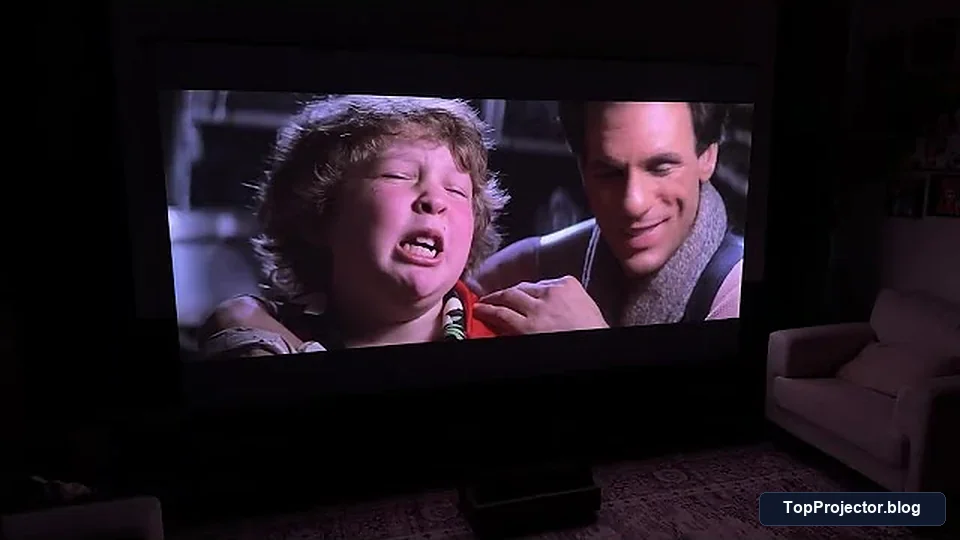
Standard matte white projection screens scatter ambient light indiscriminately, destroying contrast in bright rooms. However, specialized ALR micro-serrated materials actively reject overhead ceiling light while reflecting projector beams forward.
Achieving true daylight viability with projection demands matching high-lumen laser light engines with directional optical fabrics. Without this pairing, washed-out blacks render daytime viewing deeply disappointing.
High-gain ALR materials utilize microscopic optical structures to actively reflect off-axis ambient illumination away from the viewer while redirecting the projector's direct beam forward, preserving a usable 1000 ANSI lumen image in bright rooms.
- Self-emissive panels maintain contrast in sunlit rooms effortlessly.
- ALR projection surfaces require careful angle matching with ultra-short throw lasers.
- Ambient room illumination degrades matte white projector gains severely.
Pitch-Black Theater vs. Living Room Daylight
Dedicated media rooms eliminate all stray photons, allowing high-gain white screens to maximize perceived ANSI contrast ratios without washing out delicate dark details.
Living spaces flooded with windows demand specialized ambient light rejection. Check out options in our best projector screen roundup to successfully salvage daytime projector utility.
- Blackout curtains transform standard rooms into pristine optical environments.
- Specialized ambient rejecting fabrics salvage daytime projection contrast.
Micro-Structure Directional Filtering
Sawtooth optical layers actively reject overhead ceiling light while maintaining a wide 160-degree viewing cone, ensuring daytime performance without washing out vital shadow details during mixed-use living room sessions.
Native Contrast Ratios, Black Floors, and Shadow Detail
Modern OLED televisions achieve infinite contrast by completely shutting off individual pixels. This pristine black floor allows starfields and deep shadows to pop with striking realism.
Projection screens reflect light rather than emitting it, making them vulnerable to ambient bounce. Even in dark rooms, light reflecting off white walls can raise the black floor significantly.
To combat washed-out blacks, dedicated home theaters utilize gray-based projection materials. These specialized surfaces absorb scattered light, boosting perceived contrast at the expense of peak white output.
While OLED televisions achieve infinite contrast with a true zero-nit black floor, projectors rely on lens positioning. Learn how optics work by reading our guide to projector throw ratios.
- OLED panels deliver absolute zero black levels.
- Gray projection screens enhance shadow detail in treated rooms.
- Room reflectivity impacts projection contrast more than flat panels.
Evaluating Shadow Separation in Dark Environments
Dark scene performance relies heavily on your display's ability to render subtle gradations near absolute black. TVs manage this natively through local dimming zones.
Projectors achieve dark separation through precise iris control and high-quality optical lenses. Screen gain choice directly influences how well shadow details survive ambient bounce.
- Local dimming algorithms prevent blooming artifacts on flat panels.
- Optical lens quality dictates fine shadow separation on large screens.
Room Reflection Management
Even high-end laser units struggle to maintain deep blacks if your room features white walls, reflecting back up to 20 percent of emitted light and ruining perceived ANSI contrast performance.
Peak Brightness, HDR Specular Highlights, and Gain Management
High dynamic range content demands intense peak luminance to render blinding specular highlights like explosions or sun reflections. Premium flat-panel TVs easily exceed high nit thresholds.
Projectors measure output in lumens spread across massive surface areas. Achieving true HDR punch on a massive screen requires powerful laser light sources and low-gain materials.
Screen gain acts as a multiplier for projected light, focusing beam dispersion. High-gain surfaces boost center brightness but introduce narrow viewing angles and noticeable hot-spotting artifacts.
Projector screens distribute reflected light based on screen gain ratings, where a 1.1 gain surface concentrates punchy highlights while sacrificing off-axis viewing angles compared to a completely matte white unity surface.
- Flat panels excel at delivering intense HDR nit counts.
- Projector HDR depends on balancing room size with total lumen output.
- Screen gain management prevents severe off-axis brightness drop-off.
Lumen Output Versus Panel Luminance
Understanding the difference between projector lumens and television nits is vital for accurate comparison. Lumens measure total light output, while nits measure luminance per square meter.
A massive projection screen distributes total lumens across a vast area, reducing perceived punch. Televisions concentrate high nit output into a smaller footprint for dramatic impact.
- Lumen distribution dictates large-format projection brightness.
- Nit concentration creates intense visual pop on smaller displays.
HDR Tone Mapping Realities
Because projectors cannot match the 2000-nit peaks of flagship TVs, sophisticated onboard dynamic tone mapping is essential to reveal bright cloud details without clipping high-IRE specular highlights.
Massive Screen Scaling Versus Traditional Display Geometry
The single greatest advantage of a projection setup is adjustable, cinematic scaling. While televisions cap out at massive, expensive sizes, projectors easily deliver 120 to 150-inch diagonals.
Immersive viewing angles require occupying a significant portion of your visual field. Projection screens achieve authentic commercial movie theater immersion at a fraction of the per-inch cost.
Flat-panel televisions over ninety inches become exceptionally heavy, fragile, and difficult to navigate through standard doorways. Projection screens ship disassembled and assemble easily inside your room.
Scaling beyond a 120-inch diagonal fundamentally alters your cinematic immersion, delivering a massive field of view that fixed flat panels simply cannot replicate without prohibitive shipping and installation costs.
- Projectors scale effortlessly beyond standard television limits.
- Large flat panels present severe delivery and structural mounting hurdles.
- Cinematic immersion scales directly with physical display footprint.
Calculating Throw Distance and Room Geometry
Ultra-short throw projectors sit inches from walls, projecting upward onto tensioned surfaces. Plan your ideal room dimensions using our throw distance calculator tool for precise mounting.
Standard long-throw models require careful ceiling mounting and precise optical alignment. Room dimensions dictate maximum achievable image size based on lens throw ratios.
- Ultra-short throw setups minimize space requirements dramatically.
- Long-throw models demand dedicated ceiling installation and alignment.
Aspect Ratio Flexibility
Cinematic setups leverage constant image height masking systems to accommodate 2.39:1 scope movies natively, avoiding distracting letterbox bars that permanently limit usable pixels on traditional 16:9 televisions.
Color Gamut Tracking, Motion Handling, and Console Gaming
Modern gaming requires ultra-low input lag and fast refresh rates. Premium flat-panel TVs feature built-in gaming hubs, variable refresh rates, and lightning-fast response times.
While modern gaming projectors have drastically reduced input lag down to single-digit milliseconds, they rarely match the comprehensive HDMI 2.1 feature sets found on high-end displays.
Color accuracy across both display types is remarkably high when properly calibrated. Laser projectors utilizing wide color filters cover expansive DCI-P3 gamuts matching cinema standards.
Modern gaming projectors achieve competitive input lag figures under 15 milliseconds at 4K/60Hz, pairing fluid motion handling with wide DCI-P3 color gamut coverage for vibrant, responsive competitive sessions.
- Televisions dominate modern gaming feature sets and refresh rates.
- Laser projection now offers impressive color volume and wide gamuts.
- Input lag has improved significantly across both display categories.
Motion Resolution and Fast-Action Sports Performance
Fast-moving objects can introduce motion blur on basic panels. Premium televisions utilize sophisticated black frame insertion and high refresh rates to maintain razor-sharp motion clarity.
Projectors handle motion naturally due to inherent display technologies, though high-end models include frame interpolation algorithms to smooth out rapid camera pans during sports broadcasts.
- Motion clarity is essential for fast sports and competitive gaming.
- Frame interpolation helps reduce stutter on massive projected images.
Laser Phosphor Accuracy
RGB laser engines bypass traditional color wheel bottlenecks, delivering precise calibration tracking and wide color volumes without the visible rainbow artifacts common in older single-chip DLP designs.
Architectural Integration, Throw Distances, and Room Requirements
Integrating a massive display into your living space involves distinct aesthetic choices. A large black television dominates the room visually even when powered off.
Motorized projection screens roll completely out of sight into the ceiling, leaving your living room decor untouched. This architectural flexibility is a major selling point for multi-use spaces.
Permanent fixed-frame projection screens offer optimal surface flatness, eliminating wrinkles or waves. However, they require a dedicated wall surface that cannot double as artwork display.
Compact laser units sit inches from walls, utilizing specialized screens to eliminate mounting hurdles. As noted in our Epson EpiqVision Mini EF12 review, massive imagery is easily achievable.
- Motorized screens conceal completely when not in active use.
- Fixed-frame screens guarantee optimal optical surface flatness.
- Large televisions act as massive black rectangles in living spaces.
Wall Preparation and Structural Mounting Challenges
Hanging a heavy flat-panel television requires locating sturdy wall studs and utilizing heavy-duty VESA hardware to ensure absolute safety.
Tensioned projection screens require precise wall anchoring to maintain uniform fabric pull. Any warping across the screen frame can distort linear geometry during projection.
- Heavy televisions demand robust wall stud reinforcement.
- Screen tensioning systems prevent undesirable fabric warping.
Throw Ratio Calculations
Always verify your precise throw ratio before committing to a ceiling mount, ensuring the lens optics can fill your target 120-inch screen from the available physical anchor points.
Definitive Scenario-Based Buying Verdicts
Selecting between a projection screen and a television comes down to prioritizing room lighting conditions versus physical image size. There is no universal optical winner.
Choose a high-end television if your viewing area features abundant natural light, mixed daytime use, and heavy console gaming demands with advanced HDMI 2.1 features.
Invest in a dedicated projection screen and laser projector pairing if you want authentic cinema-scale immersion, adjustable image sizing, and a clean living room aesthetic.
Choose a large flat panel TV for well-lit multi-purpose family rooms requiring instant power-on convenience, while dedicated projection setups remain the undisputed king for immersive movie nights and massive scale.
- Televisions win for bright, multi-use rooms and advanced gaming.
- Projection screens win for massive cinematic scale and room aesthetics.
- Analyze your primary room lighting before making a final purchase.
Final Summary for Home Theater Enthusiasts
Balancing optical performance with practical living space constraints ensures long-term satisfaction. Modern technology has narrowed the performance gap between both display formats.
Understanding your specific viewing habits and lighting environment will guide you toward the ideal display solution for your home entertainment setup.
- Prioritize room lighting when evaluating display options.
- Match your budget to your desired screen immersion level.
The Ultimate Decision Matrix
Prioritize absolute black levels and daytime vibrancy with a premium television if you refuse to install room darkening shades, but accept the hard size limits of standard flat panel displays.
Frequently Asked Questions
Can projection screens compete with TVs in bright daylight?
Standard projection screens struggle in lit rooms, but specialized ambient light rejection fabrics successfully rescue daytime performance. However, flat-panel televisions still maintain superior contrast and brightness dominance in sunlit living spaces.
How large should my screen be for an immersive home theater?
Achieving true cinematic immersion typically requires a diagonal screen size of at least 120 inches. Projection screens scale effortlessly to this dimension, whereas televisions at this size become exceptionally expensive.
Do projection screens require professional installation?
While fixed-frame screens can be assembled by handy DIYers, achieving precise alignment with ultra-short throw lasers demands patience. Many enthusiasts hire professionals to ensure perfect optical calibration and secure wall mounting.
Which option is better for modern console gaming?
Flat-panel televisions remain superior for gaming due to built-in 120Hz refresh rates and advanced HDMI 2.1 features. Gaming projectors have improved input lag significantly, but they rarely match TV gaming ecosystems.
What is screen gain and why does it matter?
Screen gain measures a surface's ability to reflect directional light compared to a standard reference material. Choosing the right gain helps optimize brightness and viewing angles for your specific projector and room.