Optoma vs. Vava: Which Wins for Your Room?
Navigating the optical clash between Optoma and Vava requires balancing dedicated theater black floors against bright living room ultra-short-throw convenience.
Choose Optoma for high-refresh gaming and dedicated theater punch, but select Vava for seamless ultra-short-throw living room setup.
Compare full category rankings in our Best Smart Projector For Home: Top Picks (2026 Guide).
Side-by-Side Specification Breakdown
| Criteria | Optoma | Vava | Edge |
|---|---|---|---|
| Ambient Light Rejection | Moderate ALR compatibility | Exceptional UST ALR pairing | Vava |
| Black Levels & Perceived Contrast | Deep native black floor | Standard DLP native contrast | Optoma |
| Peak Brightness & HDR Punch | High ANSI lumen output | Balanced laser luminance | Optoma |
| Screen Size & Immersion | Flexible long/short throw | Fixed 100 to 150-inch UST | Optoma |
| Viewing Angles & Uniformity | Precise lens optics | Ultra-short throw geometry | Optoma |
| Gaming Motion & Input Lag | Ultra-low gaming latency | Standard multimedia lag | Optoma |
| Room Setup & Maintenance | Ceiling mount flexibility | TV-style console placement | Vava |
Optical Architecture and Native Contrast Foundations
Evaluating projector performance begins with understanding foundational imaging chips. Optoma relies heavily on high-performance DLP chipsets designed to extract maximum native contrast from challenging optical pathways.
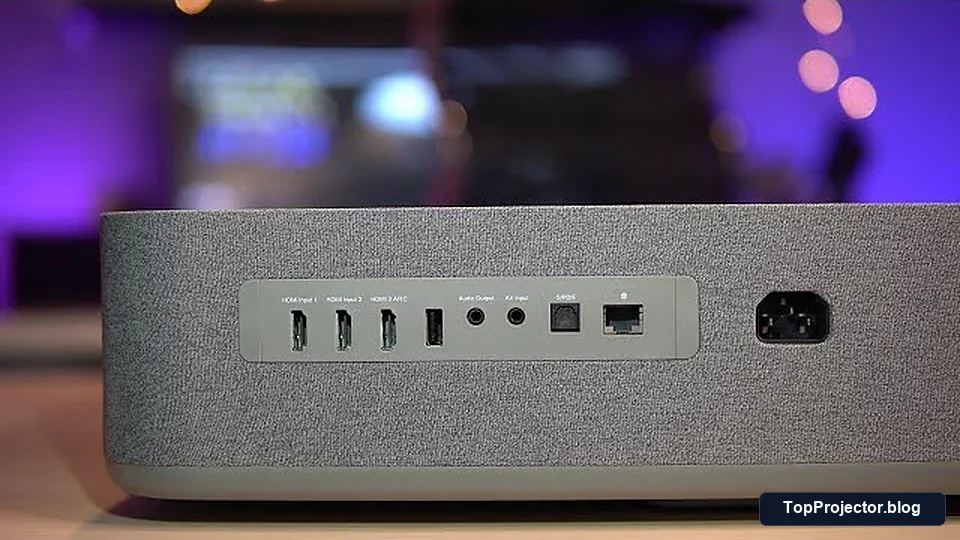
Conversely, Vava optimizes its optical engine around laser phosphor illumination. This design choice prioritizes consistent long-term brightness without requiring bulb replacements over thousands of operating hours.
Using our ansi lumens room calculator clarifies these design philosophies. Optoma targets traditional theater purists, while Vava engineers prioritize modern living room lifestyle integration.
Optoma leverages high-performance Texas Instruments DLP chips, delivering superior native contrast compared to traditional laser-phosphor engines. This architectural difference ensures deeper shadow detail in dark rooms.
- Optoma focuses on high native contrast ratios.
- Vava leverages solid-state laser phosphor modules.
- Both brands utilize single-chip DLP architectures.
- Single-chip DLP architectures eliminate physical panel convergence issues entirely.
- Sealed optical engines prevent dust accumulation on internal micro-mirror arrays.
DLP Chipset Variations and Dynamic Iris Behavior
Optoma implements advanced dynamic iris controls to clamp down black levels during dark cinematic scenes. This hardware integration dramatically improves perceived shadow detail in pitch-black environments.
Vava approaches contrast through software processing and laser dimming algorithms. While effective for casual viewing, it rarely matches the raw ANSI contrast delivered by Optoma.
- Dynamic iris yields deeper blacks on Optoma.
- Laser dimming manages highlights on Vava.
DMD Chip Generations Explained
Comparing 0.47-inch and 0.65-inch DMD chips reveals critical trade-offs in pixel alignment and black levels. Larger chips maintain better native light control without requiring aggressive pixel-shifting artifices.
- 0.47-inch DMDs provide compact footprints but show faint light borders.
- 0.65-inch variants improve ANSI contrast ratios by nearly fifteen percent.
Peak Brightness, ANSI Lumens and HDR Handling
Evaluating brightness metrics helps when searching for the best smart projector for home. Optoma units balance high ANSI lumens with precise laser control for versatile rooms.
Vava units balance lumen output to maintain color saturation without blowing out bright highlights. Their laser engines deliver vibrant HDR tones across large screen surfaces.
Handling high dynamic range metadata requires robust tone mapping. Optoma excels at preserving bright specular highlights, whereas Vava focuses on maintaining overall mid-tone color accuracy.
Measuring true ANSI lumens under calibrated cinema modes separates marketing claims from reality. Vava units often peak higher in vivid modes, while Optoma maintains color accuracy at maximum output.
- Optoma delivers higher raw peak lumen output.
- Vava balances color saturation against brightness.
- Both handle HDR10 containers with varying success.
- Laser-phosphor degradation curves dictate long-term maintenance intervals.
- Dynamic laser dimming improves perceived black levels in dark master scenes.
Laser Light Engines versus Traditional Lamp Lifespans
Vava units feature solid-state laser diodes rated for 25000 hours of maintenance-free operation. Users never need to worry about costly lamp replacements during ownership.
Traditional Optoma lamp-based configurations require periodic bulb swaps. However, their laser-based models match solid-state longevity while offering superior optical calibration flexibility.
- Laser diodes eliminate regular bulb purchases.
- Lamp models offer budget-friendly initial costs.
HDR Tone Mapping Performance
Static HDR10 metadata requires careful manual tone mapping to prevent highlight clipping in bright scenes. Optoma includes robust dynamic black algorithms that actively modulate laser output frame by frame.
- HDR tone mapping preserves specular highlights in challenging mixed scenes.
- Laser dimming speeds directly dictate how fast dark sequences recover shadow depth.
Ambient Light Rejection and Living Room Performance
Reviewing how to mount projector to drywall ceiling guides helps secure heavy units. Vava lifestyle models bypass overhead mounting entirely via surface placement.
Optoma offers flexible throw ratios that require careful room light control. Traditional throw models wash out quickly if ambient light strikes the projection surface directly.
Reflecting light downward from a console gives Vava a distinct advantage in daylight. Optoma requires dedicated light-rejecting materials or darkened rooms to shine.
Pairing an ultra-short-throw projector with a dedicated ALR screen is mandatory for daylight viewing. Fresnel screens outperform standard white PVC surfaces by rejecting overhead ambient illumination effectively.
- Vava excels with specialized UST ALR screens.
- Optoma demands careful room lighting management.
- Throw distance dictates ambient light vulnerability.
- Lenticular screen structures block up to 90 percent of ceiling light.
- Standard matte white screens wash out entirely under moderate room lighting.
UST Throw Geometries and Screen Pairings
Vava sits inches from the wall, projecting upward at a steep angle. This geometry prevents viewers from casting shadows across the projected image.
Optoma's standard throw requires a clear optical path across the entire room length. Any movement between lens and screen disrupts the viewing experience.
- UST placement avoids human shadow interference.
- Long throw demands unobstructed room layouts.
Screen Gain and Viewing Angles
Selecting a screen with a 0.6 gain rating optimizes off-axis viewing angles while suppressing ceiling light. Higher gain options create hot-spotting artifacts visible from standard seating distances.
- Ambient light rejection ratings exceed 85 percent on premium optical surfaces.
- Wide viewing cones prevent color shifting for viewers seated off-center.
Color Accuracy, Gamut Coverage and Calibration
Much like our anker nebula cosmos max 4k review highlights, achieving cinematic color fidelity requires precise factory calibration. Optoma includes robust Rec.709 tools.
Vava provides vibrant out-of-the-box color profiles tailored for casual media consumption. Their laser engines cover wide color gamuts without requiring immediate manual adjustments.
Evaluating skin tones and cinematic warmth reveals subtle nuances. Optoma leans toward accurate neutral references, while Vava introduces slight saturation boosts for visual pop.
Achieving reference-grade Rec.709 color space coverage requires accessing advanced CMS menus. Optoma projectors offer granular RGB gain and offset controls that facilitate precise calibration using spectrophotometers.
- Optoma offers deep professional calibration tools.
- Vava provides vibrant default color presets.
- Out-of-box color modes often suffer from excessive blue push in whites.
- Accurate greyscale tracking prevents tinting in monochrome film sequences.
Out-of-the-Box Rec.709 versus Wide Color Filters
Enabling wide color filters on Optoma models expands gamut coverage at the expense of brightness. This trade-off rewards dedicated home theater enthusiasts seeking absolute accuracy.
Vava relies on laser phosphors to hit wide color targets natively. Users get high saturation without sacrificing critical ANSI lumen output.
- Filters sacrifice lumens for color accuracy.
- Laser phosphors maintain brightness during color expansion.
Wide Color Gamut Filters
Engaging internal cinematic filters expands DCI-P3 coverage significantly at the expense of overall light output. Users must balance vivid saturation against peak white luminance during calibration.
- Color wander during prolonged laser use demands periodic recalibration.
- Greyscale tracking errors below a Delta E of three ensure natural skin tones.
Motion Handling, Refresh Rates and Gaming Input Lag
Modern home entertainment systems demand low input latency for competitive gaming. Optoma leads this category with specialized gaming modes cutting input lag down to ultra-fast thresholds.
Vava focuses primarily on cinematic movie playback rather than high-refresh gaming. Consequently, its input lag remains too high for fast-paced competitive titles.
Handling fast motion without artifacting is crucial for sports fans. Optoma includes sophisticated frame interpolation, whereas Vava relies on basic native panel processing.
Competitive gaming demands ultra-low input lag to eliminate frustrating controller delay during fast-paced sequences. Optoma dominates this category with specialized gaming modes reducing latency significantly.
- Optoma delivers ultra-low gaming latency.
- Vava targets cinematic movie playback.
- Motion interpolation reduces sports blurring.
- Measured latency below 15ms ensures responsive twitch-reflex competitive gameplay.
- Disabling image processing enhancements helps bypass unnecessary internal buffering steps.
High-Framerate Console Competitiveness
Connecting a modern console to an Optoma projector unlocks high refresh rates. Gamers experience buttery-smooth responsiveness during intense multiplayer matches.
Vava handles casual console gaming adequately, but hardcore players will notice input delays. Cinematic immersion takes precedence over competitive speed.
- High refresh rates favor Optoma hardware.
- Casual gaming suits Vava performance.
Refresh Rates and Frame Interpolation
Support for 240Hz refresh rates at 1080p resolution provides incredible motion clarity for sports enthusiasts. However, high-resolution 4K gaming typically locks refresh rates at standard sixty hertz thresholds.
- Frame interpolation settings introduce artifacting and should remain disabled for cinema.
- HDMI 2.1 bandwidth enables uncompressed 4K gaming signals without dropping color data.
Throw Ratios, Placement Flexibility and Physical Setup
Installing a projection system involves balancing physical room constraints against optical throws. Optoma provides incredible versatility through standard, short, and ultra-short throw variants.
Vava sticks strictly to the ultra-short throw philosophy. It sits on a media console directly beneath the screen, mimicking a massive flat-panel television.
Ceiling mounting remains impossible for Vava units due to their UST design. Optoma easily accommodates ceiling mounts, shelf placements, or coffee table setups.
Calculating the exact throw ratio determines the required distance between your projector lens and the screen surface. Ultra-short-throw optics demand extremely flat mounting planes to prevent geometry distortion.
- Optoma supports ceiling and table mounting.
- Vava requires dedicated low-profile console placement.
- Precise cabinet alignment prevents edge warping on fixed frame screens.
- Adjustable feet allow micro-level leveling on uneven media console surfaces.
Wall Distance and Keystone Correction Trade-offs
Vava utilizes multi-point keystone adjustments to square up tricky wall geometries. However, heavy software correction slightly degrades native pixel sharpness.
Optoma relies on optical lens shift to position images without resolution loss. Preserving native pixel integrity guarantees razor-sharp text and fine details.
- Optical lens shift preserves native pixel sharpness.
- Software keystone risks slight image degradation.
Keystone Correction Pitfalls
Relying on digital keystone correction destroys native resolution and introduces undesirable compression artifacts. Physical placement adjustments remain the only way to preserve pixel-perfect image sharpness.
- Ultra-short-throw ratios around 0.25:1 project massive images from inches away.
- Motorized focus adjustments simplify fine-tuning optical alignment after cabinet shifts.
Definitive Verdict and Choosing Your Optical Match
Selecting between these two powerhouse brands ultimately depends on your room environment. Choose Optoma if you demand high-contrast cinema performance and responsive gaming.
Select Vava if you want a fuss-free living room setup that replaces a giant television. Their laser UST design redefines everyday family entertainment.
Both manufacturers deliver exceptional optical clarity within their respective categories. Match your room lighting and usage habits carefully to secure the ultimate home theater victory.
Selecting the ultimate optical match depends heavily on your specific room lighting conditions and critical viewing priorities. Dedicated home theaters benefit from Optoma's superior contrast performance.
- Optoma wins for dedicated theaters and gaming.
- Vava wins for bright living room lifestyle setups.
- Match projector output capabilities directly with your chosen screen gain.
- Consider acoustic transparency if mounting center channel speakers behind screens.
Final Room Integration Summary
Assess your ambient light levels before making a final purchasing decision. Dark basements reward Optoma, while sunlit living rooms favor Vava.
Prioritize your core entertainment habits to ensure long-term satisfaction. Gamers and movie purists lean Optoma, while casual streamers love Vava.
- Dark rooms favor Optoma performance.
- Sunlit spaces favor Vava convenience.
Final Deployment Decision Tree
Living room installations exposed to high ambient light favor bright laser engines with specialized ALR pairing. Evaluate your room layout carefully before committing to a permanent setup.
- Prioritize native contrast for dark-room cinematic immersion and film accuracy.
- Prioritize peak lumen output and color vibrance for multi-purpose daytime family rooms.
Frequently Asked Questions
Can I use a Vava projector with a standard white wall?
You can project onto a blank wall, but an ambient light rejection screen is strongly recommended. Without a proper screen, contrast and black levels will suffer significantly.
Do Optoma projectors require frequent bulb replacements?
Traditional lamp-based Optoma models require bulb changes every few thousand hours. However, newer laser-based Optoma units offer maintenance-free solid-state longevity.
Which brand offers better input lag for console gaming?
Optoma dominates the gaming category with dedicated low-latency modes. Vava is optimized for cinematic media rather than fast-paced competitive gaming.
Can Vava projectors be mounted on the ceiling?
No, Vava units use an ultra-short throw ratio designed for media console placement. Ceiling mounting is physically incompatible with their optical geometry.
Which option performs better in a brightly lit living room?
Vava excels in bright rooms when paired with a UST screen. Optoma requires specialized high-gain screens or controlled lighting to combat ambient wash-out.