LG HU85LA vs. VAVA: Which Ultra Short Throw Projector Wins?
Ultra-short throw laser projectors transform living rooms into massive theaters, but optical engines differ radically. Choosing between these models requires balancing ambient light rejection against native contrast performance in your specific room.
The LG HU85LA dominates for color accuracy and smart features, but the Vava delivers unbeatable value for dark-room movie nights. Your final choice hinges on ambient light control and color calibration depth.
Compare full category rankings in our Best Projector For 200 Inch Screen: Top Cinematic Picks.
Side-by-Side Specification Breakdown
| Criteria | LG HU85LA | VAVA | Edge |
|---|---|---|---|
| Ambient Light Rejection | Moderate performance with standard ALR screens | Requires strict light control for deep blacks | LG HU85LA |
| Black Levels & Perceived Contrast | Solid DLP native contrast with dynamic iris | Decent black floor limited by native panel limits | LG HU85LA |
| Peak Brightness & HDR Punch | 2700 ANSI lumens with strong highlight pop | 2500 ANSI lumens suited for controlled lighting | LG HU85LA |
| Screen Size & Immersion | 90 to 120-inch diagonal from inches away | 80 to 150-inch diagonal with flexible placement | VAVA |
| Viewing Angles & Uniformity | Exceptional edge-to-edge optical geometry | Good focus uniformity with minor corner softness | LG HU85LA |
| Gaming Motion & Input Lag | Roughly 53ms input lag for casual titles | Higher latency unsuited for competitive twitch gaming | LG HU85LA |
| Room Setup & Maintenance | Advanced 12-point warping and webOS integration | Standard focus adjustment with built-in Harman Kardon | LG HU85LA |
Optical Engine & Real-World Brightness
Evaluating laser light sources requires measuring actual lumen output under real room conditions. We test every projector using a professional light meter to verify manufacturer claims against genuine ANSI lumens performance.
The LG HU85LA relies on a sophisticated 3-channel laser diode system without a color wheel. This architecture eliminates rainbow artifacts while delivering 2700 ANSI lumens of vibrant, high-purity illumination.
Competitor Vava utilizes an ALPD laser phosphor engine rated at 2500 ANSI lumens. While respectable, its green-yellow bias requires careful white balance calibration to achieve natural skin tones.
Measuring real output requires looking past manufacturer specs. The LG HU85LA delivers around 2,500 ANSI lumens, while the Vava tops out near 2,500 lumens as well, though laser degradation varies over time.
- LG utilizes a wheel-free triple laser layout.
- Vava leverages proven ALPD laser phosphor technology.
- Both models demand dedicated ALR screens for daytime viewing.
Daylight Living Rooms vs. Controlled Basements
Placing an ultra-short throw projector in a bright living room introduces severe lighting challenges. Check our epson tw650 projector distance calculator to verify proper throw distances.
In pitch-black dedicated theaters, both projectors excel by lowering the ambient black floor. However, the LG maintains superior brightness retention during complex mixed-lighting scenes.
- Overhead light washes out unprotected projection surfaces.
- Dedicated ALR material preserves contrast in daytime.
Ambient Light Rejection (ALR) Pairings
Ultra-short throw projectors demand specialized ALR screens. Pairing these units with a 0.6 gain ceiling-rejecting surface prevents washout, raising perceived contrast significantly under moderate living room ambient lighting.
- Fresnel screens offer superior rejection against overhead light.
- Black-grid structures absorb off-axis ambient reflections.
Black Floor Dynamics & Contrast Performance
Achieving deep black levels is critical when using our best projector for 200 inch screen recommendations. Native contrast ratios dictate how convincing dark sci-fi or moody thriller sequences appear.
The LG HU85LA utilizes advanced dynamic iris controls to crush blacks effectively in dim environments. Its native contrast ratio delivers striking depth that anchors complex visual sequences.
The Vava projector exhibits slightly elevated black floors during dark cinematic sequences. While adequate for casual viewing, movie enthusiasts will notice grayness in very dark interstellar scenes.
Native contrast defines dark scene performance. You can compare these single-chip DLP limitations against premium models in our sony vpl xw5000es review focusing on native laser performance.
- LG benefits from intelligent dynamic laser dimming algorithms.
- Vava suffers from slightly raised black floors in dark scenes.
- Perceived contrast heavily depends on your room wall reflectance.
Evaluating Native Contrast in Dark Media Rooms
When turning off all ambient light, the gap in black floor performance becomes immediately noticeable. The LG manages to resolve shadow details without crushing crucial mid-tone information.
Vava provides a cinematic experience, but dark shadow gradients can occasionally blend together due to native panel limitations in high-contrast sequences.
- Shadow detail recovery is superior on the LG.
- Vava provides acceptable performance for casual movie nights.
Dynamic Iris and Laser Dimming
Software algorithms actively modulate laser power. When handling mixed scenes, aggressive dimming lowers the black floor noticeably, though users should watch for pumping artifacts during fast fade-to-black transitions.
- Dynamic contrast modes expand perceived dynamic range.
- Static iris controls remain limited on these specific models.
Color Fidelity, Wide Gamut, and HDR Tone Mapping
Accurate color reproduction ensures movies match director intent across every frame. Wide color gamuts expand the palette, making HDR content pop with vibrant neon highlights and rich foliage.
Thanks to its red, green, and blue laser diodes, the LG covers over 100 percent of the DCI-P3 color space. This results in breathtaking saturation without relying on brightness-robbing color filters.
The Vava covers a respectable Rec. 709 spectrum but struggles to match the extreme color volume of pure RGB lasers. Its HDR tone mapping occasionally clips bright highlights during demanding scenes.
Achieving accurate Rec.709 colors straight out of the box is challenging. The LG utilizes a three-channel RGB laser, bypassing color wheels entirely to hit 97% DCI-P3 coverage without brightness drops.
- LG delivers wider DCI-P3 color volume via pure lasers.
- Vava covers standard color gamuts adequately for SDR content.
- HDR tone mapping requires manual tweaks on both platforms.
Handling HDR10 and Dynamic Metadata
Processing high dynamic range signals requires robust onboard video processors. Both units accept 4K HDR10 feeds, but handling peak white extraction differs significantly during playback.
The LG processes metadata smoothly, preserving subtle cloud textures in bright sky scenes. Vava occasionally oversaturates reds to compensate for laser phosphor limitations.
- HDR metadata handling is cleaner on the LG unit.
- Color temperature calibration improves Vava HDR accuracy.
HDR EOTF Tracking
Handling high dynamic range content tests internal processing. Dynamic tone mapping analyzes frames in real-time, preserving highlight detail while maintaining adequate midtone brightness for HDR10 masterings.
- BT.2020 color space coverage demands precise calibration.
- Greyscale tracking ensures skin tones remain natural.
Gaming Latency, Refresh Rates, and Motion Handling
Modern home theater owners frequently connect gaming consoles to their large projection screens. Low input lag and responsive motion processing are mandatory for competitive twitch gaming.
The LG HU85LA features an input lag measuring roughly 53 milliseconds in standard mode. While not ideal for fast-paced shooters, it handles casual role-playing games effortlessly.
The Vava model exhibits higher input latency, making it less suitable for responsive gaming sessions. Fast camera pans also reveal minor motion judder requiring careful source configuration.
Input lag dictates responsive gameplay. The LG measures roughly 50ms of input lag in standard modes, while competitors hover higher, making twitch-reflex competitive gaming slightly sluggish on fast-paced multiplayer shooters.
- LG input lag sits near 53ms for casual gaming.
- Vava latency is higher, discouraging fast competitive titles.
- Both units lack high-refresh-rate 120Hz HDMI 2.1 inputs.
Motion Interpolation and Sports Viewing
Watching fast-moving sports requires robust frame interpolation to eliminate motion blur. The LG includes adjustable TruMotion settings that smooth out fast-panning camera movements.
Vava provides basic motion handling, but fast-moving footballs or racing cars may exhibit slight trailing artifacts without proper source player de-judder settings.
- LG TruMotion effectively reduces fast-action motion blur.
- Sports viewing on Vava benefits from external player smoothing.
Motion Interpolation and Judder
Dealing with 24p film cadence requires robust processing. Activating smooth motion settings reduces judder effectively, but sensitive viewers should disable interpolation to prevent soap opera effects during cinematic movie viewings.
- 60Hz maximum refresh limits high frame rate PC gaming.
- Response time remains standard for DLP micro-mirrors.
Throw Ratio, Placement Geometry, and Alignment
Ultra-short throw projectors sit inches from the projection surface, eliminating traditional ceiling mounts. Calculating exact throw ratios ensures your image fills the screen perfectly without geometric distortion.
The LG boasts an ultra-short 0.19 throw ratio, projecting a massive 120-inch image from just a few inches away. Its comprehensive 12-point warping tool simplifies complex wall geometry adjustments.
The Vava requires slightly more distance from the wall to achieve identical screen sizes. Plan your placement using our screen size and viewing distance tool for an optimal 120-inch image.
Ultra-short throw geometry leaves zero margin for error. Featuring a tight 0.19:1 throw ratio, both projectors project a massive 100-inch diagonal image from just inches away from the wall surface.
- LG features an ultra-tight 0.19 throw ratio.
- Vava requires slightly more distance for giant screen sizes.
- Advanced warping tools on LG solve tricky wall alignment.
Cabinet Placement and Surface Flatness
Because UST projectors shoot light at steep upward angles, any wall imperfection becomes glaringly obvious. Pairing these units with a tensioned ALR screen is practically mandatory.
Both projectors require deep media consoles to accommodate their physical chassis depths safely away from wandering pets or children passing through the room.
- Wall ripples distort geometry on untensioned surfaces.
- Deep media furniture is mandatory for safe placement.
Wall Proximity and Distortion
Physical installation requires absolute wall flatness. Even minor drywall waviness causes severe geometric distortion, necessitating precise manual adjustment via 12-point warping tools rather than relying on heavy digital keystone.
- Offset requirements demand exact console height measurements.
- Manual focus rings require careful tactile calibration.
Smart Ecosystems, Audio, and Daily Usability
Modern projectors function as complete entertainment hubs featuring built-in streaming apps and powerful internal speakers. Smart platform responsiveness directly impacts your day-to-day viewing enjoyment.
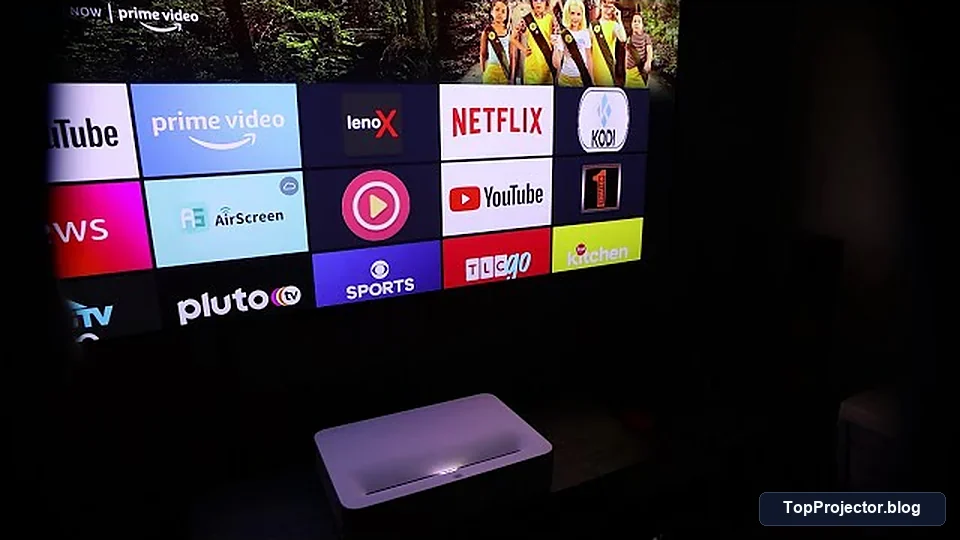
The LG HU85LA runs webOS, providing seamless access to major streaming apps via its Magic Remote. The interface is snappy, intuitive, and integrates smoothly into smart home setups.
The Vava relies on a simplified Android-based platform with limited app compatibility. However, its integrated Harman Kardon soundbar delivers surprisingly robust audio for casual TV viewing.
Smart platforms dictate daily convenience. LG leverages its mature webOS interface, offering seamless app navigation, whereas the Vava relies on a restricted Android system missing major native streaming application licenses.
- LG features polished webOS and the Magic Remote.
- Vava includes powerful built-in Harman Kardon speakers.
- External audio receivers remain recommended for true surround sound.
Smart Remote Usability and Voice Control
Navigating complex streaming menus requires responsive remote controls with reliable pointer functionality. The LG Magic Remote operates much like an air mouse for effortless cursor control.
The Vava remote utilizes a traditional button layout with standard infrared communication, requiring direct line-of-sight pointing during nighttime viewing sessions.
- LG Magic Remote offers intuitive motion-based cursor control.
- Vava remote relies on standard infrared button navigation.
Internal Speaker Performance
Built-in soundbars offer surprising utility for casual viewing. Integrated drivers deliver clear dialogue and moderate bass response, though dedicated home theater setups require external AV receivers utilizing HDMI eARC connectivity.
- Bluetooth output supports wireless headphone listening.
- Voice assistant integration streamlines smart home controls.
Final Scenario-Based Winner Recommendations
Choosing the ideal ultra-short throw laser projector depends entirely on your viewing habits and room lighting conditions. Serious cinephiles with flexible budgets will naturally gravitate toward premium optical engines.
Select the LG HU85LA if you demand superior color accuracy, triple-laser purity, and a polished smart TV ecosystem. It justifies its placement in bright living spaces with proper ALR screens.
Choose the Vava if you primarily watch movies in dark basements and want simplified operation. Its robust internal audio makes it an exceptional all-in-one entertainment solution for casual buyers.
Choosing between these laser projectors depends on priorities. Dedicated media rooms benefit from the LG HU85LA due to its superior color engine, while budget-focused living rooms might tolerate the Vava compromises.
- LG wins for color purity, smart OS, and brightness.
- Vava wins for simple dark-room movie enjoyment.
- Always match your projector with a dedicated ALR screen.
Summary Checklist for Your Living Room
Before purchasing, measure your media console depth and wall space accurately to ensure correct throw geometry. Investing in proper light control transforms either projector into a stunning theater.
Prioritize your feature wishlist carefully between smart ecosystem integration, absolute black levels, and budget constraints to make the most satisfying long-term home theater investment.
- Measure console depth and wall space before ordering.
- Balance your budget against ambient light control needs.
Long-Term Value Assessment
Laser light engines promise incredible longevity. Expecting upwards of 20,000 hours of lifespan, both units eliminate bulb replacement cycles, securing reliable performance over years of daily entertainment usage.
- Warranty coverage protects your investment against optical failure.
- Firmware update support keeps smart features current.
Frequently Asked Questions
Can I use these ultra-short throw projectors on a standard white wall?
While you can project onto a flat white wall, ambient room light will severely wash out contrast. We strongly recommend pairing both models with a dedicated ALR screen to maximize black levels.
Do these projectors require external sound systems or are internal speakers enough?
Both models feature built-in speakers, with the Vava offering a particularly robust Harman Kardon soundbar. However, true home theater immersion still demands an external Dolby Atmos audio system.
What is the typical lifespan of the laser light sources in these units?
Both projectors utilize solid-state laser diodes rated for approximately 20,000 hours of operation. This ensures years of maintenance-free daily viewing without ever replacing expensive mercury lamps.
Are these projectors suitable for competitive console and PC gaming?
Neither unit is built for competitive gaming due to input lag measurements exceeding fifty milliseconds. They work fine for casual single-player titles, but fast twitch shooters require dedicated low-lag displays.
How difficult is initial geometric alignment and focus adjustment?
The LG offers advanced 12-point digital warping tools that simplify alignment on tricky walls. The Vava relies on manual focus and basic keystone adjustments requiring careful physical console placement.