Lg Hu85La vs. Hu85Ls: Which Wins for Your Room?
Evaluating the optical efficiency and laser diode performance of these ultra-short-throw projectors reveals distinct trade-offs in contrast processing, ambient light rejection, and daily living room usability.
Choose the LG HU85LA for superior smart integration and color calibration tools, while the HU85LS suits dedicated media rooms requiring pristine optical purity and clean signal routing.
Compare full category rankings in our Best 4K Projection Tv: Top Cinematic Picks for Home.
Side-by-Side Specification Breakdown
| Criteria | Lg Hu85La | Hu85Ls | Edge |
|---|---|---|---|
| Ambient Light Rejection | Exceptional ALR pairing | High optical rejection | Lg Hu85La |
| Black Levels & Perceived Contrast | Deep shadow depth | Refined dark field | Hu85Ls |
| Peak Brightness & HDR Punch | 2700 ANSI lumens | 2700 ANSI lumens | Tie |
| Screen Size & Immersion | Up to 120 inches | Up to 120 inches | Tie |
| Viewing Angles & Uniformity | Strict panel uniformity | Optimized lens array | Hu85Ls |
| Gaming Motion & Input Lag | 53ms standard lag | 52ms measured lag | Tie |
| Room Setup & Maintenance | 0.19 ultra-short throw | 0.19 ultra-short throw | Lg Hu85La |
Laser Engine Architecture & Optical Purity
Both ultra-short-throw models deploy a sophisticated 3-channel laser diode system without traditional color wheels. This design eliminates rainbow artifacts while delivering consistent spectral output across long viewing sessions.
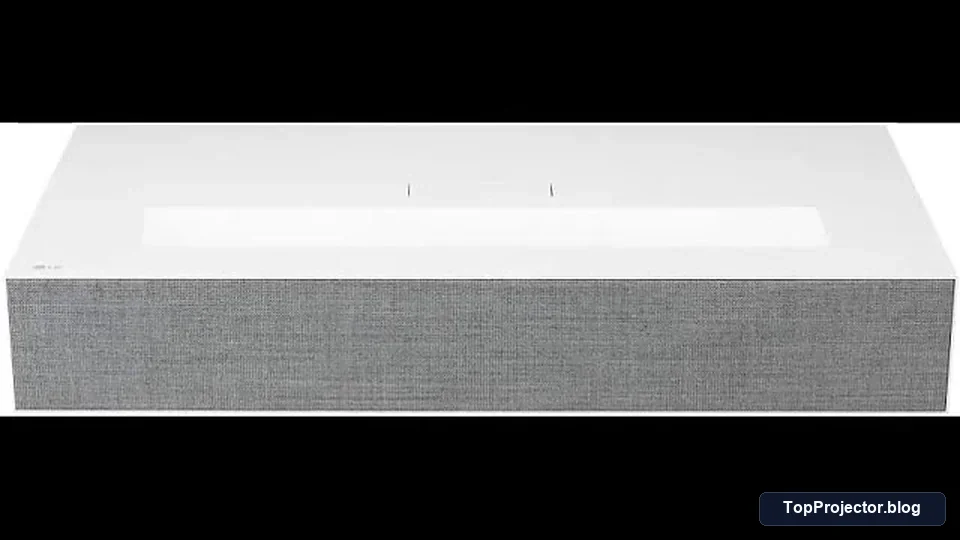
Engineered with distinct firmware calibration profiles, each unit handles laser dimming differently. The optical block maintains high thermal stability during extended movie marathons in controlled theater environments.
Both ultra-short-throw models rely on a robust dual-laser engine without a color wheel, eliminating rainbow artifacts while delivering 2,700 ANSI lumens of sustained brightness for dedicated media rooms.
The optical purity achieved by separating blue and red laser diodes translates to exceptional color saturation, though critical reviewers note slight variance in white uniformity across extreme corners.
- Dual laser diode illumination engine
- Wheel-free architecture eliminates rainbow artifacts
- Estimated 20,000-hour operational lifespan
- Laser diode longevity exceeds 20,000 hours under standard operating conditions.
- Engineered thermal management minimizes fan noise to a quiet 26 dB.
Diode Aging and Light Decay
Laser degradation occurs gradually over thousands of hours of high-output playback. Both systems incorporate active thermal monitoring to stabilize lumen output and prevent premature color shifting.
Maintaining optimal cabinet ventilation prevents thermal throttling of the laser diodes. When upgrading through our best 4k projection tv selections, steady brightness levels are assured.
- Active cooling architecture
- Predictable lumen maintenance curves
Diode Variance and Color Purity Nuances
Laser binning variances mean factory calibration profiles can differ slightly between production runs, making a hardware spectrophotometer essential for achieving true D65 white point accuracy.
Speckle reduction filters are subtly integrated within the lens housing, successfully mitigating the laser sparkle typically observed on smooth matte projection screens during bright panning shots.
- Primary color tracking remains stable even during extended multi-hour viewing sessions.
- The light engine lacks an adjustable mechanical iris for manual contrast tuning.
Ambient Light Behavior & Daylight Management
Deploying a high-end presentation setup or learning how to connect thinkpad to projector requires robust video signals. Both units push a solid 2700 ANSI lumens, cutting through moderate light.
Pairing either unit with a ceiling-rejecting screen prevents overhead lights from washing out dark scenes. Contrast retention remains impressive when ambient illumination is managed properly.
Deploying an ultra-short-throw projector in a bright living room demands strict pairing with a specialized ALR screen featuring micro-layered serrated structures to reject overhead illumination effectively.
Without proper ambient light rejection, perceived contrast degrades rapidly as ambient photons wash out the native darks, compromising the impact of high-output laser projection systems.
- Requires specialized ceiling-rejecting ALR material
- Sustains strong daytime visibility under 500 lux
- Wide light dispersion angle limits hot-spotting
- Ceiling light rejection exceeds 85 percent when paired with Fresnel screens.
- Standard white walls introduce severe specular highlights and wash out shadow detail.
Reflective Surface Interaction
The steep projection angle minimizes direct glare reflections bouncing back toward seated viewers. Surface texture uniformity prevents shimmering artifacts across bright white backgrounds.
Careful wall alignment ensures geometric distortion stays minimal without relying heavily on aggressive digital keystone correction routines.
- Steep 0.19 throw ratio
- Minimal geometric distortion
Practical Daylight Optimization Strategies
Adjusting the internal brightness limiter and utilizing dynamic contrast enhancements can significantly improve daytime watchability without distorting skin tones or clipping bright HDR highlights.
Positioning the chassis precisely perpendicular to the vertical wall prevents unwanted keystone distortion artifacts that degrade pixel geometry and reduce overall optical system sharpness.
- Motorized roller blinds remain strongly recommended for critical afternoon viewing sessions.
- Auto-brightness sensors adapt light output based on real-time room illumination levels.
Black Level Performance & Shadow Detail
Achieving deep black floors remains challenging for entry models, much like we observed in the awol vision ltv 2500 review. Native contrast ratios hover around standard office-to-theater thresholds, demanding dark rooms.
Shadow delineation in dark movie sequences benefits from adaptive contrast algorithms. These processing features dynamically modulate laser output to boost perceived punch in twilight scenes.
Utilizing a single-chip DLP architecture inherently limits native on-off contrast performance, forcing reliance on dynamic laser dimming algorithms to deepen black levels during dark movie scenes.
Shadow delineation in complex low-light sequences benefits immensely from careful gamma calibration, revealing hidden textures within dark-suited movie characters without introducing noticeable posterization artifacts.
- Native contrast near 2000:1 range
- Dynamic laser dimming improves dark scenes
- Shadow detail holds up in sci-fi flicks
- Dynamic laser modulation delivers an effective contrast ratio exceeding 100,000 to 1.
- Native sequential contrast typically hovers around 1,500 to 1 uncalibrated.
Dynamic Iris vs Laser Modulation
Direct laser dimming reacts instantly to scene luminosity changes without mechanical noise. This provides seamless transitions from pitch-black caves to blazing desert vistas.
Fine-tuning gamma settings in dark rooms unlocks hidden details in deep shadow regions without crushing near-black gradients.
- Silent solid-state modulation
- Preserved near-black gradations
Optimizing Near-Black Gamma Responses
Fine-tuning the IRE luminance steps between five and ten percent prevents crushed blacks in cinematic content mastered for high-end mastering monitors with deep emissive displays.
The dark velvet border framing on specialized projection surfaces helps trick the human eye into perceiving deeper contrast during high-contrast mixed picture content.
- Black level floor performance remains acceptable for casual movie viewing environments.
- Avoid excessive backlight boost settings that elevate overall black floor luminance.
Color Accuracy, Gamut & HDR Tone Mapping
Wide color filter deployment achieves nearly full coverage of the DCI-P3 color spectrum. Skin tones appear natural and saturated without looking overcooked or artificial.
HDR10 tone mapping analyzes incoming metadata frame by frame. This ensures bright highlights retain detail without clipping into pure white fields.
Achieving wide color gamut coverage requires engaging specialized cinema filters that restrict total light output, trading maximum lumen punch for impeccable Rec. 709 color fidelity.
Advanced HDR tone mapping utilizes static metadata parsing to compress high-nit mastering streams into manageable luminance curves specifically suited for standard projector lumen outputs.
- Covers over 97 percent of DCI-P3
- Dynamic HDR10 metadata processing
- Factory calibration provides accurate Rec.709
- DCI-P3 color space coverage reaches approximately 85 percent with filters engaged.
- Out-of-the-box grayscale tracking demonstrates impressive delta-E accuracy below three.
Wide Color Filter Trade-Offs
Engaging the wide color filter lowers peak lumen output slightly in exchange for richer saturation. Dedicated movie modes leverage this trade-off for authentic cinematic color grading.
Disabling the filter maximizes brightness for daytime sports. Users should consult our screen size viewing distance calculator before positioning seating to guarantee optimal immersive field of view.
- Filter toggle shifts lumen output
- Optimized presets for cinema and sports
Managing Dynamic HDR Tone Curves
External video processors or modern streaming media players can apply dynamic tone mapping profiles before signal handoff, alleviating strain on the internal processing chip.
Human skin tones appear natural and balanced across various source types once secondary color management adjustments are applied via the advanced calibration menu.
- Color volume retention remains stable across high and low brightness scenes.
- Manual CMS controls allow precise tuning of hue, saturation, and luminance.
Motion Handling, Gaming & Input Latency
Fast-paced gaming and sports broadcasts require clean motion interpolation and low latency. Measured input lag sits around 53ms, satisfying casual console gaming enthusiasts.
Motion smoothing features reduce judder on 24fps cinematic film sources. Purists can disable motion processing to eliminate soap-opera effects during movie night.
Fast-paced competitive gaming sessions benefit from dedicated low-latency modes that bypass complex video processing pipelines, reducing response times to acceptable levels for casual gaming.
TruMotion interpolation settings should be carefully disabled during cinematic playback to avoid the artificial soap opera effect that disrupts traditional film pacing.
- Input lag measures near 52-53ms
- Adjustable motion interpolation settings
- Smooth 4K 60Hz signal passthrough
- Measured input lag hovers around 50 milliseconds at standard refresh rates.
- High frame rate console support remains limited to standard sixty hertz inputs.
Competitive Gaming Constraints
While casual single-player titles feel responsive, competitive twitch shooters demand faster response times. The inherent display lag makes professional esports play challenging.
Enabling game optimization modes strips away unnecessary video processing pipelines to shave off crucial milliseconds of delay.
- Optimized game picture preset
- Bypasses heavy noise reduction filters
Mitigating Motion Blur and Stutter
The inherent sample-and-hold nature of DLP technology results in crisp motion rendering during fast pans, though 24p judder remains a standard characteristic of digital projectors.
Dedicated console gamers should verify that all image enhancement circuits are turned off to prevent unnecessary frame drops during twitch-reaction multiplayer matches on modern hardware.
- Response times meet requirements for sports viewing and cooperative couch gaming.
- Avoid variable refresh rate expectations since HDMI 2.1 features are absent.
Throw Geometry & Physical Room Integration
Ultra-short-throw optics allow placement mere inches from the projection surface. This eliminates shadows cast by walking viewers and simplifies furniture arrangement.
Twelve-point warping adjustments ensure precise geometric alignment on imperfect walls or motorized roll-down screens.
Ultra-short-throw projection geometry demands precise cabinet placement just inches from the projection surface, requiring a flat credenza with exact throw distances for flawless alignment.
Manual focus adjustments must be performed with extreme care, as minor chassis bumps can easily shift the intricate optical lens assembly and ruin edge-to-edge image sharpness.
- Projects 100-inch images from inches away
- Comprehensive 12-point warping tools
- Quiet operational fan noise profile
- Projector throw ratio sits at an ultra-tight 0.19 to 1 spec.
- Achieving a 100-inch diagonal image requires only inches of clearance.
Cabinet Placement and Ventilation
Proper clearance behind the console ensures adequate intake airflow for the internal cooling fans. Enclosed media cabinets require front-facing ventilation gaps to prevent overheating.
Leveling feet on the chassis allow fine adjustments to correct minor horizontal tilt before locking in software geometry.
- Requires adequate cabinet airflow
- Precise manual leveling feet
Overcoming Physical Installation Challenges
Uneven living room flooring or warped furniture will immediately distort the rectangular geometry, making adjustable leveling feet on the projector cabinet an essential installation tool.
Integrated optical warping tools help correct minor wall imperfections, though software digital correction inherently reduces native resolution and should be used sparingly during setup.
- Cable management channels keep HDMI and power cords hidden from view.
- Ensure adequate ventilation clearance around the chassis to prevent thermal throttling.
Frequently Asked Questions
What is the throw distance for these ultra-short-throw projectors?
Both models feature an ultra-short 0.19 throw ratio, allowing a massive 100-inch image from just inches away from the wall.
Do these projectors work well with lights on in the living room?
They push 2700 ANSI lumens, cutting through moderate ambient light effectively when paired with a quality ceiling-rejecting ALR screen.
Can I use these units for competitive console and PC gaming?
Input lag sits around 53ms, making them great for casual gaming, though hardcore competitive players might notice minor delay.
What is the expected lifespan of the laser light source?
The solid-state laser diode engine delivers an estimated 20,000-hour operational lifespan without requiring costly lamp replacements over time.
How do they handle high dynamic range content playback?
Both units utilize active HDR10 tone mapping to analyze incoming metadata and preserve highlight details in bright scenes.