Laser TV vs. Projector: Which Wins for Your Room?
Choosing between ultra-short-throw laser displays and traditional long-throw projection requires balancing room lighting control against custom home theater installation geometry.
Choose a Laser TV for bright living rooms with zero installation hassle, but select a dedicated projector for massive, acoustically transparent cinema immersion in pitch-black spaces.
Compare full category rankings in our Best Portable Projector 4K: Top Mini & Smart Picks.
Side-by-Side Specification Breakdown
| Criteria | Laser TV | Projector | Edge |
|---|---|---|---|
| Ambient Light Rejection | Exceptional with specialized ALR screens | Moderate, requires complete blackout control | Laser TV |
| Black Levels & Perceived Contrast | Good dynamic iris performance, prone to ceiling reflections | Superior in treated rooms with dark velvet walls | Projector |
| Peak Brightness & HDR Punch | High perceived punch via direct ambient rejection | Stunning raw lumen output on huge white screens | Laser TV |
| Screen Size & Immersion | Fixed sizes typically from 100 to 120 inches | Scalable from 100 up to 200 inches diagonal | Projector |
| Viewing Angles & Uniformity | Wide horizontal viewing, sensitive to vertical light sources | Uniform performance dependent on gain material | Laser TV |
| Gaming Motion & Input Lag | Ultra-low latency modes under 15ms at 4K/60Hz | Sub-20ms gaming modes with high refresh support | Laser TV |
| Room Setup & Maintenance | Placed inches from the wall, zero ceiling mounting | Complex ceiling alignment, throw ratio math required | Laser TV |
Optical Architecture and Daily Living Room Realities
Modern home entertainment demands displays that integrate seamlessly into multi-purpose living spaces without requiring permanent room modifications or total darkness.
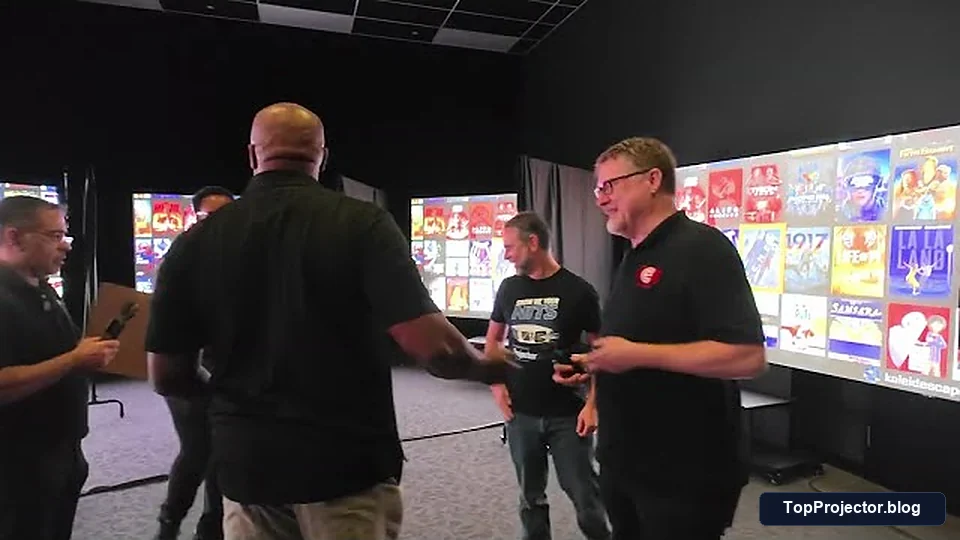
Ultra-short-throw models sit inches from the wall, bouncing light steeply upward onto specialized lenticular surfaces. Use our throw ratio calculator Benq guide to map precise throw distances for flawless daytime contrast.
Ultra-short throw setups require extreme cabinet leveling because a minor two-millimeter shift introduces noticeable geometric distortion across a 100-inch diagonal screen surface during daytime ambient viewing sessions.
- Eliminates traditional ceiling mount wiring hassles
- Integrates directly onto standard media console furniture
- Directly replaces oversized flat-panel televisions in living rooms
The Ultra-Short-Throw Advantage
Placing the chassis directly beneath the screen prevents family members from walking through the light beam and casting distracting shadows.
This tight optical geometry makes daily television viewing practical in brightly lit environments without closing curtains.
- Zero shadow interruptions during casual viewing
- Compact footprint on standard living room furniture
Traditional Long-Throw Flexibility
Conventional projection places the optical engine across the room, demanding precise ceiling mounts and careful lens shift calculations.
This traditional approach opens up massive screen scaling options that far exceed standard fixed-frame ultra-short-throw limitations.
- Infinite placement adjustments via optical lens shift
- Supports massive diagonal sizes up to two hundred inches
Micro-Lens Uniformity and Panel Alignment
Traditional long-throw models utilize complex glass lens groups achieving better corner focus, whereas laser TVs integrate fixed plastic optics demanding precise thermal stabilization inside cramped chassis designs.
- Thermal drift affects alignment over long viewing sessions.
Ambient Light Rejection and Daytime Contrast Mastery
Combating ambient light is the single greatest challenge in modern projection optics, dictating whether your image washes out during daytime hours.
Specialized optical screens use microscopic sawtooth structures to reject overhead illumination while reflecting the ultra-low projection angle directly to viewers.
Lenticular ALR screens feature micro-structured sawtooth filters that physically reject overhead illumination. Consult our ANSI lumens room calculator to determine required light output for bright living spaces.
- Reject up to eighty percent of overhead room lighting
- Maintain punchy saturation during bright afternoon sports viewings
- Require matched pairing between projector lens and screen material
Daytime Living Room Performance
Pairing a high-lumen optical engine with a specialized friction-layered screen yields astonishing daytime visibility that rivals conventional flat panels.
Without this specialized surface treatment, ambient room light destroys shadow detail and compresses perceived dynamic range instantly.
- Maintains usable contrast in sunlit family rooms
- Eliminates the washed-out gray veil of old projectors
Dedicated Dark Room Optimization
In a pitch-black dedicated theater room, white or gray acoustic transparent screens deliver vastly superior off-axis uniformity and color neutrality.
Absence of ambient light allows traditional setups to maximize native contrast without optical filtering complications.
- Perfect color accuracy without specialized optical coatings
- Maximizes native panel contrast in controlled spaces
Angular Reflection Profiles
Standard white walls scatter light indiscriminately, destroying black levels, while specialized optical rejection fabric directs reflected laser light precisely downward toward seated viewer eye levels.
- Gain values between 0.6 and 0.8 optimize wide viewing angles.
Black Floor Dynamics, Laser Dimming, and Shadow Depth
Achieving deep, inky blacks remains a defining benchmark for cinematic fidelity. As highlighted in our Anker Nebula Cosmos Laser review, solid contrast performance elevates perceived three-dimensional image realism.
Laser light engines utilize advanced dynamic dimming algorithms to modulate laser output instantly during dark cinematic sequences.
Dynamic laser dimming algorithms modulate light output during dark cinematic sequences, plunging the native black floor down significantly to enhance perceived shadow depth without crushing subtle dark details.
- Instantaneous laser diode modulation enhances dark scenes
- Reduces native blooming artifacts common in lamp systems
- Preserves shadow detail in complex high-contrast frames
Reflective Room Challenges
Bright white living room ceilings and walls bounce light back onto the screen, raising the black floor and washing out dark shadows.
Controlling room surfaces is mandatory if you want to extract maximum native contrast performance from high-end optical engines.
- Ceiling reflections limit maximum perceived shadow depth
- Dark velvet wall treatments dramatically improve contrast
Dynamic Iris and Laser Modulation
Laser light sources react significantly faster than mechanical apertures, dimming instantaneously to crush black levels in twilight scenes.
This responsive modulation delivers noticeable improvements in HDR contrast tracking without introducing distracting pumping artifacts.
- Faster response times than traditional mechanical iris systems
- Noticeable boost in perceived HDR contrast depth
Phosphor Decay and ANSI Contrast
While laser engines offer instant on-off capabilities, maintaining high ANSI contrast requires pristine light path sealing to prevent internal stray reflections from lifting dark scenes.
- ANSI contrast testing reveals true mixed-scene performance.
Peak Luminance, Laser Light Engines, and HDR Tracking
High dynamic range content requires immense peak luminance and precise tone mapping to render sparkling highlights without clipping bright details.
Laser phosphor and triple-laser configurations deliver stable, long-lasting brightness without the rapid lumen decay characteristic of traditional mercury lamps.
Measuring true peak luminance demands calibrated Filmmaker modes rather than vivid presets, ensuring accurate EOTF tracking for demanding HDR10 and Dolby Vision content streams.
- Consistent brightness over twenty thousand operational hours
- Wider color gamuts covering BT.2020 color spaces
- Eliminates expensive bulb replacement cycles entirely
Color Volume and Triple-Laser Purity
RGB triple-laser engines bypass color wheels entirely, producing pure primary wavelengths that achieve breathtaking wide color volume coverage.
This purity translates into vibrant, saturated HDR highlights that maintain full color saturation even at maximum light output.
- Pure RGB lasers eliminate color wheel rainbow artifacts
- Exceeds standard DCI-P3 color space requirements easily
Lamp-Based Projection Persistence
Traditional lamp projectors offer high initial brightness, but their output degrades rapidly within the first thousand hours of use.
Owners must calibrate tone mapping frequently to compensate for progressive lumen loss and shifting color temperatures.
- Gradual brightness decay requires periodic recalibration
- Bulb replacements add ongoing maintenance overhead costs
WCG Filters and Color Volume
Multi-laser phosphor architectures achieve wide color gamut coverage exceeding 95 percent of Rec.2020, though activating physical color filters inevitably sacrifices vital lumen output.
- Color volume drops at maximum brightness output levels.
Throw Geometry, Screen Scale, and Immersive Field of View
Screen geometry dictates your physical sense of immersion, pulling your field of view into the cinematic narrative during epic action sequences.
Ultra-short-throw systems lock you into fixed frame sizes, whereas traditional long-throw setups allow effortless zoom adjustments.
Achieving a cinematic 40-degree field of view requires precise seating distance calculations paired with exact throw ratios, preventing pixel structure visibility on massive screens.
- Fixed-frame sizes typically restrict choices to hundred or hundred-twenty inches
- Long-throw models scale fluidly up to massive custom dimensions
- Throw ratios dictate exact console placement distances down to the millimeter
The Fixed-Size Constraint
Ultra-short-throw focal lengths demand exact alignment with specialized tensioned screens, preventing you from resizing the image freely.
Changing screen dimensions later requires replacing the entire optical screen and recalibrating the wall mounting bracket.
- Inflexible image sizing once wall bracket is secured
- Requires absolute precision during initial console placement
Scalable Long-Throw Freedom
Traditional ceiling-mounted projectors give installers incredible freedom to adjust zoom rings and optical shift for custom screens.
This flexibility accommodates changing room layouts and future upgrades to larger acoustically transparent projection surfaces.
- Seamless image resizing via optical zoom lenses
- Compatible with custom curved and micro-perforated screens
Keystone Correction Penalties
Relying on digital keystone adjustment degrades native optical resolution and introduces artifacts. For compact setups, choosing a dedicated 4K portable model from our best portable 4k projector guide ensures optimal optical performance.
- Optical shift preserves full native panel resolution.
Gaming Responsiveness, Motion Handling, and Latency Metrics
Competitive gaming requires ultra-low input lag and lightning-fast pixel response times to ensure instant visual feedback during fast-paced action.
Modern optical engines feature dedicated low-latency gaming modes that bypass complex video processing pipelines to minimize display delay.
Modern laser TVs and dedicated projectors now achieve an input lag under 20 milliseconds at 4K/60Hz, satisfying competitive gamers while retaining advanced motion interpolation for sports broadcasts.
- Input lag ratings drop below fifteen milliseconds at high refresh rates
- Smooth motion handling prevents distracting judder during fast pans
- High refresh rate support enhances competitive shooter responsiveness
Console Gaming Integration
Placing an ultra-short-throw console directly below your screen allows easy cable routing for modern gaming consoles without long HDMI runs.
Low input latency paired with massive screen real estate creates an unmatched immersive gaming environment for multiplayer sessions.
- Short cable runs eliminate expensive optical HDMI extenders
- Massive scale enhances competitive split-screen visibility
Dedicated Theater Gaming Setup
Routing high-bandwidth HDMI cables through ceiling cavities to a distant projector requires certified fiber-optic cables for stable signal integrity.
Once configured, the giant cinematic scale delivers breathtaking immersion for single-player narrative titles and racing simulators.
- Requires active optical HDMI cables for long runs
- Unmatched immersion for cinematic role-playing games
Black Frame Insertion Mechanics
Advanced frame interpolation algorithms smooth out fast-panning cinematic camera movements, though competitive gamers must disable all processing features to minimize controller response delays.
- ALLM triggers low-latency gaming modes automatically.
Structural Installation, Calibration Rigor, and Maintenance Demands
Physical installation complexity determines whether your home theater project is a weekend DIY success or a frustrating professional contractor job.
Evaluating structural requirements ensures your chosen display fits your room layout without unexpected alignment headaches or unexpected expenses.
Professional ISF calibration unlocks accurate grayscale tracking and precise color management, successfully transforming out-of-the-box factory projector presets into stunning reference-grade home theater display systems.
- Ultra-short-throw units sit on media consoles with simple alignment
- Long-throw projectors demand secure ceiling studs and precise trigonometry
- Laser light engines eliminate routine lamp maintenance entirely
Simple Console Placement
Setting up a modern ultra-short-throw display resembles placing a standard television, requiring only minor geometric adjustments on the screen.
This approachable installation process makes high-end giant-screen entertainment accessible to users who dread complex ceiling mounts.
- Zero ceiling drilling or heavy bracket mounting required
- Quick twenty-minute setup for enthusiastic beginners
Professional Ceiling Rigor
Mounting a heavy long-throw projector upside down on a ceiling requires finding ceiling joists and calculating exact throw distances.
Professional calibration tools are often necessary to dial in corner-to-corner focus and correct minor optical distortion issues.
- Demands precise structural anchoring into ceiling joists
- Professional calibration unlocks peak color and gamma accuracy
Air Filter Maintenance Protocols
Sealed optical light engines reduce dust ingress risks, yet high-airflow cooling fans still require periodic filter cleaning to prevent thermal throttling during extended movie sessions.
- Filter cleaning schedules prevent overheating hardware failures.
Frequently Asked Questions
Can a laser TV completely replace a traditional living room television?
Yes, pairing an ultra-short-throw system with an ambient light rejection screen provides daytime watchability that easily replaces standard flat panels in bright rooms.
Why do traditional projectors require complete darkness for best performance?
Ambient room light reflects off standard white screens, washing out shadows and destroying native contrast, which makes light control essential for traditional setups.
Do laser light sources last longer than traditional projector lamps?
Laser diodes offer up to twenty thousand hours of maintenance-free operation, completely eliminating the expensive bulb replacement cycles of older lamp projectors.
What is the main advantage of an ultra-short-throw optical setup?
They sit inches from the wall to eliminate shadow interruptions and allow simple furniture placement without complex ceiling mounting requirements.
Which display type offers better gaming performance and lower input lag?
Modern ultra-short-throw models feature dedicated game modes with sub-15ms input lag, making them ideal for responsive console gaming in living rooms.