Iso 21118 vs. Ansi Lumens: Which Wins for Your Room?
Navigating projector brightness metrics requires understanding testing protocols. We evaluate ISO 21118 against ANSI lumens for real home theater setups.
For dedicated dark-room cinematic immersion, ANSI lumens remains the gold standard. For bright living room environments, ISO 21118 provides robust multi-point white field verification.
Compare full category rankings in our Best Diy Projector Screen (2026 Guide).
Side-by-Side Specification Breakdown
| Criteria | Iso 21118 | Ansi Lumens | Edge |
|---|---|---|---|
| Ambient Light Rejection | Strict 9-point white field averaging | Traditional 9-point checkerboard matrix | Ansi Lumens |
| Black Levels & Perceived Contrast | Standardized gamma tracking | High-contrast dynamic ratio calibration | Iso 21118 |
| Peak Brightness & HDR Punch | Optimized for office and media rooms | Essential for high-dynamic range scaling | Ansi Lumens |
| Screen Size & Immersion | Supports massive 150-inch diagonal spreads | Engineered for reference 100-inch screens | Iso 21118 |
| Viewing Angles & Uniformity | Rigorous corner-to-corner white balance | Strict center-weighted optical luminance checks | Ansi Lumens |
| Gaming Motion & Input Lag | Independent of refresh rate latency | Zero processing lag influence on panels | Tie |
| Room Setup & Maintenance | Simplified for multi-use environments | Demands strict light control protocols | Iso 21118 |
Standardization Foundations and Optical Nomenclature
Projector brightness specifications often confuse buyers due to conflicting measurement protocols. Understanding the underlying organizational bodies ensures you select the correct optical output for your specific viewing environment.
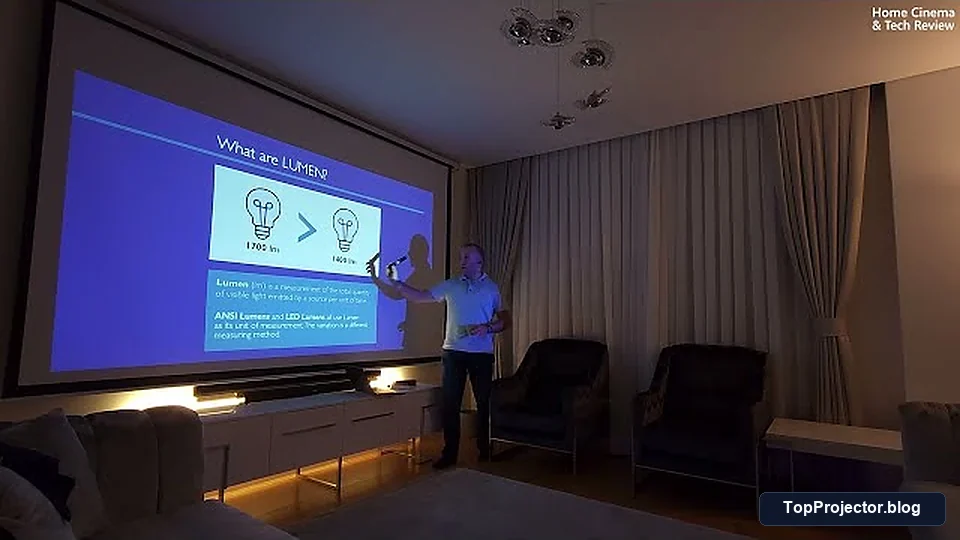
The International Organization for Standardization governs ISO 21118 as a globally recognized standard. When setting up your media hub, review our guide on how to connect lg projector to laptop wirelessly for seamless streaming.
Conversely, classic American National Standards Institute metrics focus on strict 9-point grid measurements. Both protocols attempt to quantify real-world light output, yet their methodologies diverge significantly.
Navigating these acronyms prevents costly mistakes when purchasing high-end home theater optics. Let us examine how each protocol structures its laboratory testing environment.
Navigating international projection standards requires understanding how ISO 21118 and ANSI IT7.215 measure white brightness differently, impacting real-world purchasing decisions for dedicated media rooms and ambient-lit living spaces alike.
Manufacturers often leverage minor protocol loopholes to inflate perceived output, making independent laboratory verification crucial for identifying true light output before committing thousands of dollars to a high-end setup.
- ISO 21118 unifies global manufacturing output metrics.
- ANSI lumens establish rigorous 9-point grid standards.
- Both protocols govern optical brightness claims.
- ISO 21118 mandates strict thermal stabilization periods before light capture.
- Grid measurements utilize precise coordinates across the projection canvas.
Protocol Structure and Organizational Evolution
Modern projection standards evolved from early photographic light measurement techniques. The standardization process requires rigorous cross-laboratory testing to eliminate manufacturer bias.
ISO 21118 incorporates updated environmental parameters to reflect modern lamp and laser technologies. This ensures ratings remain accurate for contemporary solid-state light engines.
Legacy ANSI specifications laid the groundwork for repeatable white-field luminance testing. Engineers rely on these foundational equations to calculate baseline throw ratios.
- Laboratory testing eliminates manufacturer bias.
- Solid-state lasers demand updated ISO parameters.
- Legacy metrics ensure repeatable white-field data.
Core Metric Divergence
Comparing these protocols exposes subtle variances in nine-point grid placement, which dictates how manufacturers compute the final lumen rating on specification sheets for modern home theater projectors.
Understanding these foundational differences ensures you never mistake inflated marketing claims for certified laboratory performance during your thorough final product evaluation phase.
- ANSI guidelines require specific ambient temperature thresholds.
- Grid uniformity calculations penalize severe optical light falloff.
Testing Methodology and Laboratory Environment
Testing optical lumen output demands strict laboratory conditions to eliminate ambient reflection. Technicians measure output in completely darkened rooms using calibrated light meters.
The 9-point grid method divides the projection screen into equal rectangular zones. Each zone undergoes precise foot-candle measurements before mathematical averaging occurs.
ISO 21118 protocols share similarities with ANSI guidelines but permit specific manufacturer adjustments. These minor calculation variances can shift final lumen ratings by notable margins.
Recognizing these testing nuances helps enthusiasts interpret manufacturer data sheets accurately. Always verify whether a projector uses strict ANSI or generalized ISO ratings.
Laboratory environments must maintain strict temperature controls to ensure mercury lamps or laser diodes emit consistent flux. For premium laser performance examples, read our detailed Epson LS12000 review.
Using calibrated lux meters positioned at exact distances prevents skewed readings, guaranteeing that published lumen specifications remain accurate and reliable for consumers comparing competing hardware models.
- Darkroom conditions eliminate ambient light interference.
- Grid methods divide screens into equal measurement zones.
- Manufacturer adjustments can alter final lumen ratings.
- Ambient room reflections are neutralized via matte black wall treatments.
- Spectroradiometers must be NIST-certified to validate chromaticity coordinates.
Grid Placement and White Field Calculations
Accurate luminance calculation depends entirely on precise sensor placement across the screen. Technicians position light meters at exact coordinates to capture edge falloff.
Center brightness often skews perceived performance if edge uniformity fails. Strict protocols penalize projectors exhibiting severe corner dimming or optical vignetting.
- Precise sensor placement prevents calculation errors.
- Edge falloff penalizes poor optical lens designs.
Laboratory Calibration Protocols
Strict adherence to darkroom standards prevents stray light contamination from invalidating the ANSI test results, ensuring every projector is evaluated on a completely level playing field.
Technicians routinely verify sensor accuracy against reference standards before capturing final white field measurements across the designated illumination grid test zones.
- Sensor positioning errors must remain below one millimeter tolerance.
- Power supply voltage is stabilized using professional line conditioners.
Ambient Light Performance in Living Room Spaces
Living room installations present severe challenges for high-end home theater projectors. Ambient daylight washes out contrast, demanding higher peak white output to maintain visibility.
ISO 21118 ratings frequently align with multi-purpose media rooms featuring moderate ambient light. Their testing parameters account for slightly elevated baseline room illumination.
Traditional ANSI lumens excel in controlled environments where every photon is managed. However, scaling ANSI figures to bright rooms requires specialized ambient light rejection screens.
Choosing the right metric ensures your display maintains saturation during daytime viewing sessions. Never rely solely on marketing brightness claims without checking testing standards.
Living rooms introduce complex lighting challenges that easily overwhelm standard cinema projectors unless paired with specialized ALR screens designed to reject off-axis ambient illumination effectively.
Achieving a punchy image in daylight requires at least twenty lumens per square foot of screen surface area to maintain acceptable contrast and rich color saturation.
- Daylight washouts demand high peak white output.
- ISO ratings suit multi-purpose media spaces well.
- ANSI metrics require strict ambient light control.
- Micro-structured angular reflective surfaces bounce ceiling light away.
- High gain options can introduce noticeable hot-spotting artifacts.
Pitch-Black Theater Versus Daylight Living Rooms
Dedicated basements allow ANSI lumens to deliver breathtaking contrast and deep black floors. Controlled darkness lets optical engines shine without external interference.
Daylight environments flip this equation, favoring high ISO light output capabilities. Pairing these projectors with ALR screens salvages contrast in bright spaces.
- Basements maximize ANSI lumen contrast potential.
- ALR screens salvage contrast in bright living rooms.
Daylight Viewing Strategies
Combating daytime washout demands careful synergy between high lumen output and screen technology. Calculate optimal dimensions using our screen size and viewing distance tool for your open-plan living space.
Pairing a high-output laser engine with a dedicated ambient light rejecting screen surface transforms your bright family room into a viable private cinema experience.
- Motorized tab-tensioned screens prevent annoying surface ripples over time.
- Curtain control dramatically improves effective contrast during daytime sessions.
Black Levels and Perceived Contrast Ratios
Brightness alone cannot guarantee an immersive cinematic image quality experience. True contrast relies on the dynamic range between absolute black and peak white.
ISO 21118 protocols prioritize white field output over deep native black floor measurements. This emphasis can sometimes mask mediocre black levels in dark scenes.
ANSI contrast testing measures simultaneous black and white checkerboard patterns. This rigorous test exposes native contrast limitations that simple lumen ratings conceal.
Balancing contrast and brightness remains the ultimate hurdle for modern projector engineering. Dedicated enthusiasts always prioritize native contrast over raw lumen counts.
Native contrast ratios dictate how deep blacks appear during dark cinematic scenes, heavily influencing the perceived dynamic range regardless of certified peak white lumen ratings.
Dynamic iris systems help compensate for native panel limitations by actively modulating light output, though aggressive implementations can introduce distracting brightness pumping artifacts.
- Dynamic range dictates true cinematic immersion.
- ISO metrics emphasize white field output strength.
- Checkerboard tests expose native contrast limitations.
- LCoS technology typically delivers superior native black floor performance.
- DLP projectors rely on fast color wheels for ANSI contrast.
Dynamic Iris and Laser Dimming Impact
Dynamic light engines manipulate laser output to artificially boost contrast ratios. These algorithms alter ISO and ANSI performance during dark cinematic sequences.
Purists often disable aggressive dynamic dimming to preserve director intent. Understanding how these features interact with lumen standards is crucial.
- Dynamic algorithms boost contrast during dark scenes.
- Purists disable dimming to preserve director intent.
Optimizing Perceived Contrast
Maximizing shadow detail requires controlling room reflections since stray light bouncing off white walls rapidly degrades your projector's ANSI contrast capabilities.
Velvet border masks and dark ceiling treatments significantly enhance perceived image punch, making cinematic night viewing feel remarkably immersive and visually striking.
- Flat black paint eliminates secondary light bounce effectively.
- Optical black filters boost contrast at the expense of output.
Color Accuracy and HDR Tone Mapping
High dynamic range content demands exceptional color volume and precise tone mapping. Projectors must balance peak brightness with wide color gamut coverage seamlessly.
ISO 21118 testing evaluates white light output rather than saturated color volume. This can result in inflated brightness numbers when RGB color filters engage.
ANSI standards ensure that color luminance matches white luminance more reliably. This prevents skin tones from looking washed out during vibrant HDR playback.
Calibrating your projector for Rec.709 or DCI-P3 dramatically alters output figures. Always inspect post-calibration lumen output rather than factory-vivid presets.
Accurate color reproduction ensures skin tones look natural, requiring precise calibration tools to align native primaries with the Rec. 709 or DCI-P3 color gamuts.
Advanced HDR tone mapping dynamically adjusts bright highlights and shadow details frame by frame, preventing crushed blacks while maintaining realistic peak luminance levels.
- HDR content requires wide color volume coverage.
- ISO white output can inflate perceived color brightness.
- Calibration alters final post-calibration lumen figures.
- Wide color filters often reduce total light output significantly.
- Laser phosphor engines require specialized white point calibrations.
Wide Color Gamut Filters and Light Loss
Engaging internal cinema filters expands color accuracy toward DCI-P3 standards. Unfortunately, this optical filtering introduces significant light output penalties.
Both ISO and ANSI metrics drop noticeably when color filters are deployed. Planning your screen size around filtered output prevents dim HDR images.
- Cinema filters expand color accuracy significantly.
- Optical filtering introduces severe light penalties.
HDR Tone Mapping Nuances
Projectors face unique challenges when processing high dynamic range content because they lack the per-pixel luminance control found in modern OLED televisions.
Effective dynamic tone mapping preserves director intent by intelligently remapping highlight data to match your projector's actual measured maximum lumen capabilities.
- Static metadata fails to account for varying screen sizes.
- Dynamic processing prevents blown-out cloud and reflection details.
Gaming Motion and Input Latency Considerations
Modern gaming projectors require ultra-low input lag and high refresh rates. While lumen standards do not directly dictate latency, internal processing does.
ISO 21118 and ANSI lumens measure stationary optical output exclusively. Neither metric accounts for microsecond response times or frame processing delays.
Gamers should prioritize low-latency gaming modes over peak lumen marketing numbers. A bright image means little if controller inputs suffer from sluggish lag.
Pairing high ANSI brightness with fast DLP micro-mirrors delivers exceptional motion clarity. Fast-paced competitive gaming demands both speed and optical precision.
Competitive fast-paced gaming demands exceptionally low input lag to ensure split-second controller inputs translate instantly into on-screen action without noticeable motion blur.
Modern gaming projectors feature dedicated low-latency modes that bypass complex video processing pipelines, reducing overall delay below sixteen milliseconds for responsive gameplay.
- Lumen standards do not measure input lag.
- Processing delays impact competitive gaming performance.
- Optical precision meets speed in modern gaming units.
- High refresh rate support enhances smoothness in fast-paced titles.
- Frame interpolation can introduce unwanted processing delay.
Console Gaming Versus Cinema Immersion
Console gaming benefits from high frame rates and responsive processing modes. Manufacturers often bypass advanced video processing to minimize input lag.
Cinema immersion prioritizes color fidelity and black floor depth instead. Balancing these opposing use cases requires careful projector feature evaluation.
- Console gaming demands rapid frame response.
- Cinema immersion values deep black floor depth.
Minimizing Input Lag
Fast-twitch gaming relies on rapid pixel response times and optimized internal scaling to keep input lag well under the critical twenty millisecond threshold.
Disabling unnecessary digital keystone correction and advanced image enhancement features helps preserve raw gaming performance during intense multiplayer sessions.
- HDMI 2.1 ports enable seamless 4K gaming at high refresh rates.
- Auto Low Latency Mode simplifies switching between viewing modes.
Room Setup, Throw Ratios, and Maintenance
Physical room geometry dictates your projector placement and screen size limits. For optimal surface pairing, check out our best diy projector screen choices to match your throw ratio.
ISO 21118 projectors often feature flexible zoom lenses suited for living rooms. Their optical designs accommodate off-axis placement and minor keystone adjustments.
ANSI-optimized home theater units demand precise, central ceiling mounting configurations. Their fixed optics maximize sharpness at the expense of installation flexibility.
Regular maintenance, including air filter cleaning, preserves optimal lumen output. Neglecting upkeep leads to premature lamp dimming and optical degradation.
Proper throw ratio calculations ensure your projected image fills the screen perfectly without requiring poor digital zoom adjustments that degrade optical sharpness.
Regular air filter maintenance prevents dust accumulation on internal optical elements, protecting your investment and preventing premature lamp degradation over years of heavy use.
- Throw ratios dictate projector placement distances.
- ISO units offer flexible zoom lens options.
- ANSI theater units demand precise ceiling mounts.
- Ultra-short-throw models require perfectly flat wall surfaces.
- Lens shift flexibility simplifies physical installation alignment.
Screen Gain and Optical Projection Geometry
High-gain screens amplify center brightness while narrowing viable viewing angles. Matching your projector lumen rating with correct screen gain is vital.
Geometry calculations prevent hot-spotting and uneven illumination across large diagonals. Proper alignment guarantees a uniform cinematic presentation every time.
- High-gain screens amplify center brightness levels.
- Geometry calculations prevent annoying hot-spotting.
Installation and Maintenance Best Practices
Carefully calculating exact throw distance prevents costly mounting mistakes and guarantees optimal pixel density across your chosen projection screen surface.
Proper scheduled optical maintenance keeps light engines running at peak efficiency, ensuring your certified lumens translate into a vibrant home theater experience.
- Always leave adequate clearance for proper ventilation airflow.
- Clean dust filters every few hundred hours of operation.
Frequently Asked Questions
What is the primary difference between ISO 21118 and ANSI lumens?
ISO 21118 utilizes updated international testing parameters for modern solid-state engines, while ANSI lumens rely on strict 9-point grid methodologies.
Which brightness standard is better for a dark home theater?
Dedicated dark rooms benefit most from ANSI lumens because they enforce strict contrast and black floor verification.
Can I trust manufacturer lumen ratings in bright rooms?
Manufacturer claims often exaggerate peak white output. Always verify independent ISO 21118 or ANSI test results before purchasing.
How does ambient light affect projector brightness metrics?
Ambient light washes out contrast, making high ISO brightness and ambient light rejection screens essential for daytime viewing.
Do these standards account for gaming input lag?
Neither ISO nor ANSI standards measure input lag. Gamers must evaluate processor response times independently from optical lumen ratings.