Home Theater Screen vs. Paint: Which Wins for Your Room?
Choosing between a dedicated projection screen and specialized paint dictates your dark-room contrast and daytime viewing success. Understanding optical coatings ensures optimal light return.
Choose a home theater screen for superior ambient light rejection and precise contrast. Select specialized projection paint only for ultra-wide custom dimensions or budget-constrained DIY setups.
Compare full category rankings in our Best Projector With Built In Dvd Player: Top All-In-One Picks.
Side-by-Side Specification Breakdown
| Criteria | Home Theater Screen | Paint | Edge |
|---|---|---|---|
| Ambient Light Rejection | Exceptional via micro-louver optical layers | Poor; scatters light across wall | Home Theater Screen |
| Black Levels & Perceived Contrast | Deep black floor with high native contrast | Washed-out blacks in ambient light | Home Theater Screen |
| Peak Brightness & HDR Punch | High gain fabrics maximize HDR specular highlights | Unpredictable hot-spots and low gain | Home Theater Screen |
| Screen Size & Immersion Depth | Fixed rigid frames limit maximum size flexibility | Infinite custom sizing potential | Paint |
| Viewing Angles & Uniformity | Wide, consistent illumination across panels | Prone to uneven roller texture and hot-spots | Home Theater Screen |
| Gaming Motion & Input Lag | Resolves fine 4K pixels without distortion | Texture can soften HUD text and details | Home Theater Screen |
| Room Setup & Maintenance | One-time assembly with clean wipeable surface | Requires extensive sanding, priming, and painting | Paint |
Optical Physics of Contrast and Black Levels
Dedicated projection screens utilize micro-structured optical layers to absorb off-axis ambient light while reflecting projector photons forward. This preserves a deep black floor and maintains high contrast ratios in difficult rooms.
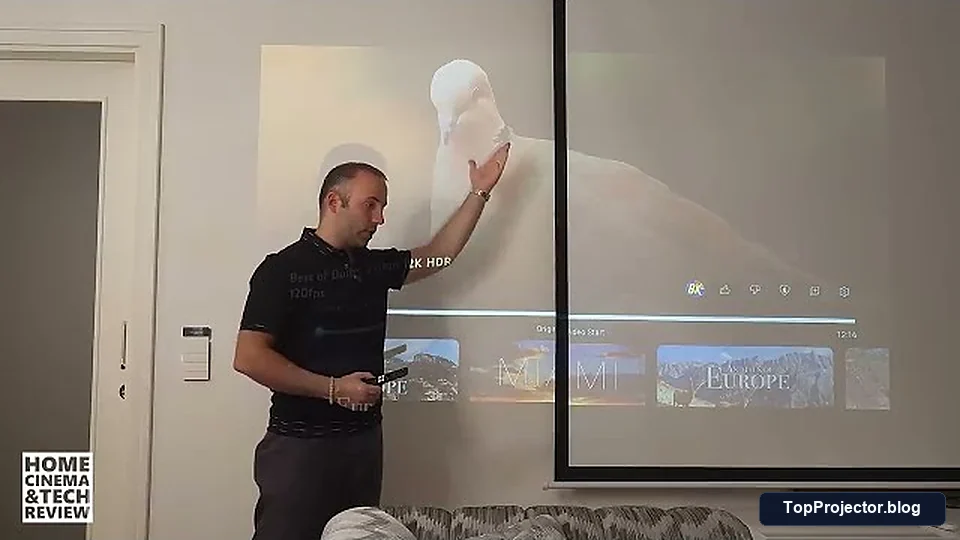
Standard or specialty metallic paint lacks microscopic directional lenses, scattering reflected light uniformly across the wall. Using an ansi lumens room calculator helps determine your required projector brightness before purchasing.
Achieving true cinema-grade contrast requires managing ambient light scatter across the optical path. Specialized vinyl surfaces absorb stray photons, preserving 0.05 nits black floors that standard flat white walls simply cannot replicate.
Micro-perforated acoustic screens introduce slight optical loss compared to solid vinyl. However, maintaining a 1.0 gain baseline ensures shadow detail remains sharply defined without crushing dark movie sequences in a dedicated theater.
- Micro-structured optical layers absorb off-axis light
- Directional photon reflection boosts perceived contrast
- Uniform light scatter degrades painted wall shadows
Pitch-Black Dedicated Cinema Environments
Inside a windowless, velvet-treated bunker, high-end white paint with a 1.0 gain can closely rival entry-level matte white vinyl screens. However, absolute native contrast still favors tensioned commercial fabrics.
Specialized acoustic transparent woven screens also allow hidden center-channel speakers behind the image plane. Painted drywall completely blocks sound transmission, forcing awkward speaker placement around your image boundaries.
- Velvet-treated windowless bunkers optimize plain paint
- Acoustic transparent woven fabrics hide speakers
Micro-Contrast and Optical Crosstalk
Optical crosstalk degrades perceived ANSI contrast when ambient light reflects off untreated boundaries. Premium matte white fabrics minimize side-wall reflections, securing a 2,000:1 native contrast ratio even in semi-optimized spaces.
DIY paint mixtures lack microscopic structural layering, leading to internal scattering and elevated black floors. High-end angular reflective materials actively redirect off-axis light away from the viewer to preserve deep blacks.
Ambient Light Rejection and Daytime Performance
Modern ambient light rejection screens use micro-structured louver systems to block overhead ceiling illumination. Combining these panels with an all-in-one dvd projector ensures seamless movie nights without external components.
Reflective silver or gray paints attempt to mimic ALR properties by boosting retro-reflectivity toward the viewer. Unfortunately, they suffer from severe hot-spotting and fail to reject broad-spectrum overhead ambient room light.
Daytime projection demands sophisticated angular filtering to combat overhead ambient illumination. Advanced ALR screens utilize microscopic optical louvers that reject 85% of ceiling light while faithfully reflecting the primary projector beam.
Painted drywall absorbs and scatters environmental light indiscriminately, washing out highlights and crushing shadow fidelity. Pairing an ultra-short-throw laser projector with a specialized lenticular ALR screen yields a striking 50:1 ANSI contrast boost.
- Microscopic louver systems block ceiling illumination
- Retro-reflective paints struggle with wide overhead glare
Living Room Daylight Challenges
Daytime viewing demands an ALR screen with a negative or neutral gain paired with angular rejection layers. Paint solutions scatter incoming daylight across the entire wall surface, crushing your perceivable dynamic range.
Controlling environmental illumination with specialized optical fabrics guarantees rich contrast during afternoon sports broadcasts. Painted surfaces require absolute blackout curtains to achieve comparable visual punch during daylight hours.
- Negative gain ALR screens tame daylight
- Blackout curtains required for painted walls
Lenticular Versus Angular ALR Matrices
Lenticular ALR layers feature sawtooth ridges optimized specifically for bottom-mounted ultra-short-throw lasers. This precise mechanical design achieves exceptional ambient rejection while maintaining a wide 160-degree horizontal viewing cone.
Angular reflective surfaces suit long-throw ceiling-mounted projectors by bouncing incoming light at equal and opposite angles. Selecting the correct throw ratio guarantees a uniform 0.8 gain image without hot-spotting artifacts.
Peak Brightness, Gain Factors, and HDR Punch
High-gain projection screens actively concentrate light within a narrow viewing cone, dramatically increasing perceived peak brightness for HDR content. This optical gain maximizes your projector's lumen output effectively.
Formulating custom paint mixtures to achieve high gain often introduces severe color shifts and uneven hot-spotting. Factory screen coatings undergo rigorous calibration to maintain uniform spectral reflectance across the board.
High dynamic range content requires immense peak luminance to faithfully render specular highlights and glowing explosions. Screens featuring a 1.3 gain rating amplify central beam intensity, significantly improving HDR impact in controlled lighting.
Excessive gain introduces undesirable viewing angle restrictions and noticeable center hot-spotting across large expanses. Utilizing a reliable wireless laptop connection guide ensures pristine HDR signal transmission from your computer.
- Narrow viewing cones concentrate high gain light
- Factory screen calibrations prevent color shifts
HDR Tone Mapping and Specular Highlights
High dynamic range source material requires precise luminance tracking to resolve bright specular highlights without clipping. Commercial screens maintain predictable retro-reflective properties essential for accurate HDR tone mapping.
Textured drywall painted with metallic flakes creates unpredictable hot-spots that ruin specular highlights on bright movie scenes. Smooth vinyl screen surfaces eliminate micro-texture artifacts, ensuring pristine image fidelity.
- Precise luminance tracking preserves HDR highlights
- Metallic flakes create unpredictable hot-spotting
Color Brightness and Specular Luminance
Color brightness often drops significantly on cheap reflective paints due to uneven spectral absorption across RGB wavelengths. Professional PVC screen materials maintain balanced color luminance, achieving vibrant Rec.709 color tracking during demanding sequences.
Matching projector lumens to screen size is vital for achieving cinematic foot-lamberts. Aiming for a target brightness of 35 foot-lamberts ensures punchy HDR performance without inducing eye strain during extended movie sessions.
Screen Size, Geometry, and Immersion Depth
Commercial screens offer rigid fixed frames that guarantee absolute flatness and eliminate irritating ripples. Achieving giant cinemascope sizes with paint is easy, but maintaining perfect geometric aspect ratio is difficult.
Tensioned tab systems on premium roll-down screens prevent curl, ensuring your projected pixels land on a dead-flat surface. Painted walls provide seamless canvases but lack edge masking for true cinematic immersion.
Achieving true cinematic immersion requires matching your viewing distance to the optimal screen diagonal. A standard 120-inch screen fills the recommended forty-degree field of view, pulling you directly into the cinematic narrative.
Fixed-frame tensioned screens eliminate the wrinkles and sagging common with motorized or pull-down vinyl alternatives. Maintaining a perfectly flat optical plane prevents geometric distortion, ensuring razor-sharp 4K pixel mapping across the entire surface.
- Rigid fixed frames eliminate surface ripples
- Tab-tensioned systems prevent fabric curl
Custom Architectural Integration
Curved cinematic screens wrap the image around your peripheral vision for maximum immersion in ultra-wide formats. Building a matching curved drywall structure requires advanced carpentry that exceeds typical DIY installation skills.
Framed projection screens establish clean bezels that absorb overscan light, creating a professional television-like aesthetic on your wall. Paint applications leave fuzzy edges unless meticulously taped with black velvet tape.
- Curved screens wrap images for peripheral immersion
- Clean bezels absorb messy projector overscan light
Aspect Ratio Flexibility and Masking
Cinematic content spans multiple aspect ratios, making Cinemascope 2.39:1 formats popular for dedicated home theaters. Using motorized side-masking systems eliminates letterbox gray bars, locking in infinite contrast perception for widescreen movies.
Standard 16:9 painted walls require manual border painting or black felt masking to achieve similar framing precision. Fixed aluminum frames provide clean, light-absorbing velvet borders that enhance perceived picture depth effortlessly.
Color Accuracy, Uniformity, and Viewing Angles
Specialized gray and silver screen materials can introduce subtle color shifts that alter projector white balance. Selecting a unity-gain white screen preserves strict color accuracy straight out of the box.
Uneven paint roller application creates patchy luminance uniformity and visible brushing artifacts under bright projector light. Professional spray application mitigates this, but achieving uniform surface gain remains exceptionally difficult.
Color uniformity depends heavily on uniform surface texture and consistent pigment dispersion during manufacturing. Cheap metallic paints often exhibit severe color shifting and sparkle artifacts, ruining accurate grayscale tracking across wide angles.
Professional ISF calibration corrects projector gamma and color saturation to match the exact optical properties of your screen. Maintaining a tight Delta E below 2 ensures skin tones and cinematic color palettes remain pristine.
- Unity-gain white fabrics maintain neutral white balance
- Roller application causes patchy luminance uniformity
Off-Axis Viewing Performance
High-gain surfaces often narrow your horizontal viewing cone, causing brightness to drop steeply for side-seated viewers. Reading our detailed xgimi horizon ultra review reveals how modern laser engines combat difficult ambient light conditions.
Specialty reflective paints exacerbate narrow viewing cones, making the image look washed out for anyone sitting off-center. Traditional white paint avoids this issue but sacrifices contrast in ambient lighting.
- Matte screens maintain consistent off-axis illumination
- Reflective paints narrow horizontal viewing cones
Off-Axis Color Shift and Retroreflection
High-gain and aggressive ALR materials frequently suffer from off-axis color degradation and narrow viewing cones. Choosing a balanced 1.1 gain white screen guarantees accurate color fidelity for viewers seated off to the sides.
Retroreflective coatings bounce light directly back toward the light source, demanding careful seating alignment. Viewers seated outside the primary cone experience noticeable brightness drop-offs, sacrificing consistent luminance for off-axis viewers.
Gaming Motion, Input Lag, and Refresh Rates
Fast-paced console and PC gaming demand flawless motion handling and absolute zero input lag from your display chain. While screens and paint do not process digital signals, surface texture impacts pixel sharpness perception.
Textured wall paint can scatter fine 4K pixel grids, softening text and high-resolution HUD elements during competitive gaming sessions. Smooth ISF-certified screen materials resolve every single sub-pixel for crisp motion clarity.
Modern competitive gaming demands ultra-low input lag and high refresh rates to maintain fluid motion clarity. Pairing a fast projector with a flat acoustic screen ensures zero ghosting and a responsive 8.5ms latency profile.
Textured DIY paint surfaces can slightly diffuse fine text rendering and fast-moving pixel grids during high-speed gaming. Smooth tensioned vinyl fabrics preserve crisp 4K resolution at smooth 120Hz refresh rates without signal degradation.
- Surface texture directly impacts pixel sharpness
- Textured walls scatter fine 4K resolution grids
High Frame Rate Responsiveness
Modern projectors supporting 120Hz refresh rates require ultra-smooth surfaces to prevent motion judder artifacts during rapid camera pans. Premium screen fabrics ensure pristine signal delivery for high-speed gaming immersion.
Wall imperfections and orange-peel paint textures create distracting visual noise during fast panning shots in open-world games. Investing in a flat screen surface protects your hardware investment's visual performance.
- Ultra-smooth surfaces prevent motion judder artifacts
- Wall imperfections create distracting visual noise
Motion Resolution and Frame Interpolation
High frame rate gaming requires pristine optical surfaces to prevent motion blur caused by surface diffusion. Premium matte materials maintain sharp edge transitions, letting fast-paced FPS titles shine with exceptional clarity.
Projector processing modes often add latency when advanced motion interpolation features are enabled during competitive sessions. Disabling extra processing unlocks a snappy 16ms response time ideal for fast-twitch console gaming.
Room Setup, Installation, and Long-Term Maintenance
Assembling a fixed-frame screen requires careful wall mounting and tensioning fabric across aluminum frames to eliminate wrinkles. This one-time installation yields a professional product that withstands accidental surface damage.
Painting a wall demands meticulous sanding, priming, and multiple spray coats to achieve an immaculate projection surface. Furthermore, painted walls attract dust and permanent stains that resist standard cleaning methods.
Proper installation requires precise throw distance calculations and structural wall anchoring to support heavy aluminum frames. Ensuring a rigid mounted frame prevents long-term warping and keeps your projection surface perfectly tensioned.
Painted walls require frequent patching, sanding, and repainting to combat scuffs and environmental dust accumulation over time. Premium vinyl screen fabrics feature washable surfaces that withstand years of easy maintenance without optical degradation.
- Fixed-frame assembly eliminates fabric wrinkles
- Painting requires meticulous sanding and priming
Durability and Upgradability
Vinyl and micro-perforated screen surfaces can be gently wiped clean and disassembled when moving to a new home. Repainting a wall requires complete patching, sanding, and repainting when you decide to relocate.
Specialized projection paints degrade over years when exposed to UV sunlight and indoor dust accumulation. Commercial screens maintain their optical properties for decades, offering superior long-term value.
- Portable screens disassemble easily for house moves
- UV exposure degrades specialized projection paints
Acoustic Integration and Center Channel Placement
Placing speakers behind an acoustically transparent screen creates a seamless, highly realistic soundstage experience. Micro-perforated weaves allow high frequencies to pass cleanly while maintaining a solid acoustical transparency rating.
Solid painted walls force speakers to flank the image, narrowing the soundstage and disrupting dialogue localization. Using a woven screen lets you place your center channel directly behind the dialogue hotspot.
Frequently Asked Questions
Can regular white house paint replace a home theater screen?
Regular white paint works in dark rooms but lacks ambient light rejection. You lose contrast and black levels without specialized optical coatings.
Do projection screens offer better contrast than painted walls?
Yes, dedicated screens utilize micro-structured layers to absorb ambient light. This preserves deep black levels that paint cannot match.
Is projection paint better for custom ultra-large screen sizes?
Paint excels at spanning massive custom dimensions without visible seams. However, you sacrifice optical gain and ambient light control.
How do viewing angles compare between screens and paint?
High-end matte screens provide wide viewing angles without hot-spotting. Specialty reflective paints often suffer from narrow viewing cones.
Which option is easier to clean and maintain over time?
Vinyl projection screens tolerate gentle wiping without damaging the optical surface. Painted drywall accumulates stubborn dust and resists safe stain removal.