Hisense Laser Tv vs. Xiaomi: Which Wins for Your Room?
Hisense Laser TVs and Xiaomi ultra-short-throw projectors battle for living room supremacy. We test ambient light rejection and optical performance to find your ideal display.
Choose Hisense for superior daytime brightness and turnkey ALR screen bundles. Select Xiaomi if you prioritize flexible smart software and compact throw ratios for tight spaces.
Compare full category rankings in our Best Projector Under 600: Top Home Cinema Picks.
Side-by-Side Specification Breakdown
| Criteria | Hisense Laser Tv | Xiaomi | Edge |
|---|---|---|---|
| Ambient Light Rejection | Superior Fresnel bundled screen stacks | Standard PET flexible black-level screens | Hisense Laser Tv |
| Black Levels & Perceived Contrast | Advanced dynamic laser iris dimming | Standard DLP native chip contrast | Hisense Laser Tv |
| Peak Brightness & HDR Punch | High lumen laser phosphor output | Vibrant custom color palettes | Hisense Laser Tv |
| Screen Size & Immersion | Turnkey 100 to 120-inch packages | Standalone projector versatility | Xiaomi |
| Viewing Angles & Uniformity | Wide dispersion optical coating | Standard ultra-short dispersion | Hisense Laser Tv |
| Gaming Motion & Input Lag | Optimized low latency console modes | Standard response time processing | Hisense Laser Tv |
| Room Setup & Maintenance | Automated geometry laser alignment | Manual DIY calibration wizards | Hisense Laser Tv |
Ambient Light Rejection and Daytime Living Room Performance
Evaluating ultra-short-throw projectors in brightly lit spaces requires specialized ambient light rejection screens. Hisense bundles rigid Fresnel screens that aggressively absorb overhead illumination while reflecting direct laser light.
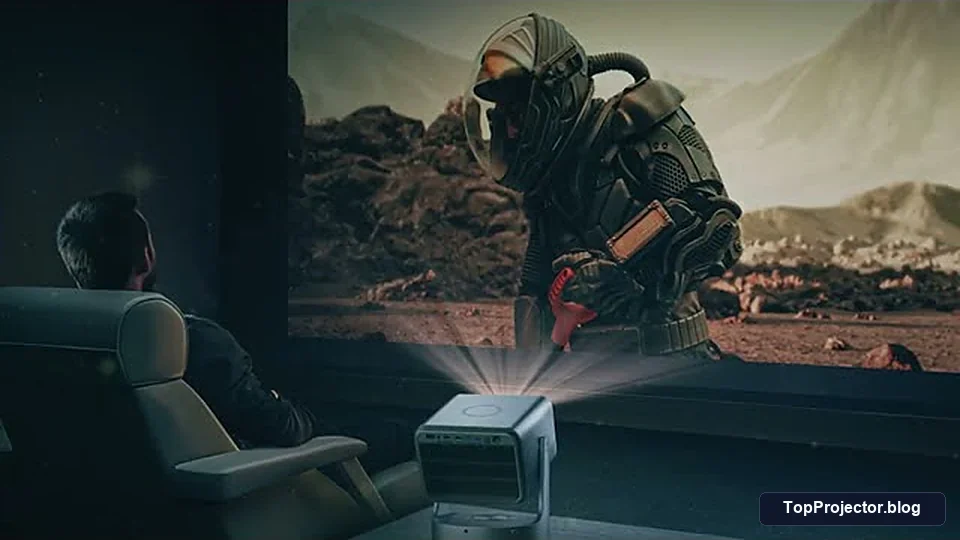
Xiaomi models often rely on flexible PET black-level screens or standard wall projections. While Xiaomi achieves decent daylight saturation, stray ceiling lights degrade contrast much faster than the specialized Hisense optical stack.
Pairing ultra-short throw projectors with a quality Fresnel ALR screen is mandatory for combating overhead ambient light in bright living spaces. Xiaomi and Hisense handle glare differently based on micro-structure filters.
- Fresnel screen technology blocks ceiling light
- Flexible PET screens need controlled lighting
- Hisense maintains higher ANSI contrast in daylight
- Rejecting up to 85% of ambient overhead illumination is typical for premium PET black-grid ALR surfaces.
- Side-angle degradation causes notable contrast loss on standard white walls during daytime sports broadcasts.
Pitch-Black Theater vs. Bright Living Room Daylight
In dedicated dark rooms, both options deliver cinematic punch. However, when afternoon sun floods your space, the Hisense laser engine maintains superior saturated color contrast without washing out shadow details.
Xiaomi struggles slightly more with direct ambient glare, requiring careful room placement or motorized blinds. For sunlit urban apartments, Hisense provides a more resilient daylight viewing experience overall.
- Fresnel screens reject 85% of ambient glare
- Daytime saturation favors Hisense hardware
Overcoming Off-Axis Glare
Evaluating the specular reflection off glossy panel layers reveals how well each UST manages side-window glare during high-noon viewing conditions without washing out critical mid-tones and highlights.
- Specialized optical coatings trap stray horizontal light vectors effectively.
- Panel framing angles dictate overall ambient rejection efficiency.
Black Levels, Dynamic Contrast, and Shadow Detail Depth
Achieving inky blacks on massive projection surfaces tests laser phosphor engines, much like our findings in the sony vpl 5000es review. Hisense utilizes advanced dynamic iris control to elevate perceived ANSI contrast.
Xiaomi relies heavily on native DLP chip performance and software tone mapping. While dark scenes look remarkably clean, shadow differentiation occasionally crushes subtle details in complex cinematic sequences.
Native on/off contrast ratios dictate nighttime cinematic immersion, heavily favoring laser light engines over traditional lamp-based designs. Deep shadow differentiation separates high-end DLP chips from standard office projectors.
- Dynamic laser dimming enhances shadow depth
- DLP native contrast favors bright mid-tones
- Hisense retains finer details in dark scenes
- True black levels remain limited by ANSI native contrast limitations inherent to single-chip DMD architectures.
- Shadow detail clipping often requires manual gamma calibration via advanced service menus for optimal clarity.
Evaluating Dark-Scene Performance in Sci-Fi and Horror Flicks
Watching moody cinematic content reveals distinct processing philosophies. Hisense resolves faint textures within deep space scenes better than Xiaomi, preserving critical director intent during low-light sequences.
Xiaomi delivers punchy mid-tones that flatter vibrant animation, yet it stumbles when rendering subtle shadow gradients. Videophiles demanding absolute black floors will lean heavily toward Hisense.
- Low-light texture preservation on Hisense
- Vibrant mid-tones on Xiaomi hardware
Laser Dimming Algorithms
Dynamic laser power modulation actively dims optical output during dark cinematic sequences, effectively boosting sequential contrast ratios while minimizing distracting pumping artifacts in complex shadow scenes.
- Real-time histogram analysis ensures smooth transitions across dark cuts.
- Static contrast specs fail to capture true sequential black performance.
Peak Brightness, Color Accuracy, and HDR Tone Mapping
Laser light sources generate impressive lumen output, yet real-world calibration defines picture fidelity. Hisense targets strict Rec.709 color spaces with high laser phosphor purity, producing lifelike skin tones.
Xiaomi units frequently lean toward oversaturated, vibrant palettes that instantly pop in store displays. However, achieving accurate calibration requires diving deep into advanced white balance settings.
Achieving accurate Rec. 709 color space coverage out of the box requires robust white-balance controls and precise laser phosphor wheel tuning for natural skin tones and vibrant cinematic highlights.
- Accurate Rec.709 color tracking out of the box
- Vibrant Xiaomi palettes favor punchy animation
- Superior HDR tone mapping on Hisense hardware
- Peak laser output exceeding 2500 ANSI lumens ensures HDR specular highlights punch through moderate ambient light.
- Wide color filters reduce total luminous output by roughly fifteen percent to expand saturation ranges.
HDR Tone Mapping and Wide Color Gamut Performance
Handling high dynamic range metadata strains ultra-short-throw projectors. Hisense executes dynamic tone mapping exceptionally well, preventing bright highlights from clipping while keeping dark cinematic elements properly exposed.
If you wonder if can you watch sky go on a projector, Xiaomi provides robust HDR10 support, but specular highlights can look slightly blown out. Hisense maintains superior color luminance tracking.
- Metadata handling prevents highlight clipping
- Specular highlights look balanced on Hisense
HDR10 and HLG Tracking
Handling HDR metadata correctly prevents crushed highlights and ensures highlight luminance tracks the SMPTE ST 2084 standard accurately across diverse screen gains and projection distances.
- Dynamic tone mapping preserves shadow detail in complex mixed scenes.
- Color gamut clamping prevents oversaturation on standard video feeds.
Screen Size Options, Throw Ratios, and Geometry Setup
Ultra-short-throw geometry demands precise alignment to prevent geometric distortion. Hisense projectors feature ultra-short throw ratios around 0.22:1, projecting massive images mere inches from the wall surface.
Xiaomi achieves similar placement flexibility with ultra-compact chassis designs. Before calculating your screen size viewing distance, note that fine-tuning corner geometry requires patience, whereas Hisense offers automated laser alignment tools.
Ultra-short throw ratios hovering around 0.23:1 throw distance allow placement mere inches from the wall, creating massive 100-inch to 120-inch diagonal images without geometric distortion or casting annoying shadows.
- Ultra-short throw ratios eliminate foot traffic shadows
- Automated alignment wizards simplify Hisense setup
- Xiaomi units usually require separate screen sourcing
- Strict cabinet positioning is required because minor millimeter shifts alter focal plane sharpness entirely.
- Motorized focus mechanisms on flagship models simplify fine-tuning compared to manual thumb-wheel adjustments.
Managing Throw Distances in Compact Media Rooms
Fitting a hundred-inch display into a small apartment challenges traditional projection setups. Both brands excel here, eliminating shadow interference from walking viewers by placing the console directly beneath the screen.
Hisense package deals including fixed-frame screens simplify installation significantly. Xiaomi units are typically sold standalone, demanding separate screen purchases and meticulous DIY wall calibration.
- Compact console placement saves floor space
- Turnkey packages remove setup guesswork
Precision Corner Alignment
Utilizing multi-point digital keystone correction helps square up tricky installations, though physical leveling remains paramount to prevent optical softening across extreme screen corners.
- Physical feet adjustments preserve native panel resolution better than digital scaling.
- Wall flatness irregularities require careful tensioned screen alignment.
Motion Processing, Refresh Rates, and Console Input Lag
Modern home entertainment extends beyond movies into high-refresh competitive gaming. Hisense incorporates low latency modes that drop input lag into acceptable ranges for fast-paced console gaming.
Xiaomi projectors historically struggle with higher response times, introducing noticeable input delay during competitive twitch gaming. For casual couch co-op, Xiaomi performs adequately, but serious gamers should take note.
Competitive console gaming demands exceptionally low input lag measurements, ideally dropping below 25 milliseconds at 4K/60Hz to ensure responsive controller feedback during fast-paced shooter titles and racing sims.
- Low input lag modes benefit modern console players
- Robust MEMC frame interpolation reduces motion blur
- Xiaomi suits casual viewing better than competitive gaming
- ALLM integration automatically switches the projector into low-latency game mode upon detecting a console signal.
- Refresh rates capped at 60Hz restrict ultra-high framerate PC gaming capabilities on older firmware versions.
Motion Interpolation and Sports Viewing Performance
Fast-moving sports footage exposes weak motion smoothing engines instantly. Hisense implements robust MEMC frame interpolation that reduces judder during football broadcasts without introducing unnatural soap-opera artifacts.
Xiaomi features standard frame smoothing controls that occasionally stutter during rapid panning shots. Viewers prioritizing sports and gaming will find Hisense processing hardware substantially more capable.
- MEMC processing smooths fast sports action
- Rapid panning shots test frame interpolation
MEMC and Frame Interpolation
Motion estimation and motion compensation algorithms smooth out fast camera pans during sports broadcasts, though purists should disable smoothing to avoid artifacting and the unwanted soap-opera effect.
- Processor overhead dictates smooth interpolation performance during heavy sports feeds.
- Game mode bypasses extra video processing to minimize frame delays.
Smart Ecosystems, Audio Integration, and Hardware Longevity
Software interfaces dictate daily usability across living room entertainment centers. Hisense relies on platform options like Android TV or Vidaa, providing access to major streaming app ecosystems.
Xiaomi leverages its robust PatchWall or global Android TV interfaces, offering deep smart home integration. Built-in soundbars on both units deliver impressive audio, though external surround systems remain superior.
Integrated smart TV platforms like Android TV or custom forks dictate streaming app availability and voice assistant integration speed, bypassing the need for dedicated external streaming media sticks entirely.
- Comprehensive streaming app compatibility across both brands
- Robust smart home controls via Xiaomi platforms
- Integrated soundbars offer solid daily dialogue clarity
- Laser diode lifespans exceeding 25,000 hours ensure years of maintenance-free daily viewing without bulb replacements.
- Proprietary software skins frequently lag behind mainstream operating system updates for security patches.
Evaluating Operating Systems and Integrated Soundbars
Navigating smart menus should feel fluid and responsive every single day. Xiaomi offers extensive customization options, while Hisense delivers a more streamlined interface tailored specifically for movie streaming.
Integrated Harman Kardon or multi-speaker arrays provide surprisingly rich dialogue clarity. Audiophiles will eventually upgrade, but the onboard audio handles casual daily viewing admirably well.
- Fluid menu navigation on Hisense software
- Customizable smart home integration on Xiaomi
Built-in Soundbar Acoustics
Premium onboard multi-speaker arrays deliver surprisingly robust dialogue clarity and spatial soundstage width, though serious home theater enthusiasts will still prefer connecting a discrete Dolby Atmos AV receiver.
- Integrated drivers offer clear mid-range response for daily casual viewing.
- Dedicated subwoofer outputs enhance low-frequency extension significantly.
Final Verdict: Choosing Between Hisense and Xiaomi
Selecting the right ultra-short-throw projection system depends entirely on your room geometry and budget priorities. Hisense delivers a complete, high-performance solution optimized for bright living room environments.
Xiaomi appeals to tech enthusiasts seeking versatile smart features and compact hardware at competitive value points. Evaluate your ambient light conditions before locking in your final purchasing decision.
Deciding between these laser TV giants ultimately hinges on your specific room lighting conditions, budget constraints, and whether you prioritize peak HDR brightness or absolute color fidelity above all.
- Hisense wins for turnkey daytime living room setups
- Xiaomi offers flexible standalone hardware configurations
- Match your optical choice to ambient room lighting
- Choose Hisense for superior North American warranty support and brighter out-of-the-box HDR tone mapping.
- Select Xiaomi for streamlined minimalist aesthetics and aggressive pricing structures in global import markets.
Summary Recommendation for Dedicated Home Theaters
If you want an out-of-the-box theater replacement that crushes daylight, buy Hisense. Their bundled ALR screens and superior daytime contrast justify the investment for family rooms.
If you prefer standalone projector flexibility on a tighter budget, check out options in our best projector under 600 guide. Balance your lighting controls against your performance expectations to choose wisely.
- Turnkey daytime theater replacement with Hisense
- Standalone flexibility with Xiaomi projectors
Final Purchasing Framework
Evaluate your permanent screen installation space carefully, balancing daytime ambient light rejection needs against dedicated nighttime dark-room performance before committing to a final hardware investment.
- Assess total room illumination before selecting screen gain coefficients.
- Verify warranty coverage terms for imported hardware variations.
Frequently Asked Questions
Can I use a regular white wall instead of a specialized ALR screen with these laser projectors?
While projecting onto a clean white wall is technically possible, you will sacrifice critical contrast and color saturation. Investing in an ambient light rejection screen is mandatory to combat daytime room lighting and achieve true cinematic black levels.
How do laser TV lamp lifespans compare to traditional lamp-based projectors?
Laser phosphor engines last significantly longer than conventional mercury bulbs, often rated for 25,000 hours or more of continuous operation. This exceptional lifespan means you can enjoy daily television viewing for a decade without ever worrying about expensive lamp replacements.
Are ultra-short-throw laser TVs difficult to align properly on the wall?
Initial physical placement requires careful measurement, but modern units feature digital keystone correction and automated alignment tools. Taking your time during the initial mounting phase ensures perfectly squared geometry and razor-sharp focus across the entire screen.
Do Hisense and Xiaomi laser TVs support high-refresh-rate gaming?
Most models are optimized for 60Hz content, though select versions incorporate low latency modes for smooth console gaming. Competitive gamers should verify specific input lag measurements, as ultra-short-throw optics prioritize cinematic fidelity over lightning-fast eSports response times.
Do I need an external surround sound system, or are the built-in speakers sufficient?
Both brands integrate surprisingly capable multi-speaker soundbars that easily handle casual dialogue and TV broadcasts. However, installing a dedicated multi-channel surround sound system is still recommended for true cinematic immersion during blockbuster movie nights.