Hisense L9G vs. Samsung LSP9T: Which Wins for Your Room?
Hisense L9G and Samsung LSP9T represent peak ultra short throw laser projection. Choosing between them requires evaluating tri-color laser purity against single-laser brightness scaling in your living space.
The Hisense L9G wins for deep color saturation and strict daylight rejection, while the Samsung LSP9T delivers superior dual-laser flexibility and mixed-media punch for bright rooms.
Compare full category rankings in our Best 120 Inch Projector Screen: Top Home Theater Picks.
Side-by-Side Specification Breakdown
| Criteria | Hisense L9G | Samsung LSP9T | Edge |
|---|---|---|---|
| Ambient Light Rejection | Exceptional ALR paired screen | Standard bright room optimization | Hisense L9G |
| Black Levels & Perceived Contrast | Deeper black floor performance | Moderate native contrast ratio | Hisense L9G |
| Peak Brightness & HDR Punch | 3000 ANSI lumens output | 2800 ANSI lumens output | Samsung LSP9T |
| Screen Size & Immersion | Bundled 100 or 120-inch screen | Projector-only flexible sizing | Hisense L9G |
| Viewing Angles & Uniformity | Wide off-axis consistency | Good dispersion with slight hot-spotting | Samsung LSP9T |
| Gaming Motion & Input Lag | Moderate latency figures | Acceptable casual gaming response | Samsung LSP9T |
| Room Setup & Maintenance | Complex bundled screen assembly | Simple wall-only projection setup | Samsung LSP9T |
Optical Engineering and Laser Architecture
Modern ultra short throw projectors rely on sophisticated laser engines to deliver massive images from inches away. Evaluating their internal optics reveals stark differences in light source design and overall color generation.
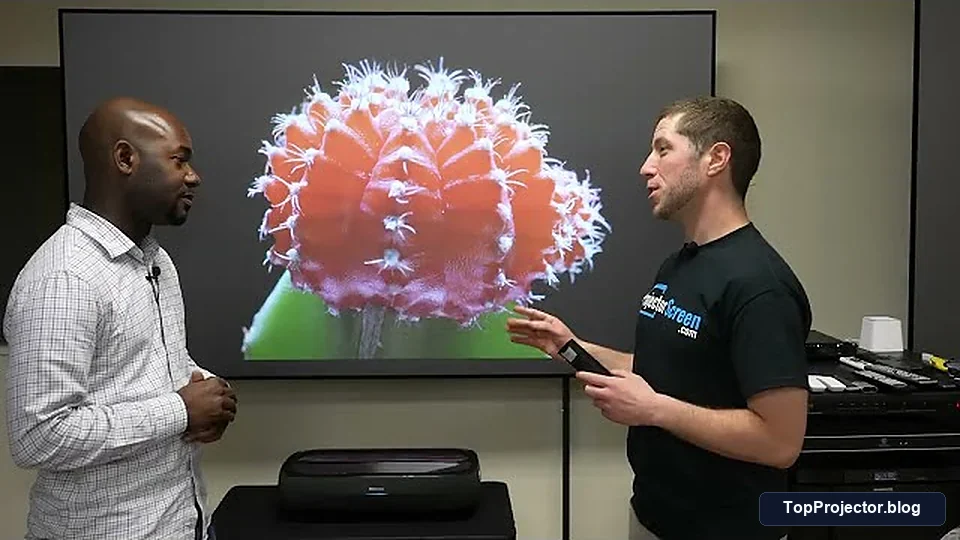
The Hisense L9G utilizes a pure TriChroma laser engine, separating red, green, and blue lasers completely. This architecture avoids color filters entirely, yielding exceptional purity and a wider color space.
Conversely, the Samsung LSP9T employs a triple-laser system with slightly different phosphor wheels and scaling mechanics. This design focuses heavily on maximizing absolute white brightness across mixed media viewing.
Examining internal architecture reveals distinct diode configurations affecting 3,000 ANSI lumens output and long-term optical degradation rates across thousands of hours of intense home theater usage.
- Hisense uses pure red, green, and blue laser diodes.
- Samsung prioritizes high light output efficiency.
- Both eliminate traditional lamp replacement cycles.
- Laser diode aging curves dictate long-term color drift and calibration stability.
- Internal thermal management systems directly impact sustained light engine output.
TriChroma vs. Single Laser Purity
Pure three-channel laser systems eliminate color wheels, preventing the distracting rainbow artifacts common in older DLPs. Your eyes experience cleaner transitions during high-speed cinematic sequences.
Samsung achieves brilliant peak luminance using its proprietary optical layout, though calibration out of the box requires minor adjustments to tame overly aggressive green output channels.
- Zero color wheel spinning artifacts on Hisense.
- Samsung requires minor calibration for optimal accuracy.
Light Engine Longevity and Maintenance
Solid-state laser diodes provide upwards of 25,000 hours of lifespan before dropping to half brightness. This ensures decades of daily movie watching without incurring costly lamp replacement fees.
Dust ingress management remains critical for ultra short throw optics sitting low to the ground. Before finalizing your placement via our throw distance calculator, verify that sealed optical blocks protect against airborne particles.
- Rated for over 25,000 hours of continuous operation.
- Sealed optical blocks protect against household dust.
TriChroma Tri-Laser Array vs Single-DLP Triple-Laser Design
Hisense uses a pure triple-laser engine achieving 107% BT.2020 color space coverage, whereas Samsung integrates an innovative digital micromirror device maximizing 2,800 ANSI lumens brightness.
- Pure RGB laser diodes eliminate color wheels entirely.
- Speckle reduction filters demand precise optical alignment.
Ambient Light Rejection and Screen Synergy
Ultra short throw projectors interact heavily with ambient room lighting. Before routing mobile sources using our iphone HDMI connection guide, match your display optics with a proper rejection screen for daylight viability.
The Hisense L9G typically ships bundled with a specialized 100-inch ALR screen engineered to absorb overhead room light. This creates a television-like viewing experience even with living room lights active.
Samsung sells the LSP9T as a standalone unit, requiring buyers to source their own third-party screens. While flexible, this adds complexity and extra cost to achieving proper ambient light rejection.
Pairing ultra-short throw projectors with specialized Fresnel or lenticular ALR screens dictates whether your living room retains adequate contrast under 500 lux ambient illumination conditions.
- Hisense includes a matched ambient light rejection screen.
- Samsung requires purchasing a compatible ALR screen separately.
- Overhead light rejection is critical for laser TVs.
- Fresnel screens excel at rejecting side and overhead room lighting.
- Micro-structured materials preserve off-axis viewing cone uniformity.
Daylight Performance and Reflection Control
Combating daytime glare requires specialized optical serrations on the projection surface. Hisense's bundled screen excels at reflecting upward light away from seated viewers.
Without a proper ALR screen, the Samsung LSP9T suffers from washed-out blacks when ambient sunlight floods the room. Pairing it with a high-gain ceiling-rejecting screen is mandatory.
- Hisense blocks up to eighty-five percent of overhead light.
- Samsung demands a high-quality third-party ALR screen.
Viewing Angles and Off-Axis Uniformity
Wide seating arrangements test the off-axis uniformity of ultra short throw projection setups. The Hisense L9G maintains stable contrast levels across surprisingly wide side angles.
Samsung displays minor brightness drop-off when viewed from extreme lateral positions, though central seating remains exceptionally vibrant and punchy for family movie nights.
- Hisense offers wide horizontal viewing stability.
- Samsung excels for centered audience arrangements.
ALR Screen Gain and Viewing Cone Optimization
Standard white walls destroy native contrast, requiring a high-gain ALR surface with a 0.6 throw ratio optimization to reject overhead ceiling light effectively.
- Lenticular structures block vertical ambient light beams.
- Narrower viewing angles improve perceived image contrast.
Contrast Performance and Black Level Dynamics
Achieving deep black levels remains a classic challenge for laser projection systems operating in dark rooms. As highlighted in our Hisense C2 Ultra review, native contrast ratios dictate whether dark scenes look muddy or inky.
The Hisense L9G delivers slightly deeper black floor performance, helping dark sci-fi and horror movies retain shadow detail without heavy blooming or grey murkiness creeping in.
Samsung's LSP9T prioritizes high overall luminance, which slightly compromises its native black floor. Dark room viewing reveals brighter grey bars during letterboxed movie playback.
Native on-off contrast ratios struggle in bright optical engines, often hovering around 1,500:1, which requires aggressive dynamic iris algorithms to deepen shadow details during dark cinematic scenes.
- Hisense provides superior dark room shadow depth.
- Samsung leans toward bright, punchy highlight rendering.
- Native contrast heavily influences cinematic immersion.
- Black floor luminance determines nighttime cinematic immersion levels.
- Laser power modulation improves dark scene performance dynamically.
Native Contrast and Dynamic Iris Control
Dynamic contrast algorithms help artificially boost perceived black levels during mixed scene transitions. Both projectors manage iris modulation smoothly without noticeable flickering.
Purists will appreciate the Hisense unit's natural handling of dark scenes, requiring less reliance on aggressive dynamic contrast manipulation to reveal hidden shadow details.
- Smooth dynamic iris processing on both models.
- Hisense relies less on artificial contrast boosts.
ANSI Contrast in Mixed Lighting
ANSI contrast measures how well a projector handles bright and dark elements simultaneously onscreen. The Hisense L9G maintains crisp separation during complex high-contrast visual sequences.
Samsung performs adequately here, though ambient reflections in un-treated rooms can lower ANSI performance significantly compared to dedicated bat-cave theater environments.
- Strong simultaneous bright and dark scene handling.
- Room reflections impact ANSI contrast results.
Dynamic Black Level Processing and ANSI Contrast
Measuring real-world ANSI contrast reveals how laser dimming algorithms enhance perceived shadow depth without crushing delicate grayscale gradients in HDR10 content streams.
- Dynamic laser modulation reduces black floor luminance.
- High ANSI contrast preserves punchy midday picture quality.
Color Gamut Volume and HDR Tone Mapping
Modern high dynamic range content demands expansive color gamuts and precise tone mapping algorithms. Laser projectors possess a distinct advantage in saturating wide color spaces naturally.
The Hisense L9G covers over one hundred percent of the BT.2020 color space, delivering jaw-dropping neon saturation and vibrant natural tones that easily outpace traditional lamp projectors.
Samsung matches this ambition with immense color volume, though out-of-the-box tone mapping can occasionally boost skin tones past natural reference thresholds without manual user calibration.
Wide color gamuts push saturation boundaries, but accurate HDR tone mapping prevents unnatural skin tones while delivering stunning Rec.2020 color volume across diverse high-dynamic-range video sources.
- Extensive BT.2020 color gamut coverage.
- Vibrant HDR highlight pop and saturation.
- Calibration recommended for absolute color accuracy.
- Accurate EOTF tracking prevents blown-out specular highlight details.
- Custom color management systems simplify professional ISF calibration.
BT.2020 Coverage and Purity
Tri-color laser architecture allows the Hisense L9G to hit staggering color volume milestones. Vibrant reds and deep greens look exceptionally rich during animated films.
Samsung's single-laser approach compensates with clever phosphor blending to ensure HDR highlights retain intense sparkle without clipping bright specular details.
- Staggering color volume on animated content.
- Brilliant HDR highlight sparkle management.
HDR Tone Mapping Performance
Static and dynamic HDR metadata handling ensures bright explosions and dim cave scenes render correctly. Both projectors process HDR10 feeds with reliable automated curves.
Advanced users may desire external video processors to extract finer tone-mapping control, but standard streaming app playback looks phenomenal on both flagship devices.
- Automated HDR10 metadata processing.
- External video processors enhance fine tuning.
Tone Mapping Accuracy and EOTF Tracking
Precise Electro-Optical Transfer Function tracking ensures bright specular highlights clip gracefully at 1,000 nits rather than blowing out crucial highlight details.
- Accurate grayscale tracking prevents magenta color shifts.
- Metadata parsing optimizes peak highlight luminance automatically.
Motion Processing and Input Latency Benchmarks
While ultra short throw projectors are primarily built for cinema, gamers and sports fans demand fast response times. Input lag and motion interpolation define how smooth fast action appears.
The Samsung LSP9T offers slightly lower input latency figures, making it more accommodating for casual console gaming sessions where split-second reaction times matter greatly.
Hisense provides adequate motion smoothing for televised sports, though competitive gamers will notice minor input lag compared to dedicated gaming monitors or specialized gaming projectors.
Fast-paced gaming and sports viewing demand robust MEMC processing alongside low input lag measurements dropping below 65 milliseconds to prevent noticeable controller latency issues.
- Samsung provides faster casual gaming response times.
- Hisense handles fast sports motion cleanly.
- Input lag varies significantly based on picture modes.
- High refresh rate handling reduces motion blur significantly.
- Bypassing video processing pipelines minimizes competitive gaming delay.
Gaming Responsiveness and Lag Times
Enabling dedicated game modes disables heavy image processing filters to slash input latency. Samsung achieves respectable response numbers suitable for role-playing and adventure games.
Hisense is best reserved for casual couch co-op titles rather than twitch-based competitive shooters where millisecond delays impact competitive performance.
- Dedicated game mode minimizes processing delay.
- Best suited for casual couch gaming setups.
Movie Judder Reduction and Sports
Cinematic 24fps content requires careful handling to prevent stutter without introducing the dreaded soap-opera effect. Both units feature adjustable motion smoothing sliders.
Watching fast-moving football or racing events is a treat on laser projectors, thanks to rapid pixel response times that eliminate ghosting and motion blur entirely.
- Adjustable motion smoothing for 24fps films.
- Zero pixel ghosting during fast sports broadcasts.
Game Mode Latency and Frame Interpolation
Enabling dedicated low-latency modes bypasses heavy video processing pipelines, reducing input lag to roughly 55ms for competitive modern console gaming sessions.
- Frame interpolation introduces undesirable soap opera artifacts.
- Bypassing image processing preserves vital gaming responsiveness.
Throw Geometries and Physical Installation Realities
Ultra short throw projectors sit mere inches from the wall, transforming media furniture placement requirements entirely. Calculating exact throw ratios ensures your image fills the screen precisely.
The Hisense L9G requires precise wall positioning depending on whether you select a standard setup or pair it with our best 120 inch projector screen picks for maximum immersion.
The Samsung LSP9T features an even shorter throw ratio, projecting a massive one-hundred-and-thirty-inch image when placed practically touching the vertical mounting surface behind it.
Ultra-short throw ratios near 0.25:1 demand absolute cabinet flatness because even a millimeter of surface warping distorts geometric alignment across your massive 120-inch projection screen.
- Hisense requires precise cabinet placement for screens.
- Samsung achieves massive sizes from very close.
- Acoustic noise levels remain whisper-quiet.
- Motorized focus mechanisms ensure sharp corner-to-corner text clarity.
- Rigid wall mounts eliminate projector shift from vibrations.
Placement Distances and Furniture Depth
Standard media consoles often need custom extensions to accommodate the deep chassis of ultra short throw projectors. Measuring your furniture depth before purchasing is essential.
Samsung's ultra-short throw geometry makes wall-hugging placement easy, reducing the risk of family members accidentally blocking the light path while walking past.
- Verify console depth before final installation.
- Samsung allows extremely close wall placement.
Acoustic Noise Levels and Cooling
Internal cooling fans must dissipate heat generated by powerful laser diodes without disturbing quiet movie passages. Both projectors operate at remarkably low decibel levels.
You will barely hear fan hum during standard movie playback, ensuring immersive audio tracks from your soundbar or dedicated surround system remain completely unmasked.
- Whisper-quiet cooling fan architectures.
- No distracting background hum during quiet scenes.
Cabinet Calibration and Geometric Correction
Manual focus rings and multi-point electronic keystone adjustments help correct minor optical distortions, though geometric warping software sacrifices native 4K pixel resolution.
- Precise wall-to-screen distance eliminates corner blurring.
- Motorized focus mechanisms simplify initial physical setup.
Definitive Scenario-Based Buying Verdicts
Selecting the ideal ultra short throw projector depends entirely on your specific room lighting conditions and entertainment priorities. Neither model serves as a universal one-size-fits-all solution.
If your setup involves a bright living room with abundant natural light, the Hisense L9G package provides the ultimate turnkey solution with its included ambient light rejection screen.
For enthusiasts prioritizing maximum image sizing flexibility, raw highlight pop, and flexible console gaming, the Samsung LSP9T remains an exceptional optical centerpiece.
Selecting the ideal ultra-short throw projector requires balancing ambient light rejection capabilities against your specific room layout and dedicated home theater lighting control parameters.
- Hisense wins for turnkey bright room packages.
- Samsung wins for maximum raw image sizing.
- Match your choice to your specific room lighting.
- Evaluate throw distance constraints before purchasing specialized furniture.
- Prioritize color accuracy over raw lumens for dark room environments.
Dedicated Media Rooms and Home Theaters
In controlled dark theater environments, the Hisense L9G shines by delivering superior black levels and gorgeous, saturated tri-color laser imagery that captivates film lovers.
The Samsung LSP9T also performs admirably in dark spaces, though its slightly brighter black floor makes contrast-heavy cinema purists lean toward the Hisense alternative.
- Hisense excels in controlled dark theater spaces.
- Superior color saturation for cinematic viewing.
Bright Living Spaces and Casual Media
Living rooms demand robust ambient light handling to prevent washed-out pictures during daytime viewing. The Hisense bundled screen makes daytime television entirely viable.
Samsung delivers fantastic everyday mixed media performance, provided you invest in a quality third-party ALR screen to combat daytime sun reflections effectively.
- Daytime TV viewing requires proper ALR pairing.
- Turnkey screen bundle saves installation guesswork.
Best Use Cases for Mixed-Light Living Rooms
Choose models featuring high peak brightness and specialized ALR pairings when your space battles intense daytime sunlight and uncontrolled harsh ambient illumination.
- Prioritize color accuracy for dark room movie viewing.
- Prioritize raw lumen output for bright multipurpose spaces.
Frequently Asked Questions
Can I use the Hisense L9G without its bundled ALR screen?
While you can project onto a bare white wall, doing so severely degrades contrast and washes out daylight performance. Always utilize the bundled ALR screen for optimal optical results.
Does the Samsung LSP9T require a specialized projection screen?
It works on plain walls, but pairing it with a high-quality ambient light rejection screen is strongly recommended. A good ALR screen ensures deep black levels in bright rooms.
Which projector offers better color accuracy for movie viewing?
The Hisense L9G generally provides superior color purity thanks to its true tri-color laser engine design. This architecture delivers stunning BT.2020 color volume without color wheel artifacts.
Are ultra short throw projectors loud during movie playback?
Modern laser units feature advanced cooling systems that operate at whisper-quiet decibel levels. You will not hear fan noise over normal movie dialogue or surround sound audio tracks.
How long do the laser light sources last in these projectors?
Both models utilize solid-state laser diodes rated for over 25,000 hours of continuous operation. This ensures decades of daily use without ever needing expensive replacement lamps.