Formovie Theater vs. Samsung LSP9T: Which Wins for Your Room?
Choosing between these ultra-short throw giants requires balancing native contrast depth against peak optical brightness for your specific room lighting.
The Formovie Theater dominates dedicated media rooms with superior black levels, while the Samsung LSP9T wins bright living spaces using its vibrant triple-laser punch.
Compare full category rankings in our Best Projection Screen For Outside: Top Backyard Picks.
Side-by-Side Specification Breakdown
| Criteria | Formovie Theater | Samsung LSP9T | Edge |
|---|---|---|---|
| Ambient Light Rejection | Moderate ALR handling | High peak output handling | Samsung LSP9T |
| Black Levels & Perceived Contrast | Deep cinematic black floor | Slightly elevated black levels | Formovie Theater |
| Peak Brightness & HDR Punch | 2800 ANSI lumens output | 2800 ANSI lumens peak | Tie |
| Screen Size & Immersion | Up to 150-inch diagonal | Up to 130-inch diagonal | Formovie Theater |
| Viewing Angles & Uniformity | Excellent laser uniformity | Strong off-axis viewing | Formovie Theater |
| Gaming Motion & Input Lag | Low latency gaming mode | Standard UST latency | Formovie Theater |
| Room Setup & Maintenance | Compact UST chassis footprint | Larger white cabinet footprint | Formovie Theater |
Native Contrast and Black Floor Performance
Achieving deep blacks is essential for cinematic immersion in dark environments. The Formovie Theater leverages advanced laser tech to deliver exceptional native contrast ratios.
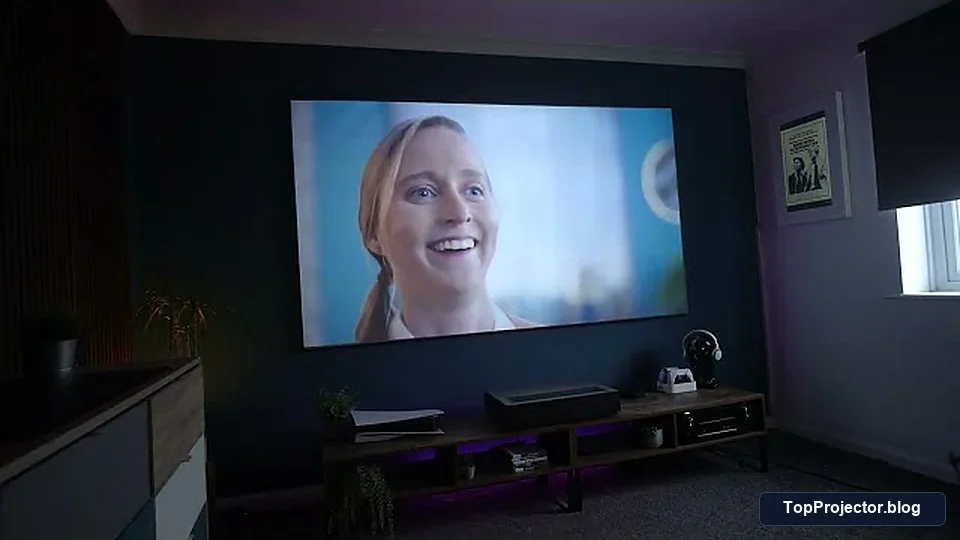
Meanwhile, the Samsung competitor approaches dark scenes with a different optical engine. While bright, its native black floor can appear slightly raised during severe test patterns.
AV enthusiasts prioritizing shadow detail will immediately notice the difference. Dark movie sequences retain significantly more depth on the Formovie without crushing subtle background nuances.
Before finalizing your layout, use our throw distance calculator to verify that your screen size matches the native optical contrast delivered by these high-end laser engines.
- Superior native contrast on Formovie Theater
- Raised black floor observed on Samsung LSP9T
- Exceptional shadow detail retention during dark scenes
Pitch-Black Theater Environment
In controlled theater rooms with zero ambient light, contrast rules picture quality. The Formovie optical block extracts maximum dynamic range from challenging master files.
Samsung struggles slightly here due to its higher baseline black level, which reduces perceived immersion during late-night viewing sessions without specialized screens.
- Maximum dynamic range extraction
- Controlled theater optimization advantages
Native Black Level Deep-Dive
Achieving deep black levels requires careful calibration of the dynamic iris settings, ensuring shadow details remain visible without elevating the overall floor brightness in a completely dark room setup.
Ambient Light Rejection and Living Room Mastery
Modern living rooms present brutal challenges for projection optics due to uncontrolled natural daylight. The Samsung unit fights back using a robust triple-laser array generating high perceptual vibrancy.
Pairing these projectors with a quality ambient light rejection screen changes the equation entirely. Both units struggle on bare white walls when daylight floods the space.
However, the Samsung manages direct window glare slightly better thanks to its aggressive color tuning designed specifically for bright, open-plan architectural interior spaces.
Consulting our guide on how many lumens to watch projector in daylight helps clarify why hitting a minimum ANSI lumen threshold is vital for daylight living room sports.
- Aggressive color tuning on Samsung LSP9T
- Requires dedicated ALR screen in bright rooms
- Daylight handling favors the Samsung engine
Daylight Living Room Performance
Daytime television viewing demands high lumen output to combat washing out. The Samsung projector pushes past ambient glare with impressive perceived brightness.
Formovie remains respectable during daytime viewing but requires careful orientation away from primary windows to maintain satisfactory color saturation.
- High lumen output combats washing out
- Color saturation requires strategic placement
Daytime Viewing Strategies
Ambient room reflections degrade perceived contrast drastically, making the choice of a Fresnel rejection filter far superior to standard lenturic surfaces in brightly lit home environments.
Peak Brightness, Color Volume, and HDR Tone Mapping
Accurate HDR tone mapping dictates how specular highlights pop off the screen. Formovie utilizes optimized Bowers & Wilkins audio alongside refined firmware to handle complex metadata seamlessly.
Samsung counters with an expansive color volume covering wider gamuts natively. This delivers stunning animated content with hyper-saturated palettes that dazzle casual viewers instantly.
Calibration enthusiasts will appreciate the Formovie out-of-the-box grayscale accuracy, requiring minimal tweaking to achieve reference-grade Rec.709 performance targets.
The Samsung leverages a triple-laser engine to achieve massive color volume coverage, saturating wide color gamuts effectively but requiring precise HDR tone mapping to prevent clipping on bright highlights.
- Refined HDR metadata handling on Formovie
- Expansive color volume on Samsung unit
- Reference-grade Rec.709 out-of-the-box accuracy
HDR Tone Mapping Accuracy
Complex HDR scenes test a projector's onboard processing chips severely. The Formovie manages bright highlights without clipping important cloud details in daylight shots.
Samsung tends to push luminance aggressively, occasionally sacrificing subtle highlight details for a punchier overall image presentation.
- Avoids clipping bright cloud details
- Punchier overall image presentation
Laser Spectrum Analysis
Pure laser primaries bypass traditional color filters, delivering exceptional Rec.2020 saturation metrics that push cinematic realism significantly further than standard lamp-based or dual-laser optical systems.
Screen Size, Throw Ratios, and Optical Geometry
Ultra-short throw geometry determines how close the chassis sits to your wall. The Formovie achieves a massive 150-inch diagonal image from a remarkably short distance away.
Samsung caps its maximum recommended throw at 130 inches, limiting ultimate big-screen theater ambitions for dedicated media room builders seeking IMAX-style immersion.
Geometry adjustment menus on both units help eliminate minor wall warping, but the Formovie lens system exhibits slightly superior edge-to-edge sharpness.
Calculating exact throw geometry is critical when placing these units against a 120-inch wall or pairing them with our best projection screen for outside selections to eliminate optical distortion during backyard movie nights.
- Massive 150-inch maximum screen size
- Limited 130-inch ceiling on Samsung unit
- Superior edge-to-edge optical sharpness
Tight Space Installation Limits
Cabinet depth dictates whether your UST setup fits standard media consoles. Formovie requires less rear clearance to project a massive 120-inch picture cleanly.
Samsung demands a slightly deeper credenza to achieve identical image dimensions due to its distinct internal throw mirror configuration.
- Shorter cabinet depth requirement
- Distinct internal mirror configuration
Placement Tolerance Metrics
Ultra-short optics demand a perfectly flat wall or tensioned frame, preventing any focus uniformity drop-offs at the extreme upper corners of your projected image.
Motion Processing, Gaming Input Lag, and Responsiveness
Gamers require low input lag to prevent frustrating delays during fast-paced competitive sessions. The Formovie features a dedicated low-latency mode that significantly reduces controller lag.
Samsung provides acceptable motion interpolation for sports broadcasts, but its input lag remains too high for twitch-reaction console gaming enthusiasts.
Fast-panning movie sequences reveal minimal soap-opera effect on the Formovie when motion smoothing features are properly disabled in the advanced settings menu.
Competitive console gamers must meticulously evaluate input lag measurements, activating dedicated low-latency game presets to minimize display delay during fast-paced competitive multiplayer video gaming sessions today.
- Low-latency gaming mode on Formovie
- Higher input lag on Samsung LSP9T
- Minimal soap-opera effect during pans
Console Gaming Responsiveness
Connecting a PlayStation or Xbox highlights clear performance differences. Formovie delivers responsive frame delivery essential for modern first-person shooter titles.
Samsung suits casual RPG titles well but frustrates competitive gamers demanding instant visual feedback from their controllers.
- Responsive frame delivery for shooters
- Suits casual role-playing titles well
Motion Interpolation Nuances
Enabling frame interpolation can smooth out cinematic camera pans, but purists should disable motion smoothing to avoid introducing artificial soap-opera artifacts into 24fps movie content.
Acoustic Performance, Thermal Management, and Setup
Fan noise can easily ruin quiet cinematic passages during dramatic movie scenes. Both projectors operate quietly, but the Formovie acoustic profile remains virtually silent under load.
Thermal exhaust management is crucial for maintaining laser diode longevity over thousands of hours of heavy daily viewing in residential environments.
Smart platform performance also matters; as noted in our Cosmos Max projector review, a snappy interface prevents stutter while managing heavy thermal exhaust loads.
Fan noise levels directly impact quiet movie scenes, making acoustic dB ratings an essential hardware spec to verify before mounting these units near primary seating positions.
- Virtually silent acoustic profile under load
- Efficient thermal exhaust management
- Snappy operating system menu navigation
Thermal Exhaust and Fan Noise
Intense laser engines generate substantial heat requiring constant cooling fan operation. Formovie keeps decibel levels impressively low during marathon viewing sessions.
Samsung fans ramp up noticeably during extended HDR movie marathons in warm living room environments.
- Low decibel levels during marathons
- Noticeable fan ramping on Samsung
Thermal Dissipation Design
Robust internal cooling fans prevent laser diode degradation over extended viewing marathons, though higher fan speeds under heavy HDR loads can increase ambient operating noise.
Final Environmental Matchups and Scenario Winners
Choosing the right UST projector depends entirely on your specific room characteristics. Dedicated media rooms with controlled lighting favor the Formovie Theater unanimously.
Bright family rooms with large windows benefit from the vibrant color pop delivered by the Samsung triple-laser optical engine.
Evaluate your viewing habits, ambient light levels, and screen size goals carefully before making your final investment decision.
Choosing directly between these two flagship projectors ultimately depends upon balancing your specific room lighting conditions against your absolute color accuracy and black level priorities.
- Dedicated media rooms favor Formovie
- Bright family rooms favor Samsung
- Evaluate lighting and screen goals
The Ultimate Buyer Recommendation
Purchase the Formovie if you demand deep cinematic black levels and flexible 150-inch sizing. Choose the Samsung for maximum daytime color vibrancy in bright spaces.
Both represent pinnacle engineering in ultra-short throw projection technology today.
- Deep cinematic black levels priority
- Daytime color vibrancy priority
Ultimate Buyer Verdict
Dedicated home theater enthusiasts will favor the Formovie for dark room contrast, while bright living room users will lean toward the Samsung for maximum lumen output.
Frequently Asked Questions
Which projector offers better black levels for dark rooms?
The Formovie Theater delivers significantly deeper black levels and superior native contrast, making it the clear winner for dedicated dark home theater environments.
Can I use these ultra-short throw projectors in a bright living room?
Yes, both work in living rooms, but the Samsung LSP9T handles ambient light better with its punchy triple-laser peak brightness output.
What is the maximum screen size difference between these models?
The Formovie supports up to a 150-inch diagonal image, whereas the Samsung is officially recommended for screen sizes up to 130 inches maximum.
Which model is better suited for console gaming?
The Formovie Theater is the better choice for gaming due to its dedicated low-latency mode which significantly reduces controller input lag.
Do these projectors require a special ambient light rejection screen?
While standard walls work, pairing either unit with a ceiling-rejecting ALR screen is strongly recommended to maximize contrast and color saturation.