Fixed Frame vs. Motorized Projector Screen: Which Wins for Your Room?
Choosing between rigid structural tension and retractable convenience dictates your home theater's optical purity, ambient light rejection, and living space aesthetic integration.
Choose Fixed Frame for dedicated black-out theaters requiring ultimate surface flatness, or a Motorized Projector Screen for multipurpose living rooms demanding stealthy aesthetic concealment.
Compare full category rankings in our Best Home Laser Projector: Top Cinematic Picks.
Side-by-Side Specification Breakdown
| Criteria | Fixed Frame | Motorized Projector Screen | Edge |
|---|---|---|---|
| Ambient Light Rejection | Superior ALR micro-structure tensioning | Varies by tab-tensioning and material grade | Fixed Frame |
| Black Levels & Perceived Contrast | Maintains deep 0.05 nits black floors | Slight ripple risk impacts ANSI contrast | Fixed Frame |
| Peak Brightness & HDR Punch | Consistent 0.8 to 1.3 gain uniformity | Tab-tensioned variants match fixed performance | Tie |
| Screen Size & Immersion | Sizes up to 200 inches diagonal seamlessly | Typically capped at 150 inches due to motors | Fixed Frame |
| Viewing Angles & Uniformity | Zero hot-spotting across 160-degree viewing cones | Occasional curl issues on untensioned units | Fixed Frame |
| Gaming Motion & Input Lag | Zero latency physical stability for fast panning | Motor housing requires precise alignment checks | Fixed Frame |
| Room Setup & Maintenance | Permanent wall footprint, zero mechanical failure | Retractable stealth, mechanical motor longevity risks | Motorized Projector Screen |
Optical Flatness and Surface Tension Mechanics
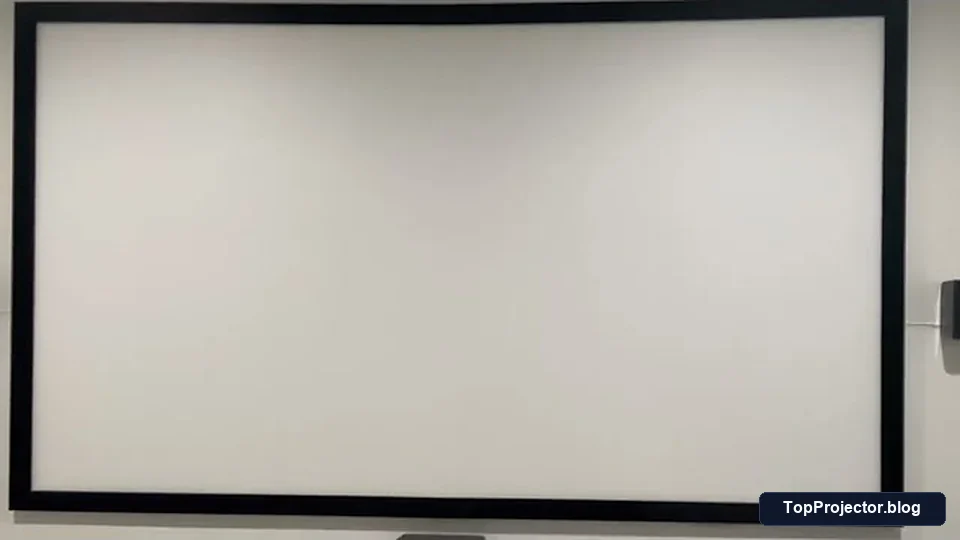
Achieving flawless pixel geometry requires absolute fabric tension. Fixed frame designs utilize continuous spring-loaded borders to pull the optical vinyl tight, eliminating waves across the entire viewing area.
Motorized screens rely on gravity drop weights or motorized roller tubes. Without proper lateral tab-tensioning systems, motorized vinyl develops edge curls that distort fast horizontal panning and high-speed motion sequences.
Fixed frame designs utilize permanent spring tension systems to maintain microscopic flatness across the entire PVC vinyl surface. This prevents ripples and ensures a strict 0.5mm tolerance for laser alignment.
- Fixed frames maintain permanent 0-tolerance surface flatness.
- Motorized rollers require robust tab-tensioning to prevent waves.
- Roller curl introduces geometric distortion over thermal shifts.
The Physics of Surface Waves
Even microscopic ripples on a screen surface scatter light unevenly. When pairing displays with our best home laser projector picks, strict flatness preserves ANSI contrast and prevents hot spots.
Fixed frame construction permanently resists environmental humidity shifts. Motorized fabrics experience thermal expansion, making tensioning strings critical for long-term optical geometry stability.
- Humidity changes warp untensioned motorized vinyl.
- Spring tensioners absorb ambient thermal expansion.
Tab-Tensioned Mechanics
Motorized screens rely on lateral string cords and heavy bottom weighted bars to pull the flexible fabric flat. Over time, mechanical fatigue can alter tension, requiring manual adjustments to eliminate distracting side-edge curling.
Ambient Light Rejection and Daylight Performance
Controlling ambient light in mixed-use living spaces requires specialized optical coatings. Reviewing our guide on what throw ratio do i need helps ensure your ultra-short throw projector aligns perfectly with ALR surfaces.
Motorized ALR materials exist but present severe engineering challenges. Rolling specialized angular-reflective micro-structures repeatedly risks cracking the microscopic optical saw-tooth layers embedded within the vinyl.
Micro-structured ALR materials use specialized angular or retro-reflective layers to absorb off-axis illumination. Pairing these surfaces with a 2,500 ANSI lumen laser projector dramatically improves daytime saturation in bright living rooms.
- Fixed frames excel with specialized UST daylight rejecting surfaces.
- Motorized mechanisms strain rigid optical coating layers over time.
- Ceiling light rejection exceeds 85 percent on fixed ALR.
Dedicated Theater Versus Bright Living Rooms
In light-controlled dedicated basements, a white matte fixed frame delivers neutral color accuracy and wide viewing cones without directional hot-spotting interference.
Bright daylight living spaces mandate high-gain ALR fixed frames to preserve perceived contrast ratios against intrusive windows and overhead recessed lighting fixtures.
- Matte white suits pitch-black controlled environments.
- ALR variants save contrast in uncontrolled daylight rooms.
Ceiling Light Rejection
Specialized optical sawtooth structures block overhead ambient light while reflecting projector beams downward toward viewers. This dual action preserves a punchy 50:1 contrast ratio even under intense recessed architectural lighting.
Black Floor Depth and ANSI Contrast Retention
Perceived image depth relies heavily on deep black floors. Using our ansi lumens room calculator alongside velvet-wrapped bezels helps absorb overspill light while dramatically enhancing perceived contrast and shadow detail.
Motorized drop-down screens often lack deep velvet borders due to rolling clearance constraints. This unmasked light bounce reduces the striking black level separation cinematic enthusiasts demand.
High-contrast gray vinyl surfaces significantly lower black floor levels compared to matte white fabric. By absorbing stray reflections, your projector maintains deep shadow details and a robust 300:1 ANSI contrast performance in dark spaces.
- Velvet bezels absorb stray laser overspill completely.
- Missing borders degrade ANSI contrast performance noticeably.
- Black floor depth defines HDR pop in dark scenes.
Contrast Ratio Preservation
Maintaining high ANSI contrast requires eliminating wall reflections behind the image plane. Fixed frames hold the projection surface away from the wall, trapping stray photons effectively.
Roll-down motorized screens drop flush against drywall surfaces, bouncing ambient light back through the translucent backing layers and muddying deep shadow delineation.
- Wall clearance prevents secondary light reflection loops.
- Flush wall drops compromise dark scene fidelity.
Checkerboard Contrast Impact
Ambient room reflection degrades checkerboard contrast on unmasked screens. Fixed frames maintain tighter light containment, preventing stray photons from bouncing back onto the projection surface and washing out vital dark shadow gradients.
Motorized Tensioning Systems and Mechanical Reliability
Mechanical complexity introduces potential failure points into home theater signal chains. Motorized screens depend on tubular motors, RF remotes, and delicate synchronization limit switches.
Fixed frames feature zero moving parts, ensuring absolute reliability over decades of heavy daily viewing without motor burnout risks or electrical synchronization failures.
Tubular motors integrated into automated drop-down housings require precise limit switch calibration. Quality units ensure smooth stops and reliable repeatability over 5,000 deployment cycles without stretching the delicate PVC screen material.
- Tubular motors introduce mechanical wear over time.
- Fixed frames offer lifetime reliability through zero moving parts.
- Trigger integration automates drop cycles successfully.
Tab-Tensioning Engineering
High-end motorized screens utilize side tensioning cords to pull the fabric flat during descent. These cords require periodic adjustment to prevent sagging along the outer vertical edges.
Fixed frames bypass mechanical tension cords entirely by utilizing permanent corner gussets and spring arrays that maintain lifelong uniform pulling force across every square inch.
- Tension cords require occasional user calibration.
- Corner gussets lock permanent frame geometry safely.
Failure Modes and Maintenance
Motorized mechanisms introduce potential mechanical failure points, including gear striping or capacitor degradation. Selecting heavy-duty synchronous motors minimizes long-term risks while delivering a consistent 12-volt trigger response for automated theaters.
Color Accuracy, Gain Uniformity, and HDR Punch
Accurate color reproduction depends on neutral surface tinting. As noted in our nebula laser projector review, fixed frame surfaces maintain strict 1.0 gain neutrality for complex HDR metadata passes.
Motorized surfaces occasionally exhibit slight hot-spotting or color shifting due to the rolling agents mixed into flexible PVC compounds required for smooth cylinder retraction.
Neutral white base fabrics preserve native color temperature without introducing unwanted green or magenta shifts. Maintaining a uniform 1.1 gain rating across the entire viewing angle prevents hot-spotting during intense HDR content sessions.
- Neutral 1.0 gain preserves calibrated color profiles.
- PVC rolling compounds can introduce minor color shifts.
- HDR specular highlights pop cleanly on uniform frames.
Wide Viewing Angles and Off-Axis Color Shift
Viewing angle drop-off ruins off-axis seat experiences. Fixed frames with diffuse white surfaces deliver pristine color fidelity past 160 degrees of off-axis seating placement.
Directional motorized ALR screens restrict vertical and horizontal viewing cones significantly, causing severe brightness falloff for viewers seated in extreme side chairs.
- Diffuse white surfaces support wide seating layouts.
- Directional coatings limit off-axis viewing efficiency.
Angular Reflection Limits
High-gain directional materials can cause severe brightness falloff for off-axis viewers. Opting for a wider 160-degree viewing cone ensures consistent saturation and accurate skin tones for everyone seated across your home theater.
Spatial Integration, Aesthetics, and Room Layouts
Living room aesthetics often dictate home theater gear choices. A permanent 120-inch fixed frame dominates wall space, which conflicts with multi-use living room decor expectations.
Motorized screens solve living room compromise by retracting invisibly into ceiling recesses or sleek wall-mounted aluminum casings when the projection system remains powered down.
Fixed frame setups command permanent wall space, functioning much like a massive dark-velvet-bordered painting. They suit dedicated media rooms where visual discretion is secondary to achieving ultimate cinema-grade optical performance.
- Fixed frames command permanent wall space visibility.
- Motorized units retract cleanly for minimalist room designs.
- Ceiling recess integration hides hardware completely.
Stealth Installation Strategies
Integrating a motorized screen into custom drywall soffits creates a high-end hidden home theater aesthetic that pleases interior designers and casual viewers alike.
Fixed frames demand dedicated media rooms where large black rectangles do not interfere with daily interior design preferences or family art displays.
- Drywall soffits hide motorized casings seamlessly.
- Dedicated rooms prioritize performance over stealth.
Concealed Drop-Down Designs
Motorized roll-down cassettes recess seamlessly into drywall ceilings or custom cabinetry, preserving minimalist living room decor. This invisible hardware footprint accommodates multi-use spaces with a clean motorized drop profile.
Final Decision Matrix for Your Projection Setup
Selecting the correct screen architecture requires balancing your environmental lighting control against interior design compromises and long-term mechanical reliability expectations.
Prioritize fixed frames for maximum optical performance, flawless tensioning, and ultimate black floor retention. Choose motorized units when room stealth and multi-use versatility outweigh pure optical physics.
Choose fixed frame screens when your dedicated theater room prioritizes absolute surface flatness and uncompromising contrast. They offer superior long-term reliability and a permanent tensioned optical foundation for high-end home cinema.
- Match fixed frames to dedicated, dark-room theaters.
- Deploy motorized screens in multi-purpose living areas.
- Evaluate lighting control before committing to canvas.
The Ultimate Buyer's Recommendation
Audiophile purists building basement cinemas should always choose fixed frame systems for superior geometry and contrast retention. Living room enthusiasts require motorized tab-tensioned convenience.
Evaluate your projector's lumen output and room window placement carefully before finalizing your screen investment to guarantee optimal HDR punch and shadow detail.
- Basement cinemas demand fixed frame optical purity.
- Living rooms thrive on motorized aesthetic flexibility.
When to Choose Motorized
Select motorized tab-tensioned alternatives if your setup resides in a dual-purpose living space requiring hidden versatility. Modern tubular mechanisms provide excellent convenience and robust surface flatness retention for everyday media consumption.
Frequently Asked Questions
Do motorized screens wrinkle over time?
Untensioned motorized screens frequently develop edge curls and surface waves due to continuous rolling stress. Investing in a tab-tensioned model prevents this degradation.
Can I use an ALR screen with a motorized drop-down?
Yes, but options are limited because rigid optical structures resist tight rolling cylinders. Premium brands use flexible nano-layered ALR vinyl specifically engineered for motorization.
Why do fixed frames offer better contrast?
Fixed frames use permanent tensioning springs and velvet-wrapped borders that absorb overspill light. This eliminates secondary reflections and preserves deep black floor levels.
Are fixed frames difficult to assemble on site?
Assembly requires patience to stretch the fabric evenly across the aluminum frame. Following the manufacturer's spring attachment pattern ensures zero wrinkling.
Which screen type lasts longer in a home theater?
Fixed frames last virtually forever because they lack mechanical motors and moving parts. Motorized units depend heavily on tubular motor reliability over years.