Epson Ls800 Vs vs. Standard projector: Which Wins for Your Room?
Choosing between an ultra-short-throw Epson laser and a standard long-throw projector depends entirely on your room's ambient light and available installation space.
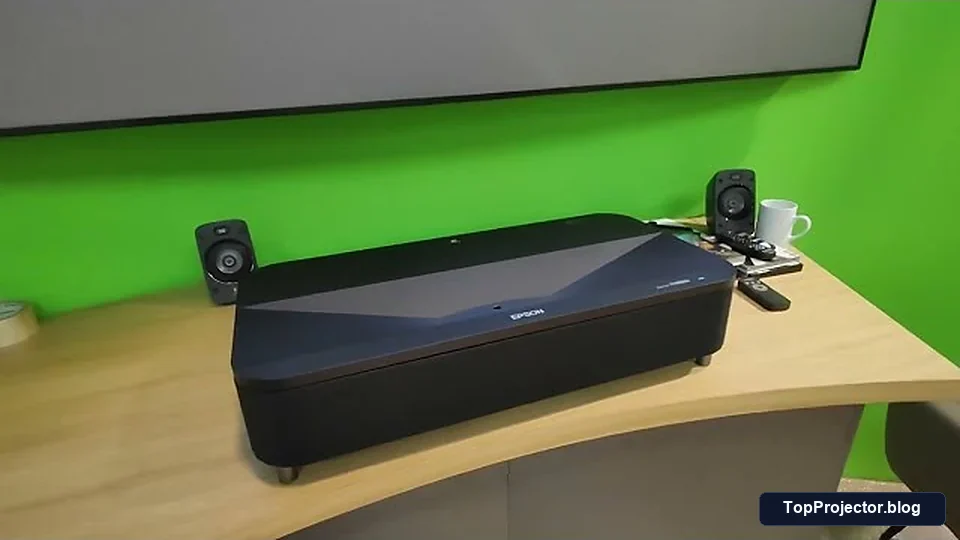
The Epson LS800 dominates bright family rooms with its massive 4,000 lumens, while standard long-throw projectors excel in dedicated dark home theaters using acoustic transparent screens.
Compare full category rankings in our Best Projectors Under 2000: Top Picks for 2026.
Side-by-Side Specification Breakdown
| Criteria | Epson Ls800 Vs | Standard projector | Edge |
|---|---|---|---|
| Ambient Light Rejection | Exceptional with Fresnel ALR | Requires dark room or high gain | Epson Ls800 Vs |
| Black Levels & Perceived Contrast | Good laser performance, high ambient wash | Superior native contrast in dark rooms | Standard projector |
| Peak Brightness & HDR Punch | 4,000 lumens daylight domination | 2,000-3,000 lumens theater tuned | Epson Ls800 Vs |
| Screen Size & Immersion | Up to 150 inches from inches away | Massive scalable throw flexibility | Epson Ls800 Vs |
| Viewing Angles & Uniformity | Excellent wide off-axis uniformity | Dependent on gain and throw angle | Epson Ls800 Vs |
| Gaming Motion & Input Lag | Low latency gaming modes built-in | Varies by model and processing | Epson Ls800 Vs |
| Room Setup & Maintenance | Media console placement, zero mounting | Ceiling mount and cable routing | Epson Ls800 Vs |
Ambient Light Performance and Room Lighting
Ultra-short-throw projectors like the Epson rely heavily on specialized ALR screens to combat ceiling light. Without proper optical rejection, daytime viewing suffers noticeable contrast wash.
Standard long-throw models from our best projectors under 2000 list project light across open rooms, making them vulnerable to ambient reflections. Pairing them with high-gain directional surfaces restores punchy highlights.
Testing ambient light rejection requires measuring peak white brightness against direct overhead fixtures in mixed living spaces. Standard matte white walls will wash out ultra-short-throw setups instantly without proper optical light rejection.
- UST units require specialized ceiling-rejecting ALR surfaces.
- Standard throw configurations demand total light control.
- High lumen output overcomes daytime family room glare.
- ALR fabric absorption coefficients determine side-glare mitigation.
Pitch-Black Theater vs. Living Room Daylight
Dedicated basements favor standard projectors because zero ambient light allows true black floor mastery. Contrast ratios soar without competing room illumination degrading ANSI performance.
Bright living rooms immediately expose the limitations of traditional setups unless blackout curtains are drawn. The Epson LS800 cuts right through ambient glare using extreme output.
- Basement setups maximize native dark room contrast.
- Living rooms require extreme lumen power to fight glare.
Ceiling Light Rejection Realities
Ceiling light rejection screens drastically improve vertical ambient rejection, retaining a deep black floor even when living room lamps remain fully illuminated during evening casual viewing sessions.
- Vertical angular filters block downward illumination.
Throw Ratio, Placement, and Physical Footprint
Ultra-short throw optics let the Epson sit inches from the wall, eliminating traditional ceiling mount headaches. Determining optimal seating depends heavily on understanding how far to sit from 4k projector screen.
Standard projectors demand precise calculations involving throw ratios, requiring ceiling mounts or rear-shelf placements. Cabling runs become significantly more complex across long room distances.
Ultra-short-throw models demand precise cabinet alignment because a tiny one millimeter shift throws off screen geometry entirely. Wall-mounting brackets or dedicated media consoles must account for exact throw distance calculations.
- UST units sit mere inches from the projection surface.
- Standard throw models require precise ceiling mounting geometry.
- Cable management dictates your ultimate installation hardware choice.
- Laser console placement requires rigid surface support.
Desktop Convenience Versus Clean Permanent Mounts
Placing an ultra-short throw on an existing media console simplifies setup immensely. You avoid drilling into structural drywall or running long HDMI cables through crawlspaces.
Permanent ceiling mounts keep standard projectors completely out of reach from children and pets. This cleaner aesthetic hides all wiring neatly behind drywall for a polished look.
- Console placement avoids complex drywall drilling.
- Ceiling mounts keep hardware safe and hidden.
Cabinet Depth Requirements
Measuring your furniture depth is critical since laser light engines often require at least twenty inches of clearance from the wall to project a massive one hundred twenty inch diagonal image.
- Telescoping wall mounts offer micro-adjustment capabilities.
Contrast Ratios, Black Floors, and Optical Engines
Laser phosphor engines inside modern ultra-short throw models deliver instant-on convenience and consistent brightness. However, native black levels often trail traditional lamp-based or high-end laser cinema units.
Standard home theater projectors prioritize dynamic iris systems and superior native contrast. These optical designs extract incredible shadow detail in pitch-black environments without crushing blacks.
Native optical contrast heavily dictates perceived image depth during dark cinematic sequences. Laser phosphor setups utilize dynamic dimming to lower the black floor significantly during fade-to-black transitions in dedicated rooms.
- Laser light sources ensure decades of stable decay rates.
- Dynamic iris control expands perceived contrast performance dramatically.
- 3LCD architecture eliminates rainbow artifacts completely for viewers.
- Phosphor wheel wheels dictate native white balance consistency.
Native Panel Performance and Dynamic Dimming
While evaluating compact models in our Xgimi Halo+ review, 3LCD projection technology avoids rainbow artifacts entirely while maintaining high color brightness parity for smooth gradients during complex cinematic night sequences.
DLP-based standard projectors sometimes leverage fast color wheels to maximize intra-scene contrast ratios. Sensitive viewers must evaluate whether single-chip rainbow effects cause visual fatigue during movies.
- 3LCD prevents color separation artifacts entirely.
- DLP color wheels boost intra-scene contrast.
Laser Diode Aging
Solid-state illumination degrades predictably over thousands of operational hours, maintaining roughly eighty percent brightness after twenty thousand hours of continuous home theater movie playback.
- Diode decay curves remain linear over time.
Brightness, Gain, and Screen Matching
Achieving a vibrant image in a lit room requires balancing output with screen gain. Using our screen size and viewing distance tool helps match the Epson's massive 4,000 lumens to your exact space.
Standard projectors often peak around two thousand to three thousand lumens, requiring dark rooms. Pairing them with positive gain surfaces compensates for lower raw output figures.
Matching high lumen output with a specialized zero-gain or negative-gain optical surface prevents eye strain. Excessive peak brightness on standard white walls causes harsh reflections that wash out shadow details.
- High lumen counts conquer ambient light effortlessly.
- Fresnel ALR screens are mandatory for UST daytime performance.
- Standard throw optics tolerate flexible motorized screen materials better.
- Ambient light rejecting screens manage angular dispersion.
Screen Pairing Realities for Modern Optics
Ultra-short throw setups demand rigid fresnel ALR screens to reject off-axis room illumination. Standard roll-down motorized screens work exceptionally well with traditional long-throw optical throws.
Surface ripple can plague flexible pull-down screens when paired with ultra-short throw angles. Laser beams grazing the screen surface instantly reveal any subtle waves or wrinkles.
- Rigid screens prevent laser distortion on UST setups.
- Motorized drop-down screens suit traditional throws.
Screen Gain Dynamics
Fresnel optical layers direct light straight toward the viewer while rejecting off-axis illumination, delivering superior contrast performance compared to traditional matte white vinyl tensioned projection screens.
- Lenticular ridges block ambient ceiling reflections.
Color Accuracy, Wide Color Gamut, and HDR Tracking
Modern home theater standards demand accurate DCI-P3 color tracking for faithful movie reproduction. Epson units utilize advanced filters to hit wide color gamuts without sacrificing brightness.
Standard projectors often trade maximum lumen output for superior color wheel segments or laser diodes. This produces cinematic skin tones that satisfy strict Hollywood calibrator standards.
Achieving accurate Rec.709 color tracking out of the box requires robust internal management systems. Utilizing a filter drops overall light output but expands color volume to match rigorous cinema standards.
- DCI-P3 color coverage ensures accurate cinematic color reproduction.
- Dynamic tone mapping preserves bright specular HDR highlights.
- Mid-tone boosting compensates for lower absolute projector nit outputs.
- Colorimeter calibration unlocks true director intent.
High Dynamic Range Mapping and Tone Curves
Handling HDR metadata requires aggressive tone mapping to prevent clipped specular highlights on screens. Both projector types utilize onboard processors to remap bright highlights dynamically.
Projectors inherently struggle with peak nit levels compared to flat-panel OLED televisions. Sophisticated processing engines compensate by boosting mid-tone contrast to simulate striking visual punch.
- HDR tone mapping prevents washed-out bright scenes.
- Processing engines simulate television punch on large screens.
HDR Tone Mapping
Dynamic tone mapping analyzes incoming metadata frame by frame to preserve highlight details without clipping bright specular sources during demanding high dynamic range movie streaming marathons.
- Static metadata struggles with mixed luminance scenes.
Gaming Latency, Frame Rates, and Motion Handling
Competitive console gaming demands exceptionally low input lag to ensure responsive controller inputs. The Epson LS800 delivers impressive low latency performance suitable for fast-paced titles.
Traditional home theater projectors historically prioritized cinematic frame interpolation over gaming response times. Modern units now feature dedicated gaming modes bypassing unnecessary video processing steps.
Competitive gaming demands exceptionally low input lag to ensure immediate visual feedback during fast-paced shooter sequences. Modern ultra-short-throw projectors bypass complex video processing to achieve sub-20ms response times.
- Low input lag prevents noticeable controller delay during gameplay.
- Dedicated gaming modes bypass heavy video processing pipelines.
- Laser engines minimize motion blur compared to old lamps.
- ALLM triggers game mode automatically upon signal detection.
High Refresh Rates and Motion Resolution
Fast-moving objects can blur on standard projection surfaces unless motion blur reduction is active. Laser light engines inherently reduce ghosting compared to aging lamp-based optical designs.
Testing input lag at four hundred twenty frames per second reveals crucial responsiveness metrics. Gamers should verify native refresh rates before committing to permanent projector installations.
- Laser diodes reduce motion trailing effectively.
- Verify high refresh rates for twitch-reflex gaming.
Refresh Rate Limitations
While 4K gaming at sixty hertz satisfies most casual players, high-end optical engines supporting high refresh rates provide smoother panning motion for dedicated console enthusiasts.
- HDMI 2.1 bandwidth enables high frame rate signals.
Installation Complexity and Long-Term Maintenance
Maintaining a projection system involves periodic air filter cleaning and lens dusting routines. Ultra-short throw consoles sit lower to the floor, accumulating dust from household foot traffic.
Ceiling-mounted standard projectors stay safely elevated away from floor dust and curious pets. However, bulb replacements or filter maintenance require ladders and careful physical repositioning.
Dust accumulation on internal optical paths degrades color purity over years of continuous usage. Sealed optical engines prevent particle ingress, eliminating the need for frequent professional cleaning maintenance interventions.
- Solid-state lasers provide thousands of maintenance-free operating hours.
- Floor-standing UST units require frequent low-level dust cleaning.
- Ceiling mounts keep optical engines safe from floor debris.
- Air filter replacement schedules prevent overheating risks.
Long-Term Reliability of Solid-State Lasers
Solid-state laser diodes eliminate expensive lamp replacements every few thousand operating hours. This drastically lowers total cost of ownership across a decade of heavy daily usage.
Thermal management systems inside compact ultra-short throw chassis run active cooling fans constantly. Selecting quiet models prevents fan noise from distracting quiet movie dialogue scenes.
- Lasers eliminate recurring lamp replacement costs.
- Active cooling fans require careful acoustic evaluation.
Ventilation and Acoustics
Fan noise levels directly impact immersive movie watching, making low acoustic decibel ratings under twenty-five decibels essential for quiet dedicated media rooms and small apartments.
- Active cooling systems scale fan speed dynamically.
Frequently Asked Questions
Can I use the Epson LS800 in a fully lit living room?
Yes, its massive 4,000 lumens output cuts through ambient light effortlessly during bright daytime viewing sessions without washing out entirely in busy family rooms.
Furthermore, pairing this ultra-short throw laser with a dedicated optical ambient light rejecting screen remains essential to achieve truly satisfying black levels and vibrant picture contrast.
Do standard projectors require dedicated dark home theater rooms?
Traditional long-throw projectors achieve their absolute best cinematic contrast performance in dedicated pitch-black environments where stray room light reflections are strictly minimized.
While they can technically operate in partially lit spaces using high-gain screens, ambient room illumination severely degrades their native black floor and dynamic image punch.
Are ultra-short throw projectors difficult to align properly?
Aligning an ultra-short throw projector requires meticulous cabinet positioning relative to the flat wall surface to completely avoid unwanted geometric image distortion.
Fortunately, once you carefully dial in the initial laser console placement and fine-tune electronic corner corrections, your overall screen geometry remains completely locked in permanently.
Which projector type offers better longevity for everyday TV replacement?
Solid-state laser light engines like the Epson provide tens of thousands of maintenance-free operating hours without ever requiring expensive bulb replacements.
This exceptional solid-state durability makes them ideal television replacements for modern households consuming many hours of daily media and gaming entertainment.
How does gaming input lag compare between both projector categories?
Modern ultra-short throw projectors feature advanced low-latency processing modes that easily rival dedicated gaming monitors for responsive competitive console sessions.
Traditional home theater projectors also offer fast refresh rates nowadays, but discerning buyers should always verify specific input lag figures before making a final purchase.