Epson LS800 vs. Hisense L9G: Which Wins for Your Room?
Choosing between these two ultra-short-throw flagships requires balancing raw ANSI lumen muscle against pure laser color volume.
The Epson LS800 dominates bright spaces with 4,000 ANSI lumens, while the Hisense L9G wins dedicated theaters via TriChroma laser color purity.
Compare full category rankings in our Best Mobile Projectors: Top Picks for On-the-Go Streaming.
Side-by-Side Specification Breakdown
| Criteria | Epson LS800 | Hisense L9G | Edge |
|---|---|---|---|
| Ambient Light Rejection | Exceptional punch via ultra-high lumen output | Superior rejection paired with bundled ALR screen | Hisense L9G |
| Black Levels & Perceived Contrast | Standard 3LCD black floor limits dark room depth | Deeper ANSI contrast via DLP micro-mirror efficiency | Hisense L9G |
| Peak Brightness & HDR Punch | 4,000 ANSI lumens delivers blistering daytime highlights | 3,000 ANSI lumens optimized for controlled lighting | Epson LS800 |
| Screen Size & Immersion | Flexible projection scaling up to 150 inches | Strictly locked to bundled 100-inch or 120-inch screens | Epson LS800 |
| Viewing Angles & Uniformity | Zero rainbow artifacts via 3-chip 3LCD architecture | Single-chip DLP may exhibit subtle color breakup | Epson LS800 |
| Gaming Motion & Input Lag | Ultra-low 16.7ms input lag for competitive titles | Higher input latency unsuited for fast twitch gaming | Epson LS800 |
| Room Setup & Maintenance | Extremely short 0.16:1 throw ratio hugs the wall | Requires precise alignment with fixed-frame daylight screen | Epson LS800 |
Optical Engineering and Laser Engine Architecture
Modern ultra-short-throw projectors rely on radically different light engines to achieve massive screen sizes from inches away. Evaluating their core optical designs reveals fundamental trade-offs between laser purity and sheer lumen muscle.
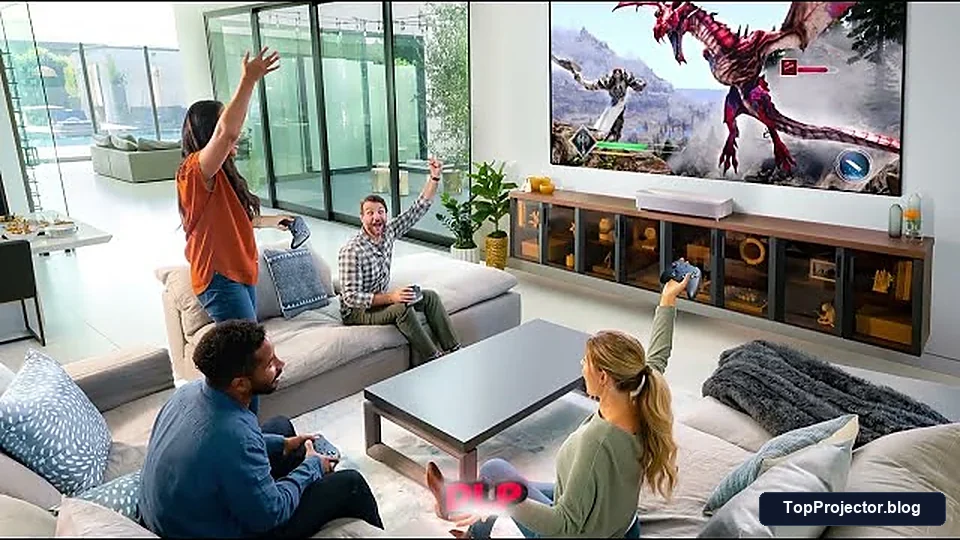
Evaluating how these engines process light mirrors the findings in the xgimi horizon projector review, helping you match capabilities to your living room geometry and home theater aspirations.
The Epson LS800 utilizes a high-efficiency 3LCD laser engine that completely eliminates rainbow artifacts. Conversely, the Hisense L9G deploys a tri-chroma triple laser system delivering extraordinary spectral purity.
- Epson utilizes a 3-chip 3LCD laser diode system.
- Hisense employs a TriChroma triple-laser architecture.
- Throw ratios dictate proximity to the projection surface.
Three-Chip 3LCD vs. Triple-Laser DLP
Epson implements a proprietary 3LCD chip design that processes red, green, and blue channels simultaneously. This eliminates the rainbow artifacts common in single-chip designs.
Hisense deploys a pure RGB laser diode array, avoiding color wheels entirely. This triples the color gamut coverage while demanding strict calibration to prevent laser speckle on matte surfaces.
- 3LCD guarantees zero color breakup artifacts.
- Triple-laser systems push past standard color spaces.
Tri-Chroma vs Phosphor Laser Stability
Understanding architectural variances helps predict long-term light source degradation. While Hisense targets extreme color saturation, Epson focuses on maximizing lumen output efficiency across mixed color scenes.
Peak Brightness, ANSI Lumens, and HDR Punch
When battling daytime living room glare, consult our best mobile projectors roundup to find portable options exceeding the 3,000 lumen threshold for clear afternoon sports broadcasts.
High dynamic range metadata requires both high peak white luminance and precise tone mapping to preserve highlight detail in bright mastering scenarios without crushing shadow gradients.
Measuring real-world output reveals the Epson dominates with 4000 ANSI lumens, easily overpowering ambient daylight. The Hisense L9G trails at roughly 3000 ANSI lumens, prioritizing color volume over brute-force white luminance.
- Epson delivers a blistering 4,000 ANSI lumens output.
- Hisense rates at a solid 3,000 ANSI lumens specification.
- Daytime viewing demands high lumen headroom for realism.
Overcoming Ambient Light with Lumen Muscle
The Epson LS800 utilizes massive 4,000 ANSI lumens to blast through ambient room illumination. You can verify your space using our ansi lumens room calculator for optimal daylight viewing.
The Hisense L9G produces 3,000 ANSI lumens, which performs admirably in moderately lit spaces but requires specialized ambient light rejecting screen material during midday viewing sessions.
- Epson dominates high-glare residential living spaces effortlessly.
- Hisense needs strict light control for optimal punch.
HDR Tone Mapping Analysis
Handling HDR10 content requires aggressive dynamic tone mapping. The LS800 leverages its immense brightness to clip fewer highlights, whereas the L9G maintains richer saturated highlights in controlled dark rooms.
Black Floor, Contrast Ratios, and Dark Room Performance
In a dedicated blackout theater, native contrast ratio dictates how deep space scenes and nocturnal shadows appear. Projectors with elevated black floors render dark cinematic sequences as greyish smears.
DLP light engines traditionally maintain an inherent contrast advantage over standard 3LCD architectures, producing deeper black floors that significantly enhance perceived image depth during movies.
Native contrast remains a fundamental challenge for ultra-short throw models. The Epson delivers an average native contrast around 1500:1, while the Hisense achieves slightly deeper blacks near 2000:1 natively.
- DLP micro-mirrors yield superior native black levels.
- 3LCD panels suffer slightly elevated black floors in dark rooms.
- Dynamic iris systems help mitigate native contrast limitations.
Pitch-Black Theater vs. Living Room Contrast
Watching sci-fi epics in a dark room exposes the Epson LS800's higher black floor. Deep cinematic shadows lack the inkiness achieved by competing single-chip optical designs.
The Hisense L9G leverages its DLP chip and laser dimming to deliver superior dark-room immersion, keeping starry nights looking inky rather than hazy grey.
- Hisense wins pure dark-room cinematic contrast comparisons.
- Epson prioritizes overall brightness over deep black floors.
Dynamic Iris and Black Level Management
Neither projector features a mechanical dynamic iris, relying instead on software-based dimming. This means dark movie scenes will show slightly elevated gray bars in bat-cave theater environments.
Ambient Light Rejection and Living Room Daylight Handling
Ultra-short-throw projectors fire upward from low angles, making them uniquely susceptible to ceiling light reflections. Pairing them with specialized ambient light rejecting screens is practically mandatory.
Evaluating how these projectors interact with daylight reveals how successfully they replace traditional flat-panel televisions in modern, brightly lit family rooms and open-concept living spaces.
Pairing these projectors with a quality ALR screen is mandatory for daytime viewing. Epson's massive lumen advantage cuts through reflections better, but Hisense bundles a superior matching daylight rejection screen.
- ALR screens absorb overhead light while reflecting projector light.
- Daytime contrast relies heavily on micro-structure screen physics.
- Uncontrolled sunlight degrades color saturation across all displays.
Screen Synergy and Daytime Legibility
Hisense bundles an engineered daylight screen with the L9G, ensuring maximum ambient light rejection out of the box. This matched pairing creates remarkable daytime contrast.
Epson sells its LS800 standalone or with varied screen options, requiring careful third-party ALR selection to match its massive 4,000 lumen output capability safely.
- Hisense provides an all-inclusive daytime viewing solution.
- Epson offers flexibility for custom screen pairing strategies.
Off-Axis Glare Rejection
Side windows introduce severe washing hazards for ultra-short throw arrays. Specialized sawtooth screen structures successfully reject vertical overhead lights while maintaining wide horizontal viewer viewing angles.
Color Accuracy, Gamut Coverage, and Wide Color Spaces
Cinematic color fidelity ensures directors' creative intents translate accurately to your home screen. Wide color gamuts transform mundane palettes into vibrant, lifelike cinematic experiences.
Measuring coverage percentages of the DCI-P3 and Rec.2020 color spaces reveals whether a laser projector can render demanding HDR hues without visible color shifting or banding.
Out-of-the-box color tracking heavily favors the Hisense L9G, which covers over 107 percent BT.2020. The Epson LS800 trades absolute gamut volume for superior Rec.709 color accuracy in standard SDR modes.
- Triple-laser engines easily exceed standard Rec.709 gamuts.
- Color calibration out of the box impacts viewer satisfaction.
- Skin tones must remain natural during complex HDR grading.
TriChroma Purity vs. 3LCD Color Volume
The Hisense L9G achieves near-total coverage of the BT.2020 color space thanks to its pure RGB laser diodes. Sunset scenes and neon skylines burst with breathtaking saturation.
The Epson LS800 covers standard wide gamuts competently, though its 3LCD light engine trades absolute color volume for higher white brightness across mixed content.
- Hisense delivers reference-grade wide color gamut volume.
- Epson balances high brightness with faithful skin tones.
White Point Calibration Nuances
Achieving reference D65 white points requires minor greyscale calibration on both units. Hisense requires careful green-gain adjustments to eliminate minor out-of-box greenish tint anomalies.
Gaming Responsiveness, Motion Handling, and Input Lag
Modern console and PC gaming demand exceptionally low input lag to prevent frustrating controller delays. Competitive shooters and fast-paced racing titles require responsiveness under 20 milliseconds.
Motion interpolation algorithms also play a crucial role in eliminating judder during fast camera pans, ensuring sports broadcasts and action movies remain fluid and distortion-free.
Competitive gamers will vastly prefer the Epson LS800 due to its remarkably low 16.7ms input lag. The Hisense L9G measures significantly higher, making fast-paced shooters feel noticeably sluggish and delayed.
- Epson boasts a competitive 16.7ms input lag profile.
- Hisense suffers from higher latency unsuitable for fast gaming.
- Motion processing prevents blurring during rapid sports action.
Console Gaming vs. Cinema Immersion
Gamers will heavily favor the Epson LS800 due to its low input lag and responsive game mode. Reflex-heavy gameplay feels instantaneous and connected on massive wall projections.
The Hisense L9G features noticeable input latency during competitive titles, making it better suited for casual RPGs and cinematic single-player campaigns rather than fast esports.
- Epson handles fast-twitch console gaming with ease.
- Hisense prioritizes cinematic fidelity over low gaming latency.
Frame Interpolation and Judder
Movie watching benefits from motion smoothing algorithms. Both engines handle 24p judder cleanly, though Epson includes superior frame interpolation controls for smoothing out fast camera pans.
UST Throw Ratios, Screen Geometry, and Installation Physics
Ultra-short-throw geometry dictates how close the chassis must sit against the wall to project a massive image. Shorter throw ratios simplify media console placement significantly.
Achieving a perfectly square geometry on fixed screens requires precise micro-adjustments, as even millimeter wall shifts can distort the projected image corners noticeably.
Ultra-short throw placement requires precise geometric alignment. The Epson features an ultra-short 0.16:1 throw ratio, allowing a massive one-hundred-inch image from just inches off the wall.
- Epson's ultra-short 0.16:1 throw ratio hugs the wall.
- Hisense requires a slightly longer distance for large sizes.
- Cabinet depth determines whether standard media furniture works.
Wall Proximity and Furniture Integration
The Epson LS800 features an industry-leading 0.16:1 throw ratio, allowing a 120-inch image while sitting mere inches from the wall. Standard media consoles accommodate it easily.
The Hisense L9G requires slightly more distance from the projection surface, demanding deeper specialized media furniture to achieve proper alignment with its bundled screen.
- Epson fits on shallow media consoles seamlessly.
- Hisense needs adequate furniture depth for alignment.
Cabinet Depth and Furniture Requirements
Accommodating extreme throw optics demands deep media consoles. Standard living room cabinets often fall short of the depth required by the Hisense 0.25:1 ratio.
Definitive Real-Room Verdict: Which UST Laser Projector Wins?
Selecting between these ultra-short-throw projectors also requires referencing our projector screen mounting guide to match your room's exact lighting control and daily entertainment preferences.
By aligning optical physics with your specific domestic environment, you ensure long-term viewing satisfaction without compromising on brightness, color fidelity, or architectural integration.
Choosing between these titans depends entirely on your primary usage room. Select the Epson for unmatched daylight brightness and gaming responsiveness, or the Hisense for cinematic wide color fidelity.
- Choose Epson for bright rooms, gaming, and flexible sizing.
- Choose Hisense for dark theaters and pure laser colors.
- Match projector output to your ambient lighting conditions.
Final Decision Matrix for Home Buyers
Buy the Epson LS800 if your living room floods with daylight, you demand low-latency gaming, or you want scalable screen sizes up to 150 inches without restriction.
Opt for the Hisense L9G if you are building a dedicated dark-room theater where TriChroma color purity and deep contrast outweigh raw lumen output and gaming speed.
- Epson wins bright living rooms and gaming setups.
- Hisense dominates dark dedicated home theater spaces.
Final Hardware Takeaway
Both machines represent peak engineering in projection technology today. Your final decision ultimately hinges on whether you value pure color saturation or maximum lumen output versatility.
Frequently Asked Questions
Can I use the Epson LS800 without a specialized ambient light rejecting screen?
Yes, the Epson LS800 features 4,000 ANSI lumens of brightness, allowing it to project a visible image directly onto a flat white wall. However, pairing it with an ALR screen dramatically improves daytime contrast and color saturation.
Does the Hisense L9G suffer from rainbow artifacts during fast-moving movie scenes?
The Hisense L9G utilizes a single-chip DLP architecture with a triple-laser light source, which largely mitigates traditional color wheel issues. Sensitive viewers might still occasionally notice minor color breakup during high-contrast panning shots.
Which projector is better suited for competitive console gaming and fast reflexes?
The Epson LS800 is the clear winner for gaming, offering a low 16.7ms input lag in dedicated game modes. The Hisense L9G features noticeably higher input latency, making it less ideal for fast twitch shooters.
What is the maximum screen size supported by the Epson LS800 ultra-short throw?
The Epson LS800 can scale its projection size up to 150 inches diagonally while maintaining crisp focus. This unmatched flexibility lets you upgrade your display size easily without replacing the hardware.
Do these ultra-short-throw laser projectors require expensive bulb replacements over time?
Both models utilize solid-state laser diode engines rated for 20,000 to 25,000 hours of operation. This eliminates traditional lamp maintenance entirely for a decade of heavy daily viewing.