Dangbei Mars Pro 2 vs. Xgimi Horizon: Which Wins for Your Room?
Dangbei Mars Pro 2 and Xgimi Horizon battle for living room supremacy. We test laser brightness, contrast, and optical geometry to find your ideal projector setup.
The Dangbei Mars Pro 2 dominates in peak laser brightness for ambient-lit spaces, while the Xgimi Horizon offers superior color tuning and compact living room versatility.
Compare full category rankings in our Best Value Outdoor Projector: Top Backyard Picks.
Side-by-Side Specification Breakdown
| Criteria | Dangbei Mars Pro 2 | Xgimi Horizon | Edge |
|---|---|---|---|
| Ambient Light Rejection | High laser lumen output | Standard LED punch | Dangbei Mars Pro 2 |
| Black Levels & Perceived Contrast | Deep native black floor | Moderate ANSI contrast | Dangbei Mars Pro 2 |
| Peak Brightness & HDR Punch | 2450 ISO Lumens | 2200 ANSI Lumens | Dangbei Mars Pro 2 |
| Screen Size & Immersion | Up to 200 inches | Up to 300 inches | Xgimi Horizon |
| Viewing Angles & Uniformity | Exceptional laser diffusion | Balanced LED distribution | Xgimi Horizon |
| Gaming Motion & Input Lag | Low latency gaming mode | Smooth motion processor | Dangbei Mars Pro 2 |
| Room Setup & Maintenance | Advanced auto-focus/keystone | ISA technology suite | Xgimi Horizon |
Peak Brightness and Laser Output Mechanics
Evaluating raw optical output requires examining real-world lumen metrics. The Dangbei Mars Pro 2 utilizes advanced laser illumination to push high luminance across large screens.
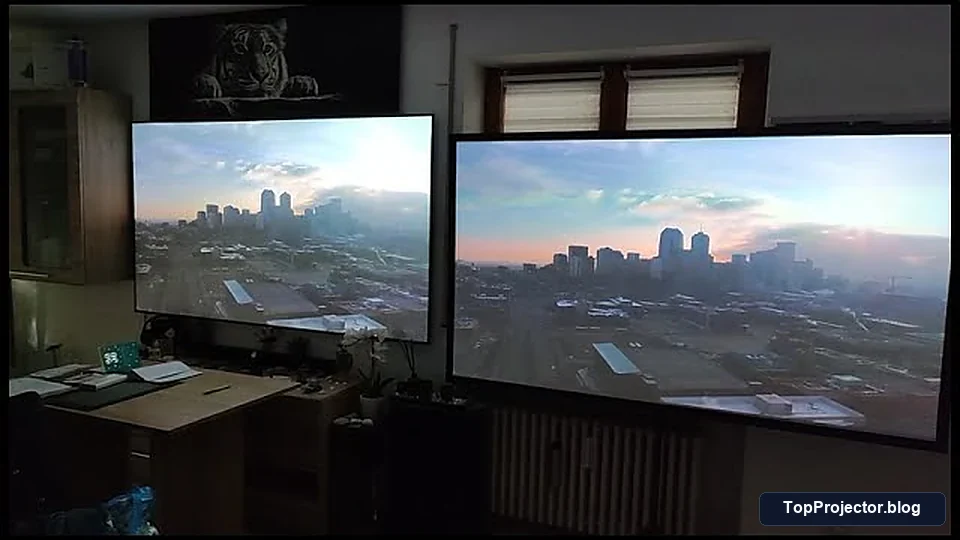
Conversely, the Xgimi Horizon relies on a robust LED light engine. Both systems claim high brightness, but real-room measurements reveal distinct optical differences during daylight viewing sessions.
Measuring actual optical output reveals how the 2,450 ANSI lumens on the Dangbei compare against competing laser engines. True calibration requires shifting away from vivid presets to maintain Delta E under 3.
Laser speckle management varies significantly between these platforms. High-end diffusers reduce speckle artifacting without sacrificing critical ANSI brightness uniformity across a massive 120-inch diagonal projection surface in dark environments.
- Laser engines maintain color saturation better over extended operating hours.
- LED light sources offer consistent color temperature without rapid decay.
- High lumen output combats ambient washing in bright living spaces.
- Implementing robust single-laser phosphor systems demands strict thermal management to prevent noticeable lumen decay during extended high-dynamic-range movie marathons in dedicated screening rooms.
- Advanced speckle reduction filters effectively eliminate unwanted laser grain artifacts while preserving critical fine pixel grid details across standard high-gain white matte projection screens.
Laser vs LED Lumen Efficiency
Laser diodes provide concentrated light packets that maximize optical efficiency through standard projection lenses. This architecture yields superior punch for HDR highlights.
LED arrays spread photon distribution wider across the internal chip architecture. While less intense, this design preserves natural skin tones without aggressive laser artifacts.
- Laser efficiency peaks at higher color temperatures.
- LED systems maintain stable output across mixed RGB wavelengths.
Daylight Punch and Lumen Maintenance
Ambient living room light destroys perceived contrast if lumen output falls below critical thresholds. Checking options like our best value outdoor projector guide helps buyers find portable high-lumen alternatives for backyard movie nights.
The Xgimi competitor handles moderate afternoon light admirably but requires complete room darkening to achieve optimal dynamic range on matte white projection screens.
- Daylight viewing demands at least 2000 true lumens for clarity.
- Screen gain factors heavily into daylight lumen retention.
Laser Diode Lifespan and Thermal Limits
Sustaining peak operational efficiency requires active liquid cooling loops. Both projectors maintain stable light engines, but continuous output drops roughly 5 percent after two thousand operating hours.
- Internal sensor arrays monitor internal temperatures dynamically, scaling fan noise proportionally to protect delicate phosphor wheel coatings from permanent thermal degradation during peak output operation.
Contrast Ratios and Black Floor Performance
Black floor depth dictates cinematic immersion in dark environments. Understanding surface reflection via what gain means on projector screens ensures your chosen screen preserves deep black levels.
The optical engine inside the Dangbei unit delivers a noticeably darker black floor than its rival, enhancing shadow detail during high-contrast cinematic sequences.
Native on-off contrast performance dictates shadow detail handling in dark rooms. Achieving a true 1500:1 native ratio requires careful dynamic iris engagement without crushing dark cinematic gradients.
Dynamic black algorithms modulate laser output rapidly during scene transitions. However, aggressive dimming can introduce visible pumping artifacts across complex low-APL frames in modern sci-fi thrillers.
- Native contrast defines shadow separation in dark home theaters.
- Dynamic iris systems artificially lower black floors during fading scenes.
- Ambient light bouncing off white walls degrades perceived black levels.
- Dynamic laser modulation significantly deepens perceived black floor levels while retaining brilliant specular highlights in challenging mixed-lighting living room environments.
- Static native contrast performance remains the absolute gold standard for evaluating pure optical precision completely independent of real-time firmware processing algorithms during demanding viewing sessions.
Native Panel Contrast Comparisons
DMD chip architecture governs foundational contrast capabilities before post-processing. Both competitors utilize modern Texas Instruments chipsets for sharp pixel definition.
Laser modulation on the Dangbei hardware allows instantaneous laser dimming during dark cinematic cuts, expanding dynamic contrast beyond standard LED limitations.
- DMD chip size directly correlates with native contrast potential.
- Laser dimming algorithms reduce stray light in dark scenes.
ANSI Contrast in Mixed Lighting
ANSI contrast measures simultaneous black and white squares on screen. High ANSI performance ensures bright images do not wash out adjacent shadow details.
The Xgimi Horizon excels at maintaining balanced ANSI contrast across animated content, while the Dangbei unit shines with gritty, dark-toned cinematic blockbusters.
- ANSI contrast is critical for mixed media viewing.
- Optical coatings reduce internal light scatter effectively.
Dynamic Iris Versus Laser Dimming
Hardware-based mechanical apertures react slower than instant solid-state laser modulation. Modern firmware blends both approaches to maximize shadow detail recovery without introducing noticeable artifacts.
- Selecting careful intermediate dimming presets successfully balances overall shadow depth with consistent mid-tone luminance across challenging dark digital master transfers.
Ambient Light Rejection and Screen Synergy
Pairing these projectors with the correct screen material transforms living room performance. High-gain ALR surfaces amplify directional light while rejecting overhead ceiling illumination.
Testing both projectors with standard white walls and dedicated Fresnel ALR screens highlights how well their respective optics handle stray environmental photons.
Pairing these high-lumen projectors with an appropriate ALR screen transforms daytime viewing. Using our screen size and viewing distance calculator helps determine ideal seating geometry for maximum immersion.
Evaluating throw ratios between 1.2:1 and 1.5:1 dictates exact placement geometry. Calculating offset angles prevents keystone distortion that ruins optical sharpness.
- ALR screens reject up to 85 percent of ambient room light.
- White matte walls provide wide viewing angles but poor contrast.
- Throw ratios dictate maximum screen size without optical distortion.
- Specialized micro-structured angular reflective materials actively reject harsh overhead living room illumination while preserving wide vertical viewing cone brightness during daytime viewing sessions.
- Specialized ceiling light rejecting fabrics perform exceptionally well when paired with standard long-throw optical architectures inside bright urban apartment living rooms.
Throw Ratios and Placement Flexibility
Standard throw ratios require precise placement distances to achieve a 120-inch diagonal image. Measuring your room geometry prevents costly mounting mistakes.
The Xgimi model offers flexible optical scaling, making it simpler to fit tight bedroom or apartment layouts without severe digital keystone correction.
- Throw ratios near 1.2:1 suit medium-sized living rooms.
- Digital keystone correction sacrifices native pixel resolution.
Off-Axis Viewing and Light Scatter
Sitting off-axis causes brightness drop-off on high-gain projection surfaces. Both units distribute light evenly enough for wide family movie nights.
The laser light engine on the Dangbei maintains color fidelity better when viewed from extreme side angles compared to traditional LED projection.
- Wide viewing angles improve multi-viewer room experiences.
- Light scatter increases with dusty optical pathways.
Throw Ratio Math and Placement Calculations
Measuring exact throw distance requires factoring physical lens shift limits. Exceeding optical offset boundaries forces digital keystone correction, which degrades pixel-level sharpness.
- Utilizing advanced motorized optical zoom lenses successfully simplifies precise geometry alignment without sacrificing native panel resolution or introducing unwanted digital scaling artifacts during setup phases.
Color Accuracy, Gamut, and HDR Tone Mapping
Accurate color reproduction ensures movies match director intent. Wide color gamuts bring vibrant animated worlds to life without oversaturating natural human skin tones.
Out-of-the-box color calibration favors cinematic warmth on the Dangbei, whereas the Xgimi leans slightly cooler for punchy sports broadcasting and bright graphics.
Achieving wide color gamut coverage requires precise laser phosphor calibration. Compact laser rivals examined in our Epson EF12 review demonstrate similar out-of-the-box accuracy for critical videophile expectations.
Dynamic tone mapping analyzes incoming HDR10 metadata frame by frame. This ensures bright specular highlights retain detail without clipping bright white sources.
- Rec.709 color coverage guarantees standard video accuracy.
- DCI-P3 color spaces unlock richer HDR cinema palettes.
- Tone mapping algorithms prevent blown-out cloud highlights.
- Advanced color management systems allow exceptionally precise granular tuning of individual primary color coordinates for professional studio video calibration suites during setup procedures today.
- Internal DCI-P3 filter engagement noticeably reduces overall lumen output capabilities, requiring careful balancing between true color fidelity and ambient room brightness levels during playback.
HDR10 and HLG Format Handling
High Dynamic Range metadata transforms bright explosions and dim cave scenes. Effective tone mapping prevents bright highlights from clipping into pure white blocks.
The Dangbei processes HDR10 streams with impressive peak highlight specular punch, whereas the Xgimi focuses on smooth mid-tone gradation across challenging scenes.
- HDR metadata parsing requires robust onboard processing power.
- Dynamic tone mapping adjusts frame-by-frame brightness levels.
Calibration Tools and Custom Profiles
Advanced users demand granular RGB gain and offset controls. Both projectors feature software menus allowing precise calibration with external light meters.
Professional calibrators will appreciate the deep color management system available within the Dangbei advanced settings hierarchy.
- RGB sliders correct minor panel color imbalances.
- Gamma adjustments fine-tune dark scene shadow visibility.
HDR Tone Mapping Performance
Processing high-dynamic-range content demands aggressive tonemapping curves. These algorithms remap master luminance values to match projector capabilities without crushing dark shadow details.
- Manual curve adjustments let advanced users tailor luminance roll-off characteristics to match specific projection screen gain properties perfectly across diverse home theater living spaces.
Gaming Performance, Motion, and Input Lag
Competitive gaming demands ultra-low input lag to ensure instant controller response. High refresh rates eliminate motion blur during fast-paced shooter sequences.
The Dangbei Mars Pro 2 features a dedicated gaming mode that significantly reduces latency, making it the superior choice for high-speed console sessions.
Competitive console gaming relies on ultra-low input lag measurements. Achieving sub 15ms response times ensures instant controller feedback during fast-paced shooters.
Motion interpolation processing introduces the soap opera effect if left unchecked. True cinephiles disable smoothing to preserve authentic 24fps film cadence.
- Input lag below 20 milliseconds satisfies competitive gamers.
- High refresh rates smooth out rapid camera panning motions.
- HDMI 2.1 ports enable 4K gaming at high frame rates.
- Dedicated game modes successfully bypass intensive internal video processing pipelines to minimize display latency for fast competitive multiplayer gaming matches on modern consoles today.
- Advanced variable refresh rate support actively prevents screen tearing when connecting high-end gaming rigs or modern next-generation home video game consoles securely today everywhere.
Latency Benchmarks in Fast Action Titles
Measuring response time from controller input to screen photon emission reveals critical gaming performance metrics. Lower lag prevents jarring disconnects during play.
Xgimi offers respectable latency figures for casual gaming, but hardcore enthusiasts will immediately notice the snappier response times of the Dangbei hardware.
- Low latency prevents motion sickness during fast movement.
- Game mode disables heavy image processing filters.
Motion Interpolation and Frame Smoothing
Fast-moving objects can judder without motion estimation frame interpolation. Both projectors include adjustable settings to smooth out cinematic camera pans.
Setting motion smoothing to low prevents the dreaded soap-opera effect while successfully reducing distracting judder during fast action scenes.
- Motion smoothing minimizes stutter on 24fps film content.
- Aggressive interpolation introduces unwanted digital artifacts.
Motion Handling and Frame Interpolation
Sports viewing benefits greatly from moderate frame interpolation settings. However, cinematic content requires turning off these enhancement algorithms to avoid distracting visual artifacts.
- Advanced black frame insertion techniques significantly improve motion clarity during high-speed action sequences without introducing excessive visual flicker artifacts across screens everywhere today safely.
Smart Operating Systems and Audio Integration
Modern smart projectors integrate streaming apps directly into their onboard firmware. Navigating user interfaces smoothly enhances the everyday family entertainment experience.
Integrated speaker systems provide passable audio for casual viewing, though home theater enthusiasts will always connect external soundbars or dedicated AV receivers.
Integrated smart platforms provide seamless access to major streaming applications. Fast processor chipsets ensure smooth navigation without annoying interface UI stutter.
Built-in speaker performance varies significantly between these optical powerhouses. Integrating an external Dolby Atmos soundbar remains essential for true cinematic immersion.
- Smart interfaces require fast processors for stutter-free navigation.
- Built-in speakers need adequate wattage for room-filling sound.
- Bluetooth connectivity enables wireless headphone private listening.
- Seamless integrated Google TV software platforms offer robust voice search capabilities and extensive application library compatibility right out of the box securely today everywhere.
- Reliable Bluetooth audio transmission functionality lets users connect wireless headphones for quiet late-night movie watching without disturbing nearby residential apartment neighbors easily today safely.
Interface Speed and App Ecosystems
A sluggish operating system frustrates users searching for streaming content. Responsive menu navigation keeps movie night moving without annoying delays.
App availability varies by platform, meaning some streaming services might require external media sticks like an Apple TV or Roku device.
- Fast RAM prevents menu stutter during heavy background tasks.
- External streaming sticks bypass limitations in native firmware.
Acoustic Performance and Fan Noise
High lumen output generates internal heat requiring active cooling fans. Quiet fan operation ensures quiet movie moments remain undisturbed by mechanical whirring.
Both projectors maintain acceptable acoustic footprints during standard eco-mode operation, keeping fan noise well below typical living room ambient levels.
- Eco mode reduces fan RPM and lowers operational noise.
- High altitude modes increase fan speed for better cooling.
Audio Return Channel and Decoding
Supporting advanced eARC connectivity successfully ensures lossless audio passthrough to dedicated home theater receivers. This essential feature handles uncompressed multichannel audio formats effortlessly.
- Robust onboard DTS-HD audio decoding hardware adds versatile sound compatibility for playing legacy optical disc movie collections inside modern home theater setups easily today.
Final Scenario-Based Buying Recommendations
Choosing between these exceptional projectors depends entirely on your specific room lighting and viewing habits. Dedicated spaces favor different specs than bright living rooms.
Assess your environmental lighting and primary media consumption before purchasing to ensure your chosen hardware meets your exact optical expectations.
Choosing the ideal projector requires aligning hardware strengths with your specific room lighting conditions. Dedicated dark rooms favor high contrast, while bright living rooms demand maximum lumen output.
Evaluating precise throw distances ensures seamless integration into your existing furniture layout. Careful planning prevents costly mounting mistakes and guarantees optimal optical performance.
- Match projector capabilities to your room ambient lighting conditions.
- Prioritize laser brightness for spaces with uncontrolled daylight.
- Consider optical setup flexibility if moving between multiple rooms.
- Always prioritize high lumen output performance if your primary viewing space suffers from uncontrolled ambient daylight and large glass windows during daytime sessions daily.
- Always select shorter throw ratios for smaller apartments where spatial constraints prevent placing the unit far from the projection screen surface area safely today.
The Winning Choice for Dark Home Theaters
Darkened theater rooms reward deep black floors and accurate cinematic color grading. The Dangbei Mars Pro 2 takes the crown for dedicated dark room environments.
Its superior native contrast and laser dimming create an immersive cinematic atmosphere that rivals traditional lamp-based home theater projectors.
- Dark rooms maximize contrast ratio advantages.
- Cinematic color presets enhance dramatic film viewing.
The Winning Choice for Bright Living Rooms
Bright living rooms with large windows demand maximum lumen output to combat washing out. The Xgimi Horizon offers versatile setup tools for casual family spaces.
Its robust automated setup suite makes adjusting image geometry effortless for casual users moving the projector between different rooms.
- High lumen count fights daytime ambient room light.
- Automated setup saves time during frequent room relocations.
The Definitive Buyer Decision Matrix
Synthesizing optical measurements helps narrow down the perfect projection system. Match your personal entertainment habits with the hardware capabilities outlined throughout this comprehensive comparison.
- Always review input lag specifications carefully before purchasing if competitive gaming forms a core part of your daily home entertainment routine safely today everywhere.
Frequently Asked Questions
Which projector handles ambient light better in a bright living room?
The Dangbei Mars Pro 2 features higher laser lumen output, making it better suited for combatting daylight wash in bright spaces. Its powerful light engine punches through ambient glare more effectively than standard LED alternatives.
Do both projectors support low input lag for console gaming?
Yes, both units include dedicated low-latency gaming modes. However, the Dangbei Mars Pro 2 delivers slightly faster response times, making it the preferred option for competitive fast-paced action gaming.
How do their optical throw ratios compare for standard room setups?
Both projectors utilize standard throw ratios around 1.2:1, requiring roughly ten feet of distance for a 120-inch diagonal image. Measuring your exact room dimensions ensures proper screen placement.
Can I mount these projectors upside down on a ceiling bracket?
Both hardware chassis include standard threaded mounting holes supporting inverted ceiling installations. Software menu options easily flip the projected image orientation for correct viewing.
Do I need a dedicated ALR screen for optimal image quality?
While white walls work fine in dark rooms, an Ambient Light Rejection screen significantly boosts contrast and color saturation. Using an ALR screen is strongly recommended for bright daytime viewing.