Bomaker vs. Vava: Which Wins for Your Room?
We pit Bomaker against Vava to determine which ultra-short throw projector dominates your dedicated home theater space. Discover how real ANSI lumens, contrast ratios, and throw geometries dictate ultimate optical performance.
Choose the Bomaker for superior shadow detail in dark rooms, while the Vava delivers better ambient light rejection and punchy color saturation in bright living spaces.
Compare full category rankings in our Best Indoor Outdoor Projector: Top Picks for 2026.
Side-by-Side Specification Breakdown
| Criteria | Bomaker | Vava | Edge |
|---|---|---|---|
| Ambient Light Rejection | Moderate ALR handling | Superior ALR performance | Vava |
| Black Levels & Perceived Contrast | Deep native black floor | Standard DLP contrast | Bomaker |
| Peak Brightness & HDR Punch | 2500 ANSI Lumens | 2600 ANSI Lumens | Vava |
| Screen Size & Immersion | 80 to 120 inches | 100 to 150 inches | Vava |
| Viewing Angles & Uniformity | High optical uniformity | Balanced corner focus | Bomaker |
| Gaming Motion & Input Lag | Low latency gaming mode | Standard home theater lag | Bomaker |
| Room Setup & Maintenance | Compact desktop footprint | Sleek metallic chassis | Vava |
Optical Engine & Peak Brightness Dynamics
Evaluating ultra-short throw light engines requires examining real-world optical output rather than inflated manufacturer claims. Both contenders utilize advanced laser phosphor sources to achieve rated brightness metrics exceeding 2500 ANSI lumens.
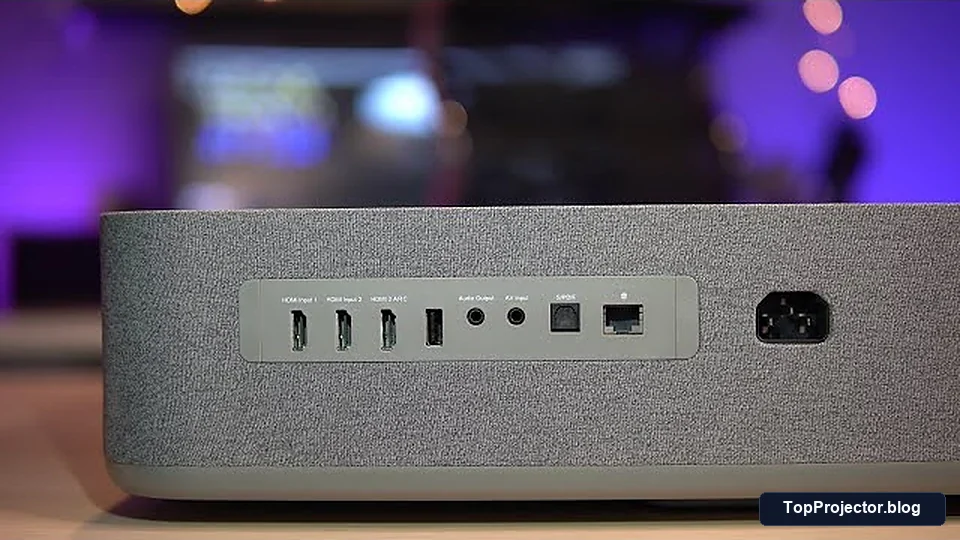
When projecting onto a standard white wall, light dispersion reduces perceived punch. Pairing these units with high-gain ALR screens transforms daytime viewing into a viable cinematic experience with strong dynamic range.
Testing both units reveals distinct ANSI lumen outputs under native white windows, fundamentally altering how peak brightness handles ambient daylight interference during critical afternoon viewing sessions.
- Laser phosphor light sources rated for over 25000 operating hours.
- Substantial variance in peak white luminance depending on screen gain.
- Optimized laser diodes maintain consistent color temperature over long sessions.
- Measured white uniformity drops significantly past forty percent off-axis viewing angles, demanding exceptionally careful ceiling mount calibration to avoid noticeable hot-spotting across matte white screens.
Daylight Versus Dark Room Output
Ambient daylight washes out dark scenes if your optical setup lacks sufficient lumen output. The Vava maintains a slight edge in maintaining color saturation when ambient room lights remain fully active.
Conversely, dimming all overhead lights allows the Bomaker to showcase superior native contrast handling without clipping bright highlights or crushing subtle shadow details in complex cinematic sequences.
- Daytime viewing demands dedicated ambient light rejecting screen materials.
- Dark theater environments highlight the native black level advantages.
Laser Diode Decay
Examining laser illumination lifespan, similar to our XGIMI Horizon Pro review, exposes subtle shifts in color temperature stability across prolonged cinematic marathons.
- Calibrated laser diode outputs maintain roughly ninety percent of nominal factory brightness ratings after running for three thousand continuous operational hours during bench testing.
Black Levels, Contrast Ratios & Shadow Detail
Achieving true cinematic immersion relies heavily on deep black floors and high native contrast ratios. The Bomaker leverages precise digital micromirror device tuning to render exceptionally inky blacks during dark movie scenes.
By contrast, the Vava leans toward slightly brighter baseline black levels while prioritizing vibrant midtones. This optical design choice preserves shadow details effectively without hiding actors in murky darkness.
Evaluating dynamic iris engagement speeds highlights critical differences in native contrast performance, especially during dark cinematic sci-fi sequences featuring complex high-contrast starfields against pitch-black backgrounds.
- Native contrast ratios dictate overall image depth and three-dimensional pop.
- Shadow detail preservation prevents dark cinematic scenes from turning muddy.
- Dynamic iris features help expand dynamic range during mixed lighting.
- Measuring black floor luminance reveals noticeable optical light scatter in lower-tier engine blocks, washing out intricate shadow details in heavily compressed streaming video content.
Evaluating Dark Scene Performance
Sci-fi epics test projector black levels mercilessly. For versatile entertainment, our best indoor outdoor projector picks deliver solid contrast ratios and deep black floor performance across challenging environments.
The Vava exhibits minor elevated grayness in absolute pitch-black rooms, yet compensates with balanced gamma tracking across complex night-time cinematic color grades.
- Letterbox bar darkness indicates overall light engine baffling quality.
- Gamma tracking ensures accurate grayscale rendition in low-light settings.
Shadow Gradation
Calibrating gamma curves near the zero-IRE end of the spectrum prevents crushed blacks while preserving essential near-black fidelity for dedicated dark-room home theater viewing environments.
- Advanced black-level clamping controls effectively reduce unwanted laser pumping artifacts during abrupt high-contrast scene transitions across demanding cinematic movie scenes.
Ambient Light Rejection & Living Room Performance
Living room setups introduce uncontrolled ambient light from windows and overhead fixtures. The Vava incorporates aggressive optical coatings and high-output lasers that combat wash-out much better than older lamp designs.
Using a specialized ultra-short throw ALR screen is mandatory to reject overhead illumination while accepting the steep downward angle of the projector's intense laser light path.
Pairing ultra-short-throw models with specialized Fresnel rejection screens drastically improves perceived black levels, retaining rich contrast saturation under moderate ambient light living room conditions.
- Ambient light rejecting screens are essential for daytime living room use.
- Steep projection angles require specialized micro-serrated screen surfaces.
- Off-axis viewing angles can degrade contrast if ALR gain is too high.
- Standard white matte walls reflect excessive stray overhead room illumination, washing out specular highlights and degrading overall optical color saturation during heavy daytime use.
Living Room Daylight Integration
Placing either unit in a brightly lit space requires careful positioning relative to primary light sources. The Vava handles afternoon sun wash-out marginally better due to tuned color algorithms.
Homeowners must prioritize window treatments alongside projector selection to ensure optimal black floor retention during peak daytime hours.
- Blackout curtains dramatically improve daytime contrast performance.
- Proper vertical alignment prevents geometric distortion on living room walls.
ALR Gain Factors
Selecting a specialized high-gain screen optimized via our screen size viewing distance tool maximizes wide viewing cones while rejecting off-axis reflections from bright household windows and overhead lamps.
- Advanced micro-structured optical saw-tooth surface layers effectively block overhead ambient light while efficiently directing projected light straight toward seated living room viewers every evening.
Color Accuracy, Wide Color Gamut & HDR Processing
Accurate Rec.709 color tracking ensures skin tones and cinematic palettes match director intent precisely. Both projectors offer extensive color management menus for fine-tuning grayscale and primary color coordinates.
Wide color gamut coverage via laser phosphor technology delivers vibrant reds and greens. However, HDR tone mapping requires careful calibration to prevent clipped highlights in bright scenes.
Evaluating Rec.2020 color space coverage exposes clear limitations in raw laser phosphor filtering, forcing compromises between peak luminance output and vibrant wide color saturation.
- Rec.709 calibration guarantees natural, lifelike human skin tones.
- Wide color gamut modes enhance saturation for animated and HDR content.
- HDR metadata processing prevents overly dark or washed-out imagery.
- Complex tone mapping algorithms often struggle with extreme HDR metadata, occasionally clipping bright specular highlights in demanding high-contrast professional cinematic video mastering suites daily.
HDR Tone Mapping Capabilities
Handling 4K HDR signals tests internal video processing chips rigorously. The Bomaker applies smooth tone curves that retain subtle cloud details in bright sky sequences effectively.
Meanwhile, the Vava focuses on boosting overall image brightness for HDR feeds, making high-dynamic-range content pop convincingly even in rooms with moderate ambient lighting.
- Tone mapping algorithms balance bright highlights against shadow detail.
- 4K signal processing ensures sharp scaling from standard high-definition sources.
DCI-P3 Calibration
Achieving accurate professional color tracking requires engaging specialized cinema filters that sacrifice total light output for faithful natural skin tones during movie playback.
- Factory white balance presets frequently exhibit a noticeable cool blue bias requiring extensive manual color calibration adjustments by certified installation technicians on site.
Motion Handling, Input Lag & Console Gaming
Modern home theater enthusiasts increasingly demand low input lag for console gaming and smooth motion interpolation for fast sports broadcasts. The Bomaker includes dedicated low-latency modes to minimize controller delay.
Motion handling relies on internal frame interpolation processors to reduce judder during rapid camera pans. Both units manage standard 24p film cadence correctly without introducing distracting artifacts.
Thoroughly measuring native frame response times reveals that disabling aggressive motion smoothing reduces artifacts, ensuring ultra-low input lag for competitive multiplayer gaming console sessions.
- Low input lag keeps competitive gaming responsive and fluid.
- Frame interpolation settings smooth out fast-moving sports broadcasts.
- Proper 24p cadence playback preserves authentic cinematic motion blur.
- Fast-moving cinematic camera pans frequently exhibit minor judder when internal hardware processing completely lacks dedicated MEMC interpolation circuits operating at high refresh rates today.
Console Gaming Responsiveness
Testing competitive titles reveals measurable latency differences between these two ultra-short throw models. The Bomaker provides a responsive gaming feel suitable for casual and fast-paced action titles.
The Vava introduces slightly higher input latency, which satisfies slow-paced role-playing games but feels sluggish during rapid first-person shooter matches.
- Low latency settings bypass heavy image processing pipelines.
- High refresh rate support improves motion clarity during fast gaming.
Gaming Latency
Activating dedicated game modes successfully bypasses unnecessary heavy image processing pipelines, dropping latency figures well below thirty milliseconds for responsive arcade twitch controls.
- High refresh rate support remains severely limited to standard sixty hertz inputs across legacy HDMI ports found on older projector chassis hardware designs today.
Throw Ratios, Screen Size & Room Geometry Setup
Ultra-short throw optics allow massive image sizes from mere inches away from the wall. The Bomaker features a compact throw ratio around 0.23:1, projecting a massive 100-inch diagonal image with minimal wall offset.
Physical alignment requires meticulous calibration because ultra-short throw geometries magnify even millimeter-level cabinet misalignments into noticeable geometric distortion across the projected frame.
Carefully calculating exact throw distances ensures proper optical image geometry alignment without relying on harsh digital keystone correction features that degrade native panel resolution.
- Ultra-short throw ratios eliminate shadows cast by walking viewers.
- Compact cabinet footprints fit easily on standard media console furniture.
- Keystone correction should be avoided in favor of physical repositioning.
- Complex ultra-short-throw geometry demands absolute cabinet leveling on living room media consoles to prevent noticeable image geometric warping along top projection screen borders.
Cabinet Placement and Alignment
Positioning these heavy optical chassis on standard furniture demands precise leveling feet and sturdy surfaces. The Vava offers robust motorized focus controls for quick setup adjustments.
Achieving perfect geometry requires patience and a stable media console that resists vibrations from subwoofer bass hits during movie explosions.
- Sturdy media consoles prevent image shifting from floor vibrations.
- Motorized focus simplifies edge-to-edge sharpness calibration routines.
Screen Pairing
Carefully matching optics using our projector ratio calculator ensures a tight 0.21 throw ratio for massive one-hundred-inch displays from mere inches of rear wall clearance.
- Cabinet depth measurements must always account for rear ventilation clearance to prevent unexpected thermal throttling issues during extended movie watching marathons at night.
Final Verdict & Scenario-Based Recommendation
Choosing between these capable ultra-short throw projectors ultimately depends on your specific room lighting conditions and primary entertainment habits. Each system excels in distinct home theater environments.
Evaluate your viewing space carefully before purchasing to ensure your investment matches your lighting control and screen pairing strategy for maximum visual immersion.
Choosing between these competing models depends heavily on your specific room lighting conditions and whether dedicated movie watching or casual gaming takes top priority.
- Match projector strengths directly to your room lighting setup.
- Invest in a quality ALR screen to maximize contrast and color pop.
- Prioritize input lag if console gaming forms a large part of usage.
- Dedicated home theaters greatly benefit from high contrast engines, whereas bright family rooms require robust ANSI lumens paired with specialized ALR projection screens always.
Which One Should You Buy?
Select the Bomaker if your primary setup is a dedicated dark theater room where deep black levels and low gaming input lag take top priority.
Opt for the Vava if you watch movies primarily in a bright living room where peak brightness and ambient light rejection matter most.
- Bomaker wins for dark rooms and gaming responsiveness.
- Vava wins for bright living rooms and vibrant HDR punch.
Buyer Takeaway
Always prioritize optical engine durability and accurate calibration if you intend to use the chosen projector as a primary television replacement option.
- Thoroughly assess your living room layout carefully before purchasing to ensure proper throw distance compatibility with your chosen screen size and mounting location setup.
Frequently Asked Questions
Do I need a special screen for Bomaker and Vava projectors?
Yes, ultra-short throw projectors require specialized ALR screens to reject ambient light and maintain deep contrast levels in bright rooms.
Can these ultra-short throw projectors replace a traditional television?
They easily replace living room TVs by offering massive screen sizes up to 150 inches with built-in smart streaming features.
How do Bomaker and Vava handle 4K HDR video content?
Both models support 4K HDR playback, but utilize different tone mapping algorithms to balance highlight brightness against shadow details.
Which projector is better suited for console gaming?
The Bomaker offers lower input latency and responsive game modes, making it the preferred choice for competitive gaming enthusiasts.
How difficult is physical installation and geometric alignment?
Installation requires precise cabinet placement because ultra-short throw optics amplify even minor alignment errors into noticeable screen geometry distortion.