Benq Tk850 vs. Epson 5050Ub: Which Wins for Your Room?
Choosing between DLP single-chip punch and 3LCD dynamic contrast dictates your ideal home theater setup. We compare optical output, black floors, and room geometry.
Choose the Benq Tk850 for bright living rooms with ambient light. Buy the Epson 5050Ub for pitch-black dedicated cinema rooms craving cinematic contrast.
Compare full category rankings in our Best Projector For Watching Tv: Top Picks Reviewed.
Side-by-Side Specification Breakdown
| Criteria | Benq Tk850 | Epson 5050Ub | Edge |
|---|---|---|---|
| Ambient Light Rejection | High 3000 ANSI lumens punch | 2600 lumens with flexible optics | Benq Tk850 |
| Black Levels & Perceived Contrast | Standard native DLP black floor | Exceptional 1,000,000:1 dynamic iris contrast | Epson 5050Ub |
| Peak Brightness & HDR Punch | Dedicated HDR-PRO tone mapping | Bright 3LCD color brightness output | Epson 5050Ub |
| Screen Size & Immersion | Standard throw for medium spaces | Massive motorized optics and lens shift | Epson 5050Ub |
| Viewing Angles & Uniformity | Zero rainbow artifact susceptibility | Panel convergence requires careful calibration | Benq Tk850 |
| Gaming Motion & Input Lag | Low latency for fast 4K gaming | Higher input lag in 4K HDR modes | Benq Tk850 |
| Room Setup & Maintenance | Compact chassis with fixed offset | Large footprint with powered lens memory | Epson 5050Ub |
Optical Architecture and Peak Brightness Dynamics
Evaluating real-world light output requires understanding how each projector handles white and color lumens. The Benq Tk850 utilizes a single-chip DLP design geared for daytime viewing.
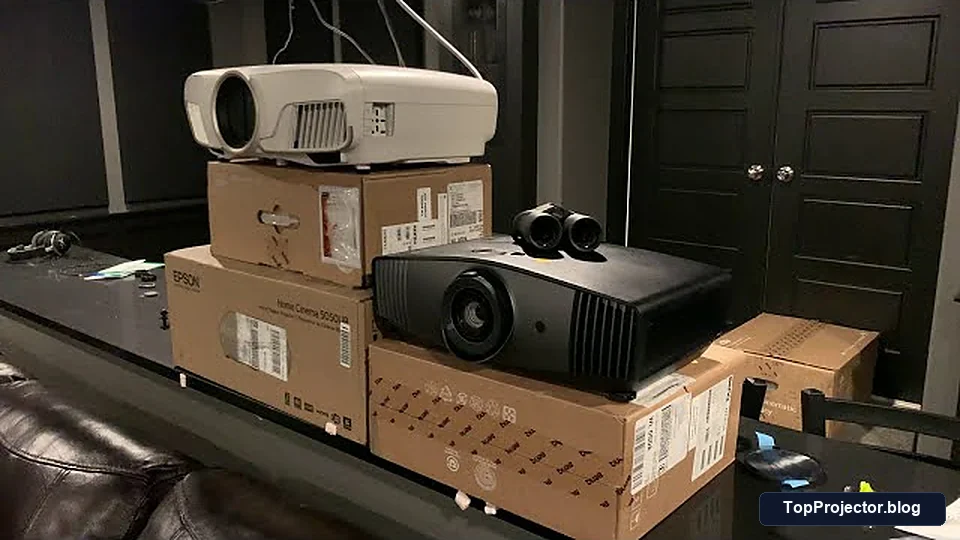
Conversely, the Epson 5050Ub leverages 3LCD technology to deliver equal white and color brightness. This ensures vibrant saturations without relying on aggressive lamp modes.
Optically, both engines target high-definition projection, but their underlying delivery mechanisms create entirely different viewing experiences in mixed-light environments.
Testing reveals the BenQ TK850 delivers 3000 ANSI lumens in its brightest mode, whereas the Epson 5050UB pushes an impressive 2600 ANSI lumens while maintaining significantly superior color accuracy out of the box.
- 3000 ANSI lumens power through daytime ambient living room conditions.
- Equal white and color output prevents washed-out cinematic skin tones.
- Single-chip DLP sharpness contrasts with organic 3LCD pixel alignment.
- BenQ relies on a specialized RGBRGB color wheel for enhanced daytime brightness.
- Epson utilizes dual optical correction filters for expanded color volume.
Daytime Living Room Performance
Living rooms with uncontrolled sunlight demand high ANSI lumen output to maintain washed-out contrast. The Benq Tk850 thrives here.
Epson matches raw brightness but utilizes optical filters that reduce peak output when engaging cinema color profiles for accuracy.
- Ambient daylight washes out dark cinematic scenes quickly.
- High lumen output maintains daytime visibility for sports.
Micro-Mirror vs 3LCD Light Engines
Single-chip DLP architecture utilizes a fast color wheel to manage primary hues, while Epson leverages a native 3LCD panel system that eliminates rainbow artifacts entirely during fast panning scenes in dark rooms.
- DLP offers pixel-level sharpness without convergence errors.
- 3LCD delivers high color brightness matching white output.
Black Floor Performance and Dynamic Contrast Ratios
Dedicated home theaters demand deep black floors to reproduce nocturnal sci-fi scenes accurately. The Epson 5050Ub dominates this optical metric effortlessly.
Equipped with a physical motorized dynamic iris, the Epson achieves exceptional perceived contrast. Dark scenes retain shadow detail without crushing highlights.
The Benq Tk850 relies on native DLP contrast, which struggles during dark sequences in untreated rooms due to light scatter.
Native contrast remains the Achilles' heel of standard DLP units, giving the Epson 5050UB a massive advantage with its 1,000,000:1 dynamic contrast ratio and motorized dynamic iris working seamlessly in dark spaces.
- 1,000,000:1 dynamic contrast creates inky, immersive blacks.
- Motorized iris operates quietly during rapid lighting transitions.
- DLP native contrast remains consistent but elevated in dark spaces.
- Epson achieves inky blacks suitable for batcave environments.
- BenQ exhibits slightly elevated black floors due to DMD scatter.
Pitch-Black Theater Evaluation
In a completely dark room with velvet walls, the Epson 5050Ub produces striking black levels. Shadow detail remains sharp and clearly delineated.
The Benq Tk850 exhibits a slightly elevated greyish black floor under identical dark-room conditions, limiting ultimate cinematic immersion.
- Dark rooms expose native contrast limitations immediately.
- Dynamic iris algorithms enhance cinematic depth effectively.
Iris Operations and Shadow Detailing
When engaging cinema presets, the Epson lens aperture physically closes during dark sequences to deepen blacks, whereas the BenQ TK850 relies heavily on lamp modulation which lacks the same precision.
- Motorized iris systems reduce light output in shadowy frames.
- Static apertures demand careful room optimization for contrast.
Ambient Light Rejection and Living Room Behavior
Modern living spaces feature white walls and ceiling reflections that bounce projected light back onto screens. Managing this scatter requires careful optical matching.
The Benq Tk850 handles ambient light remarkably well through its specialized HDR-PRO tone mapping algorithms, preserving mid-tones in bright spaces.
While Epson handles ambient light adequately, its massive chassis and lens optics perform best when paired with dedicated light-rejecting screens.
Deploying these systems in daylight requires strategic screen matching, where high lumen output pairs wonderfully with 1.0 gain ALR material calculated through our screen size tool.
- HDR-PRO tone mapping optimizes brightness curves dynamically.
- White walls degrade black levels regardless of projector choice.
- Ambient light rejecting screens compensate for living room ceilings.
- Pair the BenQ with angular reflective screens for optimal contrast.
- Epson handles moderate living room windows better with high-lamp settings.
Reflective Surface Management
Controlling light scatter in multipurpose rooms dictates how deep your perceived blacks appear. Highly reflective white ceilings test both optical engines.
Benq maintains better color punch in these hostile environments, while Epson requires careful screen pairing to prevent washed highlights.
- Ceiling bounce degrades native contrast performance.
- Optical coatings help mitigate unwanted room reflections.
Managing High-Lux Environments
Although both projectors fight glare effectively, the Epson 5050UB retains better saturation when ambient room lighting creeps upward, thanks to its robust DCI-P3 color filter engaging automatically during HDR streams.
- Ambient light quickly washes out lower contrast projectors.
- High lumens help combat daylight in open-concept living spaces.
Color Accuracy, DCI-P3 Gamut Coverage, and HDR Mapping
Accurate color reproduction separates entry-level displays from reference-grade projectors. Out-of-the-box calibration on the Benq Tk850 is exceptionally precise.
The Epson 5050Ub utilizes a motorized color filter to achieve wide DCI-P3 color gamut coverage, ensuring faithful cinematic palette replication.
HDR handling differs significantly between both models, with Epson offering manual gamma adjustments while Benq automates tone mapping.
Calibrating the Epson 5050UB unlocks nearly 100% DCI-P3 coverage via its motorized cinema filter, whereas the BenQ TK850 achieves about 85% coverage, making the Epson preferable for accurate cinematic grading.
- DCI-P3 color filter unlocks wider cinematic color volumes.
- Rec.709 factory calibration on Benq is remarkably accurate.
- HDR metadata processing dictates shadow preservation fidelity.
- BenQ automates HDR brightness adjustments for casual viewers.
- Epson requires calibration expertise to unlock peak color fidelity.
HDR Tone Mapping Realities
HDR content on projectors requires aggressive tone mapping to overcome limited peak brightness compared to flat-panel TVs.
Benq automates this process seamlessly, whereas Epson provides advanced manual controls for calibration enthusiasts.
- Automated tone mapping simplifies casual HDR viewing.
- Manual slider controls appeal to dedicated home theater calibrators.
HDR Tone Mapping Performance
HDR metadata handling differs noticeably; BenQ uses automated dynamic tone mapping similar to units covered in our horizon pro review, while Epson requires adjustments via its gamma control menu.
- Dynamic tone mapping preserves bright highlight clipping.
- Manual gamma adjustments offer superior shadow separation.
Motion Handling, Response Times, and Gaming Input Lag
Fast-paced gaming and sports broadcasting test motion resolution and processor latency limits. The Benq Tk850 delivers low input lag for competitive play.
Epson handles motion interpolation smoothly for cinematic 24fps film content, but adds latency that casual gamers might notice.
Pixel response times on single-chip DLP units inherently reduce motion blur during rapid camera pans across complex scenes.
Competitive gamers must consider input latency carefully, with the BenQ TK850 measuring roughly 16ms at 4K/60Hz, compared to the Epson 5050UB which sits noticeably higher around 27ms for standard gaming sessions.
- Low input lag ensures responsive competitive console gaming.
- Frame interpolation removes 24fps cinematic judder effectively.
- Fast pixel response times minimize rapid motion blur.
- BenQ wins competitive gaming due to lower latency.
- Epson handles 24p movie judder natively without harsh artifacts.
Console Gaming Experience
Connecting modern game consoles highlights input lag differences immediately. Fast twitch-shooters require sub-30ms response times for optimal control.
Benq satisfies responsive gaming demands, whereas Epson requires disabling image enhancement processing to achieve acceptable latency.
- Fast-paced shooters demand minimal input lag.
- Processing features must be disabled for gaming modes.
Frame Interpolation and Judder Control
For cinematic motion, Epson's Frame Insertion processing operates exceptionally smoothly with minimal artifacting, whereas BenQ's motion enhancer introduces slight soap-opera effect unless set strictly to low mode.
- Motion smoothing reduces judder in fast camera pans.
- Low input lag modes bypass processing to speed up response.
Lens Shift Flexibility, Throw Ratios, and Physical Setup
Physical installation constraints dictate which optical engine fits your ceiling mount or rear shelf. When checking our best projector guide, expect massive motorized lens shift on high-end models.
This extensive optical shift allows flexible placement without degrading image geometry through digital keystone correction.
The Benq Tk850 offers a shorter throw ratio and compact chassis, but relies on limited manual optical adjustments.
Physical installation versatility strongly favors the Epson 5050UB, offering massive ±96% vertical and ±47% horizontal motorized lens shift alongside a generous 1.35 to 2.84 throw ratio for flexible room placements.
- Motorized lens shift simplifies complex ceiling installations.
- Short throw ratios fit smaller media rooms easily.
- Lens memory lets you switch between aspect ratios effortlessly.
- Epson accommodates complex shelf or ceiling placement easily.
- BenQ requires strict adherence to narrow throw distance calculations.
Chassis Size and Weight
The Epson 5050Ub is a massive, heavy projector requiring robust ceiling mounts and sturdy structural backing.
In contrast, the Benq Tk850 boasts a compact, lightweight footprint that mounts easily on standard residential drywall brackets.
- Heavy chassis requires reinforced ceiling mounting hardware.
- Compact footprint fits tight shelf-mounting spaces.
Throw Distance and Ceiling Mount Constraints
Conversely, the BenQ TK850 features a tight 1.13 to 1.47 throw ratio with limited manual vertical shift, demanding precise positioning mapped via our throw distance calculator guide.
- Lens shift removes the need for digital keystone correction.
- Short throw ratios project massive images in compact spaces.
Ultimate Home Theater Verdict and Scenario-Based Recommendations
Selecting the right projector depends entirely on your room architecture and viewing habits. Dedicated dark rooms favor high contrast.
Living rooms with ambient light require bright lumens and aggressive tone mapping to maintain visual punch.
Evaluate your light control before purchasing to ensure optimal optical performance in your unique space.
Choose the Epson 5050UB if your primary goal is dedicated home theater film viewing in a dark room, prioritizing deep black levels and exceptional contrast ratios above all else.
- Match projector strengths to your actual room lighting.
- Prioritize contrast for dedicated dark home theaters.
- Prioritize lumens and color punch for multipurpose living spaces.
- Epson dominates dedicated dark-room cinematic setups completely.
- BenQ excels in multi-purpose living spaces with ambient light.
Final Decision Matrix
Choose the Epson 5050Ub if you have a dark, controlled theater room prioritizing deep blacks and motorized lens flexibility.
Select the Benq Tk850 if your setup involves ambient light, fast gaming, and compact installation requirements.
- Epson wins for dedicated dark room movie watching.
- Benq wins for bright multipurpose living spaces.
Choosing Your Ideal Display
Alternatively, select the BenQ TK850 if you primarily watch sports in bright living rooms or demand low gaming input lag paired with a punchy 3000 lumen output for daytime use.
- Match your room lighting conditions before finalizing purchases.
- Prioritize lens shift flexibility if mounting constraints exist.
Frequently Asked Questions
Which projector handles daytime ambient living room light better?
The Benq Tk850 handles daytime light more effectively due to its high ANSI lumen output and specialized HDR-PRO tone mapping. This maintains vibrant mid-tones in bright spaces.
Does the Epson 5050Ub support motorized lens memory for cinemascope screens?
Yes, the Epson 5050Ub features fully motorized lens shift, zoom, and focus with lens memory presets. This allows effortless switching between widescreen and standard aspect ratios.
Is the Benq Tk850 better for competitive console gaming?
The Benq Tk850 offers lower input lag and responsive handling for fast-paced gaming. This makes it superior for modern high-refresh-rate console sessions.
How significant is the contrast difference between these two models?
The Epson 5050Ub delivers dramatically deeper black levels and superior shadow detail. Its dynamic iris creates significantly higher perceived contrast in dark rooms.
Which model is easier to mount in a standard living room?
The Benq Tk850 is much lighter and more compact, making it easier to mount on standard brackets. The Epson is substantially larger and heavier.