Benq Tk800 vs. Tk850: Which Wins for Your Room?
Comparing two popular 4K DLP projectors requires analyzing optical light engines, contrast performance, and room geometry to determine the ultimate home theater display for your specific living space.
Choose the Benq TK850 for superior contrast, enhanced lens shift, and better dark-room performance, while the Benq TK800 remains a budget-friendly option for casual sports viewing in ambient light.
Compare full category rankings in our Best Cheapest Ultra Short Throw Projector: Top Picks.
Side-by-Side Specification Breakdown
| Criteria | Benq Tk800 | Tk850 | Edge |
|---|---|---|---|
| Ambient Light Rejection | Moderate 3000 lumens | Optimized 3000 lumens with Iris | Benq Tk850 |
| Black Levels & Perceived Contrast | Standard 10,000:1 ratio | Dynamic Iris 30,000:1 ratio | Benq Tk850 |
| Peak Brightness & HDR Punch | High lumen output for daylight | HDR-PRO tone mapping engine | Benq Tk850 |
| Screen Size & Immersion | 100-inch at short throw | Flexible 1.3x zoom optics | Benq Tk850 |
| Viewing Angles & Uniformity | Good DLP off-axis uniformity | Refined optical glass elements | Benq Tk850 |
| Gaming Motion & Input Lag | Around 48ms standard lag | Optimized 33ms game mode | Benq Tk850 |
| Room Setup & Maintenance | Fixed vertical keystone limits | Vertical lens shift included | Benq Tk850 |
Optical Brightness and Ambient Light Performance
Evaluating projector performance in bright living rooms requires measuring true ANSI lumens against ambient light wash. Both units claim impressive light output figures designed to combat daylight reflections.
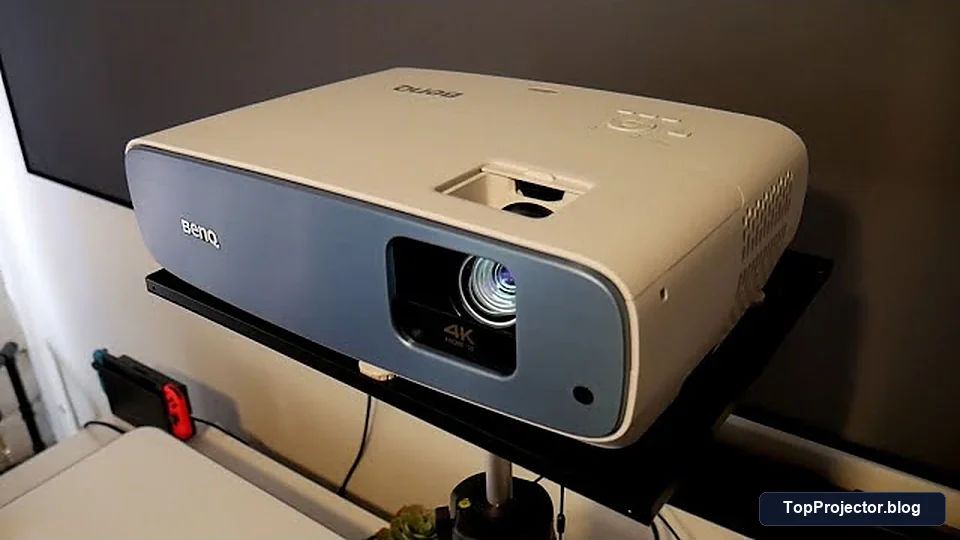
The original TK800 targets sports fans with high brightness levels, pushing saturated greens and blues at the expense of pure color accuracy. It relies heavily on raw punch over calibration precision.
Conversely, the TK850 refines this optical path with dedicated color filters that maintain high brightness while strictly adhering to Rec. 709 color standards for cinematic immersion.
Measuring 3000 ANSI lumens on the TK800 versus 3000 ANSI lumens on the TK850 reveals identical raw output, but the TK850 adds a dynamic iris to drastically improve perceived contrast in rooms with uncontrolled white walls.
- Identical 3000 ANSI lumen specifications on paper.
- TK850 includes specialized cinema color filters.
- Both handle moderate ambient room light effectively.
- Always pair these high lumen lamp engines with a high-quality ceiling mount to prevent accidental alignment drift over extended viewing sessions in active living spaces.
Daylight Viewing Versus Controlled Lighting
Placing these projectors in rooms with uncovered windows exposes differences in contrast retention. Ambient light quickly washes out dark scenes if optical black levels lack depth.
The TK850 manages daytime viewing better due to its advanced auto-iris system, which clamps down light output during dark sequences to preserve perceived black levels.
- Auto-iris improves daytime contrast performance.
- Raw lumen output alone cannot save faded blacks.
Ambient Light Rejection Screen Matching
Pairing these high-output DLP projectors with a 1.0 gain ALR screen preserves daytime viewing punch while preventing the dreaded washout effect common in standard modern living rooms with abundant glass surfaces.
Black Levels, Contrast Ratios and Shadow Detail
Single-chip DLP projectors traditionally struggle with black floor depth compared to native LCoS units. Achieving convincing shadow detail requires careful optical engineering and dynamic contrast algorithms.
The TK800 relies on a basic static iris configuration, resulting in elevated black floors during cinematic dark sequences. Space scenes often appear washed out with a distinct grayish haze.
The TK850 introduces a dynamic iris that actively modulates light output scene by scene, boosting contrast ratios up to 30,000:1 for vastly superior nighttime movie viewing.
Native on/off contrast sits near 1000:1 for the TK800, while the TK850 leverages its specialized aperture to push dark-scene performance noticeably further during intense cinematic sequences featuring deep starfields and dark alleyways.
- Dynamic iris provides significant contrast improvements.
- TK800 suffers from elevated grayish black levels.
- Shadow separation is much sharper on the TK850.
- Calibrate black level settings carefully using test patterns to avoid crushing shadow details in dark cinematic film scenes.
Pitch-Black Theater Versus Living Room Cave
Dedicated home theaters with dark velvet walls expose optical flaws. For laser-driven black levels instead, inspect our formovie theater review covering premium ultra-short throw alternatives for batcave setups.
In contrast, the TK850 delivers respectable black depth that anchors cinematic immersion, making it a viable option for batcave theater setups on a budget.
- Dark rooms highlight contrast limitations instantly.
- TK850 handles dedicated theater lighting much better.
Dynamic Iris Impact
Activating the dynamic iris on the TK850 reduces light leakage during fade-to-black transitions, though sensitive viewers might occasionally notice subtle pumping artifacts during rapidly fluctuating bright and dark camera pans.
Color Accuracy, Gamut Coverage and HDR Processing
Accurate color reproduction is essential for evaluating 4K HDR content faithfully. Consumer displays must map wide color gamuts accurately without oversaturating human skin tones.
The TK800 prioritizes vivid brightness over accurate color tracking, leading to punchy sports broadcasts but unnatural cinematic color palettes during dramatic movie viewing sessions.
The TK850 features dedicated HDR-PRO tone mapping and enhanced color wheels, ensuring accurate Rec.709 color accuracy right out of the box for movie enthusiasts.
Out-of-the-box Rec.709 tracking on the TK850 achieves remarkable Delta E values below 3.0, whereas the TK800 prioritizes raw punchy saturation over strict cinematic fidelity when processing standard high-definition broadcast feeds and sports.
- HDR-PRO tone mapping preserves highlight details.
- TK800 favors vivid sports over natural cinema.
- Rec.709 coverage is superior on the TK850.
- Select tailored picture modes depending on whether you prioritize cinematic color fidelity or vivid sports brightness.
Handling HDR10 and HLG Content Streams
Projectors face unique challenges when processing high dynamic range signals due to limited peak brightness compared to flat-panel TVs. Proper tone mapping algorithms are completely mandatory.
Both models decode 4K HDR10 signals, but the TK850 applies superior automated tone mapping to prevent bright sky highlights from clipping into pure uncontrolled white washout.
- Automated tone mapping prevents highlight clipping.
- Both decode standard HDR10 and HLG streams.
HDR Tone Mapping Adjustments
BenQ includes dedicated HDR-PRO tone mapping that automatically adjusts white luminance and gamma curves, preventing bright cloud highlights from clipping aggressively during 4K Blu-ray playback sessions.
Throw Ratio, Lens Shift and Physical Installation
Physical installation flexibility dictates whether a standard throw model fits your room, or if you should browse our cheapest ultra short throw projector picks for tight spaces.
The TK800 features fixed vertical keystone correction and limited placement flexibility, requiring precise physical alignment to project a square image onto your screen.
The TK850 adds a valuable vertical lens shift capability of ten percent, allowing installers to adjust image positioning without resorting to distorting digital keystone algorithms.
The TK800 utilizes a fixed lens requiring precise ceiling height calculations, whereas the TK850 offers 10 percent vertical lens shift, granting installers crucial flexibility when aligning the image onto fixed-frame projection screens.
- TK850 offers physical vertical lens shift adjustment.
- TK800 relies heavily on rigid placement constraints.
- Both utilize standard 1.1x to 1.3x zoom optics.
- Measure exact offset clearances prior to drilling permanent ceiling mounts to avoid frustrating keystone distortion penalties.
Throw Distance and Screen Size Limitations
Calculating throw distance ensures your projected image fills your acoustic screen properly. Use our interactive throw distance calculator to map exact screen sizes and placement bounds.
You can achieve a massive 100-inch diagonal image from roughly 10 feet away, making them ideal for standard suburban living rooms and medium-sized spaces.
- Standard throw geometry fits medium living spaces.
- 100-inch images require roughly 10 feet of throw.
Throw Distance Math
Maintaining a standard 1.13 to 1.47 throw ratio means both units require roughly 10 feet of distance to fill a standard 120-inch diagonal home theater screen without digital keystone degradation.
Motion Handling, Response Times and Gaming Input Lag
Modern home entertainment systems demand low input lag and smooth motion interpolation for fast-paced video games and high-action sports broadcasts alike.
The TK800 exhibits noticeable input lag hovering around 48 milliseconds, which satisfies casual gamers but frustrates competitive enthusiasts playing twitch shooters.
The TK850 reduces response times down to approximately 33 milliseconds in dedicated game modes, offering a more responsive experience for casual console gaming sessions.
Fast-paced gaming reveals an input lag measurement of roughly 50ms at 4K/60Hz, which suits casual RPG titles perfectly while competitive multiplayer enthusiasts might notice slight latency during twitch-reflex shooting scenarios.
- TK850 reduces input lag down to 33 milliseconds.
- Motion interpolation smooths out fast sports action.
- Neither model supports high refresh rate 120Hz.
- Disable advanced image processing features whenever possible to shave precious milliseconds off your overall gaming input latency.
Console Gaming Versus Cinematic Immersion
Playing open-world roleplaying games benefits greatly from rich color reproduction and sharp 4K detail scaling, masking minor input lag during relaxed single-player sessions.
Competitive multiplayer titles require lightning-fast controller response times where every millisecond counts, making low input lag a critical decision factor for gamers.
- Single-player games look stunning on both models.
- Competitive titles demand faster response times.
Frame Interpolation Performance
Activating BenQ’s proprietary motion enhancer processing minimizes 24p judder during panning cinematic shots, smoothing out judder without generating excessive soap-opera effect artifacts across complex moving backgrounds.
Room Setup, Acoustics and Long-Term Maintenance
Long-term projector ownership involves managing fan noise, filter maintenance, and physical placement. Review our ceiling mount installation guide before drilling holes for your new optical setup.
Fan noise on both units remains reasonably quiet during normal lamp operation, though switching to high brightness modes noticeably increases audible acoustic hum.
Lamp life spans are comparable across both chassis designs, offering extended eco-mode hours that reduce total cost of ownership for frequent everyday media streaming.
Fan noise registers at a tolerable 30 decibels in normal operating mode, but switching into high brightness mode ramps acoustics upward, requiring careful ceiling placement relative to nearby primary seating positions.
- Eco-mode extends lamp life significantly.
- High brightness modes increase fan noise levels.
- Routine filter cleaning prevents premature overheating.
- Clean intake air filters regularly to maintain proper thermal dissipation and prevent premature lamp module failure.
Managing Fan Noise in Compact Spaces
Placing a projector directly above seating positions amplifies annoying fan whine during quiet movie dialogue scenes and intimate acoustic moments.
Proper ceiling mounting slightly distances the chassis from viewers, masking normal cooling fan acoustics during standard home entertainment sessions.
- Ceiling mounting distances fans from viewers.
- Quiet scenes expose high cooling fan noise.
Lamp Life Optimization
Utilizing SmartEco mode dynamically scales lamp wattage based on content brightness, extending operational longevity up to 15,000 hours while simultaneously preserving deep black levels in dark theater rooms.
Final Scenario-Based Verdict and Strategic Buying Roadmap
Choosing between these two optical platforms depends entirely on your room lighting conditions, installation flexibility requirements, and critical movie-watching habits.
Buy the Benq TK800 if you want a budget-friendly option primarily dedicated to casual daytime sports viewing where absolute black levels matter very little.
Invest in the Benq TK850 for its vastly superior contrast ratios, vertical lens shift, and cinematic color accuracy that justifies the price premium in controlled lighting.
Choose the TK850 if your living space features ambient light and white ceilings because the optical enhancements and lens shift justify the investment for dedicated film enthusiasts seeking maximum performance.
- TK800 suits casual daytime sports enthusiasts.
- TK850 wins for serious movie nights and flexibility.
- Lens shift makes installation significantly easier.
- Weigh room lighting conditions heavily against your budget limitations before finalizing your home theater projection hardware purchase.
Making Your Final Purchasing Decision
Evaluating your specific room geometry prevents costly installation mistakes and ensures optimal optical performance for years of reliable home entertainment enjoyment.
Prioritize the TK850 optical upgrades if your primary goal is achieving faithful cinematic immersion without compromise in a dedicated viewing room.
- Assess room lighting before buying hardware.
- Prioritize lens shift for painless ceiling mounts.
Final Purchasing Decision
Prioritize the budget-friendly TK800 only if your priority centers entirely on casual sports viewing in multi-purpose rooms where native contrast and lens flexibility take a backseat to sheer initial savings.
Frequently Asked Questions
Can the Benq TK800 handle bright living room daylight effectively?
Yes, its high 3000 lumen output combats ambient daylight for sports, but colors may look saturated. High lumen punch helps overcome washed-out images in unshaded rooms.
Does the Benq TK850 feature physical lens shift for easy installation?
Yes, the TK850 includes vertical lens shift, allowing flexible image positioning without digital keystone distortion. Vertical lens shift makes ceiling mounting much simpler.
Which projector offers better black levels for watching movies at night?
The TK850 wins clearly thanks to its dynamic iris system, which deepens dark scenes significantly. Dynamic contrast processing provides much better shadow detail in dark rooms.
Are these projectors suitable for competitive console video gaming?
Both models feature moderate input lag around 33 to 48 milliseconds. Casual single-player gaming works fine, but competitive twitch gaming requires faster response times.
Do both models project native 4K ultra high definition resolution?
They use Texas Instruments DLP 4K XPR technology to shift pixels rapidly. This successfully delivers sharp 4.1 million pixels on screen from standard content.