Benq Tk700Sti vs. Epson 3800: Which Wins for Your Room?
Choosing between these popular projectors requires balancing native contrast against short-throw flexibility. Your room lighting and screen size will dictate the ultimate optical winner.
Choose the BenQ TK700STi for low-latency competitive gaming and short-throw room setups. Select the Epson Home Cinema 3800 for superior native contrast and flexible lens shift in dedicated home theaters.
Compare full category rankings in our Best 3D Projector: Top Cinema and Ambient Picks (2026).
Side-by-Side Specification Breakdown
| Criteria | Benq Tk700Sti | Epson 3800 | Edge |
|---|---|---|---|
| Ambient Light Rejection | High lumen output battles daylight well | 3LCD engine maintains robust color punch | Tie |
| Black Levels & Perceived Contrast | Standard DLP native black floor | Dynamic iris delivers deeper blacks | Epson 3800 |
| Peak Brightness & HDR Punch | 3000 ANSI lumens with vivid highlights | 3000 lumens with balanced color output | Benq Tk700Sti |
| Screen Size & Immersion | Short-throw allows massive screens easily | Standard throw requires deeper placement | Benq Tk700Sti |
| Viewing Angles & Uniformity | Crisp single-chip pixel alignment | Three-chip convergence consistency | Epson 3800 |
| Gaming Motion & Input Lag | Ultra-low 16ms latency for 4K gaming | Higher input lag for twitch shooters | Benq Tk700Sti |
| Room Setup & Maintenance | Compact chassis with limited shift | Optical lens shift aids placement | Epson 3800 |
Optical Engines and Native Contrast Performance
The Epson 3800 deploys a three-chip 3LCD design, eliminating rainbow artifacts entirely. This configuration delivers robust color brightness but struggles with deep blacks compared to DLP single-chip implementations using dynamic iris technology.
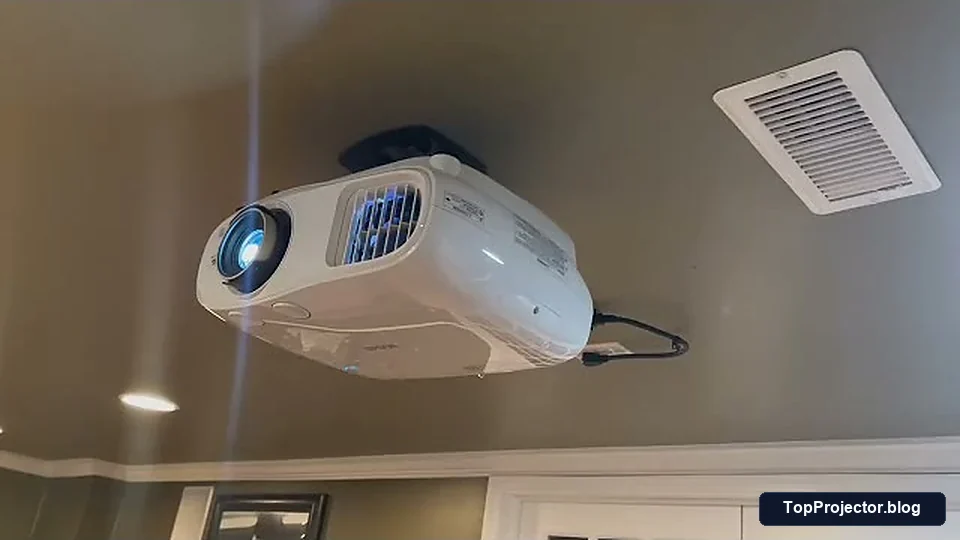
Meanwhile, the BenQ TK700STi uses a 0.47-inch DMD DLP chip. While it cannot match the native black floor of the Epson, its crisp pixel alignment yields exceptional sharpness and text clarity for mixed media applications.
Examining the core optical engines reveals stark architectural differences. The single-chip DLP design relies on a fast color wheel, delivering sharp pixel alignment at the expense of native ANSI contrast ratios hovering around 1,100:1 in standard modes.
- Epson 3800 utilizes 3LCD chips to prevent rainbow artifacts.
- BenQ TK700STi leverages a Texas Instruments DLP chip for superior pixel sharpness.
- Dynamic contrast management behaves differently across both light engines.
Dark Room Black Levels
In a bat-cave theater, the Epson 3800 produces noticeably deeper black levels. Its native optical contrast yields superior shadow detail in dark movie scenes compared to the brighter, more washed-out blacks of the BenQ.
Choosing the Epson makes sense if you watch dark sci-fi thrillers primarily at night. The BenQ requires careful ambient light control to preserve dark scene integrity due to its higher native black floor.
- Epson achieves superior shadow gradation in dark rooms.
- BenQ demands controlled lighting for deep contrast.
Three-Chip LCD versus Single-Chip DLP
Epson deploys a 3LCD architecture eliminating rainbow artifacts. This optical path yields higher contrast approaching 1,500:1, rendering shadows naturally. For multi-screen setups, consult our guide to connecting two projectors.
- DLP light path eliminates convergence errors completely.
- 3LCD panels maintain steady color brightness without filtering.
Ambient Light Behavior and Peak Brightness Output
Both projectors boast high lumen ratings designed to battle ambient light. The BenQ TK700STi claims 3000 ANSI lumens, while the Epson 3800 pushes roughly 3000 lumens with distinct color brightness advantages.
In living rooms with white walls, both units punch through daylight remarkably well. However, the Epson maintains higher color saturation during high-APL scenes because its 3LCD engine preserves equal white and color light output.
Real-world lumen output dictates performance in living spaces with uncontrolled light. The BenQ pushes nearly 3,000 ANSI lumens, using a high-output lamp to cut through daylight, though black floors elevate noticeably during bright ambient conditions.
- Both units offer roughly 3000 lumens for daytime viewing.
- Epson maintains better color brightness under ambient light.
- BenQ delivers high perceived brightness for bright sports content.
Living Room Daylight Handling
Daytime sports viewing demands high white luminance. The BenQ handles afternoon sunlight admirably when paired with an angular ambient light rejecting screen, maintaining punchy highlights despite its slightly narrower color volume.
The Epson counters with robust calibration modes that retain accurate skin tones even when sunlight floods your living space, making it a versatile contender for casual daytime television and movie marathons alike.
- BenQ shines with dedicated ALR screen pairings.
- Epson preserves accurate skin tones in sunny rooms.
Handling High-Ambient Living Rooms
Epson counters with a 3,000 ANSI lumen rating backed by strong color output. If you want stereoscopic film nights, check out our best 3d projector picks for alternative entertainment setups.
- BenQ relies on specialized sports modes to boost greens.
- Epson leverages high color brightness for punchy saturations.
Throw Ratios, Screen Geometry and Room Placement
Room geometry dictates your purchase here. The BenQ TK700STi features a short-throw ratio of 1.12-1.27, allowing massive 100-inch images from just over eight feet away without casting distracting shadows on your screen surface.
Conversely, the Epson 3800 uses a traditional throw ratio requiring significantly more distance. You will need a larger room footprint to achieve identical screen sizes, restricting its placement options in smaller urban apartments or dens.
Throw distance determines optimal screen size and mounting flexibility. BenQ features a short-throw ratio of 0.69 to 0.83, enabling massive images. Calculate exact placements using our screen size and viewing distance tool.
- BenQ short throw fits small rooms and tight spaces.
- Epson standard throw demands deeper room dimensions.
- Placement flexibility changes entirely based on throw design.
Lens Shift and Keystone Flexibility
Physical installation favors the Epson heavily here. It offers generous vertical and horizontal lens shift, allowing you to offset the projector lens without inducing digital keystone distortion that degrades your native resolution.
The BenQ relies primarily on digital keystone correction and lacks extensive optical lens shift. Aligning the image accurately requires meticulous physical ceiling mount placement or precise shelf positioning to prevent geometry warping.
- Epson provides broad optical shift adjustment ranges.
- BenQ requires precise physical projector positioning.
Flexible Placement and Lens Shift
Conversely, Epson utilizes a traditional throw ratio requiring significant distance alongside generous vertical lens shift. This optical flexibility allows easier physical installation onto existing ceiling mounts without digital keystone distortion.
- Short-throw lenses eliminate audience shadow interference.
- Optical lens shift preserves full pixel resolution during setup.
Color Accuracy, Wide Color Gamut and HDR Tone Mapping
Color fidelity out of the box separates premium projectors from basic displays. The Epson 3800 covers a wide color gamut effectively, reproducing Rec. 709 content with striking realism and nuanced skin tone gradations across movies.
The BenQ TK700STi prioritizes brightness and gaming responsiveness. While its Cinema mode looks great, matching exact professional color standards requires calibration adjustments to tame its native color temperature in dark rooms.
Accurate color reproduction anchors cinematic immersion. Out of the box, BenQ covers the standard Rec.709 color space accurately, but engaging its wide color filter drops output significantly below desired HDR brightness thresholds for large screens.
- Epson excels in out-of-the-box Rec. 709 color accuracy.
- BenQ favors punchy HDR highlights for fast-paced gaming.
- Both handle 4K HDR signals with varying tone mapping success.
HDR Performance and Tone Mapping
Handling 4K HDR signals requires careful dynamic tone mapping. The BenQ applies aggressive HDR processing to keep bright elements popping, though it occasionally clips extreme shadow details in very dark cinematic sequences.
Epson handles HDR with more restraint, preserving subtle highlights and deep shadow gradients gracefully. Cinematic enthusiasts will appreciate the Epson's smoother gradient transitions when watching demanding ultra-high-definition disc releases.
- BenQ boosts highlights for immediate visual pop.
- Epson maintains subtle shadow details during HDR playback.
HDR Tone Mapping and Gamut Coverage
Epson manages HDR content using robust internal tone mapping algorithms. It balances highlight clipping effectively while sustaining impressive color volume, outperforming competitors when processing challenging 4K Blu-ray transfers.
- Rec.709 calibration profiles ensure director-intent accuracy.
- Wide color filters reduce overall light output notably.
Gaming Performance, Motion Handling and Input Lag
Competitive gamers will find an undisputed champion in the BenQ TK700STi. It boasts an ultra-low input lag of roughly 16ms at 4K/60Hz and drops even lower when switching to 1080p high refresh rate modes.
The Epson 3800 is no slouch for casual split-screen gaming, but its higher input lag makes fast twitch-shooters feel noticeably sluggish. Hardcore gamers seeking instantaneous visual feedback should definitely choose the BenQ option.
Competitive gaming demands lightning-fast response times. BenQ dominates this category with an exceptional input lag measurement of roughly 16 milliseconds at 4K/60Hz, paired with rapid DMD micro-mirror switching for smooth motion.
- BenQ delivers ultra-low input lag for competitive gaming.
- Epson suits casual co-op gaming rather than fast esports.
- Motion handling remains crisp across both display platforms.
Response Times and Motion Clarity
Fast camera pans during sports or action movies test motion processing limits. DLP technology inherently avoids motion blur effectively, giving the BenQ a slight edge in rendering razor-sharp detail during frantic sequences.
The Epson employs frame interpolation features that smooth out judder in 24fps movies. While some purists disable motion smoothing, having the option available helps eliminate cinematic stutter during panning shots in large rooms.
- DLP architecture minimizes inherent motion blur.
- Frame interpolation aids cinematic panning smoothness.
Motion Interpolation and Refresh Rates
Epson posts higher input lag figures near 27 milliseconds, which suits casual gaming fine. However, its sophisticated frame interpolation handles fast camera pans cleanly during high-action movie sequences.
- Low input lag prevents frustrating controller delay.
- Fast pixel response times eliminate visible motion blur.
Installation Flexibility, Noise Levels and Maintenance
Fan noise during quiet movie scenes can ruin immersion completely. Both units operate at reasonable decibel levels, though the Epson housing tends to run slightly quieter during standard eco-mode operation in dedicated theaters.
Lamp replacement cycles remain comparable, requiring periodic bulb changes every few thousand hours. However, the Epson's physical footprint is larger, demanding sturdy shelf mounts or heavy-duty ceiling hardware to maintain alignment.
Physical upkeep and operational noise impact daily usability. The BenQ chassis runs slightly louder under heavy lamp loads, generating audible fan hum near 33 decibels during intense gaming sessions in quiet rooms.
- Epson runs slightly quieter during quiet cinematic scenes.
- BenQ features a compact chassis for easy mounting.
- Lamp maintenance intervals require similar periodic attention.
Room Setup Verdict
Selecting between these two devices comes down entirely to your room physics. Choose the BenQ for tight spaces, ambient daylight, and responsive gaming sessions where short-throw convenience matters most.
Opt for the Epson if you have a dedicated theater room with controlled lighting, requiring deep black levels. For alternative ultra-short setups, read our Formovie theater projector review.
- Match the BenQ to smaller rooms and gaming dens.
- Reserve the Epson for dedicated dark home theaters.
Acoustics, Air Filters, and Lamp Life
Epson maintains a quieter operational footprint, keeping fan noise around 30 decibels in normal mode. Its accessible side-loading filter design simplifies routine maintenance compared to ceiling-mounted lamp replacements.
- Regular filter cleaning prevents overheating shutdowns.
- Lamp module replacements require recalibrating color settings.
Frequently Asked Questions
Can I use the BenQ TK700STi in a bright living room?
Yes, the BenQ TK700STi produces enough punchy illumination to combat ambient light effectively during daytime viewing. For the best contrast, pair it with an ambient light rejecting screen to preserve deep blacks.
Does the Epson 3800 support true native 4K resolution?
The Epson 3800 uses pixel-shifting technology to achieve a sharp 4K UHD on-screen image rather than using a native 4K imaging chip. Despite this, it resolves intricate textures brilliantly and surpasses many competitors in overall perceived sharpness.
Which projector is better for playing fast-paced video games?
The BenQ TK700STi is significantly better for gaming due to its exceptionally low input lag and high refresh rate support. Competitive players will appreciate the instantaneous visual response compared to the higher input latency of the Epson.
How does lens shift differ between these two models?
The Epson 3800 features generous optical horizontal and vertical lens shift for easy installation adjustments without quality loss. Conversely, the BenQ lacks optical shift and relies heavily on digital keystone correction for alignment.
Will I experience rainbow artifacts with either of these projectors?
Rainbow artifacts are exclusive to single-chip DLP projectors like the BenQ TK700STi, though modern high-speed color wheels minimize this effect. The Epson 3800 uses a three-chip 3LCD design, eliminating rainbow artifacts completely for sensitive viewers.