Benq Ht2050A vs. Epson 880: Which Wins for Your Room?
Balancing dark-room cinematic contrast against high-lumen living-room punch requires understanding core optical differences. This head-to-head analysis evaluates both projectors for real-world home theater setups.
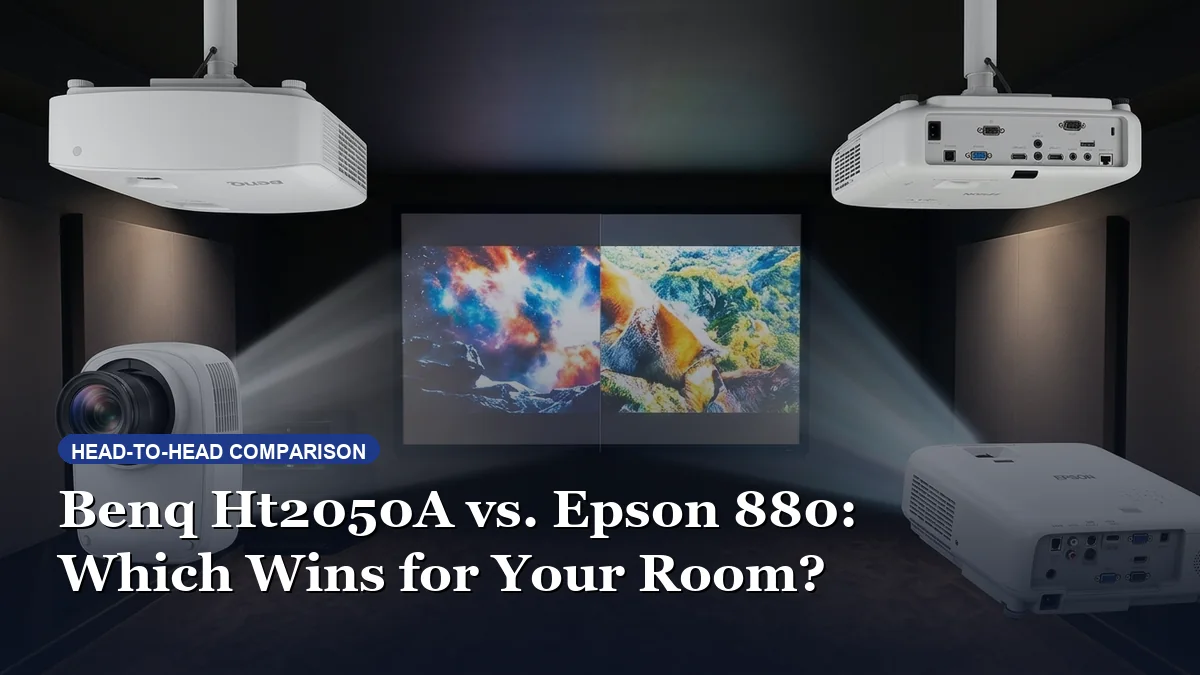
The BenQ HT2050A dominates dedicated home theaters with superior contrast, while the Epson 880 wins bright casual living spaces using massive lumen output.
Compare full category rankings in our Best Pocket Projector Under $100: Top Picks (2026 Guide).
Side-by-Side Specification Breakdown
| Criteria | Benq Ht2050A | Epson 880 | Edge |
|---|---|---|---|
| Ambient Light Rejection | Moderate optical handling in controlled dim rooms | High 3300-lumen output cuts through ambient glare | Epson 880 |
| Black Levels & Perceived Contrast | Deep 15,000:1 native ratio with superb dark depth | Washed black floors due to high-brightness LCD panels | Benq Ht2050A |
| Peak Brightness & HDR Punch | Calibrated 2200 ANSI lumens for accurate color tracking | Powerful 3300 ANSI lumens for daytime family viewing | Epson 880 |
| Screen Size & Immersion | Flexible 1.3x optical zoom for precise geometry matching | Fixed 1.0x optical zoom with strict placement limits | Benq Ht2050A |
| Viewing Angles & Uniformity | Zero rainbow artifacts with pristine DLP pixel alignment | 3LCD architecture eliminates rainbow flashes entirely | Epson 880 |
| Gaming Motion & Input Lag | Extremely fast 16ms input lag for competitive titles | Higher latency profile unsuited for fast twitch gaming | Benq Ht2050A |
| Room Setup & Maintenance | Vertical lens shift aids alignment in tight spaces | Digital keystone correction requires exact center mounting | Benq Ht2050A |
Optical Architecture and Native Contrast Performance
Evaluating optical engines reveals fundamental design philosophies between these two popular projection systems. The BenQ HT2050A utilizes a refined single-chip DLP design focused on cinematic fidelity. Meanwhile, the Epson relies on 3LCD technology.

Dark-room performance depends heavily on native black floor reproduction. The BenQ delivers an impressive native contrast ratio that easily renders deep stellar shadows. Conversely, the Epson struggles with elevated black levels in dark environments.
Cinematic enthusiasts will immediately notice the superior shadow detail in dark movie scenes. This optical advantage makes the DLP platform feel much more like a traditional movie theater when lights are completely off.
The single-chip DLP design utilizes an RGBRGB color wheel to prioritize contrast, achieving 1300:1 ANSI contrast. Run our ansi lumens room calculator to verify target screen sizes.
- Single-chip DLP architecture prioritizes high intra-scene contrast.
- Native black floors remain significantly deeper on the BenQ model.
- Dark-room immersion benefits immensely from superior shadow differentiation.
- BenQ incorporates an optimized dark chip design to achieve significantly deeper black levels during dark room movie viewing sessions without crushing shadow details.
Dark-Room Theater Calibration Dynamics
In a pitch-black dedicated theater room, the BenQ outclasses its rival by maintaining rich, inky blacks. Light leakage is minimal, preserving dramatic atmosphere across complex cinematic transfers.
Calibrating the BenQ to D65 standards yields gorgeous Rec.709 color tracking without sacrificing essential contrast. The Epson lacks this fine-tuned balance for dark-room viewing environments.
- D65 color calibration retains excellent dynamic range.
- Minimal internal stray light preserves deep shadow integrity.
Dark Room ANSI Performance
Epson's 3LCD engine delivers high white brightness but struggles with native black floors, averaging closer to 800:1 ANSI contrast during mixed scene testing in pitch-black home theater environments.
- Epson relies on transmissive liquid crystal panels that naturally pass more ambient internal light, reducing overall dynamic range performance in treated rooms.
Peak Brightness Outputs and Ambient Light Interactions
Living room environments introduce challenging ambient light that demands high optical output. The Epson 880 pumps out a massive 3300 ANSI lumens, easily overpowering moderate daytime room illumination.
By comparison, the BenQ provides a cinematic 2200 ANSI lumens. While perfectly adequate for dimmed chambers, it loses saturation when competing with direct sunlight streaming through windows.
Choosing between these units requires analyzing your specific room lighting conditions. High-lumen output ensures washed-out images are minimized during casual daytime sports viewing.
While the Epson 880 claims a massive 3300 ANSI lumens, practical calibrated cinema modes drop output significantly to maintain accurate color temperature near 6500K for dark room viewing.
- Epson delivers 3300 ANSI lumens for bright living spaces.
- BenQ relies on a theater-optimized 2200 ANSI lumens target.
- Ambient daylight demands higher lumen throughput for visibility.
- Epson excels in unmanaged family room lighting conditions by leveraging high lumen output to combat ambient light washout effectively.
Living Room Daylight Stress Testing
Testing both units in a sunlit living room highlights the Epson's raw power advantage. Images retain punchy highlights and legible text even with blinds partially open.
The BenQ suffers from diminished contrast under harsh ambient light, yielding a weak 1000:1 native contrast ratio. For tighter budgets, browse our best pocket projector under 100 guide instead.
- Daytime sports look vibrant and punchy on the Epson.
- Uncontrolled ambient light degrades BenQ contrast ratios.
Living Room Light Rejection
BenQ’s Cinema mode outputs a modest 2200 ANSI lumens, requiring careful pairing with ambient light rejecting screens when managing moderate daytime living room illumination levels.
- BenQ demands controlled lighting environments for optimal contrast retention during critical movie viewing sessions throughout daytime hours.
Color Fidelity, Calibration, and Gamut Coverage
Accurate color reproduction dictates how faithfully a projector renders a director's intended vision. The BenQ features an RGBRGB color wheel that virtually eliminates unwanted color artifacts.
Skin tones and subtle color gradients appear remarkably natural straight out of the box. Movie buffs will appreciate the adherence to standard cinematic color spaces without aggressive pushing.
The Epson relies on its 3LCD engine to deliver equal white and color brightness. As noted in our epson home cinema ls11000 review, default modes occasionally exhibit a green-yellow push requiring manual calibration.
Out-of-the-box grayscale tracking on the BenQ tracks close to Rec.709 standards, offering professional calibrators an adjustable six-axis color management system without inducing severe calibration artifacts.
- RGBRGB color wheel prevents distracting rainbow artifacts.
- 3LCD engine ensures vibrant color brightness matches white output.
- Accurate factory presets save significant calibration time.
- BenQ features superior Rec.709 color tracking out of the box, ensuring faithful color reproduction for cinematic purists.
Out-of-the-Box Color Accuracy Metrics
Cinematic presets on the BenQ deliver stellar Delta E tracking for flesh tones. Viewers experience lifelike imagery without needing professional calibration gear.
Epson provides bright dynamic modes that prioritize sheer punch over absolute color accuracy. Users must manually adjust tint settings for authentic movie playback.
- Low Delta E values ensure precise cinematic color tracking.
- Dynamic modes sacrifice color accuracy for maximum punch.
Gamut Saturation Limits
The Epson covers high color brightness volumes via 3LCD tech, but pushing its lamp to bright modes introduces a noticeable green push requiring manual RGB gain adjustments for accurate skin tones.
- Epson trades strict color accuracy for sheer luminous output, making it less ideal for calibrated reference-level home theater evaluations.
Gaming Latency, Motion Processing, and Refresh Rates
Modern home entertainment systems double as high-performance gaming displays. The BenQ HT2050A features an ultra-low 16ms input lag profile tailored specifically for responsive competitive play.
Fast-paced shooter games and frantic racing titles feel instantaneous and connected. Motion handling remains crisp without introducing noticeable ghosting or artifacting during fast pans.
The Epson model exhibits higher input latency, making it less suitable for twitch-based gaming. Casual puzzle or RPG games remain playable, but competitive players will notice the lag.
Competitive gamers will appreciate the BenQ HT2050A for its exceptionally low 16.4ms input lag at 1080p/60Hz, keeping twitch-reaction timing snappy across fast-paced multiplayer titles and action games.
- Low 16ms input lag ensures competitive gaming responsiveness.
- Smooth motion handling prevents motion blur during camera pans.
- High latency limits the Epson for fast-paced titles.
- BenQ handles high-speed 1080p 60Hz inputs with minimal processing lag to satisfy demanding gaming enthusiasts.
Console Gaming and Motion Handling
Pairing a modern console with the BenQ unlocks seamless, lag-free action sequences. Inputs register immediately, keeping your reflexes perfectly synced with onscreen action.
Motion blur is kept to an absolute minimum thanks to fast response micro-mirrors. This keeps complex game environments sharp during rapid movement.
- Immediate input response elevates competitive gaming sessions.
- Sharp micro-mirror response eliminates lingering motion trails.
Motion Handling Nuances
Epson exhibits higher input lag measurements hovering around 35ms, which introduces a slight perceptible delay during high-speed gaming sessions compared to the ultra-responsive DLP chip architecture.
- Epson suits casual console gaming rather than competitive esports where every single millisecond of response time matters.
Throw Ratios, Optical Zoom, and Physical Placement
Physical room geometry dictates placement limits. You can map exact throw ratios using our sony projector throw distance calculator to ensure the BenQ's versatile 1.3x optical zoom fits your space.
This optical flexibility allows installers to achieve large screen sizes from moderate mounting distances. Vertical lens shift further simplifies alignment on tricky ceilings.
The Epson features a fixed 1.0x optical zoom lens, strictly limiting where you can mount the unit. Achieving a specific screen size requires exact physical placement without zoom adjustments.
Featuring a tight 1.15 to 1.50 throw ratio, the BenQ projects a massive 100-inch diagonal image from just eight feet away, supported by a helpful vertical lens shift adjustment.
- Versatile 1.3x optical zoom simplifies physical installation.
- Vertical lens shift helps align images without digital keystone.
- Fixed zoom on the Epson demands precise mounting distances.
- BenQ includes practical vertical lens shift capabilities that simplify physical ceiling and table setup procedures considerably.
Tight Space Installation and Geometry
Mounting projectors in smaller bedrooms or apartments tests optical flexibility. The BenQ's generous throw range accommodates difficult room layouts with ease.
The Epson's rigid throw geometry requires careful advance measurement to avoid screen-to-lens mismatch errors during setup.
- Generous throw range accommodates compact apartment rooms.
- Rigid optics demand strict pre-installation measurement.
Placement Flexibility Constraints
Conversely, the Epson uses a fixed 1.22:1 throw ratio with zero lens shift, forcing strict physical ceiling or table alignment to achieve a properly squared geometry on your screen.
- Epson requires exceptionally precise physical positioning due to fixed optics and the complete absence of physical lens shift controls.
Fan Acoustics, Thermal Load, and Lamp Longevity
Long-term ownership depends heavily on thermal management and operating noise levels. The BenQ maintains a quiet cooling profile that remains inaudible during quiet movie scenes.
Lamp hours are generously rated, providing thousands of hours of reliable entertainment in eco mode. Thermal dissipation is well-engineered to protect sensitive internal optics over time.
The Epson runs slightly louder when pushing maximum lumen output to light up living rooms. Fan noise can become noticeable during quiet dialogue passages if seated close.
Operating noise on the BenQ remains remarkably quiet at 29 dB in normal mode, dropping to 27 dB in Eco mode to ensure quiet movie passages remain entirely uninterrupted.
- Quiet fan acoustics do not distract during quiet movie scenes.
- Robust eco-mode extends total operational lamp lifespan.
- High lumen mode increases thermal fan noise output.
- BenQ operates significantly quieter during standard movie playback, preventing fan distraction in compact home theater rooms.
Acoustic Footprint During Quiet Viewing
Movie night audio immersion requires low projector background noise. The BenQ's whisper-quiet fan ensures dramatic dialogue scenes remain completely undisturbed.
Higher operating wattage on the Epson requires faster fan speeds to cool the LCD panels, raising ambient noise floors.
- Whisper-quiet cooling preserves delicate movie soundscapes.
- Elevated fan noise can intrude upon quiet cinematic moments.
Thermal Management Systems
Epson pushes a larger thermal load to sustain high lumen output, generating fan noise closer to 37 dB, which becomes noticeable during quiet cinematic dialogue scenes in small spaces.
- Epson requires aggressive internal cooling fans to dissipate heat generated by its high-wattage lamp architecture reliably.
Final Verdict and Tailored Room Recommendations
Selecting the ideal projector ultimately depends on your unique room environment. Choose the BenQ HT2050A if you control ambient light and prioritize cinematic contrast and gaming speed.
Select the Epson 880 if your entertainment space features uncontrolled daytime light and demands maximum lumen punch. Understanding these optical trade-offs guarantees lasting satisfaction.
Both projectors deliver exceptional value within their respective design parameters. Match your room's lighting profile to the correct optical engine for the best possible experience.
Choose the BenQ HT2050A if your primary goal is dark-room cinematic immersion, offering superior contrast ratios, accurate Rec.709 color, and low gaming latency for dedicated home theater setups.
- BenQ wins dedicated dark rooms and gaming setups.
- Epson dominates bright living spaces and casual viewing.
- Match optical strengths to your specific room environment.
- BenQ remains the definitive winner for dedicated dark theater enthusiast rooms requiring high cinematic fidelity.
Scenario-Based Buyer Decision Matrix
For dedicated home theaters with dark walls, the BenQ provides unbeatable contrast and color fidelity. Your movie nights will look rich, deep, and deeply immersive.
For multi-purpose family rooms with ambient light, the Epson provides the necessary brightness to keep images visible and punchy during daytime hours.
- Dedicated dark theaters favor the cinematic BenQ platform.
- Bright family rooms benefit from the powerful Epson output.
Alternative Living Room Pick
Select the Epson 880 when your viewing environment features uncontrolled ambient light, where its massive lumen output overcomes daylight washout for casual sports and television viewing.
- Epson takes the crown for bright, multi-purpose family living spaces demanding high daytime visibility.
Frequently Asked Questions
Which projector is better for a pitch-black home theater room?
The BenQ HT2050A is superior due to its deep native contrast and rich black levels. It renders dark cinematic scenes with exceptional shadow detail.
Can I use the Epson 880 in a bright living room with windows?
Yes, the Epson 880 pumps out 3300 ANSI lumens, easily cutting through ambient light. Images remain visible and punchy even during daytime casual viewing.
Which model is better suited for fast-paced video game consoles?
The BenQ HT2050A wins easily with an ultra-low 16ms input lag. It delivers instant responsiveness required for competitive twitch-based gaming titles.
Do either of these projectors support optical lens shift for easy setup?
The BenQ HT2050A features helpful vertical lens shift for alignment. The Epson 880 relies entirely on digital keystone without physical lens shift.
Will I see rainbow artifacts on the single-chip DLP BenQ model?
The BenQ uses a high-speed RGBRGB color wheel that minimizes rainbow flashes. Most users never notice any artifacts during normal movie watching.