Alr vs. Clr Screen: Which Wins for Your Room?
Choosing the right projection surface requires balancing room lighting angles against projector throw distances. Understanding optical properties ensures optimal contrast in your specific environment.
For dedicated dark rooms, choose traditional ALR for wide viewing angles. For bright family rooms with ceiling lights, a CLR screen delivers superior contrast rejection.
Compare full category rankings in our Best Home Cinema Screen: Top Picks Tested (2026).
Side-by-Side Specification Breakdown
| Criteria | Alr | Clr Screen | Edge |
|---|---|---|---|
| Ambient Light Rejection | Angular rejection for side lighting | Specialized saw-tooth structure for ceiling light | Clr Screen |
| Black Levels & Perceived Contrast | Moderate black level preservation | Exceptional shadow depth in daylight | Clr Screen |
| Peak Brightness & HDR Punch | Balanced 1.0 to 1.3 gain options | Optimized 0.6 to 0.8 gain with high contrast | Alr |
| Screen Size & Immersion | Available up to 200 inches diagonal | Typically capped around 120 inches | Alr |
| Viewing Angles & Uniformity | Wide horizontal and vertical dispersion | Narrower vertical viewing cone | Alr |
| Gaming Motion & Input Lag | Zero latency impact on fast frames | Transparent to high refresh rates | Tie |
| Room Setup & Maintenance | Flexible wall-mount or tensioned frames | Rigid fixed-frame ultra-short-throw design | Alr |
Evaluating Optical Ambient Light Rejection Design
Ambient light rejection fabric uses microscopic angular filters to absorb overhead illumination. This specialized optical design prevents washout while preserving primary beam trajectories from standard throw projectors.
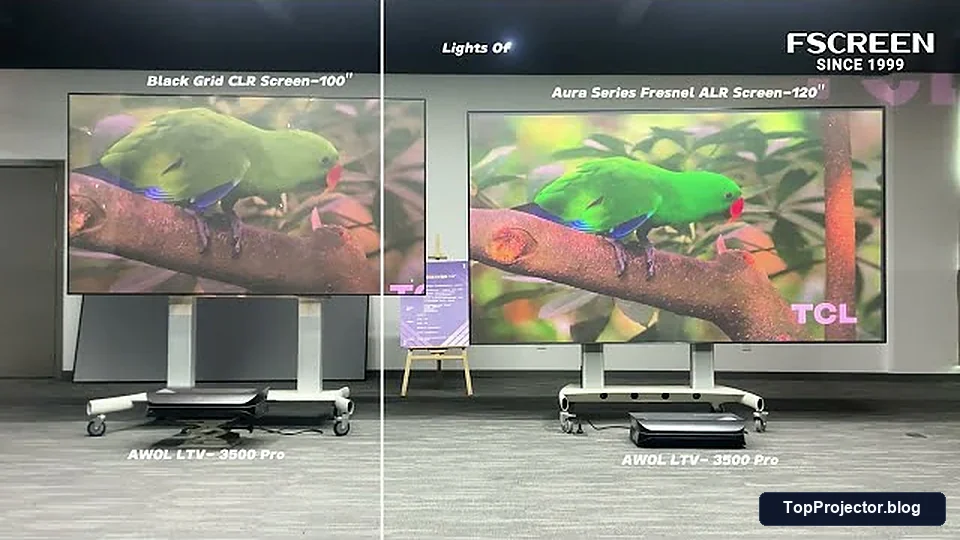
Standard matte white surfaces reflect all incident photons indiscriminately across the room. Selecting a proper ambient light rejection material fundamentally alters photon scattering characteristics for vivid daylight viewing.
Engineers tune diffusion particles within the vinyl matrix to scatter unwanted room light. Reading our guide on how to project from a laptop ensures proper signal transfer during high-ambient viewing sessions.
- Microscopic angular filters block off-axis room illumination effectively.
- Standard white surfaces scatter ambient light and wash out blacks.
- Engineered diffusion particles redirect stray photons safely away.
Standard Throw Versus Laser TV Surfaces
Traditional ambient light rejection surfaces require throw distances exceeding eight feet. These screens utilize layered reflective particles designed specifically for horizontal beam angles.
Ceiling light rejecting variants feature sawtooth ridges that intercept downward illumination. Matching your projector throw distance to the correct optical layer is absolutely critical.
- Traditional ALR matches standard throw projector throw geometries.
- Sawtooth ridges on CLR fabrics block downward ceiling light.
Black Levels, Contrast Ratios & Shadow Detail
Achieving deep black levels in a bright living room presents a massive optical challenge. Pairing screens with projectors detailed in our Epson 5050Ub review helps eliminate washed-out shadows effectively.
Darker screen tints naturally lower peak white output while boosting native contrast ratios. Finding the exact balance between brightness and shadow depth dictates cinematic immersion.
Shadow detail often suffers when aggressive optical filters over-suppress ambient photons. Premium materials maintain subtle grayscale gradients without crushing dark cinematic scenes.
- Specialized dark tints significantly enhance perceived native contrast.
- Aggressive optical filtering can sometimes crush delicate shadow details.
- Premium multi-layer designs preserve subtle grayscale gradients cleanly.
Measuring ANSI Contrast in Bright Rooms
Checkerboard contrast measurements reveal how well a screen handles reflected room light. High-performance optical surfaces maintain pristine black squares despite bright surrounding walls.
Uncontrolled white walls reflect light back onto standard screens, destroying contrast. Upgrading your projection surface protects contrast far more than changing laser power.
- Checkerboard tests validate true room contrast performance.
- White walls reflect stray light back onto matte screens.
Peak Brightness, Optical Gain & Viewing Angles
Optical gain ratings dictate how intensely a screen reflects light back toward viewers. Using our screen size and viewing distance calculator helps match your 1.0 gain surface precisely to room dimensions.
High-gain configurations concentrate reflected beams into a narrow cone for maximum punch. Viewers sitting off-axis will experience noticeable brightness falloff on high-gain surfaces.
Wide viewing angles require homogeneous diffusion particles that scatter light evenly. Balancing high gain with wide viewing cones remains an ongoing manufacturing triumph.
- Gain ratings measure light reflection intensity toward the audience.
- Narrow viewing cones concentrate brightness for central seating positions.
- Homogeneous diffusion ensures consistent off-axis picture uniformity.
Balancing HDR Highlights and Off-Axis Seating
High dynamic range content demands intense specular highlights for realistic impact. Specialized optical surfaces boost these highlights without blowing out bright daylight scenes.
Wide seating arrangements require careful consideration of viewing cone limitations. Selecting lower gain ratings often solves extreme off-axis brightness drop issues.
- HDR content requires strong specular highlight reproduction.
- Lower gain ratings eliminate extreme off-axis brightness drop.
Screen Size, Optical Geometry & Immersion
Physical screen size directly dictates your overall home theater immersion. Exploring our best home cinema screen recommendations helps you easily scale cinematic setups up to two hundred inches diagonally.
Ultra-short-throw rigid frames face manufacturing limitations around one hundred twenty inches. Larger rooms demand flexible tensioned materials to maintain perfectly flat optical planes.
Maintaining a flat projection surface prevents geometric distortion across wide cinematic vistas. Tensioned mounting systems eliminate ripples that ruin widescreen movie pans.
- Standard ALR materials scale smoothly past 150 inches diagonal.
- Rigid ultra-short-throw frames typically cap out near 120 inches.
- Tensioned mounting systems eliminate ripples and geometric distortion.
Throw Distance Geometries in Tight Spaces
Ultra-short-throw projectors sit inches from the wall, requiring rigid surfaces. This setup eliminates shadows from walking viewers but restricts maximum image size.
Standard throw configurations require deep rooms and ceiling mounts. Careful room planning ensures your projector throw ratio matches your chosen screen.
- Ultra-short-throw projectors sit inches away to eliminate shadows.
- Standard throw setups require dedicated ceiling mounting clearance.
Color Accuracy & High Dynamic Range Handling
Color fidelity depends heavily on screen fabric tint and neutral reflectance. Gray-tinted optical surfaces can sometimes impart a cool blue shift onto flesh tones.
Calibrating your projector white balance corrects minor optical tint anomalies effectively. Premium micro-structured layers maintain rec.709 color accuracy across demanding mixed-lighting conditions.
High dynamic range metadata relies on precise tone mapping to avoid clipping. Matching your projector capabilities to the screen gain ensures accurate HDR tracking.
- Gray screen tints can occasionally introduce cool color shifts.
- Projector calibration easily corrects minor optical tint anomalies.
- Precise tone mapping prevents highlight clipping on HDR content.
Wide Color Gamut Preservation in Daylight
Wide color gamuts bring cinematic blockbusters to life with vivid saturation. Ambient room light dilutes these rich hues unless filtered by specialized coatings.
Advanced optical layers selectively reflect primary color wavelengths while rejecting stray photons. This targeted filtration preserves cinematic color saturation in bright living rooms.
- Ambient light dilutes rich cinematic color saturation significantly.
- Targeted optical layers reflect precise primary color wavelengths.
Gaming Motion & Input Lag Resilience
Modern console and PC gaming demand rapid refresh rates and zero latency. Projection screens are completely passive optical components that add zero input lag.
Fast pixel response times on laser projectors pair seamlessly with specialized surfaces. High-speed camera pans remain crystal clear without motion smearing artifacts.
Reflective micro-textures do not interfere with high refresh rate gaming signals. Competitive gamers can enjoy massive displays without sacrificing response time performance.
- Projection screens are entirely passive elements with zero latency.
- Fast projector refresh rates pair seamlessly with specialized surfaces.
- Reflective textures never interfere with high-speed gaming signals.
High Refresh Rate Motion Handling on Massive Displays
Fast-paced gaming genres require immaculate motion clarity on giant screens. Pairing a high-refresh laser engine with a rigid optical surface yields stunning results.
Ghosting and motion blur stem entirely from display technology limitations. Choosing quality optical surfaces ensures your gaming visuals remain razor-sharp.
- Fast gaming genres demand immaculate motion clarity on giant screens.
- Ghosting issues stem from projectors, not passive projection screens.
Room Setup, Installation & Maintenance Demands
Installing rigid fixed-frame optical screens requires meticulous wall leveling precision. Even minor mounting errors cause noticeable geometric warping on laser displays.
Flexible roll-up materials offer easier transport and simpler ceiling hanging options. Regular dusting with microfiber cloths keeps delicate optical micro-structures functioning properly.
Protecting your investment means avoiding abrasive cleaning chemicals on specialty coatings. Careful maintenance preserves optimal light rejection performance for many years.
- Rigid fixed frames demand precise leveling during wall installation.
- Regular dusting with microfiber cloths protects delicate optical layers.
- Avoid abrasive cleaning chemicals to preserve specialty surface coatings.
Professional Versus DIY Mounting Procedures
Hanging a massive rigid frame often requires a two-person installation team. Ensuring structural anchor stability prevents catastrophic wall bracket failures over time.
Tensioned pull-down variants require careful spring alignment for flatness. Following manufacturer guidelines guarantees optimal long-term mechanical performance.
- Rigid frame mounting typically requires a two-person installation team.
- Tensioned pull-down variants require careful spring tension alignment.
Final Scenario-Based Buying Verdict
Choosing between these technologies depends entirely on your room lighting setup. Dedicated basement theaters with dark walls benefit immensely from traditional ALR versatility.
Bright family living rooms with overhead lighting require specialized surface solutions. Selecting the right optical screen transforms your projector into a true television replacement.
Evaluate your ambient light sources and projector placement before making purchases. Investing in the correct optical surface guarantees stunning picture quality in any room.
- Dedicated dark rooms excel with traditional ALR screen versatility.
- Bright family living rooms demand specialized light rejection surfaces.
- Evaluate room lighting sources carefully before final screen selection.
Matching Your Environment to the Ideal Screen
Analyze your primary viewing hours and window placement before deciding. Daytime sports viewers need aggressive optical rejection for punchy contrast.
Nighttime movie enthusiasts prioritize wide viewing angles and massive screen sizes. Aligning your hardware choices with your viewing habits ensures absolute satisfaction.
- Daytime sports fans need aggressive optical rejection coatings.
- Nighttime movie lovers prioritize wide viewing angles and scale.
Frequently Asked Questions
Can I use a CLR screen with a standard ceiling-mounted projector?
No, ceiling-mounted projectors project light away from the specialized micro-structures, resulting in a completely washed-out image. You must pair ultra-short-throw CLR surfaces exclusively with console lasers positioned directly beneath the display frame to activate optical rejection.
Do ambient light rejection screens negatively affect wide viewing angles?
Some aggressive optical rejection designs narrow the vertical and horizontal viewing cones to block room light. However, premium multi-layer engineering successfully balances high contrast rejection with wide audience seating dispersion.
How do I clean dust off a specialized optical projection surface?
You should gently wipe the delicate optical ridges using a dry microfiber cloth without applying harsh chemical solvents. Harsh scrubbing will permanently damage the microscopic angular filters.
Will an optical screen improve native contrast in a dark room?
In a pitch-black room with dark walls, white or neutral gray materials actually outperform rejection surfaces. Specialty screens are engineered primarily to combat ambient room illumination rather than enhance dark-room native contrast.
What is the maximum available size for ultra-short-throw surfaces?
Most rigid ultra-short-throw screens cap out around one hundred twenty inches diagonally due to manufacturing constraints. Larger custom dimensions require flexible tensioned materials for proper optical alignment.