85 Inch Tv vs. Projector: Which Wins for Your Room?
Choosing between a massive 85 inch display and a dedicated projection setup depends heavily on room lighting and spatial geometry.
Choose an 85 inch panel for bright daylight environments, while a dedicated home theater projector delivers unmatched cinematic immersion in pitch-black rooms.
Compare full category rankings in our Best Backyard Projector: Top Outdoor Movie Picks (2026).
Side-by-Side Specification Breakdown
| Criteria | 85 Inch Tv | Projector | Edge |
|---|---|---|---|
| Ambient Light Rejection | Exceptional self-emissive filter | Requires specialized ALR screen | 85 Inch Tv |
| Black Levels & Perceived Contrast | Deep native blacks up to 5,000:1 | Varies by room light reflection | 85 Inch Tv |
| Peak Brightness & HDR Punch | Exceeds 1,500 ANSI lumens equivalent | Typically 2,000 to 3,500 ANSI lumens | Projector |
| Screen Size & Immersion | Fixed rigid diagonal footprint | Scalable from 100 to 150 inches | Projector |
| Viewing Angles & Uniformity | Wide off-axis viewing stability | Dependent on projection angle and gain | 85 Inch Tv |
| Gaming Motion & Input Lag | Sub-10ms lag with 120Hz support | Higher lag on long-throw models | 85 Inch Tv |
| Room Setup & Maintenance | Heavy wall-mounting requirements | Flexible placement with throw ratios | Projector |
Ambient Light Rejection and Daytime Performance
Modern living rooms rarely feature total darkness during daytime viewing hours. An 85 inch display utilizes heavy anti-glare polarizers to combat windows and overhead fixtures without washing out.
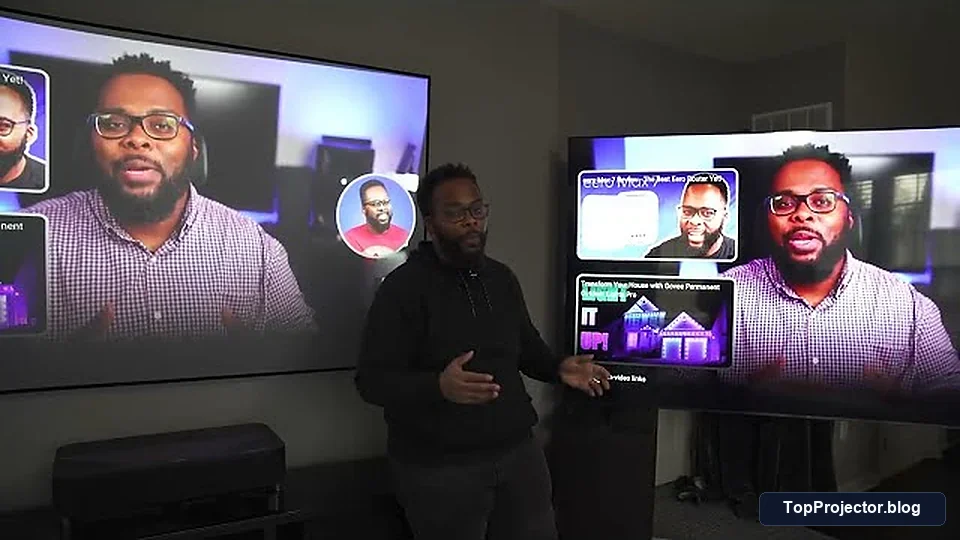
Traditional lamp-based units struggle significantly against ambient light. Standard white walls reflect scattered photons back into the viewing plane, severely degrading dark scenes and perceived contrast ratios.
Pairing high-end laser models with specialized ambient light rejection material helps mitigate washout. For compact living spaces, check out our detailed Epson EF-12 laser review covering everyday performance.
Standard white walls reflect ambient daylight aggressively, washing out standard projection setups unless you utilize specialized ALR screens with a microscopic 1.2 gain directional microstructure.
- Flat panels maintain high contrast in bright rooms.
- Standard projection requires total light control.
- ALR surfaces improve daytime projector saturation.
- Micro-structured lenticular layers trap off-axis ambient light.
- High peak ANSI lumens remain critical for daytime viewing.
Living Room Daylight Versus Basement Caves
Placing large glass-fronted panels near sunny windows creates harsh specular reflections. Selecting a matte-finish flat display diffuses direct sunlight much better than glossy glass.
Basement dens allow laser light engines to shine brightly. Controlled room illumination lets high-output optics achieve striking color fidelity and deep shadow depth without interference.
- Matte screen treatments diffuse direct window glare.
- Basements maximize native laser optical potential.
Micro-Lens ALR Mechanics
Angular-reflective materials reject overhead ceiling illumination by redirecting ambient light away from seating, preserving vital contrast ratios even in brightly lit family living rooms.
- Ambient light rejection fabrics require careful projector height matching.
Black Levels, Native Contrast and Shadow Detail
Achieving true in-room contrast relies heavily on black floor performance. Direct-lit local dimming panels turn off specific LEDs to produce near-infinite black levels.
Projectors emit light toward a white or gray surface, making absolute black dependent on ambient room reflections. Any stray light bouncing off sidewalls raises the black floor noticeably.
Advanced laser engines utilize dynamic iris mechanisms to clamp down on black levels during dark cinematic sequences. Yet, micro-LED pixels on massive displays retain superior shadow tracking.
Massive LED televisions excel in dark rooms via local dimming zones, whereas standard projectors struggle with ambient room bounce that degrades native black levels on matte white surfaces.
- Local dimming zones eliminate light bleed effectively.
- Stray room reflections degrade projector black levels.
- Dynamic irises assist optical black floor management.
- Grey contrast screens enhance black floor depth.
- Laser engines modulate output faster than mechanical irises.
Evaluating Dynamic Range in Dark Scenes
Cinematic horror and sci-fi films test low-light shadow delineation. Massive emissive panels reveal intricate background textures without crushing dark elements into muddy gray shadows.
Ultra short throw units struggle slightly with native on/off contrast in untreated rooms. Specialized high-contrast gray surfaces help restore lost dynamic punch in dark movies.
- Emissive pixels preserve subtle background textures.
- Gray projection surfaces boost perceived shadow depth.
Dynamic Iris and Laser Dimming
While indoor theaters demand laser dimming, outdoor setups require high output. Check our best backyard projector picks for portable options delivering high ANSI lumens under open night skies.
- Black floor performance dictates nighttime immersion quality.
Screen Size, Viewing Geometry and Cinematic Immersion
Stepping up from standard screen sizes transforms home viewing completely. An 85 inch flat panel fills a standard field of view impressively for most living spaces.
Projection systems shatter size limits effortlessly. Expanding diagonal footprints beyond 120 inches delivers authentic commercial cinema immersion that fixed panels simply cannot replicate physically.
Calculating optimal seating distances ensures comfortable viewing angles. Larger diagonal spreads require proper room depth to prevent visible pixel structures from distracting viewers.
Stepping up to a massive 120-inch projection setup completely fills your peripheral vision, easily surpassing an 85-inch television for true IMAX-style cinematic immersion at home.
- Fixed panels cap immersion at standard large dimensions.
- Projection scales past 120 inches for true cinema scale.
- Seeding geometry dictates maximum comfortable screen width.
- Calculate throw distance precisely using lens zoom ratios.
- Acoustically transparent screens allow hidden center-channel placement.
The Realities of Scaling Beyond 85 Inches
Transporting and mounting displays larger than 85 inches requires structural wall reinforcement. Doorways and stairwells often present severe logistical hurdles for massive rigid glass panels.
Rollable or frame-assembled projection screens bypass physical transport bottlenecks completely. Lightweight fabric materials assemble easily inside dedicated media rooms of any size.
- Rigid glass panels complicate tight residential delivery.
- Modular projection frames assemble easily on-site.
SMPTE Viewing Angle Standards
Meeting professional SMPTE recommendations requires a 40-degree field of view, which becomes mathematically impossible to achieve from standard seating distances with an 85-inch flat panel.
- Screen gain uniformity matters more at wider viewing angles.
Color Accuracy, HDR Handling and Peak Brightness
High dynamic range content demands intense peak luminance and wide color gamuts. Modern large displays effortlessly hit high brightness targets for vivid HDR highlights.
Laser light engines utilize advanced phosphor wheels and filters to cover wide color spaces. Achieving precise calibration requires careful matching with screen gain properties.
Reflective projection surfaces alter color temperature if gains are unevenly distributed. Flat panels maintain uniform color saturation across extreme off-axis viewing positions.
Projectors often struggle with wide color gamuts when calibrated for DCI-P3, whereas high-end quantum-dot TVs deliver blistering peak brightness alongside saturated HDR highlights.
- Direct displays deliver instant high-lumen HDR punch.
- Laser engines provide expansive cinematic color gamuts.
- Screen gain variations impact off-axis color tracking.
- RGBRGB color wheels minimize rainbow artifacts.
- Dynamic tone mapping preserves highlight details in HDR10.
Calibrating Laser Light Engines for Accuracy
Professional calibration unlocks studio-reference color tracking on high-end laser models. Fine-tuning white balance ensures accurate skin tones during extended movie marathons.
Out-of-the-box presets on consumer TVs often favor vivid saturation. Manual calibration modes bring both display types closer to industry color standards.
- Laser calibration ensures accurate cinematic skin tones.
- Factory presets prioritize high punch over accuracy.
Rec.2020 Color Filter Penalties
Engaging internal cinema filters on optical engines expands color accuracy closer to Rec.2020 targets, but unfortunately sacrifices up to thirty percent of total light output.
- Laser phosphor engines reduce green-cyan color shifts.
Gaming Motion, Refresh Rates and Input Lag
Competitive console gaming requires lightning-fast response times. Modern flat displays feature ultra-low input lag and robust variable refresh rate support for smooth motion.
High-performance optical units now incorporate dedicated low-latency gaming modes. However, ultra short throw models still trail traditional panels in extreme twitch-reaction gaming scenarios.
Motion interpolation on large displays eliminates judder effectively during fast-moving sports broadcasts. Projectors rely heavily on native panel processing to handle rapid panning shots.
Competitive multiplayer gaming demands ultra-low input lag under twenty milliseconds, a specification that modern gaming televisions achieve effortlessly across all four HDMI ports.
- Flat panels offer superior low-latency gaming performance.
- Dedicated gaming modes improve optical response times.
- Motion processing reduces blur during fast sports.
- HDMI 2.1 bandwidth enables 4K at 120Hz gaming.
- ALLM automatically switches display modes for minimal latency.
High Refresh Rate Performance in Fast Action
Fast-paced racing titles demand consistent 120Hz refresh rates. Premium displays handle high frame rates smoothly without introducing visible motion artifacts or tearing.
Most traditional optical systems cap gaming inputs at standard refresh intervals. Selecting specialized gaming-focused throw units bridges this performance gap partially.
- Racing titles benefit from 120Hz panel refresh support.
- Specialized throw units improve high frame rate response.
High-Refresh Projector Breakthroughs
Recent gaming-focused projectors now support 240Hz refresh rates at 1080p resolution, drastically reducing motion blur during fast-paced competitive esports titles and console sessions.
- Low latency modes disable unnecessary internal video processing.
Room Setup, Installation Complexity and Maintenance
Setting up heavy wall-mounted panels demands structural stud anchors and multiple people. Once installed, solid-state display electronics operate reliably for years without intervention.
Projection systems require precise optical calculations and physical alignment. Use our online throw distance calculator to verify your exact throw distance before mounting projection hardware.
Bulb-based optical units demand periodic lamp replacements after thousands of hours. Modern laser light engines eliminate bulb maintenance, offering twenty thousand hours of reliable operation.
Hanging an eighty-five inch flat panel requires sturdy wall studs and two people, while ceiling-mounting a projector demands precise lens shift calibration and cable management.
- Wall-mounting heavy displays requires structural reinforcement.
- Ultra short throw units simplify cabinet placement.
- Laser engines eliminate traditional lamp replacement cycles.
- Dust filters require periodic cleaning in projection units.
- Vesa mounting brackets simplify flat panel wall attachment.
Long-Term Reliability and Operational Costs
Solid-state flat panels feature minimal mechanical failure points over their lifespan. Power supply boards represent the primary replacement component in modern consumer TVs.
Optical light engines accumulate dust on internal filters over extended periods. Regular maintenance ensures optimal airflow and prevents premature thermal shutdown.
- Solid-state panels provide long-term mechanical stability.
- Optical air filters require periodic user maintenance.
Lamp Life and Optical Maintenance
Traditional lamp-based light sources require costly bulb replacements every few thousand hours, whereas solid-state laser diodes deliver twenty thousand maintenance-free operating hours.
- Solid state lasers eliminate traditional bulb degradation.
Making Your Final Buying Decision Based on Room Geometry
Choosing the ideal entertainment medium depends entirely on your specific room layout. Bright multi-use living rooms favor the robust contrast of large flat panels.
Dedicated media rooms with controlled lighting reward optical investments with breathtaking cinematic scale. Weigh your lighting conditions carefully before finalizing any purchase decision.
Balancing physical space constraints against desired screen size ensures lasting satisfaction. Both technologies offer exceptional visual fidelity when matched to the right environment.
Your ultimate hardware choice hinges entirely on environmental lighting control; dedicated theater rooms favor massive projection, while bright living spaces demand large television panels.
- Living rooms benefit from bright flat panel displays.
- Dedicated theaters maximize large-format projection scale.
- Room lighting conditions dictate the ultimate optical winner.
- Ultra-short-throw models eliminate shadow interference.
- Verify structural wall integrity before hanging heavy displays.
Summary of Core Advantages and Trade-Offs
Reviewing core performance metrics highlights distinct engineering compromises. Emissive panels conquer ambient light while projection scales effortlessly beyond standard dimensions.
Prioritize your primary usage habits between casual daily television viewing and dedicated movie nights to select the perfect visual centerpiece.
- Emissive technology excels in ambient light control.
- Projection reigns supreme for massive cinematic scaling.
Throw Ratio and Room Constraints
Always measure your exact throw distance before purchasing, ensuring your chosen throw ratio can physically fill your room. Use our throw ratio calculation guide to determine exact placement requirements.
- Short-throw lenses fit smaller room dimensions easily.
Frequently Asked Questions
Can I use a projector in a bright living room during the day?
Daytime viewing requires a specialized ambient light rejection screen and a high-output laser engine to prevent washed-out, gray images.
How long do modern projector light sources last compared to TVs?
Solid-state laser engines routinely deliver 20,000 hours of operation, matching the typical lifespan of modern consumer televisions without requiring bulb changes.
Are projectors suitable for competitive fast-paced console gaming?
While gaming models have improved significantly, flat panels offer lower input lag and superior high refresh rate support for competitive titles.
What is the main logistical advantage of ultra short throw models?
Ultra short throw optics sit inches from the wall, eliminating complex ceiling mounts and preventing shadows from walking viewers.
Which option provides better value for screens over 100 inches?
Projection systems deliver unmatched cost-per-inch value once you scale past standard large television dimensions into true cinema territory.