4K Laser Projector vs. OLED TV: Which Wins for Your Room?
Choose a 4K laser projector for massive cinematic scaling, or select an OLED TV for infinite contrast in ambient-lit rooms. Understanding your room geometry dictates the ideal display technology.
Choose a 4K laser projector for dedicated dark theater immersion over 120 inches, while an OLED TV wins for bright living room daily viewing with unmatched black levels.
Compare full category rankings in our Best Projector For Daytime Viewing: Top 2026 Picks.
Side-by-Side Specification Breakdown
| Criteria | 4K Laser Projector | OLED TV | Edge |
|---|---|---|---|
| Ambient Light Rejection | Relies on specialized ALR screens | Self-emissive panels resist glare naturally | OLED TV |
| Black Levels & Perceived Contrast | Dependent on room light and laser dimming | True pixel-level absolute zero blacks | OLED TV |
| Peak Brightness & HDR Punch | Achieves 2000+ ANSI lumens for giant throws | High local luminance on smaller scales | 4K Laser Projector |
| Screen Size & Immersion | Easily scales from 100 to 150 inches | Hard-capped around 83 inches typically | 4K Laser Projector |
| Viewing Angles & Uniformity | Subject to screen gain and viewing cones | Perfect 180-degree off-axis viewing angles | OLED TV |
| Gaming Motion & Input Lag | Low latency but lacks 1ms pixel response | Instantaneous pixel response with 120Hz support | OLED TV |
| Room Setup & Maintenance | Requires precise throw distance and mounting | Simple tabletop or wall-mount deployment | OLED TV |
Optical Physics of Ambient Light Interaction
Projectors project light onto a passive surface, making ambient light their primary enemy. Any stray light in your room washes out contrast and degrades the perceived black levels significantly.
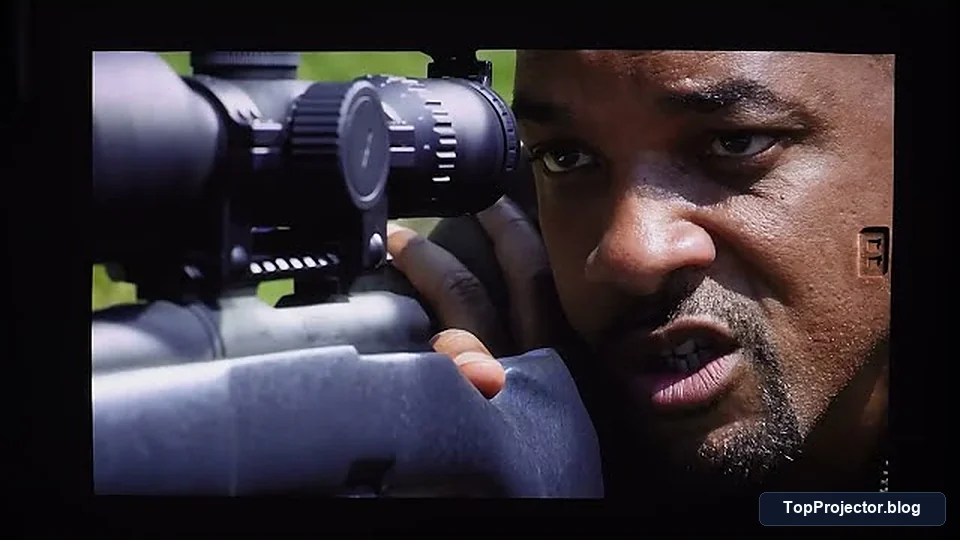
OLED televisions feature self-emissive pixels that generate their own illumination. This allows them to cut through high ambient light environments while maintaining deep, inky shadow details without external help.
Ambient light rejection screens preserve ANSI contrast ratios, while following our apple tv setup guide ensures your streaming hardware feeds pristine 4K signals directly into the projector.
- Projectors require dedicated ALR screens in lit rooms.
- OLED panels absorb or suppress direct room reflections.
- Ambient light destroys projector contrast ratios instantly.
- ALR materials feature a specialized angular reflection profile that minimizes ceiling wash.
- Losing up to thirty percent of peak white brightness is standard with dark ALR cloth.
Pitch-Black Theater Versus Living Room Daylight
In a completely dark basement theater, a laser projector shines with cinematic realism. The absence of ambient light lets optical contrast engines perform at their absolute peak capability.
Daylit living rooms completely penalize traditional projection optics. Without a high-gain ALR screen, images appear gray and washed out compared to a punchy, self-emissive OLED panel.
- Basements favor giant projected images.
- Living rooms demand high-nit OLED brightness.
Micro-Lens Array and Angular Rejection Physics
Micro-lens arrays on modern UST screens actively block ambient ceiling light by rejecting any illumination that does not originate from the ultra-short-throw projector's precise lower emission angle.
- Rejecting ambient overhead lighting preserves deep blacks in unmitigated daytime living rooms.
- Gain ratings between 0.6 and 1.0 optimize viewing angles without hot-spotting.
Black Floor Performance and Dynamic Contrast Ratios
Achieving true black is an optical challenge for projection systems. Light engines always emit a tiny baseline amount of residual light, preventing true absolute zero black floor measurements.
OLED technology completely turns off individual pixels to achieve absolute zero black. This creates an infinite contrast ratio that makes mixed HDR scenes pop with incredible three-dimensional depth.
While OLED panels achieve near-infinite black levels via self-emissive pixels, 4k laser projectors rely on advanced dynamic laser dimming and static iris adjustments to lower their native black floor during dark cinematic sequences.
- Laser dimming helps projectors improve dark scenes.
- OLED offers pixel-level luminance control without blooming.
- Shadow detail remains pristine on self-emissive panels.
- Laser modulation rapidly scales output to boost dynamic contrast metrics in dark rooms.
- True native contrast remains limited by ambient light bounce inside standard white-walled media caves.
Shadow Detail and ANSI Contrast Realities
ANSI contrast measures simultaneous white and black patches on screen. OLED excels here due to zero light bleed, whereas projectors suffer from internal light scatter across optical paths.
Advanced laser phosphor engines utilize dynamic iris algorithms to crush black levels in dark scenes, partially closing the real-world gap against smaller OLED displays during movie nights.
- ANSI contrast favors self-emissive displays.
- Dynamic iris tools improve projector black floors.
Native Panel Contrast Versus Laser Modulation
Dynamic laser modulation algorithms dynamically throttle the light engine during fading scenes, dropping the native black floor substantially lower than static lamp-based designs can ever achieve natively.
- Active frame-by-frame analysis prevents pumping artifacts during high-contrast cinematic transitions.
- Achieving a true zero-nit black floor remains physically exclusive to emissive OLED panels.
Cinematic Scaling Versus Fixed Panel Geometry
Screen size is where projection completely dominates modern display technology. Spanning a massive 120-inch diagonal delivers true commercial cinema immersion that flat panels simply cannot match.
OLED televisions offer pristine sharpness and color volume, but they remain physically capped around 83 inches for consumer budgets. Scaling past this threshold becomes exponentially more expensive.
Projector optics provide true constant image height flexibility across cinemascope and widescreen aspect ratios using anamorphic lenses, whereas fixed OLED panels lock you into rigid sixteen-by-nine boundaries with permanent letterboxing.
- Projectors easily achieve 150-inch cinematic vistas.
- OLED screens stop at practical living room sizes.
- Immersion scales directly with horizontal field of view.
- Physical masking systems enhance perceived contrast by eliminating gray letterbox bars.
- Projecting onto a one-hundred-fifty-inch diagonal screen completely overwhelms standard living room TVs.
Viewing Distance and Field of View Math
Cinematic standards recommend a 40-degree field of view. A massive projected image hits this immersion target effortlessly from standard seating distances inside dedicated home theaters.
While OLED televisions handle high ambient light well, our best projector for daytime viewing guide proves that high-lumen laser models deliver unmatched cinematic scale even in bright living rooms.
- Thump your immersion with massive throw sizes.
- Flat panels require closer seating for impact.
Anamorphic Lens Integration and Aspect Ratios
Integrating an external anamorphic lens stretches 2.39:1 widescreen movies across all available physical pixels, maximizing light output and resolving power without wasting valuable display real estate.
- Motorized lens sleds allow seamless transitions between ultrawide and standard formats.
- Optical scaling prevents the digital resolution loss inherent in software pillarboxing.
Colorimetric Fidelity, HDR Mapping, and Gamut Coverage
Modern triple-laser engines cover vast color spaces, often exceeding 100 percent of the DCI-P3 gamut. This delivers exceptionally vibrant cinematic color palettes without relying on white subpixels.
OLED panels deliver reference-grade color accuracy out of the box. Their self-lit nature preserves saturation even at high luminance levels, ensuring HDR highlights retain rich chromatic intensity.
Achieving accurate DCI-P3 color gamut coverage requires advanced laser phosphor wheels or RGB triple-laser diodes, demanding rigorous calibration to prevent oversaturated primaries from distorting human skin tones during HDR playback.
- Triple-laser units saturate wide color spectrums.
- OLED maintains color volume at peak brightness.
- HDR tone mapping requires careful projector calibration.
- Triple-laser engines easily exceed one hundred percent Rec. 2020 color space limits.
- Dynamic tone mapping algorithms remap high dynamic range metadata for lower peak lumens.
HDR Tone Mapping in Bright Versus Dark Rooms
Projectors must aggressively tone-map HDR metadata to fit limited lumen output onto passive screens. Dedicated home theater processors handle this brilliantly in dark environments.
OLED displays map HDR highlights natively with high pixel-level luminance. Every specular glint looks blindingly realistic without requiring complex external video processor boxes.
- Tone mapping is crucial for projector HDR.
- OLED handles specular highlights automatically.
Tone Mapping Calibration for Projector Optics
Dedicated external video processors perform real-time dynamic tone mapping to optimize high dynamic range contrast curves for projector screens that peak at significantly lower nit outputs than OLEDs.
- Calibrating grayscale tracking ensures accurate Rec. 709 tracking in standard HD content.
- Laser speckle reduction filters prevent chromatic shimmering across high-gain matte white surfaces.
Motion Handling, Refresh Rates, and Gaming Latency
Competitive gamers require ultra-low input lag and instant pixel response times. OLED TVs deliver sub-5ms input lag alongside near-instantaneous pixel transitions that eliminate motion blur completely.
Laser projectors have improved significantly, offering low input lag in specialized gaming modes. However, their reliance on DLP chips or LCD panels introduces minor motion artifacts compared to OLEDs.
Modern 4k laser projectors now support low latency gaming modes dropping input lag below twenty milliseconds, though competitive twitch gamers will still prefer blazing-fast OLED panels featuring instant zero-millisecond pixel response times.
- OLED provides instant 1ms pixel response times.
- Projectors offer giant-screen gaming thrills.
- High refresh rates benefit fast-paced PC titles.
- High frame rate support reaches up to two hundred forty hertz at lower resolutions.
- DLP chip switching speeds virtually eliminate motion blur during fast-paced panning shots.
Console Gaming on Giant Projected Surfaces
Playing split-screen or racing simulators on a 130-inch projected wall provides unmatched visceral scale. Modern laser units support 1080p at 240Hz for responsive competitive sessions.
While smaller, the OLED wins on raw motion clarity and variable refresh rate stability, making it the superior choice for hardcore esports enthusiasts and next-gen console owners.
- Massive screens enhance racing simulators.
- OLED rules pure competitive esports performance.
Input Lag Optimization and Frame Interpolation
Advanced frame interpolation engines smooth out judder in cinematic 24fps content, but competitive gamers should disable these processing features to minimize input lag penalties during twitch gameplay sessions.
- Bypassing image processing pipelines achieves a responsive sixteen-millisecond lag rating.
- Variable refresh rate technology eliminates screen tearing across modern console connections.
Architectural Integration and Physical Installation Realities
Setting up a projector requires precise calculations regarding throw ratio and lens shift. Use our throw distance calculator to plan your exact ceiling mounting and screen alignment dimensions safely.
An OLED TV offers straightforward plug-and-play simplicity. You can mount it on a wall or place it on a media console within minutes without calibrating optical focus.
Installing a massive ultra-short-throw laser projector requires absolute surface precision, as any millimeter of cabinet shift destroys the geometric throw alignment needed for a razor-sharp 4k image on your wall.
- Projectors demand careful optical alignment.
- OLED TVs offer effortless tabletop deployment.
- Maintenance involves filter cleaning for lasers.
- Motorized drop-down tensioned screens preserve living room aesthetics when completely retracted.
- Ceiling mounting heavy laser chassis demands secure structural stud anchoring for safety.
Ultra-Short Throw Alternatives for Modern Living Spaces
Ultra-short throw laser projectors sit inches from the wall, bypassing complex ceiling mounts. Paired with ambient light rejecting screens, they rival traditional TV living room placement.
Despite UST advancements, an OLED television remains vastly superior for maintenance-free daily use, avoiding laser diode degradation and manual focus checks over long periods.
- UST lasers simplify living room placement.
- OLED remains the ultimate turnkey solution.
Throw Ratios and Mechanical Calibration Precision
Ultra-short-throw throw ratios ranging from 0.19 to 0.25 allow projectors to sit mere inches from the screen, eliminating foot-traffic shadow interference while demanding perfectly flat mounting surfaces.
- Electric autofocus motors simplify ongoing adjustments affected by thermal expansion shifts.
- Acoustically transparent woven screens let you place center channel speakers directly behind.
Definitive Room-by-Room Scenario Selection Guide
Choosing between these technologies depends entirely on your room lighting control and desired screen size. Dedicated dark rooms strongly favor large-format laser projection setups.
Multipurpose living rooms with windows and daytime traffic benefit immensely from the high contrast and ambient resilience of a premium OLED television.
Dedicated dark-room home theaters heavily favor large-format laser projection for immersive scale, as highlighted in our epson laser cinema review, while bright family rooms demand self-emissive OLED display panels.
- Match technology to your specific lighting layout.
- Prioritize screen size for dedicated cinemas.
- Choose OLED for bright, active daily spaces.
- Controlling ambient light makes laser projection the ultimate cinematic ticket for enthusiasts.
- OLED displays excel in mixed-use environments with uncontrolled natural daylight exposure.
Final Verdict for Home Theater Enthusiasts
If your priority is recreating the commercial movie theater experience at home, buy a 4K laser projector. The sheer scale outweighs minor black level compromises.
If you watch sports during the day, play competitive games, and demand flawless black levels, invest in an OLED TV for ultimate visual fidelity.
- Scale wins for dedicated movie lovers.
- Contrast and convenience favor OLED buyers.
Hybrid Lighting Environments and Screen Selection
Balancing mixed-use living spaces requires pairing ambient light rejection screens with high-lumen laser engines to overcome parasitic room reflections without washing out shadow details during daytime viewing.
- Dedicated theater rooms benefit from zero-gain velvet screens maximizing absolute viewing angles.
- Controlling window shades transforms bright family rooms into viable projection environments.
Frequently Asked Questions
Can I use a 4K laser projector in a brightly lit living room?
Yes, but you must pair it with a specialized ambient light rejecting screen and select a high-lumen laser model. Otherwise, images will appear washed out.
Do OLED TVs suffer from burn-in during long movie sessions?
Modern OLED panels feature advanced pixel-refresh algorithms and static logo detection. Burn-in risk is extremely low for normal mixed television and movie viewing habits.
What is the typical lifespan of a laser projector light engine?
Laser diodes typically last between 20,000 and 30,000 hours of continuous operation. This ensures years of maintenance-free daily viewing without expensive lamp replacements.
Are 4K laser projectors good for playing fast-paced video games?
Many modern laser units feature dedicated low-latency gaming modes under 30 milliseconds. However, OLED TVs still hold the crown for instantaneous response times.
How does ultra-short throw projection differ from standard throw?
Ultra-short throw projectors sit directly beneath the screen, projecting steep upward angles. This eliminates shadow interference and simplifies living room installation dramatically.