3Lcd vs. Dlp Projectors For Home Theater: Which Wins for Your Room?
Comparing 3LCD and DLP optical engines reveals stark trade-offs in color brightness, native contrast, and installation flexibility for dedicated rooms.
Choose 3LCD for maximum color brightness and zero rainbow artifacts in controlled lighting, or DLP for superior native contrast, sharpness, and value in mixed rooms.
Compare full category rankings in our Best Portable Projector With Speakers: Top Picks (2026).
Side-by-Side Specification Breakdown
| Criteria | 3Lcd | Dlp Projectors For Home Theater | Edge |
|---|---|---|---|
| Ambient Light Rejection | Moderate white/color balance | High single-chip punch | Dlp Projectors For Home Theater |
| Black Levels & Perceived Contrast | Good dynamic iris support | Superior native ANSI contrast | Dlp Projectors For Home Theater |
| Peak Brightness & HDR Punch | High equal white and color lumens | Variable color brightness ratio | 3Lcd |
| Screen Size & Immersion | Excellent large throw flexibility | Sharp pixel alignment | Dlp Projectors For Home Theater |
| Viewing Angles & Uniformity | Stable panel convergence | Potential color wheel flashing | 3Lcd |
| Gaming Motion & Input Lag | Low latency, smooth response | Ultra-fast micro-mirror switching | Dlp Projectors For Home Theater |
| Room Setup & Maintenance | Requires filter cleaning | Sealed light path options | Dlp Projectors For Home Theater |
Optical Engine Architecture and Core Light Pathways
Understanding how 3LCD and single-chip DLP split white light fundamentally explains their real-world performance differences during movie playback.
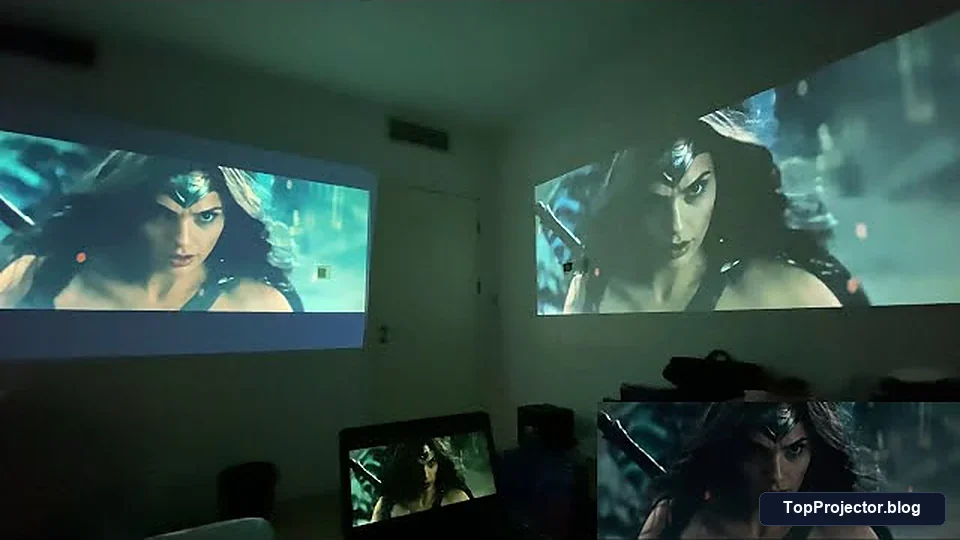
Traditional 3LCD projection splits lamp or laser light through dichroic mirrors into separate primary color panels. For laser alternative options, read the Formovie Theater review for UST performance insights.
Single-chip DLP technology uses a fast-spinning color wheel and a Digital Micromirror Device containing millions of microscopic tilting mirrors.
Understanding the core light pathway reveals why 3LCD engines split white light into red, green, and blue components using dichroic mirrors before recombining them on a single prism block for stable projection output.
- 3LCD utilizes three independent transmissive liquid crystal panels.
- DLP relies on sequential color flashes from a high-speed wheel.
- Both systems drive modern solid-state laser and traditional lamp sources.
Light Efficiency and Engine Reliability
Engine architecture directly impacts long-term brightness stability and optical maintenance requirements inside your dedicated home theater environment.
Panel degradation over thousands of hours can occasionally affect 3LCD polarization plates, requiring careful dust filter maintenance schedules.
DLP engines offer sealed optical paths on premium models, eliminating dust blobs but introducing moving mechanical color wheels.
- Sealed DLP light paths prevent internal dust accumulation.
- 3LCD systems require regular airflow checks and filter washes.
DMD Chip Switching Mechanics
Single-chip DLP architecture relies on a microscopic array of pivoting mirrors that toggle at ultra-high frequencies, rapidly pulsing light through a rotating color wheel to synthesize a full-color image on your screen.
Contrast Ratios, Black Floors, and Shadow Detail
Achieving deep, inky blacks is critical for cinematic immersion when watching dark sci-fi films. To match light output properly, use our ANSI lumens room calculator before finalizing screen size.
Native contrast ratios on standard DLP projectors frequently outperform entry-level 3LCD counterparts by rendering darker shadow floors.
Advanced dynamic iris algorithms on higher-end 3LCD units help bridge this gap, enhancing perceived shadow detail during complex night scenes.
Native contrast remains a critical battleground where high-end LCoS and 3LCD units often capture deeper native black levels, while standard single-chip DLP models struggle slightly due to internal light scatter within the micromirror grid.
- DLP chips deliver superior native ANSI contrast performance.
- Dynamic irises help 3LCD projectors lower black floor levels.
- Dark room performance favors native contrast advantages heavily.
Evaluating Shadow Separation in Dark Rooms
Testing shadow performance requires zero ambient light to properly evaluate how each projector handles near-black grayscale steps.
DLP excels at rendering crisp delineation between dark clothing and shadowed backgrounds without crushing subtle gradations.
Proper gamma calibration remains essential for 3LCD units to avoid milky highlights in low-apl mastering scenarios.
- Grayscale decoding dictates shadow separation accuracy.
- Black level floors define high-end cinematic realism.
Dynamic Iris and Laser Dimming Integration
Implementing advanced dynamic iris algorithms allows modern projectors to physically constrict the light path during dark cinematic sequences, dramatically dropping the black floor and expanding perceived ANSI contrast ratios significantly.
Ambient Light Rejection and Peak Brightness Output
Living room setups with uncontrolled ambient light demand high ANSI lumen output to combat washed-out contrast and faded colors.
Both technologies scale effectively, but 3LCD color brightness matches white brightness equally, avoiding dull skin tones.
Single-chip DLP designs sometimes sacrifice color lumen output to boost peak white brightness for bright living room viewing.
Achieving vivid daytime viewing requires evaluating real ANSI lumens rather than inflated manufacturer claims, ensuring your chosen projector can overpower stray environmental light without washing out crucial shadow details.
- 3LCD maintains 100 percent color-to-white brightness parity.
- High lumen DLP models cut through ambient living room daylight.
- Ambient light rejecting screens heavily influence final perceived pop.
Daytime Viewing vs Controlled Media Rooms
Choosing the right engine depends entirely on whether your projection surface receives direct sunlight or controlled ambient glare.
Pairing a high-output DLP with an ALR screen creates vibrant daytime images suitable for casual sports watching.
Dedicated dark rooms prioritize accurate color saturation over raw, blinding lumen output to preserve authentic director intent.
- ALR screen pairing changes daytime viewing dynamics.
- Color saturation matters more than raw white output.
ALR Screen Matching Principles
Pairing high-output lamp-based projectors with specialized ambient light rejection screens ensures overhead ceiling light is deflected away from viewers. For mobile setups, check out our best portable projector choices for backyard movie nights.
Color Fidelity, Color Brightness, and HDR Handling
Accurate color reproduction ensures cinematic content looks natural, balanced, and faithful to theatrical reference color spaces.
Because 3LCD projects all three primary colors simultaneously, it prevents rainbow artifacts entirely during high-contrast panning shots.
High Dynamic Range tone mapping tests processing engines heavily, demanding robust color volumes to render glowing highlights accurately.
Because color brightness matches white brightness on 3LCD systems, saturated neon hues pop with exceptional vibrancy, whereas traditional DLP projectors often suffer from a reduced color luminance output relative to peak white.
- Simultaneous color projection eliminates rainbow visual fatigue.
- HDR tone mapping requires high native color volume capacity.
- Wide color filters expand cinema color gamut coverage.
Managing Rainbow Artifacts and Color Breakup
Sensitive viewers easily spot rainbow artifacts on fast-spinning DLP color wheels during high-contrast scenes.
Choosing high-speed multi-segment color wheels or laser-phosphor engines largely mitigates rainbow visibility for vulnerable eyes.
3LCD inherently avoids this optical quirk due to its prism-based three-panel simultaneous light recombination process.
- Fast color wheels reduce rainbow artifact visibility.
- 3LCD offers guaranteed freedom from color breakup.
Wide Color Gamut Filters
Engaging internal DCI-P3 color filters expands the native color gamut for HDR10 content playback, though this optical trade-off typically reduces total light output by twenty to thirty percent during calibration.
Motion Resolution, Refresh Rates, and Gaming Input Lag
Modern home theaters double as immersive gaming dens, requiring lightning-fast response times and high refresh rate compatibility.
DLP micromirrors switch states in microseconds, delivering exceptional motion clarity and ultra-low input lag for competitive titles.
3LCD gaming performance has improved dramatically, offering competitive latency figures paired with smooth motion interpolation features.
Competitive gamers demand ultra-low input lag measurements, where single-chip DLP projectors frequently excel by eliminating the complex convergence alignment steps required by multi-panel 3LCD optical engines during high-speed gaming sessions.
- DLP offers class-leading sub-20ms input lag metrics.
- High refresh rates benefit fast-paced console gaming.
- Motion handling affects fast-moving sports and action films.
Optimizing Console Gaming and Sports Action
Fast camera pans in open-world games reveal whether a projector suffers from motion blur or trailing artifacts.
Engaging dedicated game modes bypasses heavy video processing to drop latency into responsive single-digit milliseconds.
Both technologies handle high frame rate feeds smoothly when paired with modern HDMI 2.1 connectivity standards.
- Game mode settings are essential for competitive play.
- HDMI 2.1 bandwidth unlocks modern console capabilities.
High Refresh Rate Limitations
Modern 1080p at 240Hz gaming modes dramatically reduce motion blur on fast-paced titles, but users must verify whether their chosen projector model supports these ultra-fast refresh rates without inducing frame-skipping artifacts.
Lens Shift Flexibility, Throw Ratios, and Room Geometry
Physical room geometry dictates projector placement, requiring flexible optical zoom ranges and robust lens shift capabilities.
Many 3LCD home theater projectors feature generous horizontal and vertical lens shift, simplifying awkward ceiling mounts.
Entry-level DLP units frequently rely on fixed offsets, demanding precise placement relative to the top of your screen.
Physical installation geometry depends heavily on lens shift flexibility, allowing installers to offset the projected image vertically or horizontally without resorting to digital keystone correction that degrades native pixel resolution.
- Wide lens shift simplifies complex ceiling installations.
- Throw ratios determine exact mounting distance requirements.
- Optical zoom flexibility avoids unwanted digital keystone distortion.
Overcoming Installation Challenges in Tight Spaces
Tight media rooms require short throw lenses or wide zoom flexibility to project large images without obstruction.
Checking throw distance calculators prevents costly mounting errors before drilling holes into structural drywall.
Utilizing physical optical lens shift preserves native pixel resolution without degrading image sharpness or contrast.
- Throw calculators prevent sizing and mounting mistakes.
- Avoid digital keystone to maintain pristine image sharpness.
Calculating Exact Throw Distances
Measuring precise throw ratios prevents costly mounting errors, ensuring your chosen optical zoom lens fills a fixed screen size. Consult our throw ratio technical guide for exact placement calculations.
Final Verdict and Scenario-Based Home Theater Selection
Selecting the ideal projector requires balancing your specific room lighting, viewing habits, and sensitivity to visual artifacts.
Opt for 3LCD projectors if you view in mixed lighting, suffer from rainbow sensitivity, or demand equal color brightness.
Choose DLP projectors when prioritizing native contrast, razor-sharp pixel alignment, and low-latency competitive gaming performance.
Selecting the ideal projector requires balancing your specific room lighting conditions against core hardware strengths, prioritizing high color brightness for mixed media spaces or deep contrast for dark dedicated theater rooms.
Ultimately, weighing input lag against optical precision ensures you purchase a display technology that satisfies both cinematic enthusiasts and competitive console gamers without compromising long-term visual satisfaction or setup reliability.
- 3LCD wins for color brightness and rainbow-free viewing.
- DLP wins for native contrast and gaming responsiveness.
- Match your room lighting profile before buying.
Frequently Asked Questions
Are 3LCD projectors better for eliminating rainbow artifacts?
Yes, 3LCD projectors use three separate panels to project colors simultaneously, completely eliminating the rainbow artifacts visible on single-chip DLP wheels.
Do DLP projectors offer better contrast for dark rooms?
Generally yes, DLP projectors provide superior native contrast performance and darker black floors, enhancing cinematic immersion in pitch-black environments.
Which technology is better for bright living room spaces?
Both work well, but 3LCD color brightness matches white output equally, preventing faded skin tones under moderate ambient light conditions.
Which projector type is better for fast-paced gaming?
DLP units typically offer ultra-low input lag and lightning-fast micro-mirror switching speeds, making them favorites for competitive console gaming.
How do lens shift features differ between the two types?
Many mid-range 3LCD units offer generous horizontal and vertical lens shift, while budget DLP models often rely on fixed mounting offsets.